
Xpeng X-Mind Release: Embedding "Veteran Driver’s Prediction" into In-Vehicle Chips

On June 29, XPeng Group released the X-Mind technical framework, which embeds a predictive world model into a large driving model, enabling the in-car intelligent agent to simulate the future before taking action. Twelve frames of future scenarios are compressed into 96 tokens — XPeng’s direct response to the computational bottleneck of VLA 2.0.
On June 29, XPeng Group unveiled a technical framework called X-Mind, whose core move is simple: embed a "future-predicting" world model into the large driving model that runs on the vehicle.
Translated into developer terms—traditional VLA (Visual-Language-Action) models see an image and output an action, with the reasoning process in between essentially being a black box. What X-Mind does is to explicitly insert a spatiotemporal inference step between “see” and “act”: it first imagines what will happen on the road in the next few seconds, and then plans the vehicle’s trajectory accordingly. XPeng calls this mechanism the Visual Chain of Thought (Visual CoT), and it has compressed it enough to run in real time on automotive-grade chips.
This is the most crucial piece in XPeng’s physical AI system puzzle, following April’s release of the generative world model X-World and the 72-billion-parameter cloud base model. X-World solves the problem of “building a simulator in the cloud,” while X-Mind tackles “compressing predictive capability into chips for mass production.” The difference between the two is the difference between a paper and an on-road product.
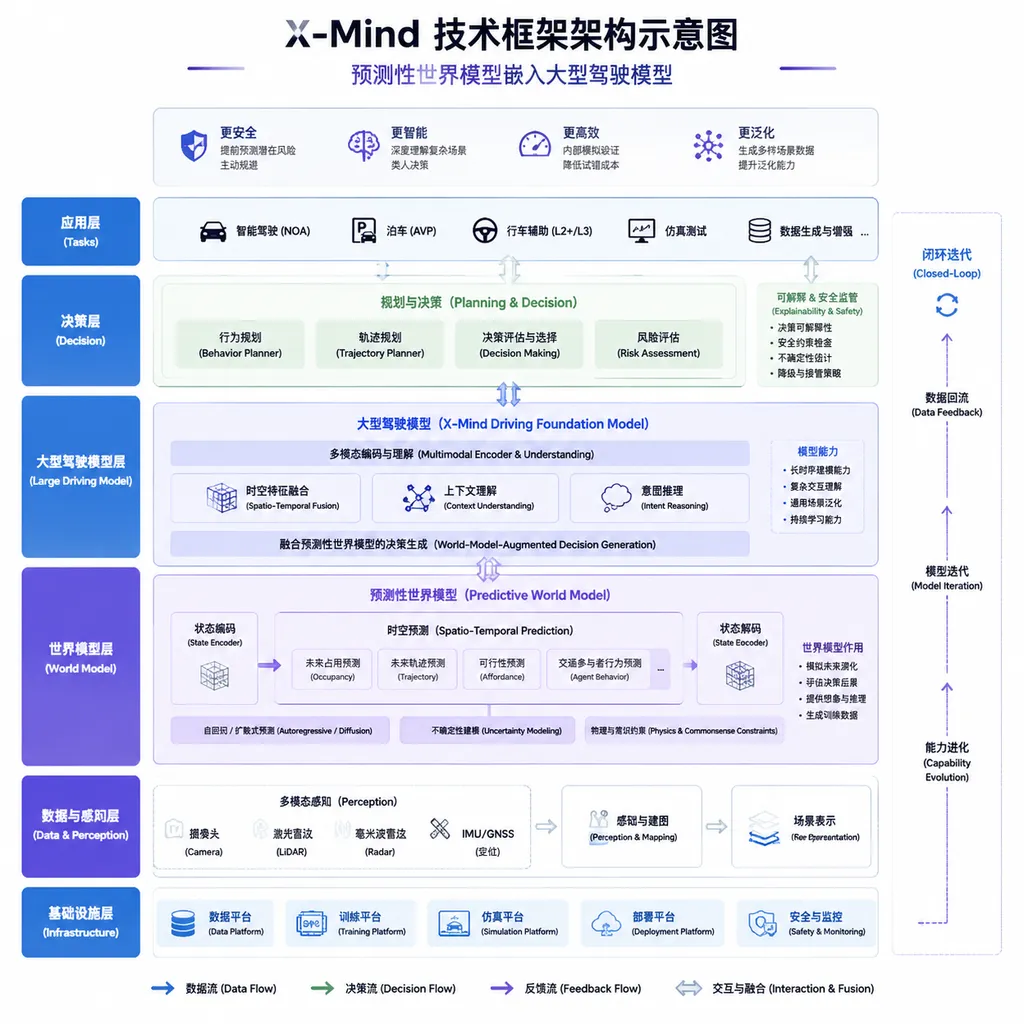
Not Just Another VLA, but a New Organ Growing on Top of VLA
To understand the value of X-Mind, you first need to see where VLA models are currently stuck.
Over the past year, end-to-end autonomous driving development has largely been dominated by two approaches. One directly feeds raw images or video into large models for end-to-end motion output—but the context length is too long for automotive-grade chips to handle. The other uses 3D Gaussian Splatting (3DGS) to reconstruct scenes as intermediate representations—high fidelity, but too slow for production deployment. XPeng itself admitted in its April X-World technical report that 3DGS reconstruction collapses when a vehicle significantly deviates from the original data trajectory, such as during lane changes or detours.
X-Mind takes a new path: instead of using high-resolution images or 3D reconstructions, it builds an intermediate representation called a cognitive canvas.
What’s on this canvas? XPeng lists four elements:
- Physical scene elements in BEV (bird’s-eye view) layout, including lane lines and obstacles
- Dynamic traffic light states
- Adaptive navigation intent
- Compliant speed profile
Notably, none of these involve texture details—in other words, X-Mind deliberately abandons “what the world looks like” in favor of preserving only the semantic priors required to model “how the world behaves.” This tradeoff is a crucial engineering decision—when making driving decisions, the pixel clarity of a billboard doesn’t matter; what matters is whether the car in front will brake suddenly in the next second.
12 Frames of the Future, Compressed to 96 Tokens
In terms of technical detail, XPeng revealed a bold figure: via a Deep Compression Autoencoder (DC-AE), 12 frames of future world inference are compressed down to just 96 tokens.
What does this mean? Roughly speaking, a standard visual Transformer processing a 224×224 image already uses several hundred image patch tokens; 3DGS scene representations can involve tens of thousands. Compressing 12 future frames into a two-digit token count slashes autoregressive inference costs to a feasible range.
The network structure is called a recurrent block diffusion mechanism, which performs progressive denoising at different internal layers within a single forward pass to generate a compact abstract sketch. This sketch becomes the input to the planner, which computes the optimal vehicle trajectory based on this inferred physical future.
Perception input → Large driving model
                   ↓
          Predictive world model (recurrent block diffusion)
                   ↓
          96-token thinking sketch (BEV + traffic lights + navigation intent + speed profile)
                   ↓
                 Planner → Vehicle trajectory
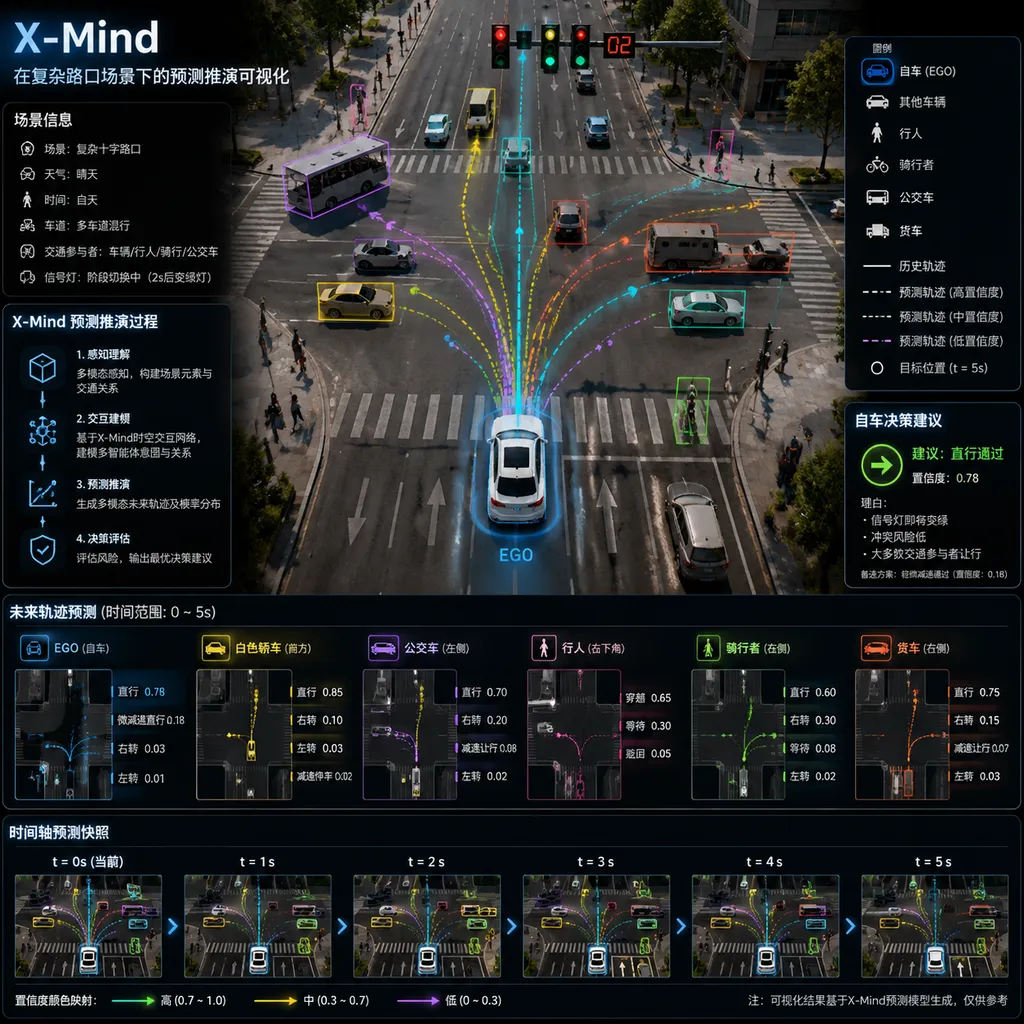
The main difference between this and traditional VLA models lies in explicit spatiotemporal inference. While traditional models react directly from perception to action, X-Mind first predicts what will happen after an action and then acts accordingly. In short, it turns reflexive reactions into decisions with foresight.
Does It Actually Work?
XPeng provided comparative experimental results from two perspectives.
Accuracy: Compared to traditional VLA models, X-Mind significantly reduces trajectory prediction error (ADE) both laterally and longitudinally, especially in complex long-tail scenarios. This is unsurprising—once the model can predict how scenarios evolve (like sudden braking or on-ramp merges), the planner can intervene earlier. Typical cases XPeng cites include intersection negotiations, ramp merges, and sudden braking—all frequent takeover points in China’s city-level NGP.
Efficiency: X-Mind’s inference latency is lower than both raw image and 3DGS approaches—this is what really determines if it can be deployed on vehicles. No matter how smart a model is, if it can’t run within a 100-millisecond budget, it stays on slides. XPeng explicitly said this architecture “has the feasibility for mass deployment on resource-constrained automotive-grade chips.” Combined with the three self-developed Turing AI chips launched on June 11 (each offering three times the compute of NVIDIA Orin, with a combined 2,200 TOPS), the hardware-software integration path is now clear.
In short, X-Mind isn’t a paradigm-shifting revolution—it’s a precise engineering tradeoff. Academically, “replacing high-fidelity representations with abstract sketches” has been explored before by projects like Wayve and Waabi; X-Mind’s value lies in compressing it to mass-producible scale and closing the loop with the cloud-side X-World for end-to-end training, validation, and deployment.
The Physical AI Trio: X-World, X-Foresight, X-Mind
With X-Mind, XPeng’s physical AI foundation is now complete, consisting of three core capabilities:
- X-World: controllable generation. Based on video diffusion (built on WAN 2.2), it generates multi-view, physics-consistent futures for closed-loop simulation, online reinforcement learning, and data generation. Since its April release, XPeng’s simulated scenarios have grown from 30,000 to over 500,000, with daily simulated mileage equivalent to 30 million kilometers of real driving.
- X-Foresight: long-horizon reasoning.
- X-Mind: active reasoning—today’s release that compresses inference to run on-vehicle.
Together, the logic is: X-World builds a “real-world simulator” in the cloud to train and validate VLAs, while X-Mind distills predictive capacity to the vehicle for on-road foresight. It’s a pragmatic “cloud training–onboard deployment” pipeline.
Another relevant event: on June 26, He Xiaopeng announced that the UN WP29 member states had approved the DCAS UNR 171 series 02 regulation (governing city-level NGP-like functions), calling it the moment when “VLA 2.0 enters a globally confirmed path.” With regulation approved, world models deployed, and in-house chips in mass production, XPeng is clearly preparing for global rollout. X-World’s ability to generate synthetic overseas data accelerates this path toward internationalization.
Compared with Industry Peers, Where XPeng Stands
Horizontally, Tesla’s FSD world model relies on enormous video data and end-to-end neural networks—its predictive ability is implicit, without an explicit “chain of thought” layer. Wayve’s GAIA series exemplifies generative world models but remains largely research-focused, with slower engineering rollout. Domestically, Huawei ADS, Li Auto MindVLA, and NIO NWM are all developing similar systems, but none have publicly disclosed technical details as concrete as XPeng—especially the “12 frames to 96 tokens” benchmark.
The real highlight of X-Mind isn’t the “seeing the future” slogan—that’s everyone’s claim—but the mature engineering methodology, especially the abstract sketch approach. If this path proves viable, it could reshape end-side autonomous driving model design paradigms: whether to keep pushing high-fidelity visual representations or to step back toward more decision-friendly abstraction.
XPeng chose the latter, supported by a coherent evidence chain: a 72-billion-parameter cloud model verifying the scaling law, X-World providing simulation and data, and X-Mind achieving onboard deployment. This “train massive models in the cloud, distill to edge” paradigm mirrors the trajectory language models have taken over the past two years. In that sense, autonomous driving is being drawn into the same rhythm as LLM evolution.
Observations for Developers
If you’re developing autonomous driving systems, several X-Mind insights stand out:
-
DC-AE in driving scenarios — Deep compression autoencoders were mainly used for image generation before; using them for driving decisions as intermediate representations is new. The 96-token/12-frame compression ratio gives VLA teams a concrete benchmark.
-
Recurrent block diffusion mechanism — multi-step denoising in a single forward pass is a valuable trick for latency-sensitive automotive environments. Watch for future technical papers revealing more details.
-
Semantic prior design of the cognitive canvas — the choice of BEV layout + traffic lights + navigation intent + speed profile is itself an engineering summary of “what information is truly needed for driving decisions.” Open-source projects can reference this.
-
Integration across the physical AI stack — X-World’s data feedback loop, X-Mind’s edge deployment, and the Turing chips’ compute power together create a tightly coupled chain. Once fully connected, this iteration loop will outperform OEMs relying on third-party suppliers—demonstrating vertical integration in the AI era.
Lastly, a note on the model ecosystem: In China’s current model application landscape, developers often call multiple proprietary APIs; aggregator platforms like OpenAI Hub let you switch among GPT, Claude, Gemini, DeepSeek, etc., with one key—simplifying SDK maintenance. Although X-Mind itself won’t be offered as a public API, XPeng’s philosophy of combining large language models for cognitive reasoning with world models for scene generation offers useful insight for developers working on agents, robotics, and embodied intelligence.
X-Mind isn’t a story—it’s a product delivery milestone. From April’s X-World paper to June 11’s G7 Turing chip debut, to June 26’s global VLA 2.0 milestone, and now June 29’s X-Mind announcement, XPeng has assembled the entire technical stack piece by piece in just three months. What remains to be seen is how it performs in real-world use—because when it comes to predicting the future, the final verdict always lies in the data collected on real roads.
References
- ITHome: XPeng launches X-Mind, claiming to give autonomous driving a “future-predicting” brain – Core report of X-Mind’s release, including architecture, compression ratio, and experiment results.
- Zhihu Column: XPeng reveals its world model foundations at CVPR – Technical interpretation of XPeng’s CVPR 2025 talk, including dual-goal merge learning details.


