
Google Cloud Accesses SandboxAQ: Quantum AI Models Enter Drug Development
Google Cloud launches two professional AI models from SandboxAQ — AQCat and AQPotency — covering semiconductor catalyst screening and drug molecule discovery. This quantum AI company, spun off from Alphabet, is taking a completely different path from general large models by leveraging large quantitative models in scientific research verticals.
On June 29, Google Cloud did something not quite typical for Google Cloud: it added another company's AI models to its own marketplace. That "other company" is called SandboxAQ, and the two models are named AQCat and AQPotency — one focuses on materials and semiconductors, the other on drug molecules.
At first glance, it might look like a routine cloud marketplace listing, but a closer look reveals some interesting points. SandboxAQ isn’t an outsider; it spun out from Alphabet’s quantum technology division in March 2022, led by CEO Jack Hidary. In other words, Google essentially invited a "former colleague's" product back home. Even before this, SandboxAQ had already secured $500 million in funding from the U.S. government under the CHIPS Act, specifically to develop AI models for semiconductor manufacturing. The company’s valuation in the capital markets has soared to roughly 40 billion RMB.
Not Just Another Large Language Model
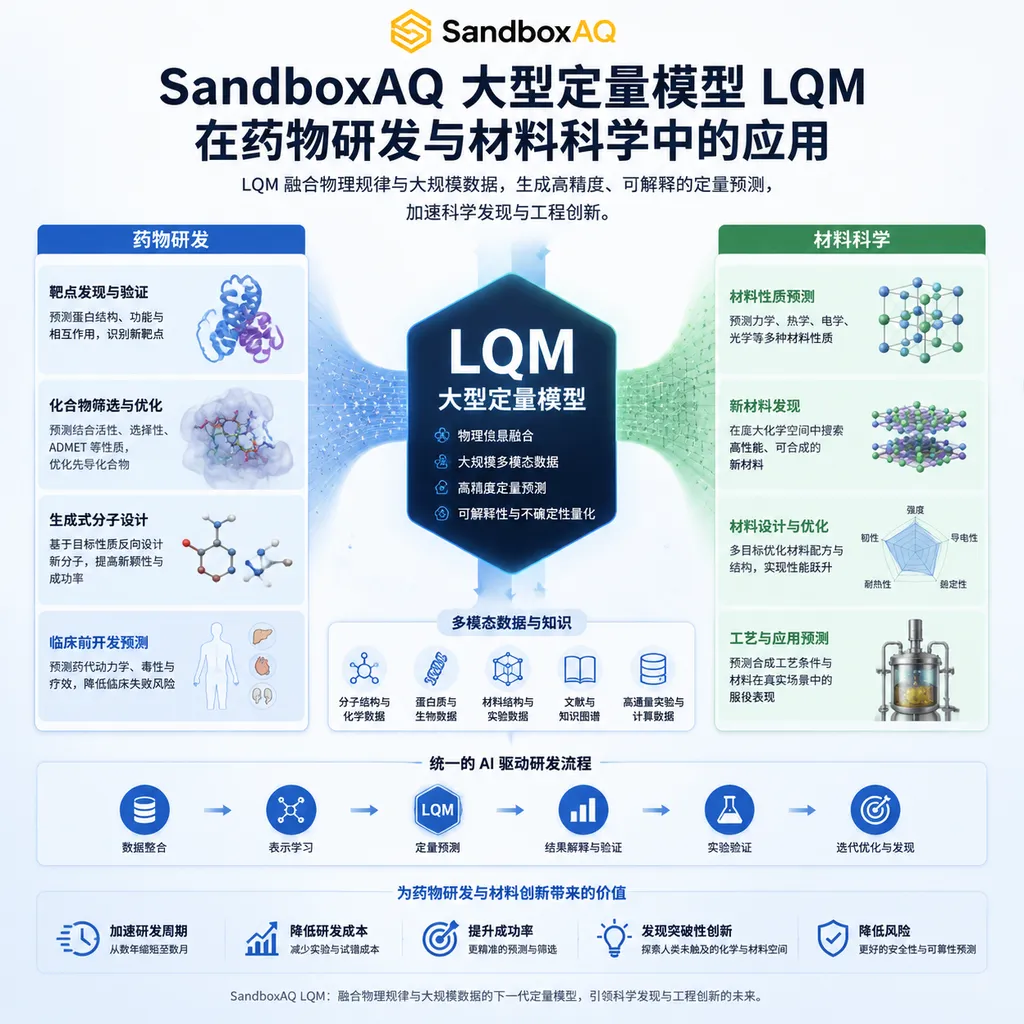
To understand the significance of this collaboration, you first need to know what SandboxAQ is working on. Its core products are not LLMs (Large Language Models), but LQMs — Large Quantitative Models.
The difference between the two is much greater than their names suggest.
LLMs learn statistical patterns in human language — essentially predicting the next token in a probability distribution. LQMs learn quantitative patterns in physical and chemical systems — molecular energy, electron orbitals, interatomic interactions, differences in free energy. Their training data isn’t web text, but numerical results derived from quantum chemistry calculations and experimental measurements.
Here’s an imperfect but intuitive analogy: LLMs are like a chef who’s read a thousand recipes and knows the amount of salt and sugar that will probably taste good; LQMs are more like a chemist armed with a mass spectrometer and thermodynamic formulas, able to calculate exactly what reaction will occur at 80°C. In scientific research, the latter is the tool researchers really need.
General-purpose large models have an awkward issue in science: they can write paper abstracts, explain concepts, and help debug Python scripts, but if you ask them to predict the binding free energy of a new molecule to a protein target, they’ll confidently make things up. SandboxAQ goes in the opposite direction — not striving for general intelligence, but going deep into one class of quantitative prediction.
Two Models, Two Trillion-Dollar Markets
The models brought to Google Cloud are:
- AQCat: For semiconductor manufacturing, battery R&D, and similar fields; used to identify promising catalysts and new material candidates.
- AQPotency: For drug discovery; helps researchers find the molecules most likely to bind to disease targets.
AQCat’s applications are quite practical. As semiconductor processes advance, every generation requires new catalysts, thin-film materials, and photoresist formulations. Traditionally, this involves combinatorial chemistry plus experimental screening — each cycle taking months. AQCat aims to bring virtual screening accuracy close to experimental levels, enabling R&D teams to eliminate 99% of ineffective candidates before synthesis. The same logic applies to batteries — with candidate chemical spaces for things like solid-state electrolytes and novel cathode materials being astronomically large, whoever nails virtual screening accuracy can save years of work.
AQPotency’s story is even more compelling. Hidary said in interviews that biopharma is the company’s "largest short-term opportunity." Current customers are working on glioblastoma, prostate cancer, Alzheimer’s disease, Parkinson’s disease, and cardiovascular conditions. Glioblastoma is one of the hardest-to-treat brain cancers, with a five-year survival rate in single digits. Small-molecule drug development for Alzheimer’s is an even bigger money sink — hundreds of billions spent over the past twenty years, and the FDA-approved effective drugs could be counted on two hands. If LQMs can truly answer the question "Which molecules are worth synthesizing?" upfront, the savings for pharma companies will be measured in time, not money.
SandboxAQ’s tech stack features notable keywords: active learning, Absolute Free Energy Perturbation (AQFEP), and generative AI. AQFEP is the gold standard in traditional computational chemistry, but expensive — running calculations for a single molecule takes many GPUs and lots of time. Combining this with generative models to teach AI where to spend compute for accurate calculations essentially digitizes the intuition of computational chemists.
Why Google Cloud Is Willing to Act as a Channel
This is another interesting angle. Google has its own DeepMind, which has AlphaFold, AlphaFold 3, and Isomorphic Labs. In protein structure and drug discovery, Google has been working end-to-end entirely in-house. So why bring in SandboxAQ?
The answer likely has two layers.
First is coverage. AlphaFold solves protein structure problems; AQPotency addresses small molecule–target binding prediction; AQCat deals with materials and catalyst problems. These three tasks are linked in pharma and materials workflows — they’re complementary rather than interchangeable. As a platform, Google Cloud’s most rational strategy is to cover the whole workflow end to end so customers don’t need other clouds.
Second is strategic relationships. SandboxAQ spun out from Alphabet, and Alphabet probably still holds a significant stake. The tech stacks are naturally compatible, and commercially their interests align. Listing third-party AI models in the Google Cloud Marketplace isn’t new, but locking in a hard-core scientific model company valued at 40 billion RMB with a $500 million U.S. government contract is a solid boost to GCP’s reputation among enterprise research clients.
That said, for domestic developers in China, access barriers to Google Cloud Marketplace offerings remain high — accounts, payment methods, and network access are all obstacles. If you just want to call mainstream closed-source models for everyday development, aggregator services like OpenAI Hub can integrate GPT, Claude, Gemini, and DeepSeek under one key, with OpenAI-compatible APIs and direct domestic connections, saving a lot of infrastructure hassle.
How It Compares to Existing Players
AI-accelerated drug discovery isn’t unique to SandboxAQ. A quick rundown:
- DeepMind / Isomorphic Labs: AlphaFold series for protein structure and complex prediction; already signed big deals with Eli Lilly and Novartis.
- Schrödinger: Established computational chemistry firm; benchmark in free energy perturbation algorithms; strong market position.
- Recursion, Insilico Medicine, Atomwise: Each offers a full-process AI drug discovery platform.
- Microsoft Research: Active in materials discovery (MatterGen) and protein design.
SandboxAQ’s differentiation comes from two points: first, making "quantum computing + AI" its core narrative (though at present, mostly quantum-inspired algorithms rather than true quantum hardware); second, betting simultaneously on both drug discovery and materials/semiconductors — rare among pharma-focused companies. AQCat’s $500 million CHIPS Act grant suggests the U.S. government acknowledges its semiconductor capabilities — that money isn’t easy to get, and requires delivery at production-ready quality.
Its weaknesses are also clear. AlphaFold has been free, API-enabled, and used by biologists worldwide for three years, with community awareness and feedback loops already established. SandboxAQ’s models are primarily paid for by enterprise customers, with incomplete transparency on client lists — outside observers must wait for papers and case studies to judge its actual impact.
What to Watch Next
A few signals worth tracking:
- Pricing model for AQCat and AQPotency on Google Cloud Marketplace — pay-per-API-call, subscription, or project-based? This will determine whether small biotech firms and materials labs can afford them.
- Public disclosure of customer cases — Hidary named glioblastoma and Alzheimer’s as indications. If in the next year or two a project using AQPotency reaches the preclinical candidate compound (PCC) stage, that’s hard evidence.
- Semiconductor field deployment — the $500 million CHIPS Act grant needs returns. News of AQCat running processes at a U.S. foundry or materials supplier may appear earlier than in the drug field.
- Boundaries with DeepMind — Isomorphic Labs has gone deep; how Google internally coordinates these two lines, whether there’s functional overlap or complementarity, will influence SandboxAQ’s positioning within the Google ecosystem.
This listing isn’t explosive news — no new model architecture, no leaderboard domination. But the direction is noteworthy: while general-purpose large models battle fiercely, specialized "small but deep" models are being delivered en masse to researchers who truly need them via channels like cloud marketplaces. Science ultimately relies on quantitative calculations; if the LQM route proves viable, it would be far more meaningful than yet another chatbot that can write code.
References
- Google Cloud to offer specialized AI models for scientific research: can accelerate biopharma, materials science, and semiconductor manufacturing - IT Home: IT Home’s detailed report on SandboxAQ’s AQCat and AQPotency models on Google Cloud, covering model functionality, CHIPS Act funding background, and CEO statements.
- This drug discovery large-model company is now valued at over 40 billion RMB - Zhihu: Industry analysis of SandboxAQ’s Large Quantitative Model (LQM) technical path and valuation, useful for understanding its commercial position.


