
Palantir Embraces Nemotron: Open-Source Model Opens the Door to U.S. Government AI
Palantir has built an intelligent engine based on NVIDIA’s open‑source Nemotron model, dedicated to deploying agentic AI in closed environments for U.S. government agencies. This marks a landmark event for open‑source models entering the core domain of sovereign AI.
An Unusual Collaboration
Palantir and NVIDIA announced a collaboration today: Palantir will build a dedicated intelligent engine for U.S. government agencies based on the NVIDIA Nemotron open-source model family. On the surface it seems ordinary, but it’s actually a watershed moment — open-source models are, for the first time, entering the secure AI core of the U.S. government at this scale.
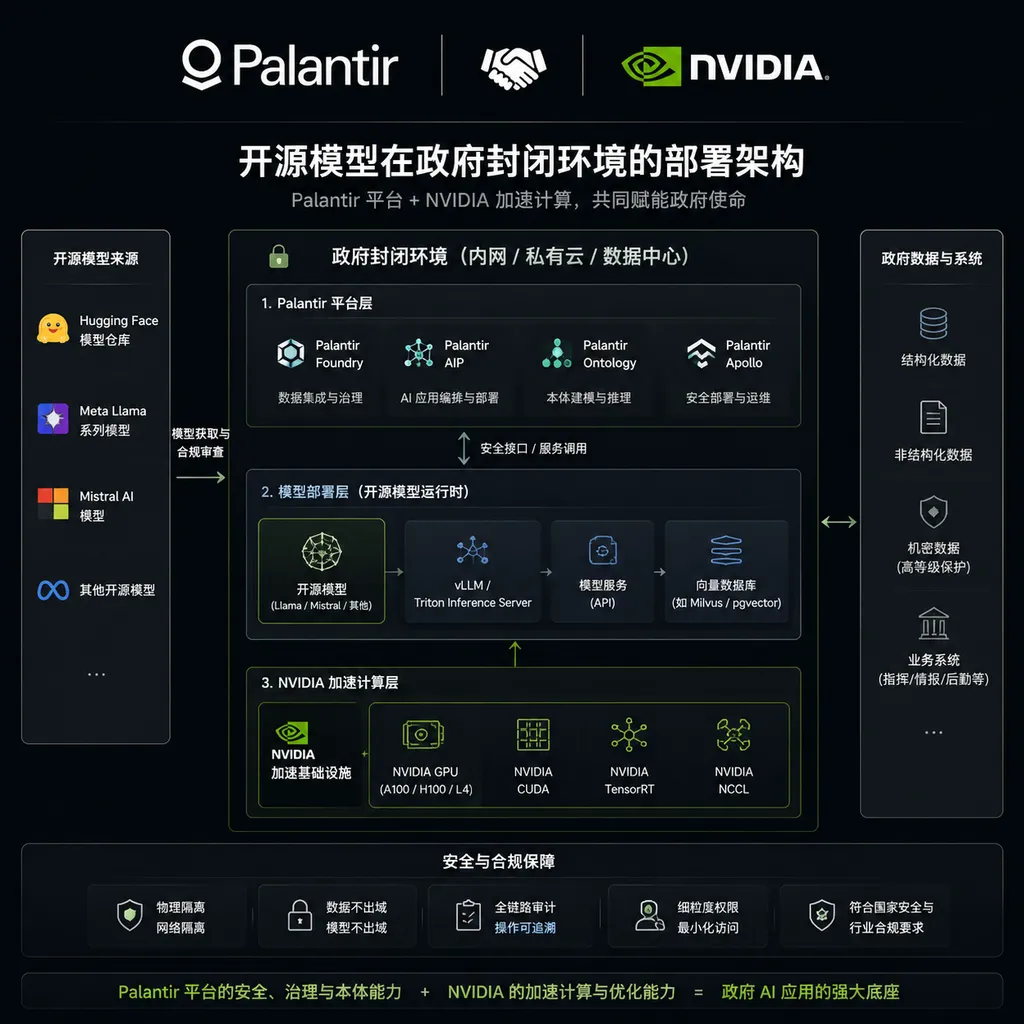
In recent years, U.S. intelligence systems, defense departments, and various classified agencies have taken a highly cautious approach to AI. There have been few models they could use, fewer still that could run in air-gapped environments, and almost none that allowed engineers to inspect weights and training data. Palantir’s solution tackles these three barriers head-on: open weights, closed deployment, and auditability.
Why Nemotron Got In
Since late last year, NVIDIA has been pushing Nemotron aggressively. The Nemotron 3 series, released in December 2025, made its positioning clear: instead of head-to-head competition with GPT or Claude in general-purpose dialogue, it targets multi-agent (Agentic AI) and industrial-scale reasoning scenarios. At GTC 2026, Jensen Huang unveiled Nemotron-3 Ultra — with a hybrid SSM (State Space Model) and MoE architecture, achieving 5× faster reasoning and 30% lower overall costs.
The most crucial factor is openness. Independent benchmarking agency Artificial Analysis’s “Openness Index” ranks the Nemotron series among the most open technologies in the frontier AI ecosystem. Evaluation dimensions include:
- License openness: whether it can be used commercially, modified, and redistributed
- Data transparency: whether the training datasets are public and their composition traceable
- Technical detail availability: whether training scripts, dataset tooling, and evaluation frameworks are also open-sourced
When Nemotron-3 Ultra launched, it even released training scripts and dataset tooling. Such openness is unimaginable for most closed-source vendors, but it’s exactly what government clients demand. Models running in a SCIF (Sensitive Compartmented Information Facility) must have auditable weights and training processes — something GPT-5, Claude, and Gemini cannot deliver.
Palantir’s Strategic Move
To understand Palantir’s place in the government market, you need to know this: starting with the Gotham platform, it has been a staple supplier for the CIA, FBI, and the Department of Defense. Since launching AIP (Artificial Intelligence Platform), Palantir has been tackling a core challenge — how to embed general-purpose large models into client systems with strict data boundaries.
This challenge isn’t about the models themselves, but about three engineering problems:
- Air-gapped deployment: models must run in environments completely disconnected from the internet, with weights, inference frameworks, and dependencies fully localized
- Data never leaves the domain: sensitive data must not enter the cloud, and even embeddings cannot be leaked
- Interpretability and auditability: every model decision must be traceable to specific inputs, context, and tool invocation chains
Closed-source API models fail almost entirely on these three points. No matter how much OpenAI emphasizes its enterprise privacy agreements, “calls must go through their servers” remains unavoidable. Anthropic’s Claude offers Bedrock and Vertex private deployment options, but the weights remain a black box. Palantir needs a model that can be fully integrated into its Ontology system and pass muster with customers’ IT security officers. Nemotron is one of the few models meeting all requirements.
What Is the Intelligent Engine?
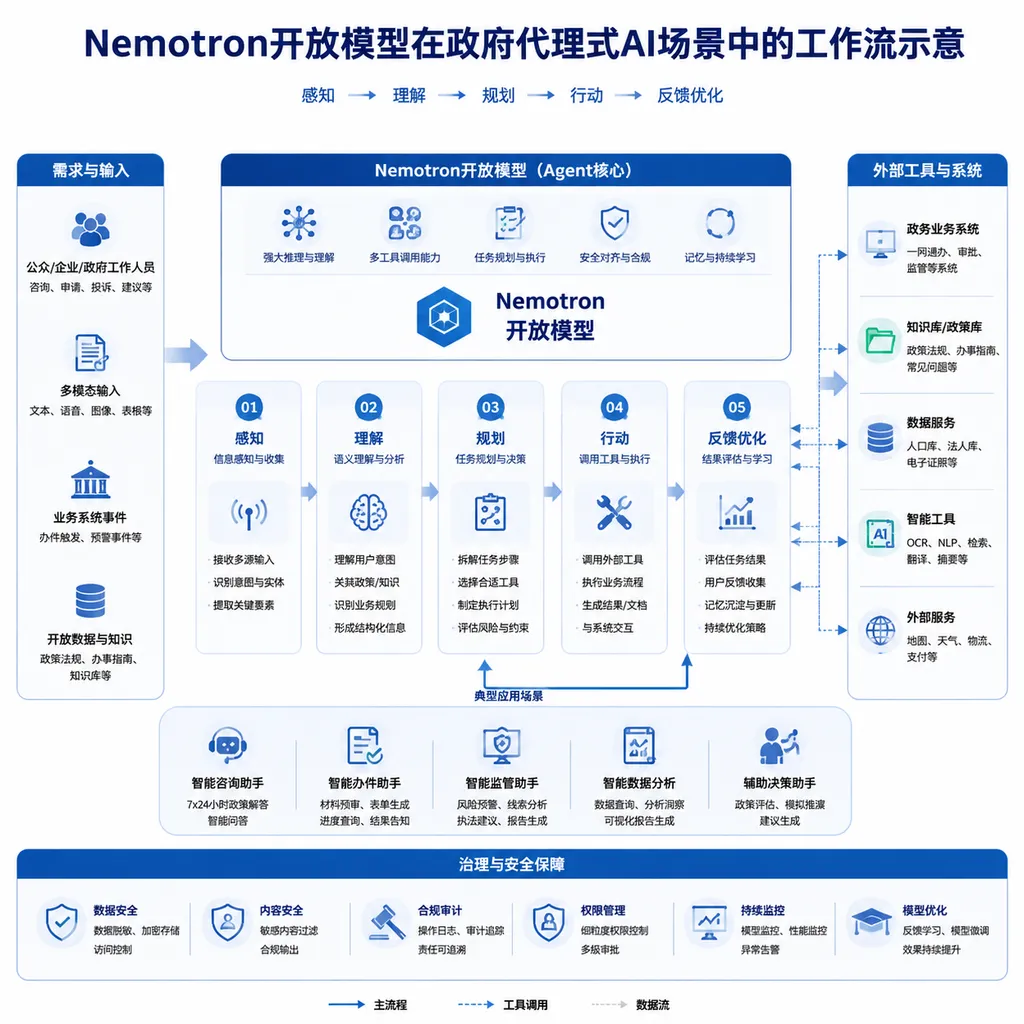
Palantir calls its new product an “intelligent engine.” From NVIDIA’s official blog description, it’s essentially an agent-style AI runtime embedding the Nemotron series into the Palantir Ontology. Developers can build multi-agent applications on it, call Palantir’s prebuilt data grids and toolchains, while the model handles reasoning and planning.
Notable architecture features for developers include:
- Replaceable model layer: use Nemotron Nano for lightweight reasoning today, swap to Nemotron Ultra for long-chain planning tomorrow — all weights reside in the client’s own data center
- Native tool invocation support: Nemotron series has enhanced tool usage capabilities from training, making integration with Palantir Ontology’s Action layer plug-and-play
- Multi-agent orchestration: individual agents handle specific tasks, orchestration layers decompose, schedule, and merge results — the full logic runs in a closed network
Looking back, in March this year Palantir and NVIDIA jointly released a reference architecture for a sovereign AI operating system. Many in the industry thought it was just a “PPT-level” concept. Unexpectedly, it became a product within three months — a very aggressive pace for government software.
An Open-Source Anecdote
The opening line of NVIDIA’s official blog is telling: in 1969, DARPA connected computers from UCLA, Stanford, UCSB, and the University of Utah, creating the prototype of ARPANET — marking the dawn of U.S. technological leadership and the spirit of open collaboration. In the Palantir-NVIDIA context, this clearly builds a narrative: for the U.S. to stay ahead in AI, it can’t rely solely on a few closed-source giants — open-source foundations are equally crucial.
This argument has real relevance to the U.S. AI policy landscape in 2026. On one hand, Llama and DeepSeek have elevated the open-source ecosystem to new heights; on the other, domestic policy circles repeatedly discuss “sovereign AI.” If the U.S. government’s most sensitive AI uses depend entirely on OpenAI’s API, those two words — “sovereign” — lose credibility. The Nemotron+Palantir combination effectively adds a key piece to the sovereign AI narrative.
What It Means for Developers
This has a direct impact on frontline developers.
First, the capability ceiling for enterprise-grade open-source models has been recalibrated. Over the past six months, many evaluated Nemotron as “adequate but not exciting,” with clear gaps compared to GPT-5 or Claude Opus. But enterprise scenarios are never single-dimensional — offline deployment, auditability, customization — in these areas, Nemotron is scarce. If you’re building agent-style AI for government or enterprise, it’s worth reassessing Nemotron’s cost-effectiveness.
Second, the engineering paradigm for Agentic architectures is converging. Palantir’s “open-source model + local orchestration + tool invocation” setup, combined with NVIDIA’s earlier Enterprise AI Agentic Toolkit (including the OpenShell security sandbox), forms a relatively mature enterprise agent-style AI reference stack. Community debates over “build your own agent framework or use vendor solutions” will increasingly have clearer answers.
Third, the model selection decision tree is now more complex. Before, model choice was mainly about benchmark performance and price; now there’s a new set of dimensions:
Selection dimensions:
  - Performance benchmarks:  MMLU, HumanEval, AgentBench
  - Deployment type:         Cloud API / Private cloud / Fully offline
  - Weight accessibility:    Closed / Open weights / Fully open-source
  - Training transparency:    Black box / Partial disclosure / Reproducible training scripts
  - Tool invocation native:   Prompt engineering / Fine-tuning support / Training-phase enhancement
  - Compliance & audit:       None / SOC2 / FedRAMP / Government-specific certification
Nemotron scores significantly higher than most options on the last four dimensions, an advantage previously held by the Llama series. NVIDIA is clearly aiming to take this territory from Meta.
A Less Optimistic View
Some caution is warranted. Palantir’s intelligent engine product still has few disclosed details — which agencies will adopt it, which Nemotron size it will run, and its real performance in secure environments remain unpublicized. Government project rollouts are notoriously slow; from contract to actual operation can take 18–24 months.
Another concern is ecosystem lock-in. Palantir Ontology is a fairly closed system; once developers build agent-style apps on it, migration costs are high. Nemotron may be open-source, but when it runs inside Palantir’s intelligent engine, it still imposes some vendor lock-in for clients. This isn’t necessarily bad, but should be kept in mind during model selection.
In Closing
Nemotron entering Palantir’s government client base isn’t just another cooperation case; it marks an identity upgrade for open-source models — from “developer community toys” and “cost-saving substitutes” to “core components in sovereign AI systems.”
As an aside, OpenAI Hub has integrated major versions of Nemotron, allowing developers to freely switch between GPT, Claude, Gemini, DeepSeek, and Nemotron with a single key for capability comparisons. It’s OpenAI format compatible and directly accessible in China. If you’re evaluating agent-style AI model options, this is a convenient starting point.
The next observation point will be Nemotron’s penetration into more verticals. Healthcare, finance, energy — industries with strong compliance requirements — may well replicate the government market’s path. My personal inclination is yes, and faster than expected.
References
- NVIDIA Nemotron 3 Series: Efficient Open Large Model Family for Multi-Agent Agentic AI — Zhihu — Technical analysis of Nemotron 3 series architecture and positioning
- NVIDIA Promotes Open-Source Model Development at NeurIPS — NVIDIA Blog — Includes Artificial Analysis’s Openness Index evaluation of Nemotron


