
Codex quota unexpectedly burning through funds, OpenAI raises urgent alert

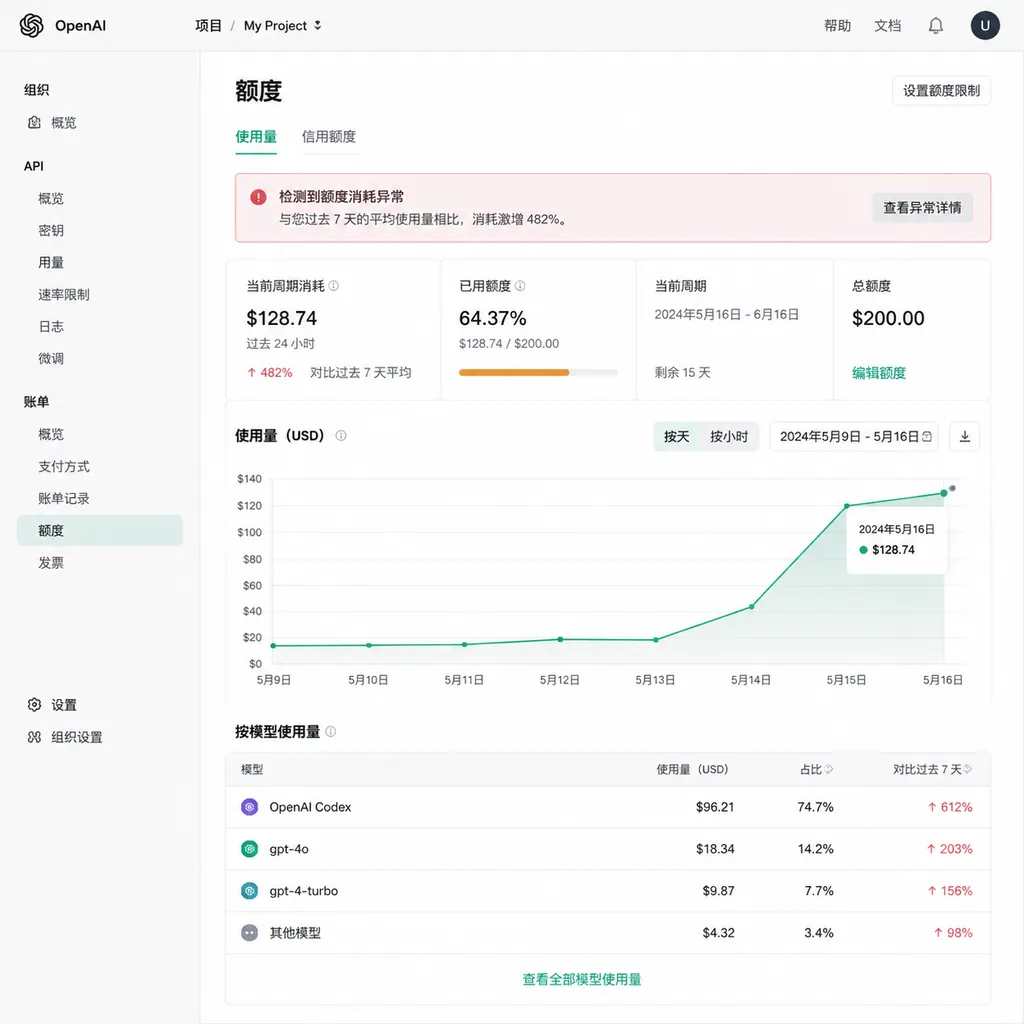
OpenAI Codex users collectively reported last weekend that their quota consumption rate had risen abnormally, with some exhausting a week’s quota in a single day. OpenAI has formed an emergency team, entered the war room to inspect logs, and reset all account quotas.
Last weekend, a group of heavy Codex users blew up on X: for the same coding tasks, credit consumption was several times faster than a week ago. Developers on the $200 Pro subscription found that credits that used to last a week were now depleted in a single day.
OpenAI reacted more strongly than expected. Codex engineering lead Thibault Sottiaux pulled the entire team into a war room on Sunday to review run logs line by line. The official status page was updated, acknowledging that some users’ credits were being “consumed faster than expected,” and all users’ credit limits were fully reset. Sottiaux posted on X: “We won’t clock out until we find the root cause.”
How the issue surfaced
It first emerged from complaints in the developer community. A software engineer named Adam wrote: “Something’s definitely wrong. I’m on the $200 plan; it normally takes a full week of heavy use to consume seven days’ worth of credits. But over the past two days, I’ve been running out of weekly credits each day—this is the first time I’ve had to manually reset them.”
Similar feedback piled up fast over the weekend. Users across different subscription tiers, regions, and usage levels all reported “burning faster.” At first some suspected their prompts were too verbose or the contexts too long, but as more veteran users provided comparison data—same repo, same refactoring task, same agent configuration, yet two‐to‐three times more consumption—it became clear this wasn’t imagination.
The OpenAI status page initially explained that the platform’s anti‑abuse and anti‑fraud risk‑control system had mistakenly throttled some accounts. In other words, the risk model misclassified normal users as suspicious, triggering abnormal credit deductions. That explained why only some users were affected, but not why consumption sped up—throttling usually means requests are rejected, not that extra tokens are charged.
The real culprit: the caching layer
As the team dug deeper, the picture clarified: the root cause wasn’t risk control but a performance optimization recently deployed.
A keyword from Sottiaux’s later explanation: cache hit rate. When Codex handles long sessions, it performs context compaction to compress conversation history and free up window space—a standard practice for any long‑context agent system. However, after this optimization changed the compaction path, prompt‑cache hit rates in long‑session scenarios plunged dramatically.
The ripple effect was nasty. Normally, Codex repeatedly reuses prefix cache during long tasks—same system instructions, same code context—and cached inputs are billed at a cheap rate. Once the cache fails, the system recomputes the full context from scratch, billing tokens at the full price. For an agent session that’s run dozens of turns, this means each new request re‑pays for all previous context tokens.
That’s why credits burned so fast.
It also explains why only some users noticed it—heavy users running long agent sessions were hit first, while casual users barely felt it. The $200 Pro‑tier engineers were the biggest victims, since their typical workflow is to let Codex refactor, test, and review large codebases for hours at a time.
How OpenAI handled it
According to Sottiaux, the team took three steps:
- Rolled back the performance optimization that caused the cache‑hit drop
- Reset Codex credits for all affected accounts, refunding unintended deductions
- Kept monitoring the status page, publicly tracking impact and recovery progress
The credit reset was a fairly generous move. A Codex credit represents a percentage‑based compute quota—heavier tasks consume faster. A universal reset meant OpenAI chose not to make users file individual claims or logs to prove over‑charging—it just leveled everyone up automatically.
From an engineering standpoint, this incident is textbook: an optimization meant to improve performance ended up breaking cache semantics on a specific path, and the billing system was tightly coupled to cache hit rates. Such “performance‑optimization‑gone‑expensive” bugs aren’t uncommon in distributed systems, but in a token‑billed AI‑agent product, the financial impact shows up right on users’ bills.
Why developers reacted so strongly
Years ago, if an IDE plugin bugged out, devs just cursed and restarted. But when a tool like Codex—an agent‑level programming assistant—fails, the reaction is on another level. It’s now deeply woven into many teams’ daily workflow.
One detail stands out: during the outage, some developers on X said “We just have to stop work and wait for the credits to reset.” That says a lot:
- AI agents are no longer just “assistive tools” but primary production tools
- Running out of credits means “can’t get the work done today,” not “can’t play with a toy”
- When the platform fails, downstream developers have almost no plan B
When Claude from Anthropic had major downtime in March, the community voiced similar frustration—half‑joking about “having to hand‑write code again.” The Codex incident exposes the same dependence, only now the symptom shifted from “service unavailable” to “service usable but burning money.”
Industry context: credit policies are tightening
Zooming out, this outage happened at a delicate time.
Over the past year, nearly all top AI providers have been tightening unlimited‑credit policies. Anthropic lowered Claude’s credit limits during March traffic peaks; many firms have canceled or revised “unlimited” plans; and enterprises now restrict AI coding‑tool use to control costs. Computing supply hasn’t kept up with agent‑driven token demand—a fundamental tension.
In this environment, user sensitivity to credit usage is at a historic high. Those paying $200 aren’t unwilling to pay—they just expect a predictable amount of compute power. Once that expectation breaks, even resets and refunds leave a dent in trust.
OpenAI’s quick response—Sunday war‑room mobilization, live status updates, public posts by the lead, and a blanket credit reset—shows awareness of the bug’s political sensitivity. Codex is OpenAI’s key product in the programming‑agent race against Claude Code and Cursor, right amid market‑share battles. Any hint of “secretly over‑charging” would be heavily amplified by competitors.
Practical takeaways for developers
If you rely heavily on AI coding agents, this episode offers a few reminders:
- Watch your usage curve, not just total credits. Sudden changes in consumption for identical tasks are the earliest failure signals—often earlier than the status page.
- Long sessions aren’t free. Even with prompt caching, once cache policies break, long‑context agents become token black holes. Start new sessions when appropriate.
- Have a fallback plan for core workflows. Using one vendor as a production tool means knowing what it costs to switch if something goes wrong.
For point 3, multi‑model aggregation is becoming a popular safety net—platforms like OpenAI Hub let a single API key call GPT, Claude, Gemini, DeepSeek, etc., using the OpenAI format and do local routing. Failsafe switching then needs minimal code changes. While Codex‑level agents can’t yet be directly swapped out, keeping the underlying model‑call layer abstracted helps prevent total work stoppage if one vendor falters.
Not over yet
As of now, OpenAI says the incident is resolved, systems are stable, and affected credits have been reset. But some community members report new credit‑usage fluctuations after “reset week,” hinting that root‑cause analysis may not be finished.
According to Sottiaux, the team will keep monitoring logs for residual issues. A billing fault triggered by “performance optimization” involves intricate coupling among caching, billing, and risk‑control layers; fully untangling those boundaries will take time.
For developers, this serves as a reminder: now that AI agents handle a large share of daily coding work, your productivity curve is deeply tied to the engineering stability of some cloud service. Both the benefits—and the risks—of that new reality are only beginning to emerge.
References
- OpenAI forms “emergency team” to investigate rapid Codex credit consumption – ITHome: Original ITHome coverage with Sottiaux’s statements and user feedback
- OpenAI “emergency team” discussion thread – linux.do: Developer community discussion with first‑hand user reports


