
Meta bans Claude and Codex: The fear isn’t about spending money, it’s about distillation
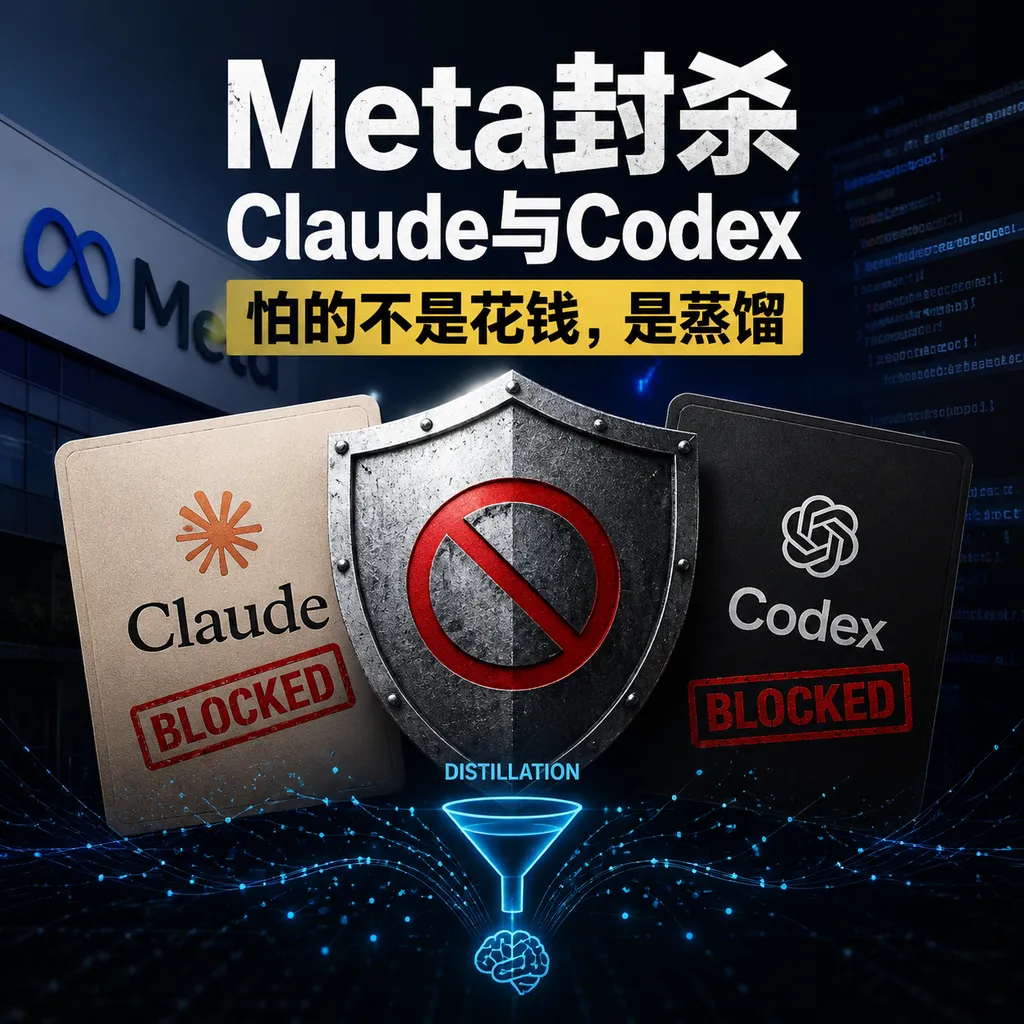
Meta internal documents reveal that since May, the AI engineering department has restricted engineers from using Claude Code and OpenAI Codex. The reason is neither cost nor efficiency, but concern that output from competitor models could contaminate the company’s own training data, triggering the “model distillation” red line.
Meta Bans Claude and Codex: The Fear Isn’t About Spending Money, It’s About Distillation
Meta has removed Claude Code and Codex from the toolboxes of its AI engineers, and the reason is rather counterintuitive — neither due to high costs nor poor performance.
According to internal documents disclosed by The Information this week, Meta’s Applied AI department has, since May of this year, been enforcing an internal policy that is still in effect, restricting engineers from using Anthropic’s Claude Code and OpenAI’s Codex in their daily development. Some teams were even asked to pause ongoing related tasks. Meta’s official statement on this was: “We have clear policies governing how teams use AI tools to ensure they can responsibly focus on high-impact work.”
Translated into plain language, the official statement means only one thing: Meta fears being accused of distillation.

This Is Not a Cost Problem — It’s a Legal Problem
Traditionally, big companies restrict employees from using external AI tools for three main reasons: data leakage, API costs, and productivity control. But Meta’s internal memo was unusually blunt — the concern is that they might “inadvertently trigger distillation.”
In the context of large models, distillation refers to using the output of a more capable “teacher model” to train a “student model,” with the latter approaching the performance of the former in a smaller footprint. This is a standard technique in model compression. But when applied to closed-source commercial models, it changes nature.
The user agreements for Claude and Codex contain explicit clauses: prohibiting the use of their outputs to train, improve, or develop any competitive AI models. Anthropic’s terms are especially strict, and OpenAI has been tightening relevant language since the DeepSeek incident.
Here’s the problem: engineers use Claude Code to write code and Codex to complete functions daily. If those code snippets are merged into Meta’s internal codebase and that codebase subsequently enters the training corpus for the Llama family of models — technically, this chain constitutes distillation. Even if no one intends to do it, the objective result remains.
Meta’s memo put it plainly: if outputs from competitors’ AI are allowed to seep into Meta’s training data, it could lead to “serious disputes and escalation with partner companies.” The phrasing “partner companies” here is delicate — at the model level, Meta, Anthropic, and OpenAI are pure competitors. So-called partners likely refer to upstream connections like cloud services or chip procurement.
The Shadow of DeepSeek Still Lingers
To understand why Meta is so tense, we have to rewind the timeline.
At the beginning of the year, the DeepSeek-R1 incident saw OpenAI publicly accusing DeepSeek of using ChatGPT outputs for distillation training. Although it didn’t result in litigation, the nerves of the entire industry were tightened. Closed-source model vendors have since increased monitoring and compliance auditing of output usage — call logs, prompt patterns, output characteristics — everything that can be checked, is checked.
Meta’s position is even more sensitive. Although Llama is open-source, the sources of its training data and synthetic data have always drawn public attention. If one day a new version of Llama is technically analyzed and found to have output styles or error patterns statistically correlated with Claude or GPT, Meta would have to produce not just an internal statement, but a complete chain of data provenance.
From this perspective, the May internal policy looks like preemptive compliance — better to block the route at the engineer’s keyboard than to explain after a problem occurs.
According to multiple sources, Meta’s restriction is not absolute. In clearly compliant scenarios like setting up test environments and conducting benchmark comparisons, teams can still use third-party AI tools, but there are two hard requirements:
- All AI-generated content must undergo strict manual review before use
- It is prohibited to use outputs from third-party models to design or evaluate the programming abilities of in-house models
The second requirement is particularly crucial. It directly cuts off the possibility of using Claude or Codex outputs as “reference answers” to fine-tune Llama’s coding capabilities — which is precisely a common unspoken practice in the industry.
Engineer’s Perspective: How to Continue Daily Work
For Meta’s internal AI engineers, how big is the practical impact?
First, there’s a rollback in coding experience. Claude Code and Codex are still in the industry’s top tier for code completion, debugging, and refactoring. Switching forcibly to Meta’s own Code Llama or internal tools creates a tangible gap, especially when working with complex contexts or large codebases.
Second, evaluation becomes more complicated. Previously, engineers might throw the same request to Claude and Llama, compare output quality, and quickly pinpoint gaps. Now that shortcut is explicitly prohibited. Internal evaluations must rely on manually annotated benchmark sets or non-generative automatic evaluation methods, slowing iteration.
The good news is Meta hasn’t banned all external AI tools — open-source model usage remains unrestricted. Engineers can still use Qwen, DeepSeek, GLM, and other open-source models for daily assistance, as their licenses impose far fewer restrictions on distillation, with some even explicitly allowing it.
What This Means for the Industry
Viewed on a larger scale, Meta’s move sends at least three signals:
First, the “output sovereignty” of closed-source model vendors is being taken seriously. In the past, everyone thought model outputs were just text and used them freely. Now, leading vendors have implemented internal isolation mechanisms. This is a substantive recognition of Anthropic and OpenAI’s contractual terms and means that if a distillation dispute occurs in the future, defending against it will be much harder.
Second, engineers’ toolchain choices are becoming politicized. What AI assistant an engineer uses used to be a matter of personal preference; now, in big companies, it’s a compliance issue. If this trend spreads, competition among model vendors will extend from product capabilities to legal frameworks — how strong your contractual terms are, how fine your monitoring methods are — directly affecting whether your competitors dare to use your product.
Third, the implicit value of open-source models is increasing. When closed-source models become “touch-me-not” assets inside big companies, open-source models naturally become the default option. This is good news for the open-source camp — not because their capabilities have suddenly improved, but because competitors have voluntarily tied their own hands.
A Slightly Awkward Situation
It’s worth noting that Meta itself is one of the biggest champions of open-source models. The Llama series has long been a benchmark in the open-source world, and Zuckerberg has repeatedly criticized the closed nature of proprietary models.
But in internal management, Meta must strictly comply with competitors’ closed-source rules — no Claude, no Codex. This sense of disconnect is a real snapshot of today’s large-model industry: talking open and sharing in public, but behind closed doors, everyone carefully guards their own red line on data.
For developers concerned with model API calls, there is another angle: on aggregation platforms where a single key can access GPT, Claude, Gemini, DeepSeek, and other mainstream models (such as OpenAI Hub), switching models for comparative testing is a routine workflow. But if your product code is also used to train your own model, then where those outputs come from and where they are used deserves careful compliance review. In this sense, Meta’s May memo is a wake-up call for any team doing model training.
Final Thoughts
Meta’s restrictions are unlikely to last long — at least not in their current form. Either Meta will negotiate a clear enterprise-level usage license with Anthropic and OpenAI, codifying distillation boundaries in contractual terms, or Meta’s internal toolchain will quickly fill the gap so engineers no longer have the motivation to use external models.
But the symbolic significance of the move will remain. When a big company starts managing AI tool usage with legal logic rather than technical logic, the industry has entered a new stage: beyond competition in model capability, competition in rules is only just beginning.
References
- Preventing Distillation of Third-Party Models, Meta Restricts AI Engineers from Using Claude and Codex - IT Home — IT Home’s Chinese summary of The Information report, including key details of Meta’s internal policy


