
Meituan LongCat-2.0 Beta Launch: 9.9 RMB for 50 Million Tokens

Meituan's trillion-parameter large model LongCat-2.0-Preview officially launches its paid plan: new users can get 50 million tokens for 9.9 RMB, 1 billion tokens for 399 RMB, with free cache hits. This is currently the only trillion-parameter model fully trained using domestic computing power.
Meituan has put its pricing cards on the table.
After quietly opening a two-month invitation-only test for LongCat-2.0-Preview at the end of April, Meituan officially launched its paid plans this week: new users get 10 million tokens after real-name authentication, a trial pack with 50 million tokens for ¥9.9, a Token Plan with 1 billion tokens for ¥399, plus pay-as-you-go API billing. Cache hits are not charged.
This pricing is a bold move among top-tier domestic models — looking only at ¥399 for 1 billion tokens, the average cost per million tokens is less than ¥0.4, which already matches the mid-range pricing of DeepSeek V4 Flash. Considering that LongCat-2.0 is a trillion-parameter MoE, supports 1M context, and has tool-call optimizations specifically for Agent scenarios, this pricing is more like an advertisement for domestic compute clusters: it works, it runs stably, and it’s cheap.
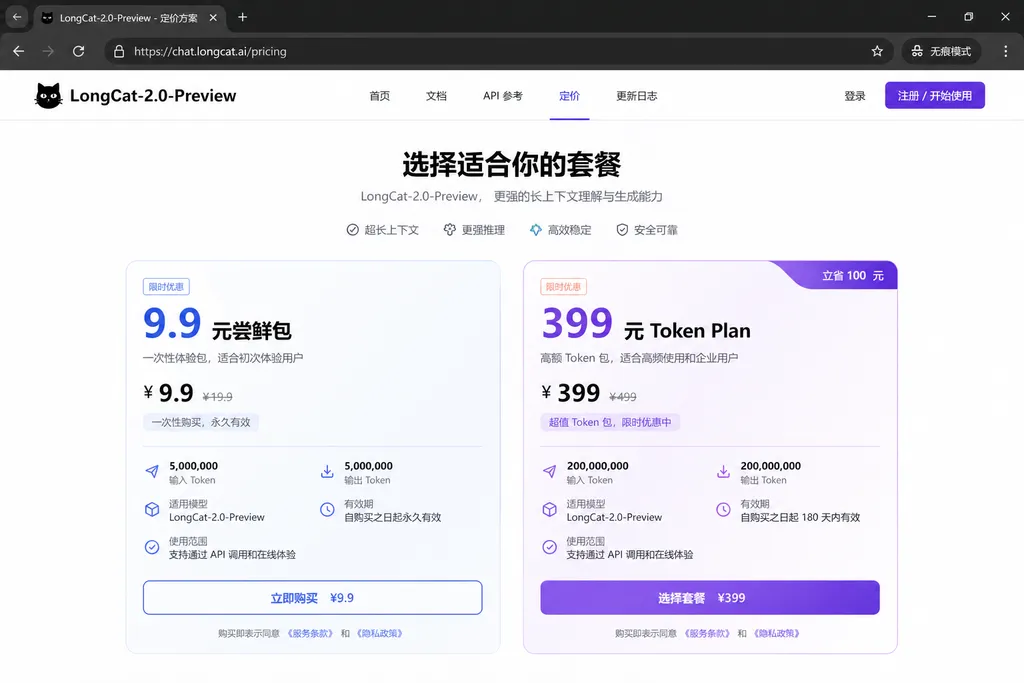
First, the pricing in detail
Meituan’s paid plan structure this time has four tiers, not too complex for developers:
- New user benefit: 10 million tokens after real-name authentication — enough for hundreds of tool-call loops in an Agent project.
- ¥9.9 trial pack: 50 million tokens, about ¥0.2 per million tokens. This price basically just covers electricity costs; the goal is to bring people in.
- Token Plan (¥399): 1 billion tokens, about ¥0.399 per million tokens. Suitable for small-to-medium teams as main API usage.
- Pay-as-you-go API: standard billing tier, cache hit portions are free.
The cache-free policy is worth highlighting. What’s the biggest cost sinkhole for Agent applications? Repeatedly passing the same system prompt, the same long context, the same tool description list. LongCat cuts that cost to zero for cache hits — essentially telling teams building AI coding assistants, RAG systems, and long-session customer servicebots: your most expensive part, I won’t charge for.
This pricing logic is similar to DeepSeek’s early “drop inference cost to the floor” approach, except Meituan has another story — it’s running entirely on domestic hardware.
Trillion parameters, trained entirely on domestic cards
LongCat-2.0-Preview’s technical foundation is roughly on par with DeepSeek V4 released at the same time:
- Total parameters exceed 1 trillion, MoE architecture, around 48B active parameters per token
- Supports 1M context window, capable of processing millions of characters in a single inference
- Training and inference completed entirely on domestic compute clusters, using 50,000–60,000 domestic AI accelerator cards
The third point is the real headline.
Before this, domestic trillion-parameter models were essentially products of NVIDIA H100/A100 clusters. Even if adapted to domestic cards later, training was usually a mixed-hardware process. LongCat-2.0 is currently the only publicly confirmed model whose trillion-parameter pretraining was fully completed on domestic compute, with a 50–60k-card scale setting a national record.
What’s the significance? A ten-thousand-card cluster is already an engineering nightmare — any minor precision deviation on a single card or any communication latency can be exponentially amplified in parallel computation, eventually causing the training job to crash or the model to fail to converge. Scaling to 50,000 cards while stably completing trillion-parameter MoE training means the team had to independently tackle parallel strategies, communication topology, mixed precision, and fault tolerance. NVIDIA’s CUDA toolchain, operator libraries, and debuggers — honed over 20 years — are basically useless here.
Meituan hasn’t open-sourced LongCat-2.0 nor released a technical report, which is a bit surprising — previous generations like Flash-Chat, Flash-Thinking, and Omni were honestly posted to Hugging Face and GitHub. This cross-generation version instead quietly released with only a few lines of update logs and an invitation-only test. Speculation: perhaps because the training stack is too deeply tied to domestic chip manufacturers, open-sourcing would offer little reproduction value for external developers and would inadvertently reveal a lot of chip-side engineering details.
Is it actually good to use?
The official update log for LongCat-2.0 only lists three things: native tool-call and multi-step reasoning support, expertise in code generation and automated workflows, deep integration with Claude Code, OpenClaw, OpenCode, and Kilo Code.
Translated: this is a model aimed straight at Agents.
From early feedback in the Linux.do community, LongCat-2.0-Preview “feels a bit like MiMo-V2.5-Pro” — speed is decent, instruction following in long contexts is clearly improved over the previous version, tool-call stability is solid enough to integrate directly into heavy-duty Agent frameworks like Claude Code without breaking. The 1M context parameter truly holds up in real use — you can throw in a hundreds-of-thousands-of-words codebase for global refactoring without the model hallucinating halfway.
But it’s not without shortcomings. Community feedback indicates that in pure reasoning tasks (math, logic problems), LongCat-2.0 still trails DeepSeek V4 and GPT-5.5; its strengths are Chinese creative writing and style imitation, while detailed code generation quality lags behind specialized models like Claude 4.5 Sonnet. In other words, it’s an “engineering practical” oriented model, not a showcase model.
This ties into Meituan’s goal for it. In a recent earnings call, Wang Xing said Meituan wants “to upgrade the Meituan App into an AI-Powered App first.” LongCat’s real training data comes from Meituan’s nationwide instant delivery network across over 2,800 cities and counties, 5.5 million autonomous vehicle deliveries, and 780,000 commercial drone orders. These scenarios demand very specific abilities from the model: to understand complex commands, call tools, and retain memory in long processes.
Compared to leaderboard showboating or code writing, Meituan clearly prioritizes the former.
Comparing to DeepSeek V4
Released the same day, similar parameter scale, similar price range — inevitable to compare.
Breaking it down:
| Dimension | LongCat-2.0-Preview | DeepSeek V4 | |---|---|---| | Architecture | Trillion-parameter MoE, ~48B active | Trillion-parameter MoE | | Context | 1M | 1M | | Training compute | Fully domestic cards (50–60k) | NVIDIA initially, then migrated to Ascend 950PR | | Open source | No | Yes | | Pricing | Cache free, ¥399/1B tokens | V4 Flash cache hit ¥0.02/million tokens | | Main scenarios | Agent / tool call / long processes | General-purpose base model |
DeepSeek’s route: “open source + extreme low price + general capability,” aiming to replace GPT and Claude in global developers’ minds. LongCat’s route: “native domestic training + closed source + scenario closed-loop,” aimed to serve Meituan’s own business and, incidentally, offer APIs.
Which path is “better” is too early to conclude. But one thing is clear: domestic compute substitution has moved from “usable” to “capable of training trillion-parameter models” faster than most expected. A year ago the industry was still debating if Ascend could stably run large model inference; this year someone has completed pretraining on a 50k-card domestic cluster.
Integration paths
Currently, developers can connect to LongCat-2.0-Preview in two ways:
- Apply for invitation testing at longcat.ai — daily quota of 10 million free tokens; good for trial usage
- Go straight to the paid plan — ¥9.9 for 50 million tokens has basically no entry barrier
API is OpenAI-compatible, model name typically longcat-2.0-preview. If you’re already using aggregation platforms like OpenAI Hub, with one key calling all major models, LongCat is already on the supported list — you can switch over directly for comparison testing without separately applying for a key.
The real signal here
Back to that pricing.
¥9.9 for 50 million tokens, cache hits free, Agent scenario optimization — this combination was unimaginable a year ago. The premise for it is that domestic compute has gone from “usable” to “affordable.” When training costs are no longer bottlenecked by overseas chip supply schedules, domestic model vendors have the confidence to push prices this low.
Meituan’s low-key release indicates their confidence: no PR hype, just let API call volume speak. For developers, there’s now another domestic option with trillion parameters, long context, stable tool calls, and cheap pricing — at least for Agent products, the choice set has grown thicker.
As for whether it can win in the long-term against DeepSeek, Qwen, and future players — that will depend on iteration speed in the coming months. The preview version is just the opening.
References
- Meituan LongCat-2.0-Preview officially launched — new users get 50 million tokens for ¥9.9 - linux.do: Community discussion from launch day, including pricing details and new user benefits
- Meituan’s large model LongCat-2.0 officially released — ¥9.9 for 50 million / ¥399 for 1 billion - linux.do: Developer trial feedback, including experience during testing and cache strategy discussion


