
vLLM launches Micro-Agent: enabling small models to team up in APIs to beat Frontier

The vLLM team today released the Micro-Agent framework, which moves multi-agent collaboration from the application layer down into the model inference API itself. By forming teams of small to medium models, it has surpassed GPT-5 and Claude 4.5 tier Frontier models on multiple benchmarks, while significantly reducing inference cost and latency.
vLLM Puts Agents into the Inference Engine
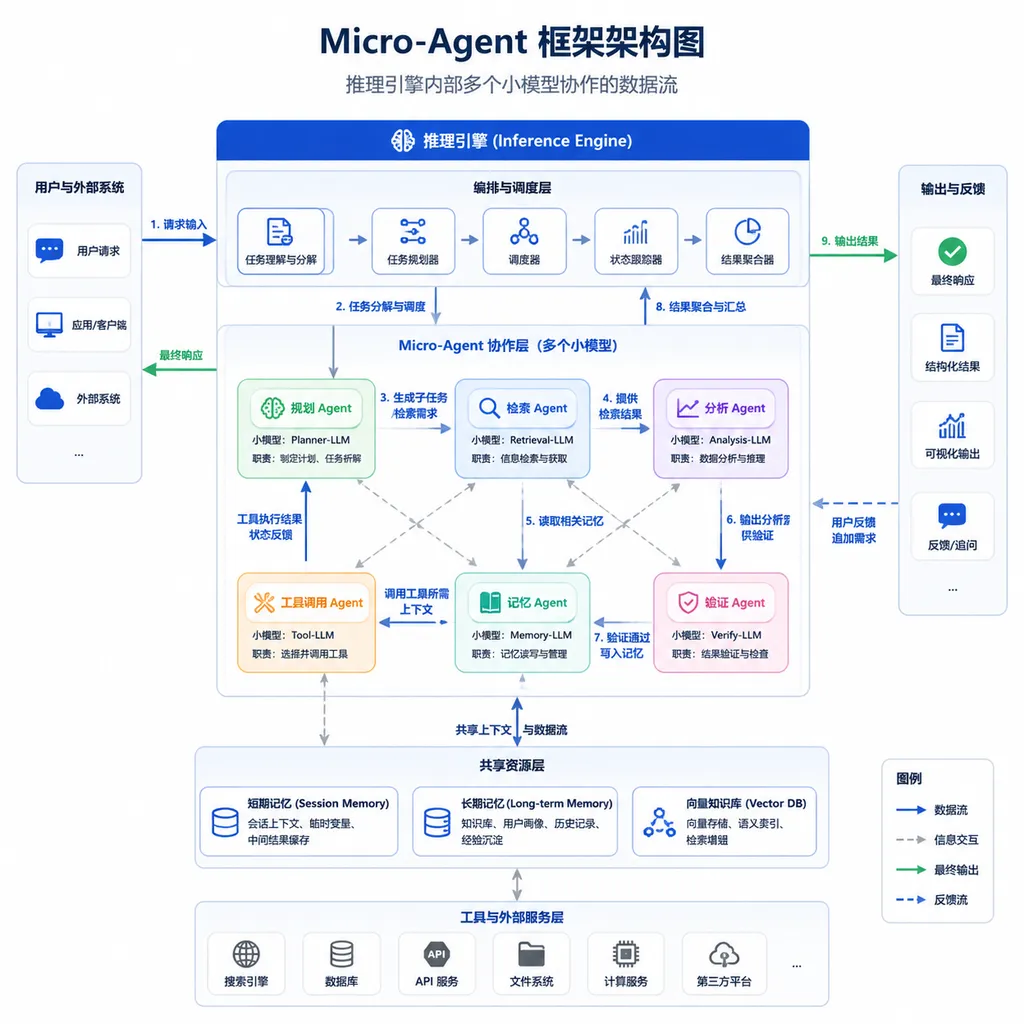
Today, the vLLM team dropped the Micro-Agent framework on their official blog. In one sentence: they’ve moved what used to run in the application layer — Multi-Agent systems stitched together with a bunch of HTTP calls — directly inside the model inference API, letting multiple small models complete division of labor, collaboration, voting, and error correction all within a single API call.
The key phrase here isn’t “yet another Agent framework” but “inside the model API.” In the past two years, most Multi-Agent setups — like LangGraph, AutoGen, CrewAI — have had an orchestrator on the outside, with each Agent being a separate LLM call, with tokens going back and forth over the network. vLLM’s idea flips this: since all these Agents ultimately run on the inference engine, why not let them collaborate while the KV cache is still warm?
According to the blog’s data, Micro-Agent teamed up mid-sized open-source models like Qwen3-32B, DeepSeek-V3.2, and Llama-4-Scout, surpassing single-model GPT-5 and Claude 4.5 Sonnet on hard benchmarks like SWE-Bench Verified, GPQA Diamond, and LiveCodeBench. The cost was only 1/4 to 1/3 of Frontier models, with end-to-end latency at a similar level. If this result holds up, it could disrupt cost structures across the industry.
Core Idea: Push Collaboration Down to the KV Cache Layer
The pain points of traditional Multi-Agent are concrete. Say you have three Agents reviewing a piece of code; each Agent has to re-read the entire context. That multi-thousand-token snippet gets prefills three times, with separate KV caches for each. If you then add an Aggregator to summarize, you have to feed the outputs from the first three Agents into a new prompt and prefill again. Looking at compute usage, repeated prefills eat up about half the resources.
Micro-Agent compiles this process into a computation graph and hands it off to the vLLM engine for unified scheduling:
- Shared Prefix Reuse: All collaboration roles share the same task context KV cache. The prefill is done only once. This leverages vLLM’s existing prefix caching capability, now applied to multi-role collaboration.
- Role-Level LoRA Switching: Different roles (e.g., Planner, Coder, Reviewer) are distinguished using lightweight LoRA adapters on a shared base model. Switching roles now costs only loading a set of adapter weights instead of a full model load.
- Built-in Collaboration Primitives: Modes like vote, debate, reflect, and aggregate — previously hand-coded at the app layer — are now implemented directly in the engine. Callers just need to declare
collaboration_modein the request. - Early Stopping and Pruning: If three Reviewer roles converge on the same judgment, the engine can halt further generation early instead of completing all runs.
In short, old-school Multi-Agent is “separate models emailing each other,” while Micro-Agent is “multiple roles passing notes at the same desk.” Closer physical proximity naturally improves efficiency.
Performance Data: Can Mid-Sized Model Teams Really Beat Frontier Models?
The blog posts some striking comparison numbers. On SWE-Bench Verified, single-model Claude 4.5 Sonnet scores 74.2%, GPT-5 scores 76.8%, while a Micro-Agent team of 4 × DeepSeek-V3.2 + 1 × Qwen3-Coder-32B scores 78.5%. On GPQA Diamond, the gap is larger: Micro-Agent scores 82.1%, nearly 3 points higher than GPT-5’s 79.3%.
This isn’t too surprising. Academic work over the past year on LLM-as-Judge, Self-Consistency, and Multi-Agent Debate has repeatedly shown that multiple samples plus voting almost always raise the performance ceiling. The problem was that it was too expensive — running Claude 4.5 five times costs 5× as much. By flattening the cost curve, Micro-Agent makes this approach practical.
A caveat: those benchmarks were run on vLLM’s in-house inference stack, with tuned parameters (temperature, top-p, collaboration rounds). Whether the same strategy works on SGLang or TensorRT-LLM remains to be seen. And if Frontier vendors roll out GPT-5.5 or Claude 4.6, the lead could vanish. This “open-source team beats closed-source” storyline replays every six months, and in the end no one really loses — except customers paying a premium for single-model APIs.
Why vLLM Is Doing This
The open-source inference engine space has been fiercely competitive: vLLM, SGLang, and TensorRT-LLM have been chasing each other in throughput and first-token latency. But pure performance optimizations are hitting physical limits — A100/H100 KV cache utilization and PagedAttention have been squeezed dry. To open up a gap now, you need a new battleground.
Micro-Agent is vLLM’s new battleground: shifting from “I run faster” to “I run smarter.” The engine is no longer just blindly executing prompts, but is participating in inference strategy orchestration. This step turns vLLM from a “faster OpenAI API implementation” into a true Agent runtime.
This repositioning matters. In the past, deploying an Agent system meant a stack like LangGraph + vLLM + Redis + lots of glue code; now vLLM can swallow most of that. It’s especially friendly for on-premises enterprise deployments — one fewer component, lower ops costs, fewer points of failure.
Incidentally, OpenAI Hub is already following up with Micro-Agent compatibility. The backend scheduler can split collaboration requests across multiple open-source model instances, allowing developers to team up GPT, Claude, and DeepSeek with a single key, without building their own inference clusters. For teams that want to test the Micro-Agent concept without immediately spinning up GPU clusters, this is a convenient entry point.
A Few Notable Details
After reading the blog and looking at the initial open-source code, here are some developer-relevant points:
Programming Model: The Micro-Agent API design follows OpenAI Chat Completions, adding agents and collaboration fields. You can declare multiple roles in one request, specify each role’s model and system prompt, and define their collaboration topology. This means minimal front-end code changes — existing OpenAI SDK users can migrate with almost no pain.
Freedom in Model Combination: In theory, you could have Qwen as Planner, DeepSeek as Coder, and Llama as Reviewer. In practice, KV cache can’t be shared across different models, so cross-model collaboration costs significantly more than multi-role single-model setups. The blog recommends “one base model + multiple LoRA roles” as the most optimal setup.
Extensible Collaboration Modes: Beyond the built-ins (vote, debate, reflect), the framework exposes an API to define custom collaboration operators. Write a Python class inheriting from CollaborationOp, register it with the engine, and it’s ready to use. Clearly targeting academic research and enterprise customization.
Unsolved Issues: How to handle streaming output in multi-role collaboration? The current implementation returns the result after the full collaboration finishes, which isn’t friendly for real-time interactive apps. The community has opened an issue, and given vLLM’s pace, a solution may come within two or three versions.
What This Means for the Industry
At a macro level, Micro-Agent is another open-source counterattack against the “Scaling Faith.” For the past two years, closed-source Frontier models have relied on “absolute advantages in parameters and training data” as their moat — no matter what you do with 70B, you can’t beat my 500B-parameter flagship. But when inference-time compute becomes the new battleground, that logic wavers. OpenAI o1 and Claude 4’s Extended Thinking take this path too — but lock inference-time compute inside their APIs.
The open-source response is: we can do inference-time compute too, and we’ll make it an open protocol anyone can use. After Micro-Agent, expect SGLang and TensorRT-LLM to roll out similar capabilities, with Hugging Face likely offering an upper-layer abstraction. This battle will blur the lines between inference and orchestration layers, adding another dimension to dev stack decisions.
At a micro level, for teams building Agent products, Micro-Agent is worth a PoC. If your Agent system often “reuses the same long context, having different roles handle it in turn” (code reviews, contract audits, complex support tickets), this can cut your bill by more than half. If your scenario is single-turn interaction with short context, the benefit is limited — you didn’t need Multi-Agent in the first place.
Reference Links
- vLLM Project Main Repository - GitHub: vLLM inference engine source code; Micro-Agent module is expected to be merged into the main branch in the next minor release
- OpenHands Microagents Deep Dive - Zhihu: another open-source project using Microagent ideas for software engineering Agents; compare its approach to vLLM’s


