
Claude Monitor Tool Released: The Era of On-Demand Agent Activation Has Arrived
Anthropic has added a new Monitor tool for Claude, allowing Agents to be awakened on demand to perform tasks instead of relying on inefficient polling, greatly reducing token consumption. This represents a substantial cost optimization for heavy API users.
Anthropic didn’t hold a big launch event this time, but what they released is solid — Claude now has a new Monitor tool that gives Agents the ability for “on-demand awakening.”
Simply put: your Agent no longer has to stupidly poll every few seconds. It wakes when needed, sleeps when idle. Your token bill instantly drops a size.
First, understand where the problem lies
Anyone who’s developed Agents knows the pain point — polling.
The traditional Agent workflow goes like this: you give it a task, such as “monitor a data source and process it when it changes.” How does the Agent do it? It asks every fixed interval: “Changed yet? Changed yet? Changed yet?”
Every query means one API call. Every call consumes tokens. Even if the data source doesn’t change all day, your Agent diligently burns through your money.
This isn’t a framework bug — it’s the endemic flaw of the Agent architecture. When Claude Code’s source once leaked, the community dissected its ToolSearch mechanism — once the number of tools exceeded a threshold, just stuffing all tool descriptions into the prompt made the token cost unacceptable. Anthropic’s internal solution was to load tool definitions on-demand, which reportedly reduced token usage by 98.7%.
But that only optimizes tool definitions. The real issue lies at runtime: while an Agent waits for external events, does it need to stay “alive” the whole time?
That’s exactly what the Monitor tool solves.
How the Monitor tool actually works
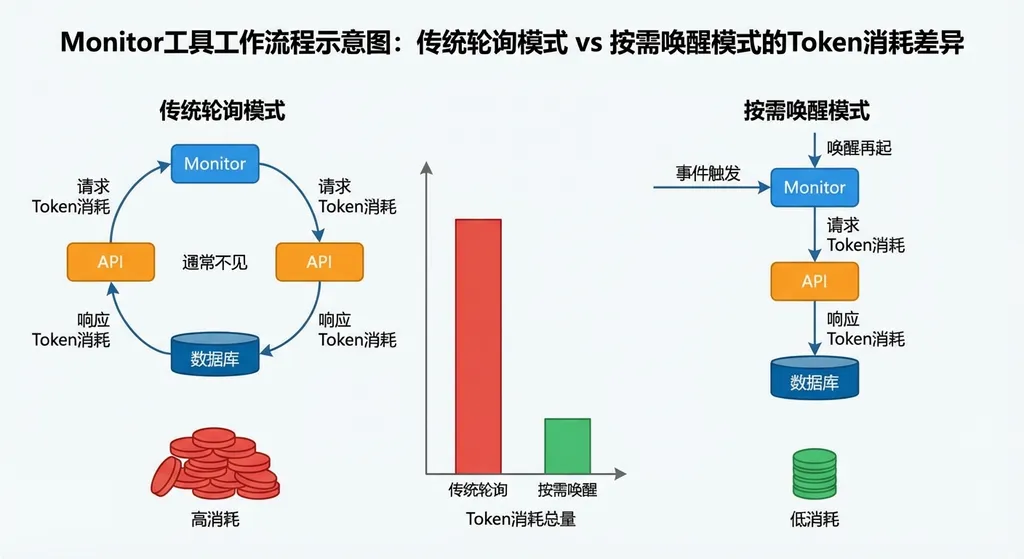
The core idea is simple: turn the Agent from an active poller into a passive responder.
In the traditional mode, the Agent’s lifecycle is continuous. Once launched, it keeps running — constantly invoking the model to determine what to do next. Even when there’s nothing to process, it consumes compute resources and tokens.
Under the Monitor mode, the Agent registers a monitoring condition and then sleeps. When that condition is triggered, the Agent wakes and proceeds with its logic. While asleep, it doesn’t call the model and consumes no tokens.
It’s the same concept as an operating system interrupt: the CPU doesn’t constantly check if a key is pressed; the keyboard sends an interrupt signal, and the CPU handles it. The Monitor tool adds a similar interrupt mechanism for Agents.
From developer community feedback, this feature is part of Anthropic’s Proactive Mode system — which includes focus awareness, scheduled awakening, skill discovery, and token budget management. The goal: evolve Agents from passive “tools” into proactive “colleagues.” Monitor is the most fundamental and practical piece of that puzzle.
Real-world scenario: how much can you save?
Let’s do the math.
Suppose you have an Agent monitoring a GitHub repo’s issues, auto-labeling new ones.
In a polling mode — checking every 30 seconds — that’s 2,880 calls a day. Suppose each call costs 500 tokens (system prompt, context, tool descriptions included), that’s 1.44 million tokens per day, 43.2 million per month. Not small change if you’re using Claude Sonnet.
And most repos only get a few new issues per day — meaning over 99% of those calls are wasted.
With Monitor mode, the Agent registers a webhook, waking only when a new issue appears. Five issues a day means five calls. Token usage drops from 1.44 million to just a few thousand.
That’s not a 10% or 20% optimization — it’s a difference in magnitude.
Another everyday example: CI/CD pipeline monitoring. You want an Agent to watch build states, analyze logs if a build fails, and suggest fixes. In polling mode, it asks “build done yet?” every minute. A 20-minute build burns 20 useless calls. With Monitor mode, the build completion triggers one wake-up — the Agent works, then sleeps again.
What this means for developers
This isn’t just about saving money — though it definitely does.
The deeper change is: the Agent architecture paradigm is shifting.
Before, building an Agent meant juggling tons of infrastructure concerns — polling intervals? duplicate handling? concurrency control? freeing resources when idle? These chores eat up half the development effort.
With Monitor, those issues move down to the platform layer. Developers only need to care about what triggers awakening and what to do once awakened.
It’s very much the Serverless mindset. Lambda functions don’t worry when servers start or stop — they run on demand and consume nothing when idle. The Monitor tool gives Agents that same elasticity.
Developers are already exploring multi-Agent collaboration systems based on this. For example: one Agent monitors and, upon detecting an anomaly, forks a child Agent to handle it, which then self-destructs on completion. The main Agent goes back to sleep. Token costs then align almost perfectly with actual workload — zero waste.
Comparison with competitors
OpenAI’s Assistants API still works on the Run model: you create a run, it executes, and returns results. To achieve continuous monitoring, you still need custom polling logic. Streaming can reduce latency but doesn’t fix token waste during idle periods.
Google’s Gemini integrates event-driven agents more at the Vertex AI platform level, using Cloud Functions and Eventarc. The approach is solid, but it tightly binds developers to the GCP ecosystem.
Anthropic’s solution is more elegant — building event-driven capability directly into the model’s tool layer, requiring no extra cloud infrastructure. Of course, this means staying within the Anthropic framework.
At present, Anthropic is clearly ahead in Agent infrastructure. From Tool Use to Computer Use, and now to Monitor, each step lowers the barriers and costs of Agent development.
How to use it
If you’re already using Claude’s API for Agent development, integrating the Monitor tool works just like other Tool Uses — simply declare it in the tools parameter.
A simplified call example:
import requests

# Call through OpenAI Hub, OpenAI-compatible format, direct access from China
response = requests.post(
    "https://openai-hub.com/v1/messages",
    headers={
        "Authorization": "Bearer YOUR_OPENAI_HUB_KEY",
        "Content-Type": "application/json"
    },
    json={
        "model": "claude-sonnet-4-20250514",
        "max_tokens": 1024,
        "tools": [
            {
                "type": "monitor",
                "name": "issue_monitor",
                "description": "Monitor new GitHub issues",
                "trigger": {
                    "type": "webhook",
                    "source": "github",
                    "event": "issues.opened"
                }
            }
        ],
        "messages": [
            {
                "role": "user",
                "content": "Monitor the my-org/my-repo repository and automatically classify and label new issues."
            }
        ]
    }
)

print(response.json())
If you’re using multiple model APIs, aggregation platforms like OpenAI Hub make things easier — one key to call Claude, GPT, Gemini, DeepSeek, etc., without managing separate keys and billing. Handy for testing across different models.
Some caveats
Developers are already hitting snags. A user on Linux.do joked, “Just patched the cache for an hour, now I need to upgrade again,” implying Monitor might require newer SDK or API endpoints. If you’re on older Claude API clients, upgrade first.
Also, the Monitor trigger mechanism is still evolving. For now, it supports webhook and scheduled triggers, but more event types are being added. Specialized use cases may need to wait for updates.
And watch out for Token Budget Management. In Monitor mode, the Agent’s wake frequency depends on external events — token consumption becomes unpredictable. Pairing with community tools like claude-monitor is advised to track real usage, preventing bill spikes from abnormal event floods. GitHub already hosts mature guides with live token tracking, session management, and consumption rate estimates.
The bigger picture
Viewed in context, Anthropic’s aim is clear: to make Claude the foundation model of choice for Agent development.
Model capability has largely converged across labs. The real differentiator now lies in surrounding tool ecosystems and developer experience. From Tool Use to Computer Use, to now Monitor, Anthropic keeps solving the most painful parts of Agent building with native features — file handling via Computer Use, code execution via Code Execution, and now event-driven operation via Monitor.
The endpoint of this trajectory: enabling developers to build production-grade Agent systems with minimal glue code.
For teams already developing Agent products, the Monitor tool deserves immediate evaluation — not because it’s flashy, but because it tackles real operational costs. In large-scale Agent deployments, polling costs scale linearly with Agent count, while Monitor mode costs scale only with event volume.
The bigger the scale, the larger the savings.
References:
- Discussion on Claude’s new Monitor tool — Linux.do community technical discussion
- claude-monitor usage tracking guide — GitHub guide on Claude Code usage monitoring
- Agent principle discussion — Zhihu analysis on Agent efficiency and token optimization


