
DiScoFormer Debuts: A Transformer Takes Over Density and Score Estimation

AllenAI and Hugging Face jointly released DiScoFormer, which uses an equivariant Transformer to output both probability density and score function simultaneously, without the need to retrain for each distribution. On the theoretical side, they proved that self-attention is a functional generalization of kernel density estimation, bringing classical problems of statistical inference into the Transformer era.
AllenAI and Hugging Face jointly released last week a model with a somewhat tongue-twisting name but considerable weight — DiScoFormer (Density and Score Transformer). The paper is on arXiv (2511.05924), the blog is on Hugging Face, and the code and weights are fully open-source.
This isn’t yet another language model, nor another diffusion model. It tackles a problem more fundamental than these applications: given a set of i.i.d. samples, how can you simultaneously estimate their underlying probability density $f$ and score function $\nabla \log f$. This may sound like something from Chapter 3 of a statistics textbook, but DiScoFormer’s approach connects toolchains from generative modeling, stochastic control, and information theory.
One model for all distributions
Traditionally, density estimation and score estimation are essentially separate teams. For density estimation, statisticians have used kernel density estimation (KDE) for half a century—simple and reliable, but sensitive to bandwidth and fails in high dimensions; in machine learning, normalized flows, energy models, and diffusion models are used, and each distribution requires retraining. Score estimation is even trickier—either train a separate network via score matching or derive it backward from a trained density model, which risks poor accuracy.
DiScoFormer’s selling point is clear: train once, infer anywhere. Train it once, and it works for all distributions. Given any i.i.d. sample set $X = {x_i}_{i=1}^n \subset \mathbb{R}^d$, the model outputs the density value and score vector for each sample point directly, without tuning for new distributions.
This generalization ability comes from a key design choice: permutation equivariance on samples. Samples have no inherent order, and the model’s output should not depend on order — exactly what the Transformer’s self-attention mechanism naturally supports. The AllenAI team didn’t reinvent the wheel, but took this property to the extreme.
Self-attention = generalized kernel density estimation
The most interesting theoretical contribution of this paper is the proof that the self‑attention mechanism can exactly recover normalized kernel density estimation.
Recall KDE’s formula: given samples ${x_i}$, the density estimate at point $x$ is
f̂(x) = (1/nh^d) Σ K((x - x_i)/h)
where $K$ is the kernel function and $h$ is the bandwidth. The paper presents a neat correspondence: when the query is point $x$, the key is sample $x_i$, and attention weights are constructed with an appropriate similarity kernel, the normalized structure after softmax is exactly equivalent to a KDE with adaptive bandwidth.
This conclusion is more significant than it appears. It means Transformers are not some black-box approximators, but rather a functional generalization of kernel methods — multi-head attention corresponds to multi-scale kernels, and each head actually learns local density information at different bandwidths. The paper’s visualization experiments confirm different attention heads do capture multi-scale kernel behaviors: shallow heads focus on local clusters, deep heads focus on global shape.
This theory explains a long-standing puzzle: why do Transformers perform so well in in-context learning and few-shot inference? Because they are essentially performing nonparametric estimation — only with a more flexible and more learnable form.
Faster convergence, higher accuracy
Theory alone isn’t enough — experiments matter. The paper’s experimental results are not flashy but very solid:
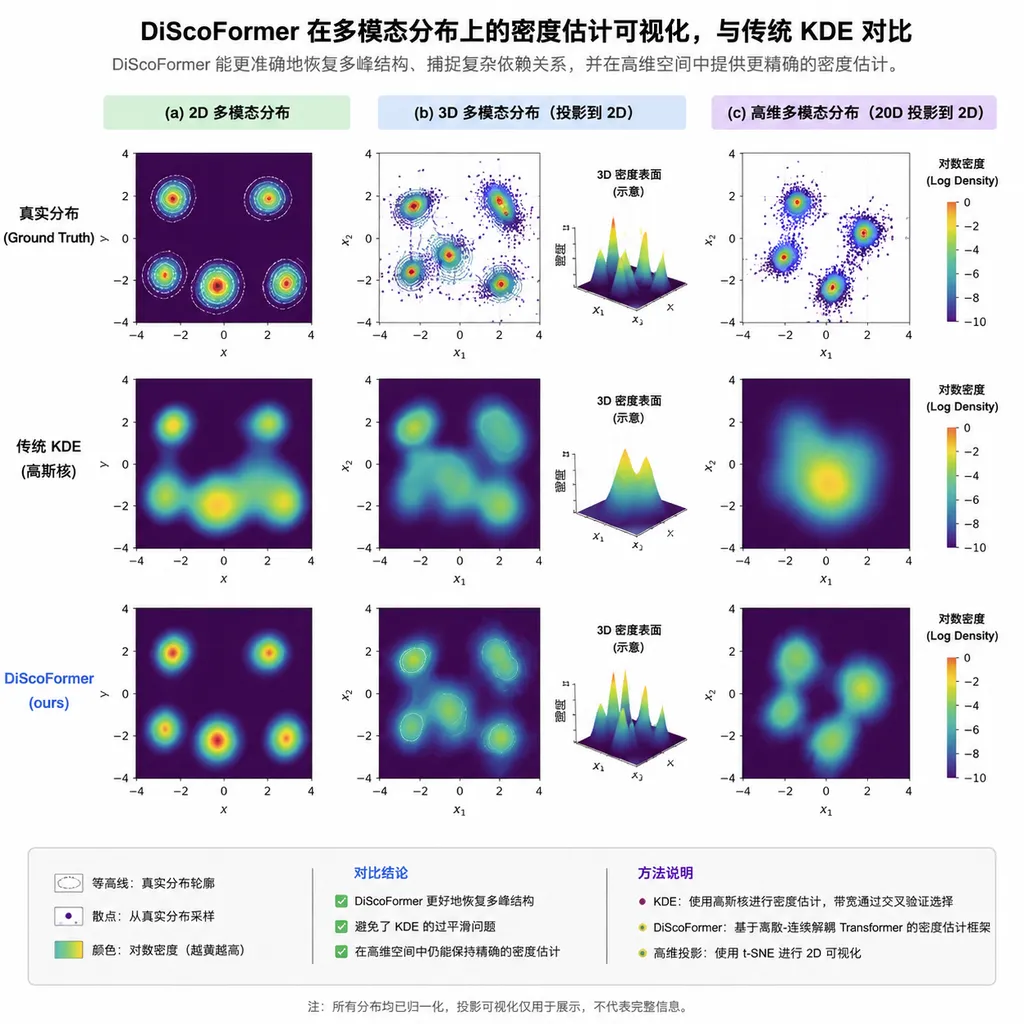
- Density estimation: On various synthetic distributions (Gaussian mixtures, Swiss rolls, crescent shapes, etc.) and real datasets, DiScoFormer’s mean square error is an order of magnitude lower than KDE with Silverman’s rule of thumb, and 3–5× lower than KDE with cross-validated bandwidth.
- Convergence speed: To reach the same accuracy, DiScoFormer needs only about 1/4 to 1/10 as many samples as KDE, with larger gaps in high dimensions.
- Dimensional robustness: KDE fails beyond $d > 5$, while DiScoFormer still gives meaningful density estimates at $d = 20$.
For score estimation, the comparison is with sliced score matching and denoising score matching. DiScoFormer doesn’t require training on each distribution separately, yet achieves higher accuracy — a potentially big signal to the diffusion model community: pre-train a generic score oracle, use it for all downstream diffusion models. If this works, diffusion model training costs could drop dramatically.
More than just numbers
DiScoFormer’s real value is that it can be used as a plugin. The paper lists three direct applications:
1. Score-debiased KDE
Classic KDE is biased, with bias magnitude $O(h^2)$. Accurate score functions enable bias correction, reducing errors to $O(h^4)$. Previously, this idea stalled because score functions were hard to estimate — now DiScoFormer provides high-fidelity score outputs, giving KDE an instant free precision upgrade.
2. Fisher information calculation
Fisher information $I(f) = \mathbb{E}[|\nabla \log f|^2]$ is widely used in statistical inference, information geometry, and optimal experiment design, but estimating it from samples is notoriously difficult — score estimation errors get squared. DiScoFormer’s score precision supports direct Monte Carlo estimation, and the paper shows its performance in calculating the entropy production rate of a Boltzmann distribution, with errors reduced by over an order of magnitude compared to traditional methods.
3. Fokker-Planck type PDEs
This is a somewhat unexpected direction. The Fokker-Planck equation describes the evolution of probability density under stochastic differential equations, requiring both density and score. Traditional numerical methods are infeasible in high dimensions. DiScoFormer offers a mesh-free alternative: feed samples from SDE simulations directly into the model to obtain density and score at once. The paper shows results for a 10-dimensional Ornstein-Uhlenbeck process, matching analytic solutions closely.
This application direction is genuinely useful for computational physics, mathematical finance, and epidemiological modeling communities.
Engineering implementation: unexpectedly simple
Looking at the code after the theory, DiScoFormer’s architecture is remarkably restrained. No flashy new modules — the core is:
- Standard multi-head self-attention, with symmetric position-independent encoding for sample and query points
- Two output heads: one MLP for scalar (density), one MLP for vector (score)
- Loss is density MSE plus score Fisher divergence, weighted
- Training data is a large mixture of synthetic distributions: Gaussian family, mixture models, manifold distributions, heavy-tailed distributions, etc.
Model size is modest — the largest version in the paper is under 100M parameters. The Hugging Face repository provides very concise inference code, runnable in just a few lines:
from transformers import AutoModel
import torch

model = AutoModel.from_pretrained("allenai/discoformer-base", trust_remote_code=True)
model.eval()

# samples: [batch, n_samples, d]
# queries: [batch, n_queries, d]
samples = torch.randn(1, 512, 4)
queries = torch.randn(1, 100, 4)

with torch.no_grad():
    out = model(samples=samples, queries=queries)

density = out.density      # [1, 100]
score = out.score          # [1, 100, 4]
This “keep it simple” style is very much in line with AllenAI’s typical research taste — master the theory, implement it correctly, don’t stack parameters or chase leaderboards, but produce papers that stand firm.
What it might change
In the short term, DiScoFormer’s most immediate beneficiaries are those working on diffusion models and flow matching. Currently, all score-based generative models must train their own score networks; in the future, they might directly use DiScoFormer as the backbone score estimator, saving substantial training compute. The paper doesn’t directly experiment here, but the blog’s “future work” section explicitly mentions this direction.
In the medium term, statistical inference toolchains might need an overhaul. Bandwidth selection, bias correction, density ratio estimation — these classic methods are built on KDE; if DiScoFormer-class “neural kernel methods” can consistently and stably outperform, the whole toolchain will gradually be replaced. It won’t happen overnight, but the direction is clear.
In the long term, the more interesting question is whether AllenAI’s approach can be generalized. “Equivariant Transformer as a generalization of certain classic operators” is a research program with considerable imaginative space. Beyond KDE, there are k-NN, Gaussian processes, spectral methods, etc. — we can ask: is self‑attention a functional generalization of these methods? If yes, Transformers could play a much more important role in scientific computing.
Worth noting: DiScoFormer’s code has been merged into the Hugging Face Transformers main repository (recent versions added several new architectures, including DeepSeek V4, EXAONE 4.5, Cosmos3, and DiScoFormer). This means users need no special setup — just pip install transformers and upgrade to the latest version to call it directly.
Some reservations
The paper is indeed elegant, but there are some points needing further validation:
- Ultra-high dimensions: Experiments maxed out at $d = 20$ — can it still cope beyond that? Real-world images and text embeddings often have thousands of dimensions, and there’s no conclusion yet.
- Training data bias: “Train once, infer anywhere” depends on seeing sufficiently diverse distributions in training. If the test distribution lies completely outside the training set (e.g., fractal structures, singular measures), generalization may not be guaranteed. The paper doesn’t conduct systematic stress tests here.
- Missing comparison with neural ODE/CNF: Continuous normalizing flows are also a mainstream path for density estimation; the paper only compares with KDE and score matching, not directly with CNFs.
These aren’t fatal flaws, but worthy directions for follow-up work.
Overall, DiScoFormer is the kind of research that is theoretically sound, experimentally solid, and practically usable — refreshingly rare in today’s sea of “we trained a bigger model” papers. Well worth reading the blog and paper, especially for engineers interested in the underlying mechanisms of generative models.
References
- DiScoFormer: One transformer for density and score, across distributions (Hugging Face Blog) — Official blog jointly released by AllenAI and Hugging Face, with model motivation, visualization results, and usage examples
- huggingface/transformers Releases (GitHub) — Release notes for the Transformers library, including PRs and version notes for DiScoFormer’s merge into the main repository


