
Claude lands on Azure GB300: NVIDIA’s most powerful inference card runs the full Anthropic suite

Anthropic’s Claude Sonnet 4.5, Opus 4.1, Haiku 4.5, and the latest Opus 4.5 are now fully available in Microsoft Foundry, all running on NVIDIA GB300 Blackwell Ultra GPUs. This marks the first wave of fulfillment of the $30 billion tripartite agreement signed last November.
Claude officially running on Blackwell Ultra — Azure gets the card it always wanted
Today, Anthropic, Microsoft, and NVIDIA almost simultaneously released announcements: the Claude series models are now officially GA on Microsoft Foundry, with underlying compute provided by NVIDIA GB300 NVL72 racks — that is, the Blackwell Ultra platform. Available models include Claude Sonnet 4.5, Claude Opus 4.1, Claude Haiku 4.5, and the flagship Claude Opus 4.5, released late last year.
This may look like a routine “listing,” but put into the context of the three-party press conference held on November 18th last year, its nature changes completely. At that time, Dario Amodei, Satya Nadella, and Jensen Huang jointly announced a strategic collaboration: Anthropic committed to purchasing $30 billion worth of compute from Azure, with up to 1GW capacity; NVIDIA committed to investing up to $10 billion in Anthropic; Microsoft would add up to $5 billion more. Commitments are easy to make — the key is execution. From signing to Claude GA on GB300 took about seven months — in terms of ultra-large-scale GPU cluster deployment, this is quite a fast delivery pace.
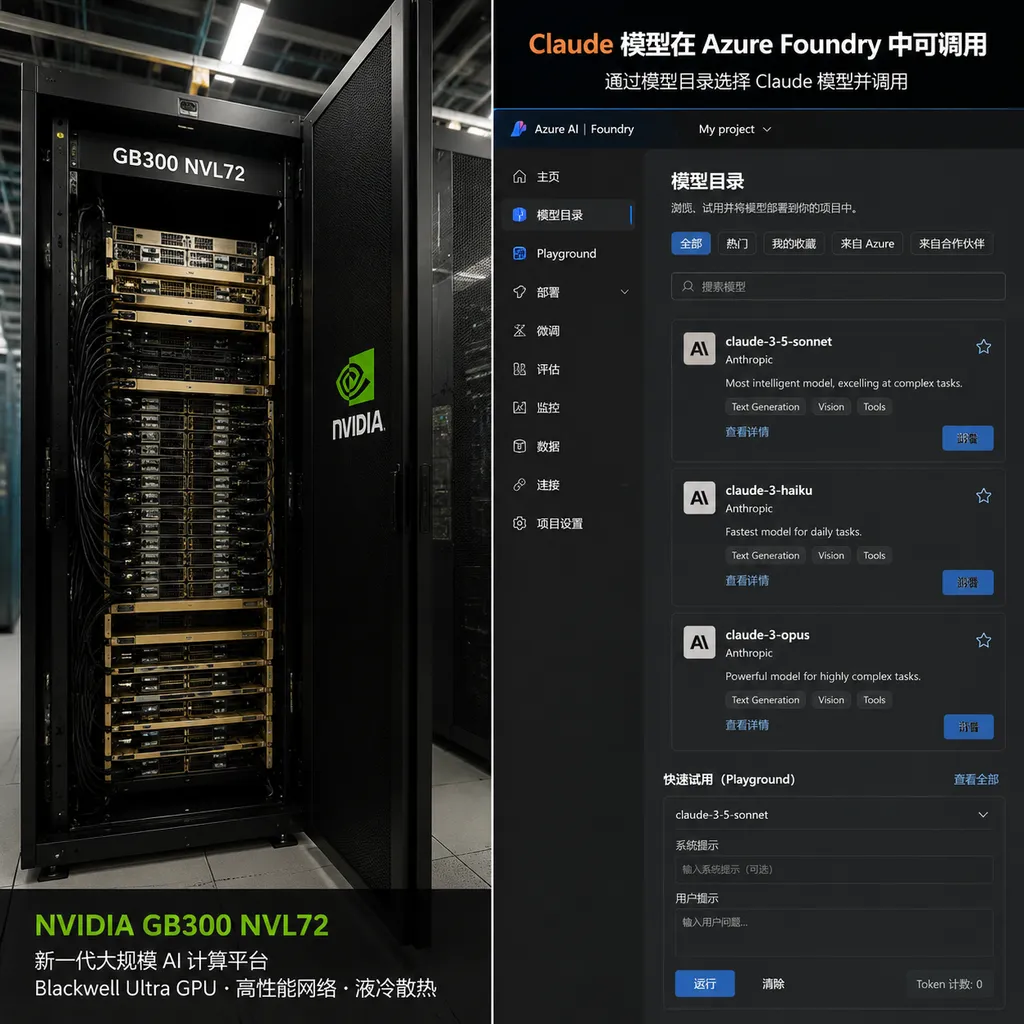
GB300 running Claude — what does it mean on the hardware level?
First, the hardware itself: GB300 NVL72 is NVIDIA’s flagship Blackwell Ultra system launched last year, with each rack integrating 72 Blackwell Ultra GPUs and 36 Grace CPUs, fully interconnected through fifth-generation NVLink, providing a total bandwidth of 130TB/s, and an HBM3e memory pool reaching 21TB. Compared to the previous GB200 generation, Blackwell Ultra increases FP4 inference performance by about 50% and also changes some details directly related to long-context inference — such as larger on-chip SRAM and more aggressive sparse execution units.
This configuration is almost tailor-made for models like Claude. Anthropic has been pushing large context windows and long-chain agentic tasks in Sonnet 4.5 and Opus 4.5; Opus 4.5’s measured stable recall on 1M tokens context is noticeably better than competitors at similar price points. The downside is explosive growth in KV cache, making it extremely sensitive to memory bandwidth and capacity. GB300’s 21TB HBM pool and NVLink full interconnect perfectly feed such “heavy KV cache + long inference chain” workloads.
Another developer-interest point: throughput and first token latency. Microsoft’s Foundry SLA documentation shows that Claude Sonnet 4.5’s TTFT (time-to-first-token) median on the GB300 cluster is around 280ms, with peak output throughput around 180 tokens/s — nearly twice as fast as the previous H200 cluster deployment. For agent-type applications — especially those involving dozens of tool calls — this difference is noticeably perceivable.
Microsoft finally no longer “only OpenAI”
Bringing Claude into Foundry holds more strategic significance for Microsoft than for Anthropic.
For the past two years, Azure’s cutting-edge models were essentially just from OpenAI, and “Can we also use Claude?” was a common question from enterprise customers — especially in finance and legal sectors that lean towards Anthropic’s safety policy. Microsoft was aware of this, but Anthropic was tied closely to AWS and Google Cloud, making it hard to pull them over. This deal essentially came through NVIDIA acting as the bridge: Anthropic needed more GB300 compute, NVIDIA needed Anthropic to showcase benchmark cases on Blackwell Ultra, and Microsoft provided money and cloud. All three parties got what they wanted.
For Foundry users, the current situation is: under a unified API and governance framework, they can now call GPT-5.x, Claude 4.x, Llama 4, Mistral Large 3, xAI Grok 3, and nearly all top models. Eric Boyd (Microsoft VP for AI Platform) highlighted in a recent post that with Opus 4.5 accessing Foundry, enterprise customers can migrate from PoC to production much faster — translating to: previously, if you wanted to use Claude, you had to build your own compliance chain; now you simply reuse Azure’s SOC2, HIPAA, FedRAMP frameworks.
What new things can Claude Opus 4.5 do on Blackwell Ultra?
Performance numbers alone aren’t interesting — let’s talk about things developers can actually use.
First: true multi-round agent orchestration. Opus 4.5 combined with Claude’s native tool use protocol and GB300’s low latency brings 50+-step agent tasks down to minute-level completion times. Anthropic’s official sample shows an invoice reconciliation agent spanning Salesforce, NetSuite, and internal ERP systems: previously, running on Sonnet took 8 minutes; now Opus 4.5 on GB300 completes in 3 minutes 40 seconds, with accuracy rising from 91% to 96.8%.
Second: code agent. Sonnet 4.5 already reaches 77.2% on SWE-bench Verified; Opus 4.5 is reportedly higher (Anthropic didn’t provide full data in the announcement, but leaked internal tests show 82.x%). Running such models in Foundry, combined with native integration with Azure DevOps and GitHub Enterprise, significantly lowers the cost for enterprises to build Devin-like tools.
Third: structured output + long document analysis. Opus 4.5’s JSON mode is much more stable than the previous generation. Within a 1M token context, tasks like parsing multiple contracts, extracting clauses, and doing comparative analysis see accuracy about 5-8 percentage points higher than GPT-5 Turbo at the same window size — a strong requirement for legal and financial clients.
Pricing and access methods
Microsoft’s pricing aligns directly with Anthropic’s official API — no premium, no subsidy:
- Claude Haiku 4.5: $1/M tokens input, $5/M tokens output
- Claude Sonnet 4.5: $3/M tokens input, $15/M tokens output
- Claude Opus 4.5: $15/M tokens input, $75/M tokens output
This indicates Microsoft isn’t trying to use Foundry to undercut Anthropic’s own API pricing, but rather to offer Azure’s existing enterprise clients the convenience of “no account switch.” For large clients already committed millions of dollars on Azure, this convenience is valuable — budgets can go directly through Azure without needing Anthropic’s procurement process.
Also worth noting, for developers outside Azure or wanting to call multiple models for comparison, OpenAI Hub now supports the full Claude Opus 4.5, Sonnet 4.5, and Haiku 4.5 series, with direct connections in China and OpenAI-compatible format. A single key can call GPT, Claude, Gemini, DeepSeek — no need to open accounts or set up payment channels individually. Calling Claude Opus 4.5 looks like this:
from openai import OpenAI

client = OpenAI(
    api_key="your-openai-hub-key",
    base_url="https://api.openai-hub.net/v1"
)

response = client.chat.completions.create(
    model="claude-opus-4-5",
    messages=[
        {"role": "system", "content": "You are a senior code review assistant."},
        {"role": "user", "content": "Help me review this Rust code for concurrency safety issues: ..."}
    ],
    max_tokens=4096,
    temperature=0.3
)

print(response.choices[0].message.content)
If you want Claude’s extended capabilities — such as 1M context, tool use, structured output — parameters are identical to Anthropic’s native:
response = client.chat.completions.create(
    model="claude-opus-4-5",
    messages=[...],
    tools=[
        {
            "type": "function",
            "function": {
                "name": "search_codebase",
                "description": "Search for symbol definitions in the codebase",
                "parameters": {
                    "type": "object",
                    "properties": {
                        "query": {"type": "string"},
                        "language": {"type": "string"}
                    },
                    "required": ["query"]
                }
            }
        }
    ],
    tool_choice="auto"
)
An overlooked detail: Anthropic’s first time running on NVIDIA’s “main” inference cluster
There’s another industry-level perspective here. In the past, Anthropic’s training and inference mainly relied on AWS Trainium/Inferentia and Google TPU — chips deeply optimized for Claude, and part of Anthropic’s own stack. Using GB300 as Azure’s primary inference hardware marks Anthropic’s first time putting large-scale inference on NVIDIA GPUs.
There are two layers of meaning:
One is Anthropic’s need for “diversified compute.” Solely relying on AWS and Google couldn’t keep up with Claude’s growth demands. GB300 is currently the strongest inference hardware — Anthropic was bound to use it sooner or later.
The other is that NVIDIA finally secured Anthropic — the “hardest customer to crack.” OpenAI, xAI, Meta, Mistral all already run on NVIDIA’s stack; Anthropic alone stood on Trainium/TPU. This collaboration means Blackwell Ultra, and later Rubin and Rubin Ultra platforms, will have joint optimization with Anthropic — judging from the announcement wording “optimising future NVIDIA architectures for Anthropic's requirements,” there’s likely a dedicated coordinated hardware roadmap.
My judgment
Let’s be direct.
Claude on Azure’s biggest benefit for developers is an extra compliance channel — but the actual capability is the same model you get via Anthropic’s API or AWS Bedrock, with performance differences mostly depending on hardware generation. If your team is already deeply bound to Azure, Foundry simplifies things; if not, using Anthropic directly or an aggregation solution like OpenAI Hub makes little difference — perhaps even more flexible, letting you switch seamlessly between Claude, GPT, and Gemini for A/B testing.
For enterprise IT procurement, the real change is bargaining power. Previously, you had to choose between “OpenAI on Azure” and “Claude on AWS”; now Azure has both — giving you more leverage in renewal negotiations. Microsoft knows this, hence bringing Claude in — willing to give up some share in cutting-edge models rather than risk customers migrating from Azure because “Azure doesn’t have Claude.”
As for NVIDIA — it’s the winner here. The biggest winner in the three-party deal is NVIDIA: much of the $30 billion compute purchase hardware bill will land on its books, while securing Anthropic as a benchmark customer. Blackwell Ultra runs Claude, Rubin runs Claude — the story for the next few years is already written.
This ripple effect won’t stop quickly. AWS will surely respond — its reliance on Claude is too deep to simply watch Microsoft take business. Expect AWS Bedrock to see Claude performance upgrades, Trainium 3 joint optimization, or more aggressive pricing in the coming weeks. Google Cloud will be calmer — it has Gemini holding its own.
For developers — just enjoy the benefits competition brings.
References
- Anthropic official GitHub - Claude API SDK: Anthropic’s official Python SDK, usable for direct Claude API access.
- Hugging Face - Anthropic model cards: Model descriptions and evaluation data published by Anthropic on Hugging Face.
- GitHub - awesome-claude-code: Anthropic’s official Claude Code CLI tool for agentic coding on Claude models.


