
AWS’s billing for Anthropic has changed from computing power to tokens.
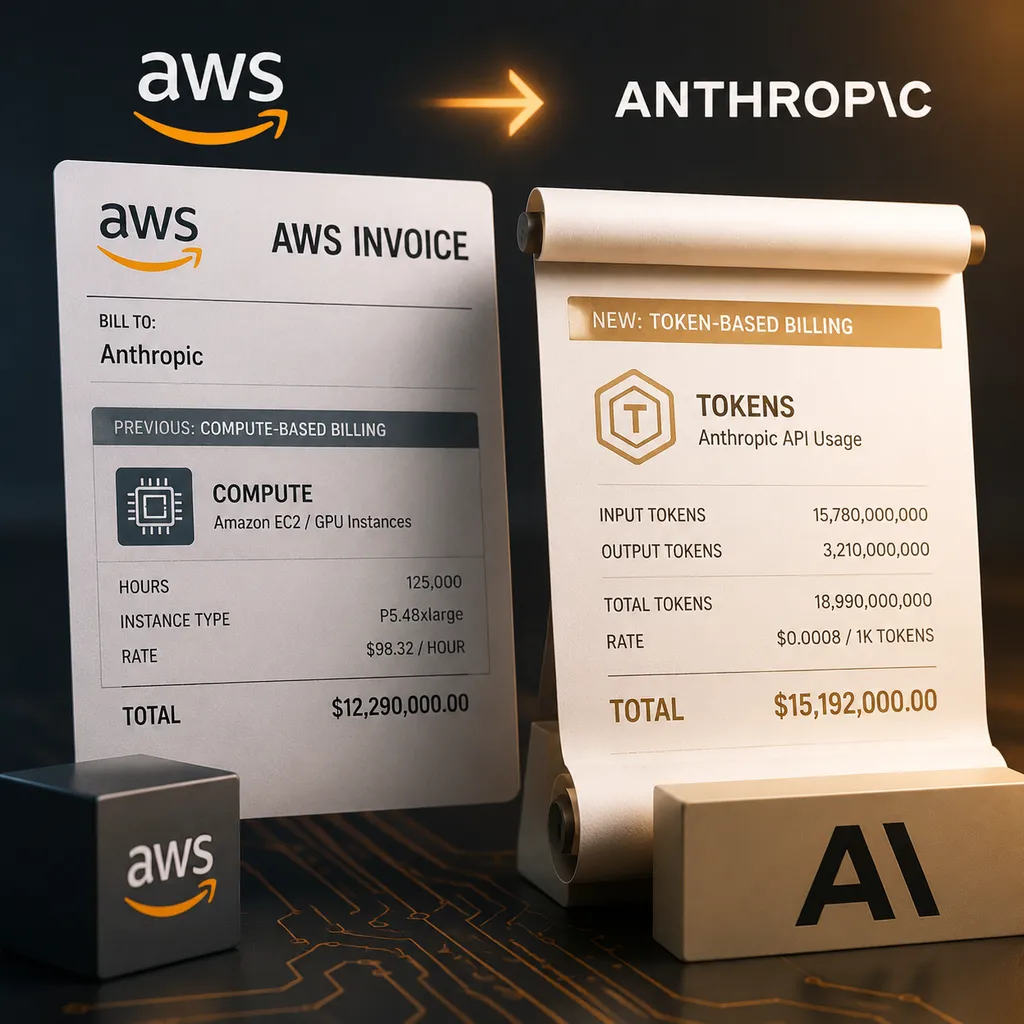
Amazon and Anthropic have renegotiated the settlement method: when running models such as Claude on AWS, payment to Anthropic will be based on tokens rather than computing power. This means the more Amazon’s own business uses it, the more money it pays to Anthropic—the billing logic has completely changed.
AWS Shifts Anthropic Billing from Compute to Tokens
On June 30, The Information broke a detail-rich but weighty piece of news: Amazon and Anthropic renegotiated a key term in their deep collaboration — when Anthropic models run on AWS, Amazon will now pay based on tokens instead of compute.
At first glance, this seems like an internal accounting tweak by the finance department, but in reality, it touches the most sensitive nerve between cloud providers and AI model vendors: how the money is split.
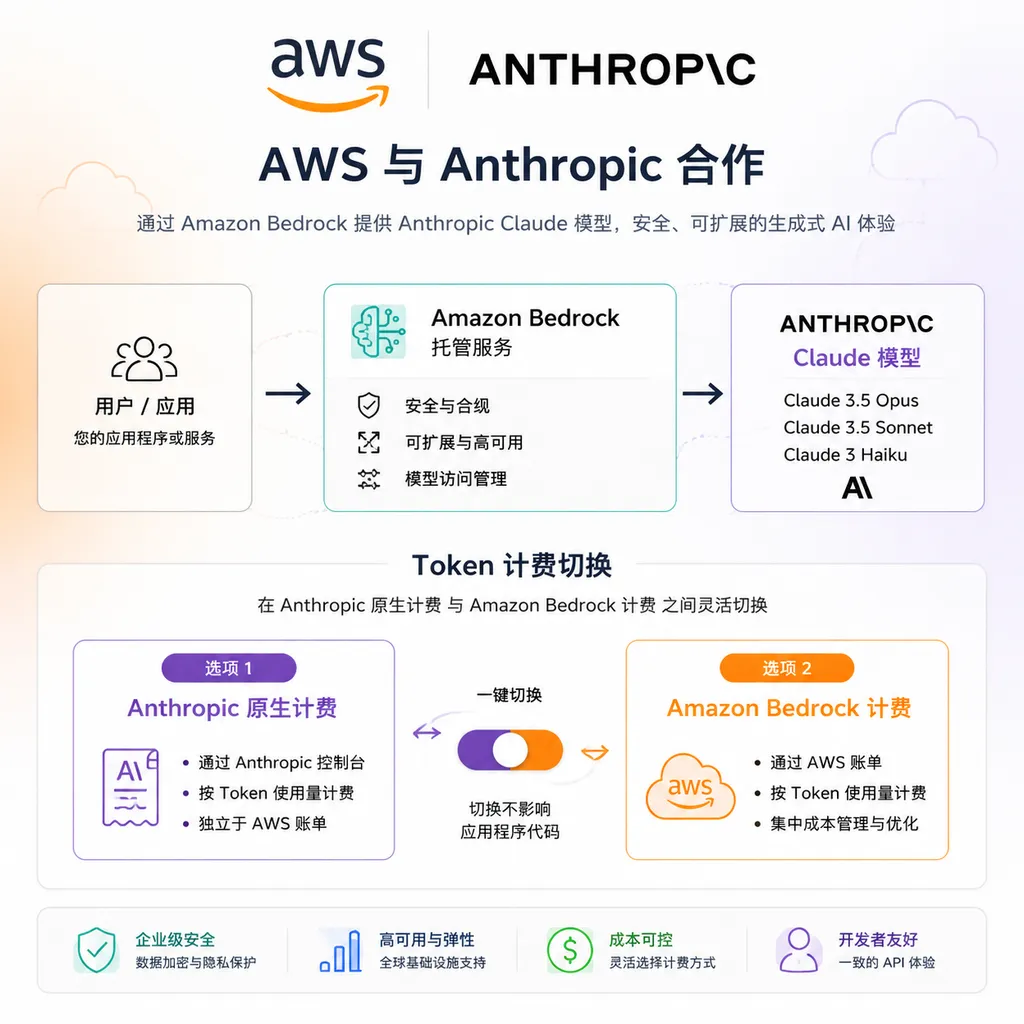
One Bill, Two Calculations
Let’s clarify the background. Since 2023, Amazon has invested a total of $8 billion in Anthropic, in return for Anthropic using AWS as its primary training and inference infrastructure and launching the Claude series models on Amazon Bedrock exclusively or with priority. This is a typical “cloud resources for equity + collaboration” model, with the same playbook as Microsoft–OpenAI.
But one detail hasn’t been carefully unpacked: when Amazon’s own products (like Alexa+, Kiro, Quick) call Anthropic’s models, what’s the pricing for settlement?
According to insiders, in the past it was billed by compute — simply put, it’s based on how much GPU Anthropic rented on AWS, and how many hours it ran. Amazon then settled with those costs when its own products called the models. This method favored Amazon: compute was its own asset, with controllable costs — essentially “our people using our own stuff, at an internal price.”
Now, switching to token-based billing completely flips the logic. Tokens are the unit of model output, and pricing power lies in the hands of the model provider. This means:
- Amazon’s spending shifts from “cost-side” to “market-side.” Previously, costs were reverse-calculated from Anthropic’s compute usage; now settlement is based on Anthropic’s public token price on Bedrock (or some negotiated discount).
- Anthropic’s revenue expectations are clearer. The more the model is used, the linearly higher the split — aligning with its commercial model for external clients on Bedrock.
- Amazon’s “internal cost advantage” is eroded. Every Alexa shopping recommendation, every Kiro code completion, every Quick email summary means real money in tokens flowing to Anthropic.
Why is this switch important? Because Amazon’s reliance on Anthropic’s models is much deeper than most outsiders realize.
Nova Isn’t Cutting It — Claude Is the Frontline Workhorse
Amazon’s own Nova series models, launched late last year, have not gained traction. Performance lags clearly behind GPT, Claude, and Gemini in the top tier, and developer community feedback has been lukewarm. Bedrock’s selling point was “one-stop multi-model platform,” but the real driver of usage has been Anthropic’s Claude.
Current status of major business lines:
- Alexa+: The next-generation Alexa overhaul last year handed core conversational abilities to Claude. Amazon aims to make it a “agent-style” home assistant, with complex commands involving multi-round model calls.
- Kiro: Amazon’s flagship AI programming tool this year, targeting Cursor and Copilot. Heavy-load tasks like code understanding, generation, and refactoring rely mainly on the Claude Sonnet series.
- Quick: A workplace assistant for enterprise users — writing emails, summarizing, reading documents — also tapped into Claude.
- AWS internal toolchain: Including ops assistants, security analysis, customer service scenarios — Claude is among the default choices.
These businesses share one trait: they consume massive tokens, scaling linearly with user base. An Alexa+ user may generate tens of thousands of tokens daily; a heavy Kiro user may write hundreds of thousands of tokens daily in code completions. Multiply this by Amazon’s customer base — it’s enormous.
After moving to token billing, every Alexa+ subscription sold or Kiro paid user gained means a bigger check to Anthropic. This is a far cry from the old logic of “compute is ours anyway.”
Why Would Amazon Give In?
This is the most intriguing question. Paying by token is clearly disadvantageous to Amazon — why accept it?
Possible explanations:
First: Anthropic’s bargaining power is rising. The Claude series has seen increased reputation and market share over the past year, especially in coding and enterprise domains. Anthropic is also diversifying infrastructure partnerships — its relationship with Google Cloud remains, and there are rumors it’s in contact with other cloud providers. If Amazon wants to keep Anthropic locked into AWS, it must offer more favorable commercial terms.
Second: The old compute-billing model was unsustainable. Anthropic needs to report revenue accurately. If its models are heavily consumed inside Amazon at “internal pricing,” Bedrock’s public pricing and actual revenue diverge sharply — negatively impacting Anthropic’s valuation story. Switching to token billing aligns revenue logic across all channels — whether via proprietary API or Bedrock.
Third: Amazon is buying time for its own models’ “transition period.” Peter DeSantis stated in a CNBC interview this month that the goal is to launch a frontier-level model next year. That means Amazon admits Nova isn’t there yet, but is betting on catching up in 2026. Until then, it needs Anthropic to hold the fort — paying more is just part of the deal.
Sound familiar? Microsoft and OpenAI followed almost the same path these past two years — binding deeply, providing resources and channels, while secretly building in-house models (MAI series), then gradually reducing dependency when ready. Amazon is in the latter half of that journey: dependencies deepening, self-development just starting.
What This Means for Developers
Short-term, this change has little impact on end developers — Claude’s pricing on Bedrock won’t adjust immediately due to this internal agreement shift. But mid to long term, several signals are worth noting:
Bedrock’s pricing transparency may improve. Now that internal billing is token-based, external pricing logic will align more closely with Anthropic’s official API. Previously, using Claude on Bedrock could occasionally be cheaper via certain discounts than direct API access — this margin will shrink.
Amazon will push Nova more aggressively. Economic pressure will drive AWS sales to guide customers toward Nova — especially cost-sensitive SMBs. Expect greater prominence of Nova in the Bedrock console, stronger default recommendations, and heavier price incentives.
Anthropic’s multi-cloud strategy will stand out. Over-binding is bad for both sides. Expect Claude’s prioritization on Google Cloud Vertex AI and announcements of partnerships with other infrastructure vendors to appear more frequently in coming months.
An Overlooked Detail: Kiro’s Cost Structure
A fun observation: Kiro, Amazon’s promoted AI programming tool, now has a much more sensitive cost model.
Programming tools are token guzzlers. A single code completion may be just a few hundred tokens, but an agent-mode multi-file refactor or cross-repository search-plus-generation can easily run into tens of thousands. Products like Cursor constantly adjust subscription prices and usage limits precisely for this reason.
Amazon once used “internal compute pricing” for Kiro, enabling low subscription prices to attract users. Now with token billing, Kiro’s unit economics immediately tighten. Choices: raise prices, limit heavy users, or accelerate migration of core scenarios to in-house models — none of these paths are easy.
The Real Watershed Moment
Broadly speaking, Amazon and Anthropic’s billing change marks a new stage in the “cloud vendor invests in AI company” playbook.
2023–2024 was about resources for equity: cloud vendors provided money and compute in exchange for equity and exclusive/priority model access. The plan was to lock AI growth dividends into their own cloud.
2025–2026 shifts to real settlement: once an AI company’s model becomes critical to a cloud vendor’s own business, the old “internal mutual exemption” logic collapses. Model companies ask for market rates, and cloud vendors pay market rates — with clear accounting.
This is a healthy signal for the ecosystem — it means AI models as a commodity are finding price-discovery maturity. Model providers are no longer “strategic investments” on cloud vendor balance sheets, but commercial suppliers with clear revenue contracts.
As for whether Amazon’s self-developed frontier model next year can deliver, few industry insiders are betting on it. Nova’s engineering capacity, data strategy, and training compute orchestration have yet to show signs of catching up to the top tier. But Amazon holds a unique advantage: its application scenarios (e-commerce, Alexa, AWS console, Kiro, etc.) generate massive, authentic usage data — a goldmine for training.
If Nova can truly produce a usable frontier model in the second half of 2026, today’s token billing agreement is just a transition clause. If not, this agreement will become an increasingly heavy item on Amazon’s financial statements.
Incidentally, if you’re developing applications that need to mix and match Claude, GPT, Gemini, and other models — and don’t want to open separate accounts and manage separate quotas — aggregation layers like OpenAI Hub (openai-hub.com) are a handy choice: one key to call all mainstream models, with direct access from China, compatible with OpenAI formats. In times of shifting cloud–model vendor relations, maintaining an abstraction layer and avoiding being tied to a single channel’s pricing volatility is a pragmatic strategy.
References
- Amazon AWS reportedly to pay Anthropic for model usage by token - IT Home: A Chinese recap of The Information’s original scoop, detailing Amazon’s various AI business dependencies on Anthropic’s models and Peter DeSantis’s remarks on the in-house model timeline.
- How does Amazon compensate Anthropic - Reddit r/aws: AWS community discussion on Amazon–Anthropic settlement mechanisms, offering a technical perspective from the Bedrock Marketplace subscription mechanism.


