
Huawei open-sources Pangu 2.0: 92-billion-parameter Flash version goes live today
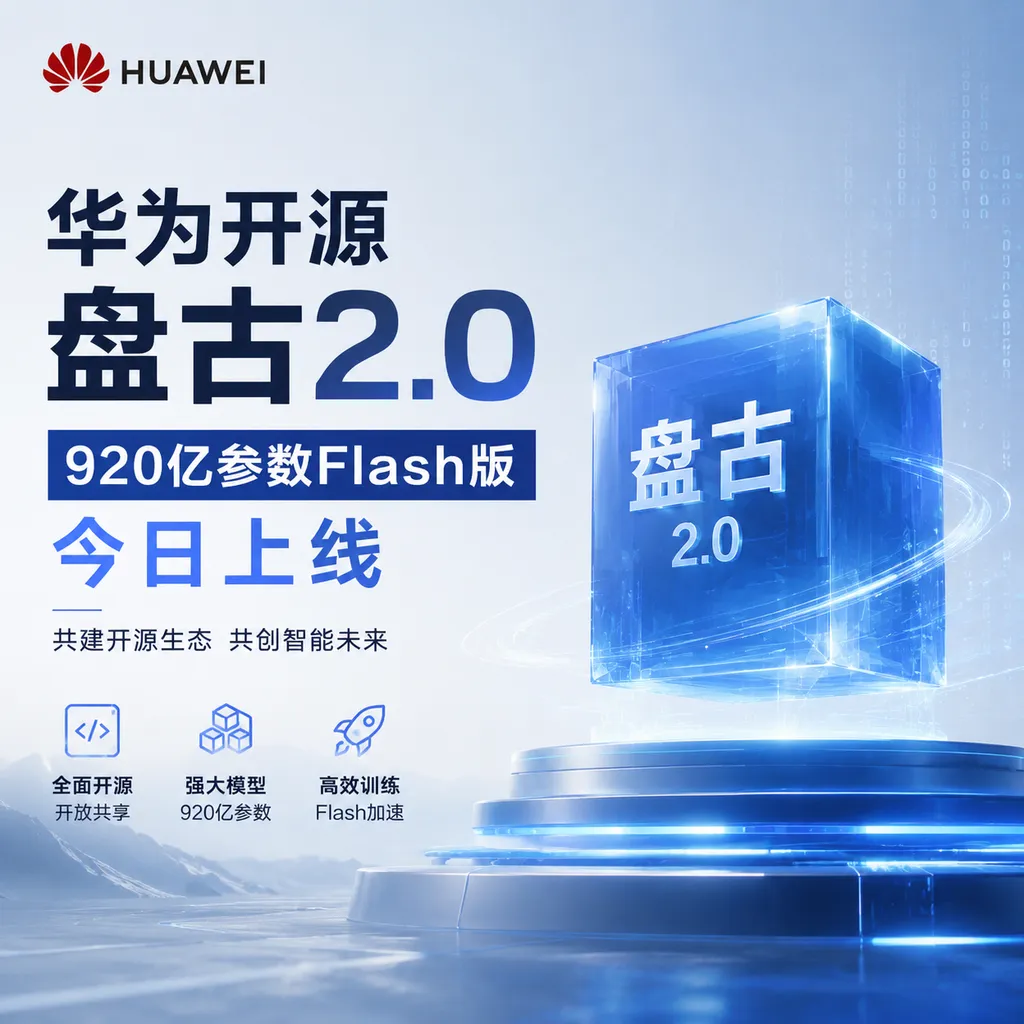
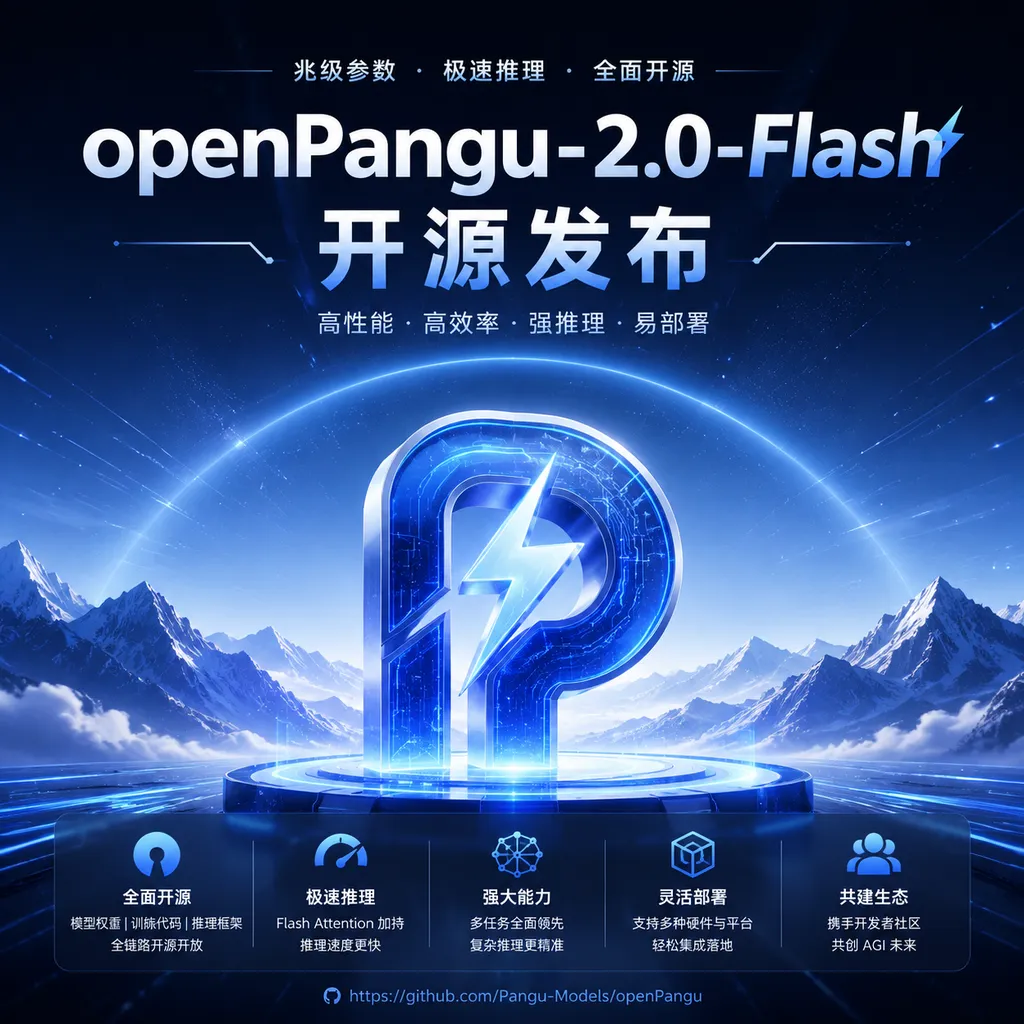
Huawei today officially open-sourced openPangu-2.0-Flash, a sparse MoE model with a total of 92 billion parameters and 6 billion activated parameters, featuring a 512K context length, deeply optimized for Ascend computing power. The Pro version with 505B parameters will follow in July.
Today (June 30), fulfilling the promise made at the beginning of the month during HDC 2026, Huawei released the first piece of the open-source Pangu 2.0 series — openPangu-2.0-Flash officially open source and online — packaging together the model weights, basic inference code, and training/inference operators, hosted under the ascend-tribe repository on GitCode.
This is the most important open-source move for Huawei’s large model business since Yu Chengdong resumed leadership last National Day. Flash is the vanguard, with the 505B flagship Pro version scheduled to launch in July, and the remaining pre-training code, post-training code, and other components to be released gradually in the second half of the year. The complete openPangu 2.0 will open source a total of 7 major components — three more valuable pieces than the industry’s typical "weights + inference code + technical report" quartet.
A lightweight version, but the parameters are not light at all
Let’s put the specs out first:
- Total parameters: 92B (92 billion)
- Active parameters: 6B (6 billion)
- Context window: 512K
- Architecture: Sparse MoE
- Target hardware: Ascend native optimization
Huawei calls it “Flash,” positioned for “lightweight deployment,” but 92 billion total parameters are already quite large among open-source MoE models. The key is the active parameters — 6B active means that actual inference compute consumption is close to a 6B dense model, but capability ceiling is backed by the total capacity of 92B. This approach is similar to DeepSeek-V2 and Qwen3-MoE: trade sparse activation for “big model brain, small model cost.”
The Flash version deliberately lowers the sparsity ratio. Sparsity ratio simply means how many experts are activated per forward pass and what proportion of parameters are used. The lower the ratio, the less compute per token, but the higher the demands on routing accuracy and expert training sufficiency. Huawei’s trade-off here is obvious — Flash is designed for single-card, low-latency, device-side or edge scenarios, where faster runtime is more important than full usage.
512K context + Agent optimization, aimed at HarmonyOS
Both versions come standard with a 512K context window, which ranks among the top tier in the open-source camp, on par with Gemini and Claude. But the real motivation for opening 512K is clear when you look at HarmonyOS.
In Huawei’s official narrative, openPangu 2.0 is repeatedly positioned as the “intelligent foundation of the HarmonyOS ecosystem.” HarmonyOS’s Agent system requires cross-application scheduling, long task memory, and complex tool invocation — scenarios that have an insatiable appetite for context length. 512K is not to boost benchmarks, but to allow Agents on phones and PCs to contain the entire conversation history, document context, and tool states. Huawei also explicitly stated at the launch that Flash has specialized optimization for Agent tasks within HarmonyOS — tuning execution speed, accuracy, and resource usage simultaneously.
This is actually worth developers’ attention. Most open-source models’ “long context” is a training target rather than a deployment target — you get 128K but running it consumes VRAM instantly in KV cache. Flash combines 6B active parameters with 512K context to truly enable running long contexts on devices.
Ascend native: the real signal behind the open-source move
The most noteworthy part of Huawei’s open-source release is not the parameters but its hardware narrative.
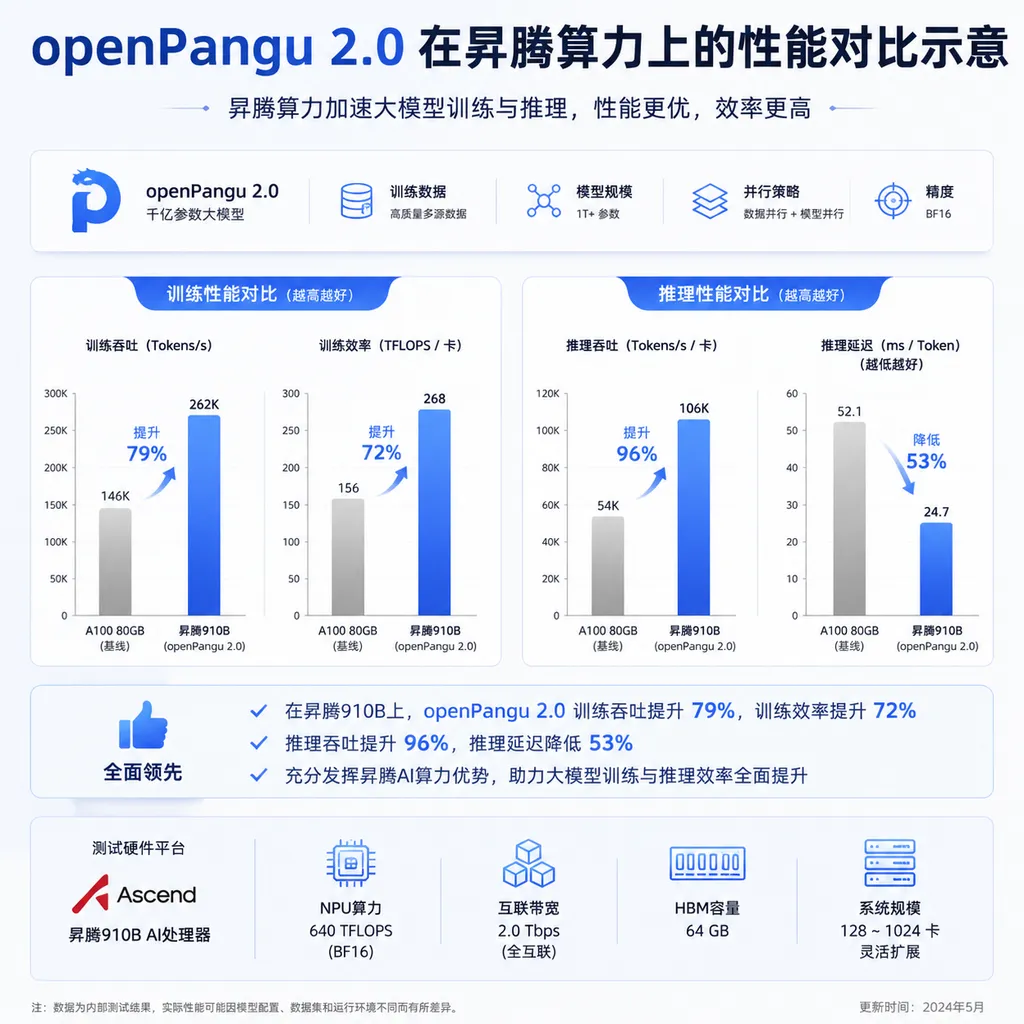
Huawei repeatedly emphasizes “Ascend-native training and inference.” According to Huawei’s own data, openPangu 2.0’s single-card inference throughput on Ascend hardware “can reach twice the level of mainstream open-source models.” They didn’t elaborate on the calculation, but the concept is clear — model architecture, operator implementation, and inference scheduling are all optimized end-to-end for Ascend.
The open-source “training/inference operators” are a key component. Operator-level open-sourcing is unusual; most companies only release weights and inference framework shells. Huawei releasing the operators essentially tells all Ascend developers: take them, modify, optimize — they are examples for you to learn from. Combined with the MindSpore framework, Ascend chips, and HarmonyOS systems, this forms a complete “end-to-end autonomous controllable” narrative. Pangu 2.0’s open source is more like a comprehensive developer tutorial for domestic AI stacks.
Yu Chengdong made an interesting remark at HDC 2026 — he admitted that Huawei’s own compute capacity is limited, and much of it must be used to support domestic enterprises’ needs. Translation: Pangu open source isn’t because they have excess, but because compute is tight, so Huawei must use open source to build an ecosystem and spread costs.
Who’s the competition? The open-source MoE track is already crowded
Placing Flash within the mid-2026 open-source MoE landscape:
- DeepSeek series: has already pushed the open-source MoE cost-performance ceiling very high.
- Qwen3-MoE: Alibaba is also heavily investing in MoE, with a mature ecosystem.
- Mixtral successors: pace has slowed in Europe but still updating.
- GLM, MiniMax and other domestic open source: varied routes, fierce competition.
The 92B total / 6B active ratio is more like the positioning of DeepSeek-V2-Lite — not aiming to shine in general benchmarks, but to be usable, effective, and runnable in specific hardware and scenarios.
Frankly speaking: whether openPangu 2.0 Flash can outperform equivalent-scale DeepSeek or Qwen in general capability depends on community test scores. But if you use Ascend, work within HarmonyOS, or care about domestic stacks, this is an option you can’t ignore.
How clean is the open source?
Huawei’s open-source scope this time is much more sincere than the previous Pangu generation. Pangu 1.0 was criticized for not being thoroughly open. This time, the seven components are released in batches:
- Model architecture
- Model weights
- Technical report
- Inference code
- Pre-training code (new)
- Post-training code (new)
- Training/inference operators (new)
The last three are the differentiating features this time. Pre-training code means you can reproduce the training process from scratch; post-training code covers SFT, RLHF alignment steps; training/inference operators let you tune on Ascend yourself. In theory, a team with this package can retrain a Pangu-style model on their own data — provided they have matching compute capacity.
Repository address on GitCode: gitcode.com/ascend-tribe. Flash’s weights, inference code, and operators are available to pull locally today.
How developers can get started
If you have Ascend devices, the most direct path: pull weights, install MindSpore (or PyTorch + Ascend backend), and run using official inference code. The operators are optimized, so single-card throughput should immediately show a difference.
If you use NVIDIA cards, it’s more complicated — weights are open source, but official operators are written for Ascend. Running on CUDA needs your own adaptation or waiting for community contributions. MoE architecture support in mainstream inference frameworks (vLLM, SGLang) is far more mature than a year ago, so integration is likely soon.
For cloud calls, openPangu 2.0 is still in the rollout stage on open-source platforms; mainstream API aggregation services haven’t yet integrated it. You can observe community follow-up pace.
A judgment
Huawei’s open-source posture this time is more notable than the model itself.
Flash’s 92B parameters, 512K context, Ascend-native optimization, and Agent tuning — these tags paint a clear picture: this is not a model aimed at topping leaderboards, but a model intended as a showcase for the domestic AI stack. Its target users are developers and enterprises using Ascend, building for HarmonyOS, and caring about autonomous controllability — not researchers chasing Hugging Face rankings.
When the Pro version launches in July, the entire openPangu 2.0 series will be complete. Looking back at Flash then, its role will be clearer — a forward outpost, not the main battleship. But as an outpost, its sincerity, specs, and hardware coordination are all in place.
The rest depends on whether the community is willing to catch the baton.
References
- Huawei openPangu-2.0-Flash model officially open source and online (IT Home) — Detailed open-source information and the release schedule for the 7 components
- Huawei released openPangu 2.0 discussion (linux.do) — Community discussion on model specs and open-source strategy
- Huawei released openPangu 2.0 (Reddit r/LocalLLaMA) — Overseas developer community discussion on Pangu 2.0’s throughput and architecture


