
OpenSquilla 0.4.0 Released: AI Coding Agent Introduces “Self-Verification” Mechanism for the First Time
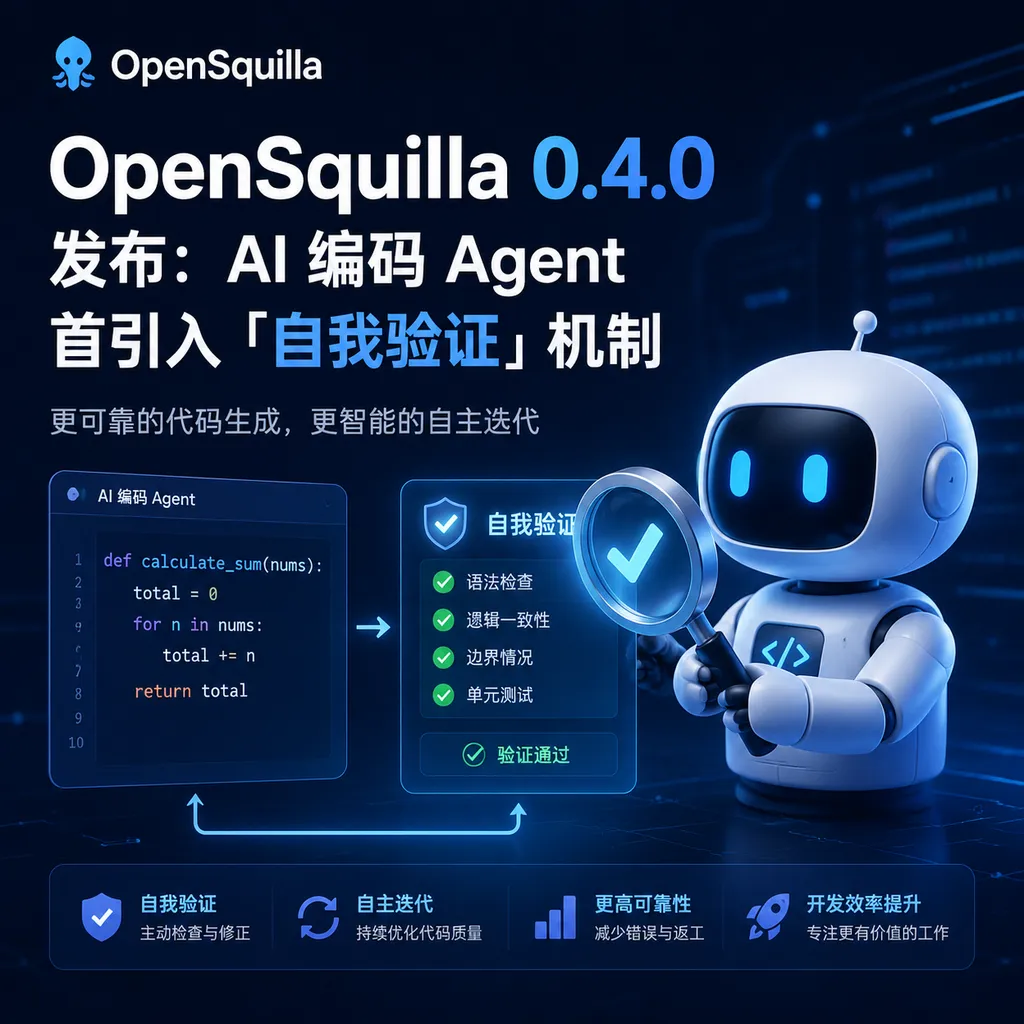
The open-source AI Agent project OpenSquilla recently released version 0.4.0. The core update introduces a brand-new coding workflow mode and, for the first time, brings a "self-verification" mechanism to AI coding, enabling the Agent to autonomously validate and correct code after generation.
OpenSquilla 0.4.0 Released: AI Coding Agent Introduces “Self-Verification” for the First Time
At the end of June 2026, the open-source AI Agent project OpenSquilla officially released version 0.4.0. The two most notable changes in this update are: the launch of a brand-new coding workflow (“coding mode”), and the first introduction of a “self-verification” mechanism for AI coding. At a time when Coding Agents such as Claude Code, Codex, and OpenCode have already become frontline productivity tools, the open-source community has taken another major step forward in answering the question: “How do we make Agents write more reliable code?”
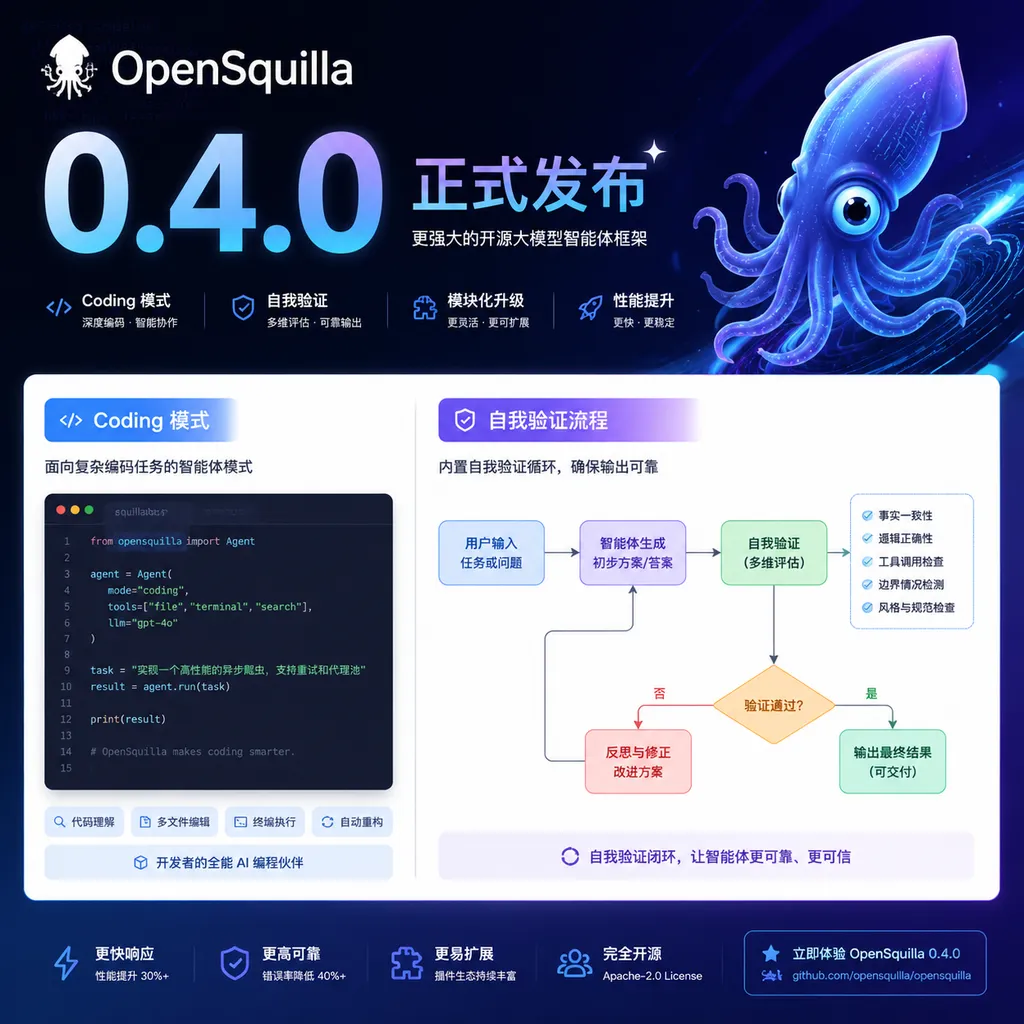
1. What Is OpenSquilla: Starting from a “Token-Saving Harness”
To understand the significance of the 0.4.0 update, it’s necessary to first look at the OpenSquilla project itself.
OpenSquilla is an open-source, locally runnable AI Agent framework written in Python, positioned as a “token-efficient microkernel AI Agent.” Over the past six months, one label frequently associated with it in the Chinese developer community has been:
“Saving Agents driven to despair by runaway token costs.”
Some of its key characteristics:
- Microkernel architecture: The core Harness is extremely lightweight, with all capabilities loaded on demand in the form of “skills.” The community edition has already identified more than 134 skills, covering common Agent scenarios such as file operations, code search, Shell execution, Git operations, and web scraping.
- Multiple access interfaces: The same Agent Core can run simultaneously in a CLI, Web UI, and chat channels (IM/chatbots).
- Cross-platform support: Supports Windows, macOS, and Linux, offering a Windows portable version and fast terminal installation via
uv tool install, while also supporting direct execution from source usinggit clone. - Industry peers: In terms of positioning, OpenSquilla is often compared with open-source Agent projects such as OpenClaw and Hermes Agent. Together, the three form the top tier of “locally runnable, customizable, auditable” open-source Agents in 2026.
Before 0.4.0, OpenSquilla’s stable release had remained at 0.3.1. The 0.3.x series mainly focused on solving the long-standing problem of “Agents consuming too many tokens” — reducing token usage for complex tasks to one-third to one-half of comparable solutions through a combination of microkernel architecture, on-demand skill loading, and context compression.
With 0.4.0, however, the focus shifts from “efficiency” to “accuracy.”
2. Core Updates in 0.4.0: Coding Mode and Self-Verification
1. A Brand-New Coding Workflow Mode
Version 0.4.0 introduces a dedicated coding mode designed specifically for software engineering tasks. This is a pre-orchestrated workflow, not simply a bundle of skills stitched together.
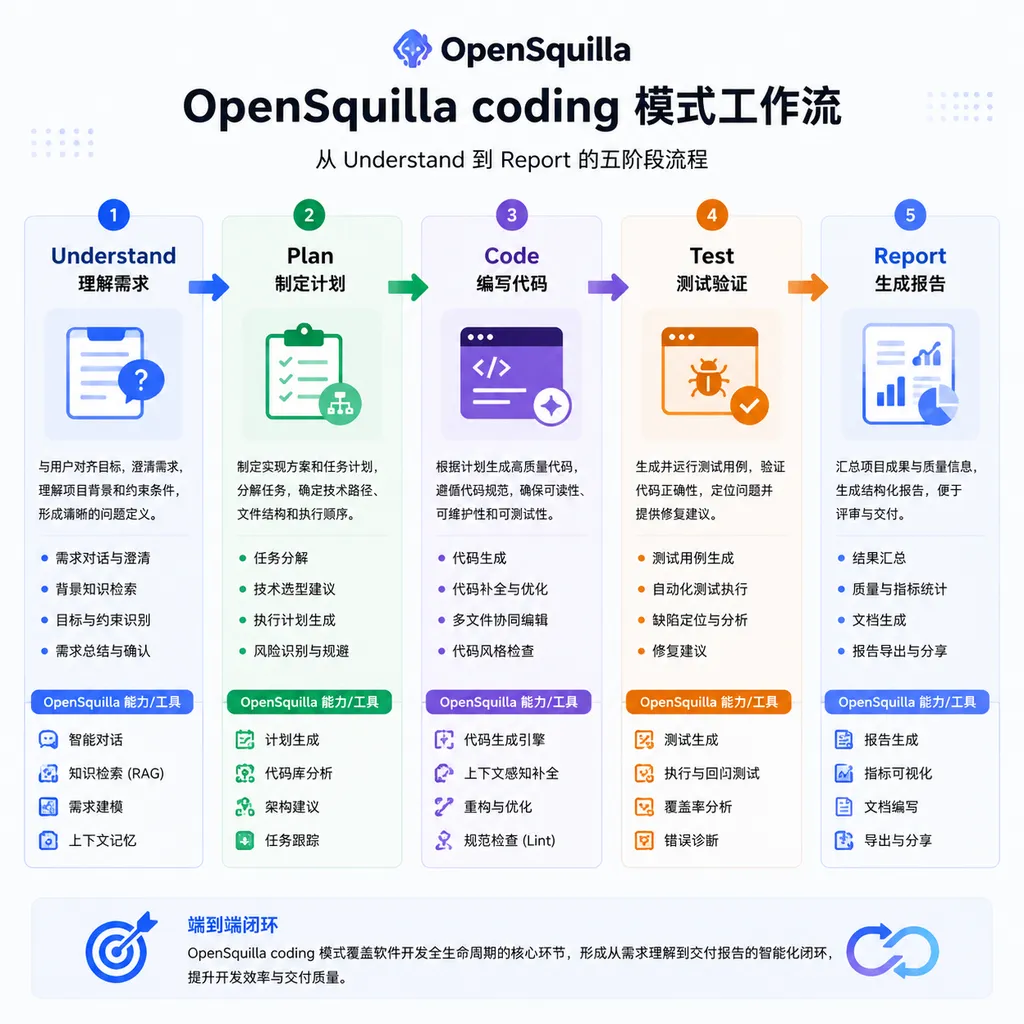
In coding mode, OpenSquilla advances through a coding task along the following main stages:
- Understand: Read relevant source code, README files, and tests to build a contextual map of the task.
- Plan: Generate a human-reviewable modification plan, including files to change and tests to add.
- Edit: Modify files step by step according to the plan, following a “read → modify → verify” iterative cycle.
- Verify: The core new phase introduced in 0.4.0, performed by the Agent itself.
- Report: Output diffs, test results, and remaining risk points.
Compared with the previous rough approach of “letting the LLM directly write code + human visual review,” coding mode is more like embedding the standard operating procedure of a junior engineer directly into the Harness.
2. Introducing “Self-Verification” for the First Time
The biggest highlight of 0.4.0 is the introduction of self-verification as a first-class component in the AI coding workflow.
The core idea is not complicated, but implementing it robustly at the engineering level is not easy. In simple terms:
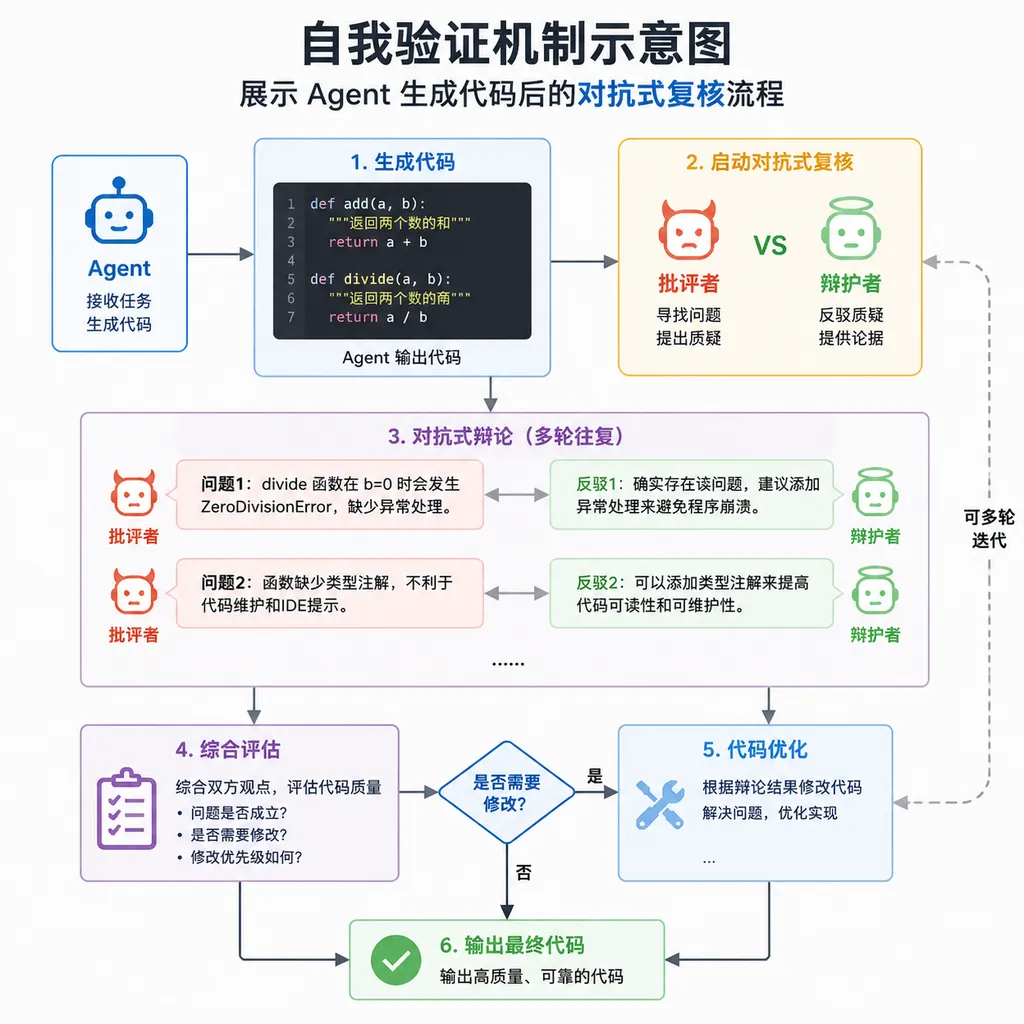
After generating code, the Agent is forced to go through an “adversarial review” process against itself.
More specifically, self-verification includes, but is not limited to, the following layers:
- Execution verification: Run tests whenever possible. If tests cannot run, attempt to construct a minimal reproducible example (“minimal repro”) and use actual execution results instead of relying on intuition that the code “looks correct.”
- Reverse explanation: Have the Agent explain its own diff in natural language and compare it against the original task description to check for “answering the wrong question.”
- Adversarial verification: Introduce an independent “challenger” role that assumes the code is wrong by default. The code only passes if sufficient evidence can convince the challenger.
- Coverage checking: Verify that every requirement mentioned in the task has corresponding code changes or test coverage, avoiding situations where “half the work was missed.”
- Side-effect scanning: Check whether unrelated files were modified, unnecessary dependencies introduced, or existing APIs broken.
This mechanism follows the now well-established “thinking → analysis → self-verification → self-correction” paradigm repeatedly proven effective in Agentic Workflows. Teams using similar approaches have already achieved production outcomes such as “automatically submitting 72 security patches.” OpenSquilla 0.4.0 embeds this paradigm directly into the Harness itself, instead of requiring every user to assemble it independently.
3. Embedding Capabilities “Into the Harness”
In the 0.4.0 design notes, the OpenSquilla team repeatedly emphasizes one idea:
Form a kind of self-evolving mechanism so that these capabilities ultimately become internalized within the Harness.
This sentence is effectively the guiding principle of the entire 0.4 series. In the past, developers wrote prompts, collected skills, and tuned workflows, but much of that experience remained scattered across personal dotfiles and internal documentation. With coding mode + self-verification, 0.4.0 transforms “good coding practices” from “prompts users need to remember” into “things the Harness does by default.”
3. Why Is “Self-Verification” So Important for Coding Agents?
By mid-2026, Coding Agents have been fully integrated into software engineering workflows. Leading productivity tools include Claude Code, Codex, and OpenCode, while using these Agents locally through VS Code has become a mainstream development pattern.
Anyone who has used Coding Agents for some time has probably encountered the same problems:
- The code looks elegant but crashes when run;
- The unit tests pass because the Agent wrote them itself, but critical scenarios are completely uncovered;
- Modifying file A silently breaks file B;
- The most important requirement in the user request gets omitted.
The root cause of these problems is not that LLMs are “not smart enough,” but rather the absence of a mandatory, unavoidable validation stage. In traditional software engineering, this stage is called Code Review + CI. In AI coding scenarios, it has largely depended on human users acting as the gatekeeper.
What OpenSquilla 0.4.0 aims to do is partially hand that gatekeeping role back to the Agent itself:
- It does not replace human review, but it can block content that is “obviously wrong,” “obviously incomplete,” or “obviously excessive” before the Agent produces its final output;
- It forces the Agent to undergo a round of “self-refutation” before output, reducing the side effects caused by overconfidence;
- It directs token usage toward higher-value tasks — the cost of one verification cycle is often far lower than having a human discover issues and asking the Agent to redo the work.
This also aligns with OpenSquilla’s long-standing identity as a token-efficient system. Although self-verification appears to consume more tokens on the surface, in practice it replaces the high cost of “post-failure rework” with the lower cost of “in-process validation.”
4. Installation and Getting Started: Maintaining the “Run Out of the Box” Experience
Version 0.4.0 continues the installation methods introduced in 0.3.x. Users can choose whichever path best fits their needs:
| Method | Suitable For | Description |
| --- | --- | --- |
| Quick terminal install (recommended) | End users on any OS | Install the published wheel in one line using uv tool install |
| Windows portable | Windows users | Precompiled portable launcher with no installation required |
| Install from source | Users following the main branch | Run directly from a git checkout without editing source code |
| Develop from source | Developers who want to contribute | Run from a git checkout with direct source editing support |
Recommended quick installation commands (run in a terminal):
# Recommended approach: install the precompiled wheel via uv
uv tool install opensquilla

# If PATH has not refreshed after installation, open a new terminal
opensquilla --help

# Enter coding mode
opensquilla coding
To try the latest features from source:
git clone https://github.com/opensquilla/opensquilla.git
cd opensquilla
uv sync
uv run opensquilla coding
Note: The Quick terminal install method does not automatically add the executable to PATH. If the command cannot be found, simply open a new terminal.
5. Differentiation from OpenClaw and Hermes Agent
In the Chinese developer community, OpenSquilla is frequently compared with OpenClaw and Hermes Agent. Version 0.4.0 makes their differing directions even clearer:
- OpenClaw: More “all-purpose,” with a rich skill set and active ecosystem, closer to a general-purpose Agent capable of running almost anything.
- Hermes Agent: More “message-driven + multi-channel,” with strengths in deep integration with IM, email, Webhooks, and similar channels.
- OpenSquilla: Focused on “token efficiency + engineering rigor,” with strengths in microkernel architecture, workflows, and now self-verification.
For developers using Coding Agents in serious projects while caring about both cost and correctness, OpenSquilla after 0.4.0 is likely to be a comfortable choice.
6. Final Thoughts: Harness Capabilities Are Being “Internalized”
In the AI Coding landscape of 2026, the competitive focus has quietly shifted from “whose model is stronger” to “whose Harness understands engineering better.” Closed-source solutions such as Claude Code and Codex continue to lead in product polish, while open-source projects like OpenSquilla offer a different possibility:
- Localizable: Code, data, and prompts all stay on your own machine;
- Auditable: Every skill and workflow can be inspected directly in the source code;
- Evolvable: Best practices contributed by the community can directly become default behaviors in the next release.
The “coding mode + self-verification” feature set in 0.4.0 is a concrete implementation of this philosophy of “embedding capabilities into the Harness.” For developers struggling with token bills and Agent-generated errors, this release is worth trying seriously.
References
- OpenSquilla GitHub Repository: Official source for project code, release notes, and installation methods, including the complete 0.4.0 changelog.
- Popular Harness Project OpenSquilla: Saving Agents Driven to Despair by Token Costs - Zhihu: A detailed Chinese-language analysis of OpenSquilla’s design philosophy and the concept of “embedding capabilities into the Harness.”


