
X Launches Official MCP Server, Enabling Agents to Connect Directly to the Twitter API
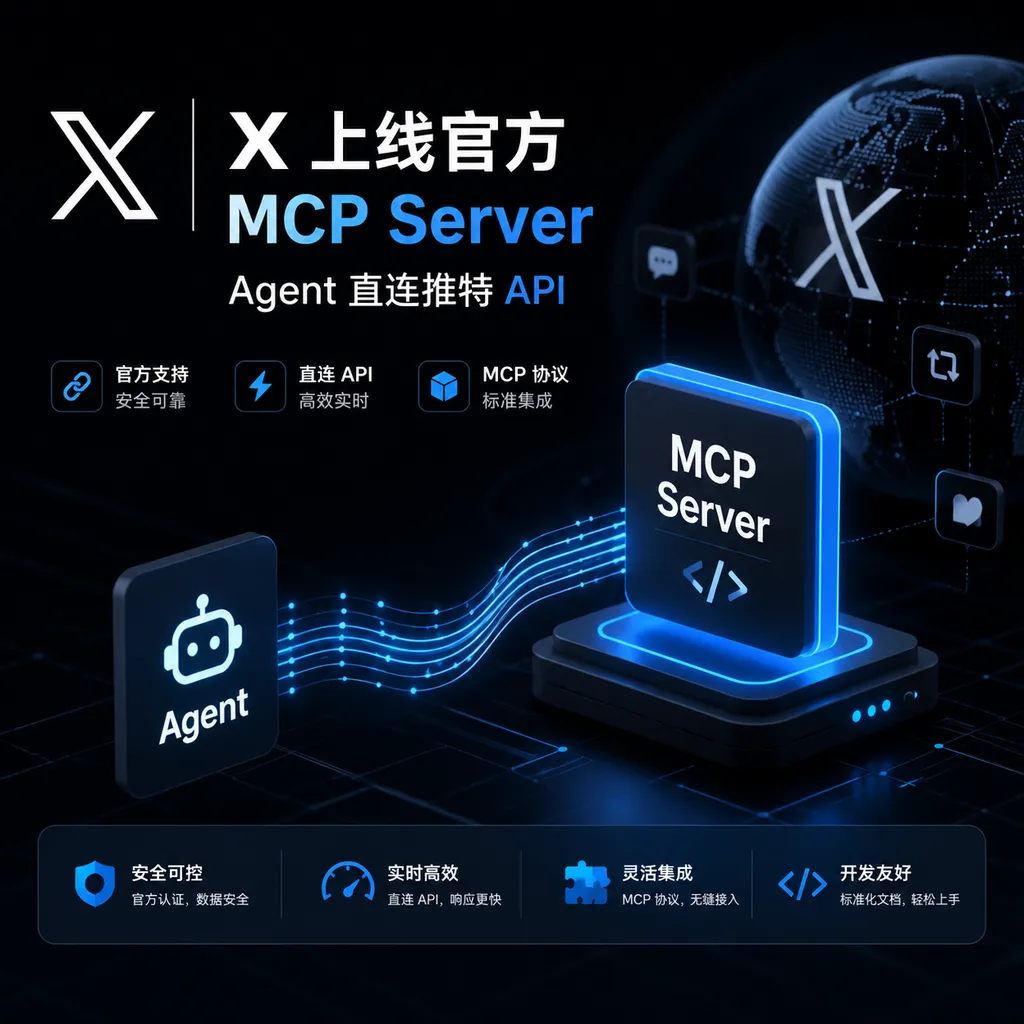
X officially launches hosted MCP Server. AI Agents can directly call the X platform API, read and write posts, and query documentation through a unified protocol. Developers no longer need to build a separate adaptation layer for X’s API.
X Launches Official MCP Server — AI Agents Can Finally Use X "Natively"
On June 30, X (formerly Twitter) quietly launched an officially hosted MCP Server. No press conference, no late-night Musk tweet — just a new page added to the developer docs. But for people building Agents, this is a significant development.
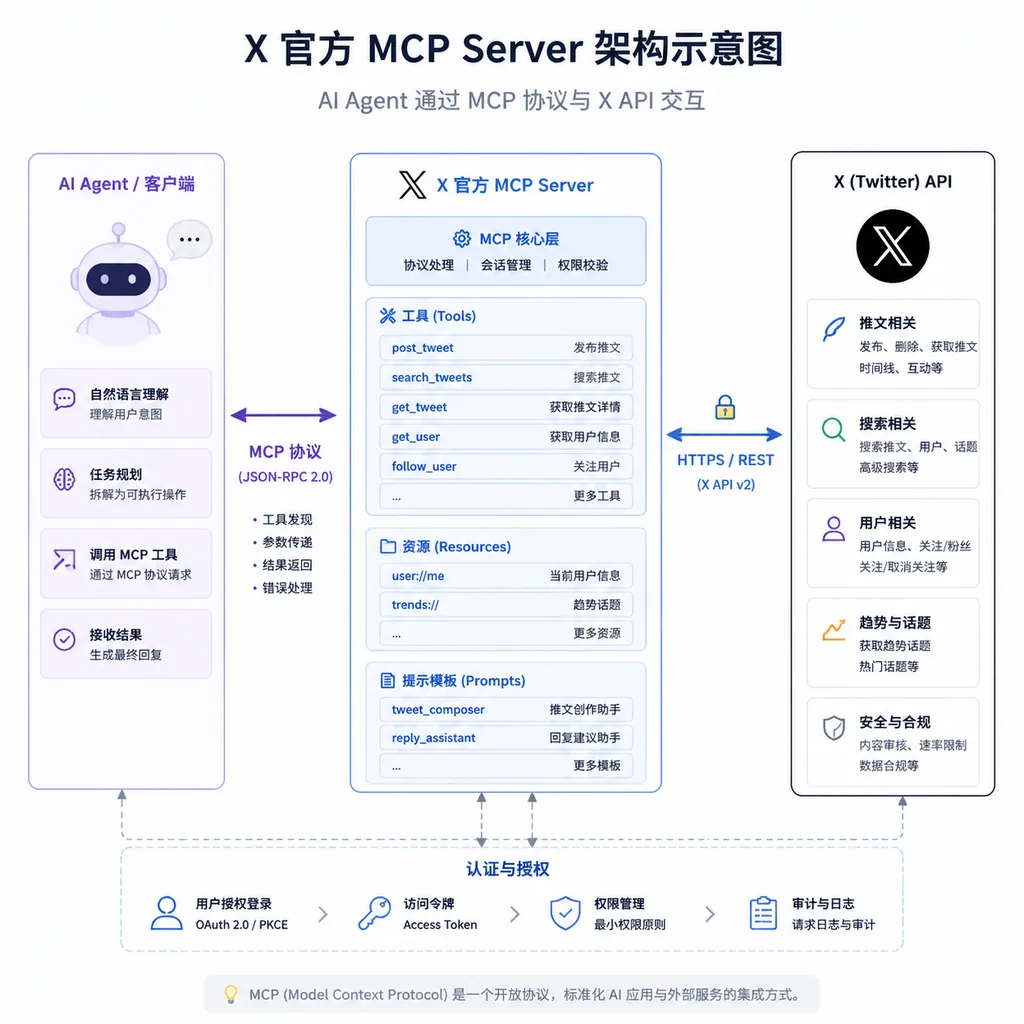
Simply put: going forward, if you're building an AI Agent and want it to search tweets, post content, read user profiles, or check API documentation, you no longer need to wrap the X API in your own SDK layer or maintain the OAuth 2.0 authentication flow yourself. Agents can connect directly to X's official servers through the MCP protocol, and X has already defined tool calls, parameter descriptions, error handling, and related details for you.
This is the latest major platform to officially join the ecosystem after Anthropic pushed MCP into becoming a de facto standard over the past six months, followed by GitHub, Cloudflare, Stripe, and Notion launching official MCP Servers. X may not be early this time, but for the Agent ecosystem, the social data layer is now finally in place.
What Exactly Did X Release This Time?
According to the X developer platform documentation at docs.x.com/tools/ai, X released an entire set of AI Agent-oriented resources in one go, not just a standalone MCP Server.
Specifically, it includes four components:
- Docs MCP (
docs.x.com/mcp): An MCP endpoint hosted on X's own servers. Agents can search and read any page of the X API documentation in real time. In other words, when your Cursor, Claude Code, or Windsurf instance is writing code against the X API and encounters an unfamiliar field, it can "look it up on demand" without you manually feeding in the docs. - llms.txt: A documentation index file containing the title, URL, and description of every page, designed specifically for LLMs to ingest all at once.
- llms-full.txt: The entire documentation bundled into a single Markdown file, suitable for RAG or direct full-context loading.
- OpenAPI specs and skill.md: Integration specifications for tools like Grok and Cursor, defining how an Agent should "use" the X API as a skill.
One important detail: the official MCP Server that X is promoting right now is focused primarily on documentation retrieval, not directly helping you post tweets, delete tweets, or DM users. In other words, this Server solves the problem of "teaching Agents how to use the X API," while actual business operations still go through the X API itself (though once the Agent understands how to call it, it can construct requests on its own).
This design is pragmatic. X's API involves billing, rate limiting, and content moderation. Directly exposing write operations to all MCP clients would carry substantial risk. Starting with MCP-enabled documentation so Agents can "self-learn" is a cautious first step.
Why Now, and Why MCP?
MCP (Model Context Protocol) is an open protocol introduced by Anthropic in late 2024. Its core idea is to standardize how AI models call external tools. Before MCP, every AI application integrating a new service had to define its own function-calling schema, handle authentication independently, and specify its own return formats. With MCP, service providers expose an MCP Server, and all MCP clients (Claude Desktop, Cursor, Cline, various Agent frameworks) can use it directly.
The protocol has expanded rapidly over the past six months. By Q2 this year, nearly every mainstream developer tool and SaaS platform had either an official or community MCP Server: GitHub, Linear, Notion, Slack, PostgreSQL, Stripe, Cloudflare, Vercel... X appears to be the first major social platform to officially enter the space.
Why did X choose this moment? My guess is there are two reasons:
First, Grok needs it. xAI has deeply integrated Grok with X, and post-Grok 4 versions are clearly investing heavily in Agent capabilities. For Grok itself to act as an MCP client calling the X API, there is probably no more logical solution than an official MCP Server.
Second, the community was already building it. Before X officially stepped in, the community had already produced a number of third-party X MCP Servers. Upload-Post created a 40-tool version supporting tweeting, scheduling, and analytics; twitterapi.io released a version based on scraping routes that bypass the official API, packaging 12 read-only tools. If X didn't release an official version soon, control of the ecosystem narrative would shift to third parties. In particular, scraper-based solutions bypassing API billing pose a direct threat to X's business model.
What's It Like in Practice?
Configuration is very simple. In the config file of an MCP-compatible client (such as Claude Desktop or Cursor), add:
{
  \"mcpServers\": {
    \"x-docs\": {
      \"url\": \"https://docs.x.com/mcp\"


