
Nano Banana 2 Lite Arrives: DeepMind Slashes Multimodal Costs to the Floor
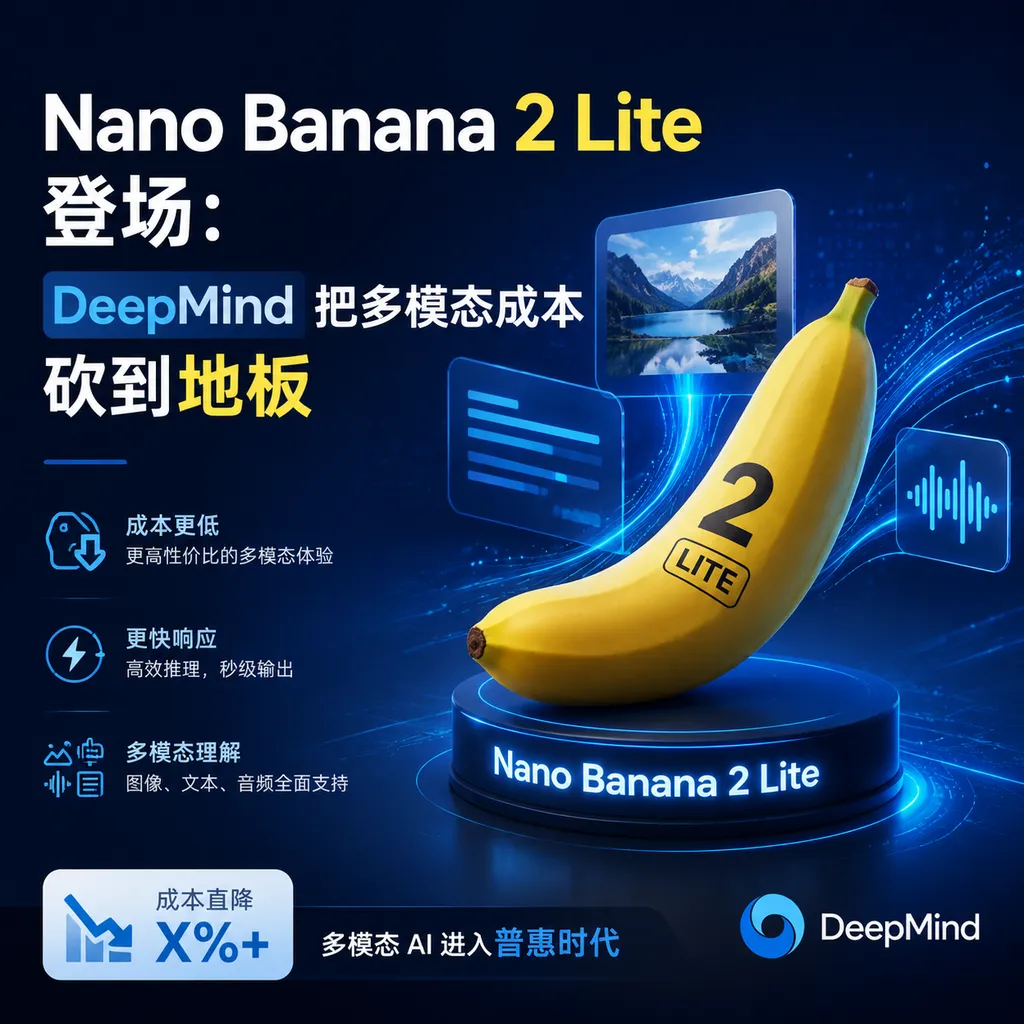
Google DeepMind has launched Nano Banana 2 Lite and Gemini Omni Flash, focusing on lightweight multimodal development. The former cuts image generation costs in half compared to the Pro version, while the latter unifies speech, vision, and text with Flash-level latency. Developers can finally afford to use multimodal capabilities.
Nano Banana 2 Lite Arrives: DeepMind Slashes Multimodal Costs to the Floor
At the end of June, Google DeepMind dropped another major update. This time the stars are Nano Banana 2 Lite and Gemini Omni Flash, two models whose names already make it clear they’re targeting the “lightweight + fast” route. The official blog title says it plainly — “Start building with Nano Banana 2 Lite and Gemini Omni Flash.” In other words: stop watching and start shipping.
If the Nano Banana 2 (Gemini 3.1 Flash Image) released this February lowered the barrier for enterprise-scale image generation to an affordable level, then this Lite version pushes that line down even further, aiming directly at indie developers and small-to-medium teams.

Why Make a Lite Version?
First, let’s straighten out the timeline so new readers don’t get lost:
- August 2025: Nano Banana (Gemini 2.5 Flash Image) quietly appeared on LMArena and became famous for character consistency and multi-image fusion
- November 2025: Nano Banana Pro launched, focused on professional-grade image quality
- February 2026: Nano Banana 2 (Gemini 3.1 Flash Image) released, cutting costs to half of Pro, with 4K image pricing at $0.151 per image
- June 2026: Nano Banana 2 Lite + Gemini Omni Flash arrive
See the pattern? DeepMind’s rhythm is very clear: first use a flagship model to build reputation, then use the Flash series for scale, and finally use Lite to capture long-tail developers. OpenAI has done this before (GPT-4 → 4o → 4o mini), and Anthropic too (Opus → Sonnet → Haiku), but Google’s advantage is this: it’s advancing an entire multimodal product line in parallel — image, video, audio, and world models are all iterating simultaneously.
And the Lite version is really solving one pain point: cost. Even though Nano Banana 2 already pushed 4K image pricing down to $0.151, that’s still not cheap for high-concurrency applications like bulk e-commerce image generation, social avatar creation, or dynamic illustration generation for educational products. According to official disclosures, Lite cuts costs by another roughly 60%, pushing 512px/1K image pricing into the range of “almost negligible.”
The Tradeoffs in Nano Banana 2 Lite
Making a Lite model isn’t about blindly cutting parameters — it’s about targeted subtraction. DeepMind’s tradeoff logic this time is worth examining.
Capabilities retained:
- Character consistency: Still supports visual locking for up to 5 characters and 10 objects within a single workflow. This is the Nano Banana series’ signature feature — removing it would defeat the point.
- Fine-grained natural language editing: Core interactions like background replacement, clothing changes, and object removal remain intact
- SynthID watermarking + C2PA credentials: Compliance features are non-negotiable
- Multilingual text rendering: The in-image translation capability introduced in Nano Banana 2 is still included
Capabilities removed or weakened:
- Maximum resolution: Lite tops out at 2K output, while 4K is reserved for Nano Banana 2 and Pro
- Dynamic reasoning levels: Lite defaults to the minimal reasoning path and no longer supports high/dynamic modes
- Extreme aspect ratios: Ratios like 8:1 and 1:8 are unsupported, though standard formats like 1:1, 16:9, 9:16, and 4:3 remain
- Complex multi-image fusion: Quality noticeably declines when using more than 5 reference images
Put simply, Lite is built for scenarios where “I just need to generate large volumes of acceptable-quality images”, not for artistic posters or cinematic storyboards.
This segmentation is actually pretty smart. Many developers previously found that when scaling Nano Banana 2, 90% of their use cases didn’t need 4K or advanced reasoning at all — but they still had to pay for it. Lite effectively separates out those needs and prices them appropriately.
Gemini Omni Flash: Compressing Multimodality into Flash-Level Latency
Even more interesting than Lite is the simultaneously released Gemini Omni Flash.
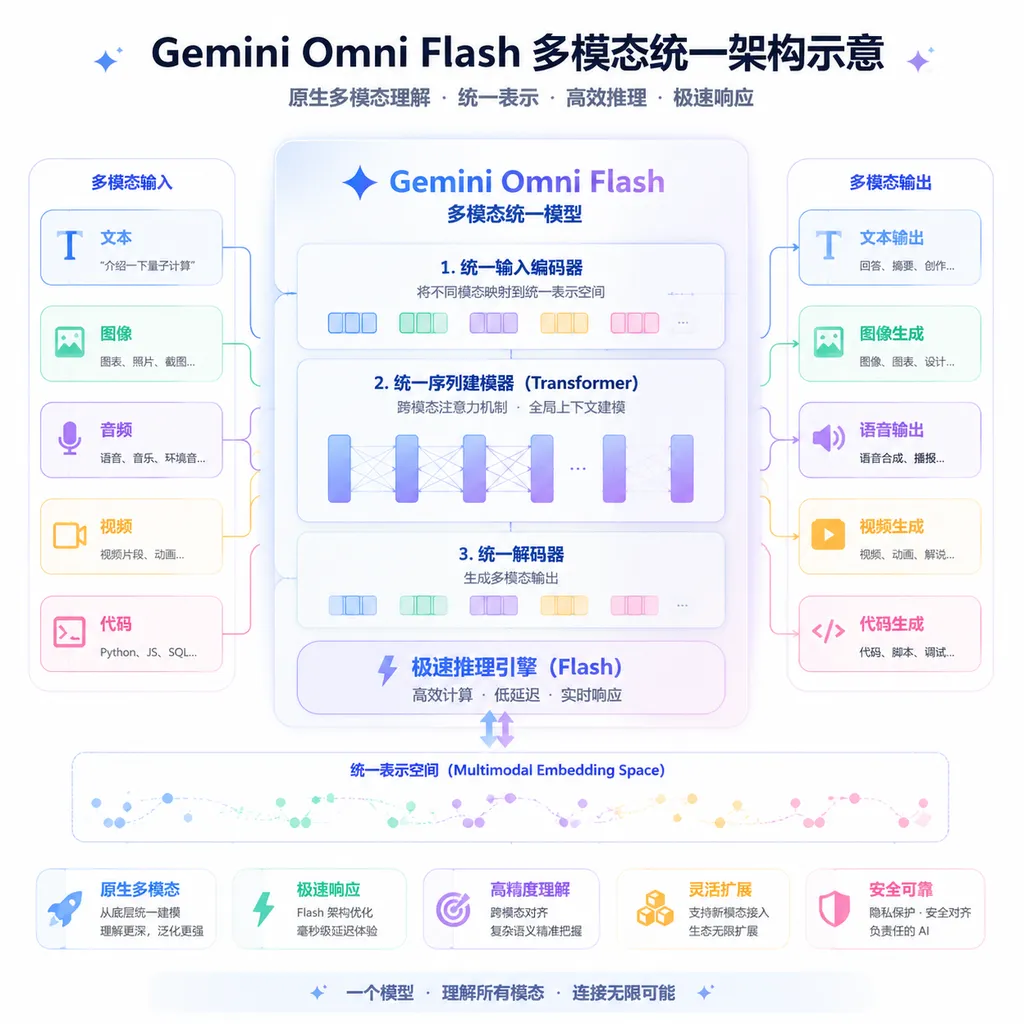
This model is positioned as a “unified multimodal Flash” system — text, image, audio, and video inputs and outputs all packed into a single Flash-latency model. It sounds somewhat similar to GPT-4o’s omni direction, but Google is pushing it even further:
- First-token latency under 300ms (for text scenarios)
- End-to-end voice conversation latency around 600–800ms
- Image generation built on Nano Banana 2 Lite
- Video understanding supports up to 1 hour of input
This means developers can use a single API endpoint for voice assistants, real-time translation, video summarization, image generation, and more. Tasks that previously required stitching together three or four separate models can now be handled by one Omni Flash model.
One complaint here — Google’s model naming is getting increasingly absurd. Nano Banana is the product name, Gemini 3.1 Flash Image is the technical name, Nano Banana 2 Lite is another version number, and Omni Flash is yet another branch… developers can spend half a day just figuring out which endpoint they’re supposed to call. Google really should standardize its naming conventions internally, or in a couple years even their own teams may not remember them.
Hands-On Testing: Where Does Lite Actually Fall Short?
After getting API access, I ran the same prompts through both Nano Banana 2 and Lite and noted several observations:
Speed: Lite averaged 1.2–1.8 seconds per image, nearly twice as fast as Nano Banana 2’s 2.5–3 seconds. For applications requiring real-time feedback — such as AI avatar editors — the difference is very noticeable.
Quality: For standard portraits, product images, and scene illustrations, Lite and Nano Banana 2 are nearly indistinguishable at 1K resolution. But at 2K, Lite’s textures become softer, and high-frequency details like skin and hair can develop a slight plastic-like appearance.
Instruction following: In complex prompts (for example, prompts with more than five described elements and spatial relationship constraints), Lite’s execution accuracy drops significantly. I asked it to generate “a Shiba Inu sitting on the left side of a wooden table, with a cup of coffee and an open notebook on the right side, against a morning windowsill background.” Lite swapped the notebook and coffee positions in 3 out of 5 runs, while Nano Banana 2 got all 5 correct.
Chinese text rendering: Still the same old problem. Although the Nano Banana 2 series claims multilingual in-image text support, the error rate for Chinese characters on Lite is dramatically higher than for English. Mixed simplified/traditional characters and malformed glyphs are common. Google really needs to address this seriously, otherwise it will always feel slightly behind in the Chinese market.
What Does This Mean for Developers?
From an ecosystem perspective, the Lite + Omni Flash combination sends several signals:
-
Multimodality is becoming infrastructure. A year ago, using image generation models required separate quota applications and complicated SDK integrations. Now it’s available directly through the Gemini API. Anthropic and OpenAI are following the same trend.
-
The price war has begun. Nano Banana 2 Lite’s pricing effectively rewrites the unit economics of image generation. Middlemen making money from API pricing spreads will find things increasingly difficult.
-
A boom for vertical applications. Once multimodal usage costs become low enough, developers are more willing to build “multimodal-heavy” applications — AI picture books, smart albums, automatic video editing, virtual streamers, and other areas that previously didn’t make economic sense can now be reconsidered.
It’s also worth mentioning that OpenAI Hub has already added support for Nano Banana 2 Lite and Gemini Omni Flash, allowing Chinese developers to connect through a unified OpenAI-compatible interface without dealing with Google Cloud configuration. For teams simultaneously using GPT, Claude, Gemini, and other model families, this aggregation approach genuinely simplifies things.
A Few Thoughts
In less than a year since Nano Banana first launched anonymously last August, the series has already iterated through four versions (Banana → Pro → 2 → 2 Lite), updating at a pace roughly an order of magnitude faster than OpenAI’s DALL-E series. This reflects a broader shift in Google’s generative AI strategy — instead of pursuing one super-model to solve everything, it’s using a product matrix to cover every price tier and use case.
The advantage of this strategy is stability. The downside is naming chaos and higher cognitive load for developers. But as long as pricing and quality continue improving, developers will keep coming.
In the short term, Nano Banana 2 Lite’s most direct competitors are not Stable Diffusion or Flux, but rather OpenAI’s hypothetical GPT-image-1 mini and Anthropic’s not-yet-official image generation lineup. Google moved early with Lite and timed the positioning well.
As for Gemini Omni Flash, it looks like Google laying groundwork for the next generation of AI agents. When a single model can simultaneously process speech, vision, and text — with low enough latency and cheap enough pricing — AI agents that can truly “see and hear” become commercially viable. OpenAI is pursuing the same direction with GPT-4o, but Google’s latency numbers this time do look significantly better than the previous generation.
What’s worth watching in the second half of the year is whether DeepMind will bring Omni Flash capabilities into system-level APIs for Workspace and Android. If that happens, the rules of the game may change again.
References
- Google announces Nano Banana 2 with half-price costs, high-quality image generation, and text translation - iThome — Detailed pricing and capability analysis from the Nano Banana 2 launch


