
Anthropic Launches Claude Science: Betting on Scientific Research Workflows
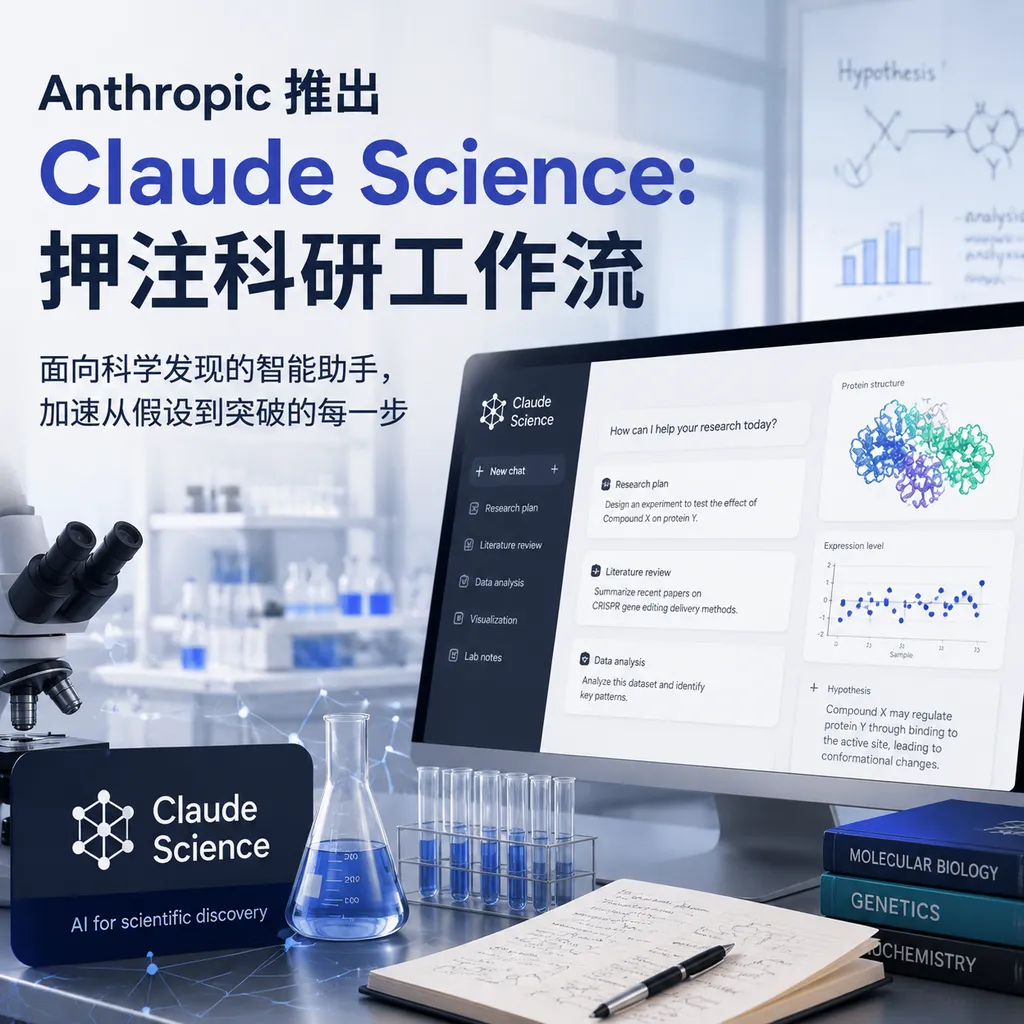
Anthropic today launched Claude Science, a unified workspace for computational research that integrates databases, pipelines, and agent tools. This time, instead of releasing a new model, they’re betting that what scientists really need is to switch windows less often.
Anthropic Launches Claude Science: This Time It’s Not a New Model, but a Workbench for Scientists
Today (June 30), Anthropic announced Claude Science, a unified research environment built specifically for computational research workflows. Unlike its previous major launches, there’s no new model, no benchmark charts, no Opus 4.x naming upgrade—instead, the entire product page focuses on one idea: scientists no longer need to constantly switch between databases, analysis pipelines, literature tools, and chatbots.
It’s an interesting product decision. In 2026, while everyone else is competing on model capabilities, Anthropic is betting on the "workflow."
What exactly is it?
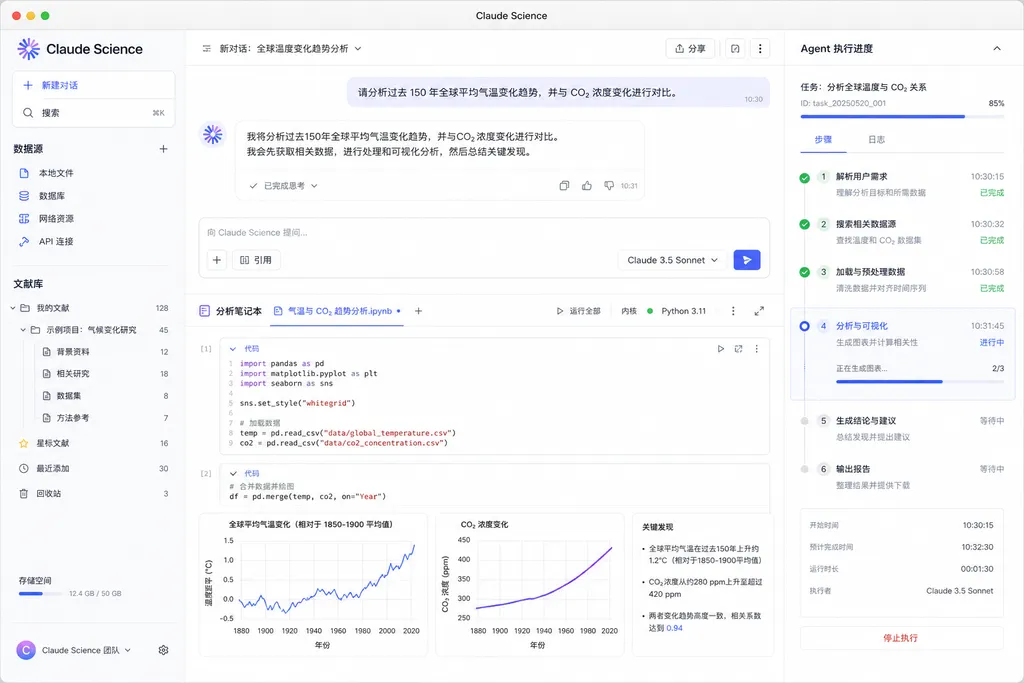
Anthropic officially describes Claude Science as "a workbench for computational research." In practice, it combines the following into a single interface:
- Literature search and review: Reuses the Multi-Agent architecture from Claude Research, where a Lead Researcher plans the direction and multiple Subagents scan literature databases in parallel;
- Data connectivity: Direct integration with scientific databases such as PubMed, UniProt, PDB, GEO, and arXiv, eliminating the need to manually download CSVs before feeding them into a model;
- Code and analysis environment: Built-in notebook-style execution environment where Claude can directly run the analysis code it writes, with results fed back into the conversational context;
- Pipeline orchestration: Packages multi-step workflows such as bioinformatics and computational chemistry into reusable Agent workflows;
- Collaboration and citation traceability: Every conclusion includes source links, allowing team members to audit each step of the Agent’s reasoning and data provenance.
In plain terms: previously, a computational biologist performing an RNA-seq differential analysis might need to search for data on NCBI, run pipelines in Galaxy, write scripts in Jupyter, ask questions in ChatGPT, manage papers in Zotero, and discuss results in Slack. Claude Science is trying to collapse those six windows into one.
Why workflows instead of a new model?
TechCrunch summed up the decision quite directly in its coverage: Anthropic bets on workflow, not a new model. There are actually two layers of logic behind this.
The first is diminishing returns in model capability gains. From Opus 4 to Opus 4.7, and now the rumored Opus 4.8 and Fable 5, improvements on general-purpose benchmarks are no longer enough to impress scientists. A model that can solve 3% more Math Olympiad problems means little to a researcher trying to identify CRISPR off-target sites. The real bottlenecks are no longer the models themselves, but engineering issues such as data access, reproducibility, and citation reliability.
The second is customer value and retention in the research market. Academic institutions and pharmaceutical companies purchase software by seat, but they have extremely low tolerance for switching tools—once a biologist learns a workflow, they may stick with it for years. Whoever establishes the default workbench first effectively locks in the AI entry point for scientific research over the next decade. Anthropic clearly understands this calculus, and OpenAI’s Deep Research as well as Google’s Co-Scientist are competing for the same territory.
Reusing the Multi-Agent architecture in scientific research
Under the hood, Claude Science continues Anthropic’s established Orchestrator-Worker architecture. A Lead Agent (typically an Opus-class model) decomposes research tasks and plans the approach; multiple Subagents (Sonnet-class) fetch data, read literature, and execute code in parallel; finally, the Lead consolidates everything into a citation-backed report.
Anthropic previously disclosed internal results showing this architecture achieved a 90.2% improvement over a single-Opus setup on general research tasks. In scientific research, this breadth-first parallel expansion is especially well-suited. For example, with a query like “Find all papers from the past five years reporting resistance mechanisms for KRAS G12C inhibitors, and cluster them by mechanism,” a single-threaded model may get stuck pursuing one line of inquiry, whereas multiple Agents can truly explore the space in parallel.
But scientific research is far more demanding than general research. One common pain point is hallucinated citations—general-purpose research systems occasionally invent highly convincing-looking DOIs. Claude Science imposes a hard constraint here: all citations must originate from real database API responses, and the model is not allowed to generate PMIDs or arXiv identifiers from memory. It’s a small engineering decision, but for research users it’s a hard requirement.
Who is it competing against?
Several products sit in the same space:
- OpenAI Deep Research: A general-purpose research Agent with strong web search depth, but lacking native integration with scientific databases and deep integration with execution environments;
- Google Co-Scientist: Google’s research Agent released last year, strong at hypothesis generation but architecturally closer to a demo than a full workbench;
- Elicit and Consensus: Vertical research search tools that entered early, but whose model capabilities have fallen behind—they now look more like targets for Claude Science to absorb;
- Galaxy, Nextflow + Copilot-style combinations: Traditional bioinformatics pipelines stitched together with AI assistants—flexible, but fragmented.
Claude Science’s differentiation is clear: it combines Agent capabilities, data connectivity, and execution environments into a single surface. That sounds simple, but it’s extremely engineering-heavy in practice—every scientific database integration requires licensing discussions, API integration, and citation normalization. Anthropic’s willingness to invest in this effort suggests they are seriously treating scientific research as a vertical market.
Several details developers should pay attention to
First, programmability. Claude Science is not just a web product—it also ships with a Science API that allows the entire scientific Agent workflow to be embedded into laboratory information management systems (LIMS) or electronic lab notebooks (ELNs). This means IT departments at large pharmaceutical companies can integrate it into existing Benchling or LabArchives workflows instead of forcing researchers to adopt entirely new tools.
Second, local data support. Anthropic explicitly supports mounting private datasets this time around—you can attach proprietary compound libraries, clinical datasets, or experimental results, and Claude will treat them as first-class data sources during Agent reasoning. For the pharmaceutical industry, this is effectively a compliance baseline; without it, enterprise procurement would be impossible.
Third, auditability. Every Agent action—which API was called, what parameters were used, what was returned, and how the model interpreted it—is recorded in a traceable execution tree. Researchers can inspect the Agent’s reasoning process the way they review Git history. This is a defining distinction between scientific research systems and general-purpose chatbots: conclusions must be reproducible and open to scrutiny.
My assessment
Claude Science is a restrained product. There are no flashy demos or showy features; the entire design philosophy boils down to one sentence: “make scientists switch windows less often.” And that restraint is exactly the right approach.
The history of scientific software tells us that winners are never the smartest tools, but rather the ones that interfere with workflows the least. Jupyter didn’t win because it had the best technology—it won because it seamlessly fit into scientists’ way of thinking. Claude Science follows a very similar philosophy.
In the short term, this product will likely gain traction fastest in life sciences, chemistry, and materials science, where work depends heavily on literature and databases. In fields like physics and mathematics, which rely more on symbolic reasoning and long-chain proofs, the value of the workbench model may be weaker—that remains territory where GPT and Gemini are stronger.
Long term, the real question is this: once model capabilities plateau, will the moat for AI companies come from the model itself or from the product? Anthropic’s answer this time is the latter. Whether that judgment is correct will depend on procurement data from pharmaceutical companies and academic institutions over the next six months.
As a side note, OpenAI Hub already supports the Claude models underlying Claude Science, including Claude Opus 4.8, Sonnet 4.6, and Haiku 4.5. If you want to integrate Claude’s scientific Agent capabilities into your own toolchain using a single API key, there’s no need to separately apply for an Anthropic account, and direct access is available in mainland China.
References
- Anthropic Multi-Agent Research System Engineering Blog: Official technical breakdown of the Orchestrator-Worker architecture underlying Claude Science (requires access to the global internet)


