
Meta Open-Sources Brain2Qwerty v2: Full Sentences Directly From Brain Signals, Achieving Up to 78% Word Accuracy

Meta has taken a major step forward in non-invasive brain-computer interfaces — v2 skips letters and directly decodes sentences, with the best participant achieving a word accuracy rate of 78%. The code and dataset have both been fully open-sourced.
Meta has pushed forward last year’s “brain‑reading typing” research another step. The newly released Brain2Qwerty v2 no longer spells word by word: it directly decodes complete sentences from continuous brain‑magnetogram (MEG) signals. The best participant reached a 78 % word accuracy, and the average was 61 %. Code, paper, and the Spanish BCBL dataset were all uploaded to GitHub and Hugging Face, while Nature Neuroscience published the work simultaneously.
What’s the significance? In one sentence: Non‑invasive brain–computer interfaces have, for the first time, reached a usable level in the “natural‑sentence decoding” task.
From “spelling letters” to “outputting sentences”: crossing the threshold
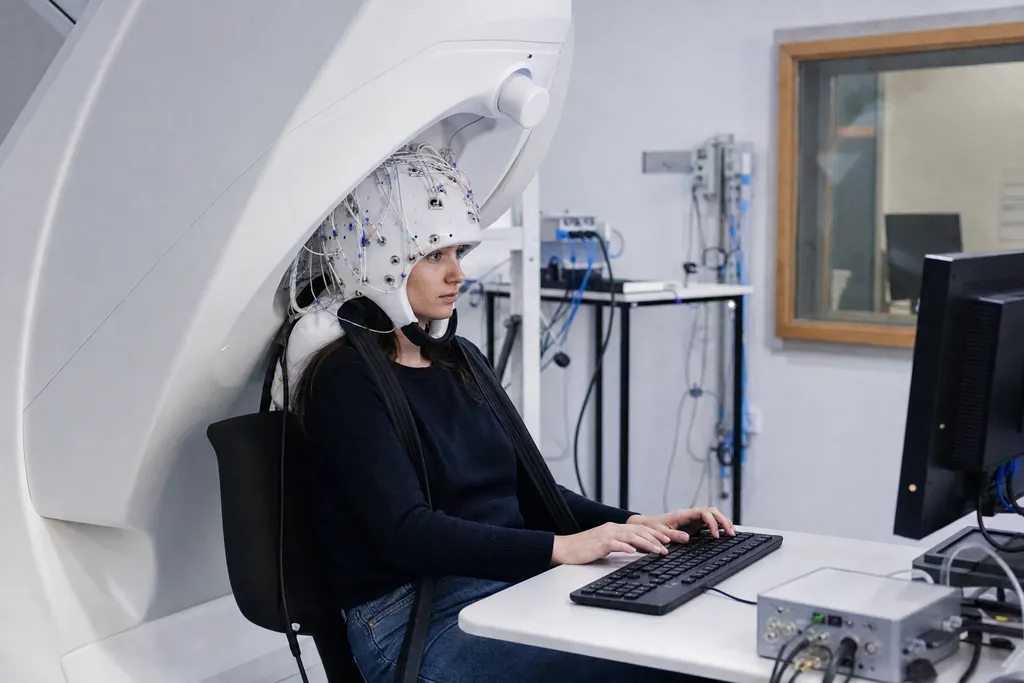
Let’s recall last year’s v1. Meta then had 35 healthy volunteers sit in an MEG scanner typing text. The model learned to map brain signals to keyboard keys, then reconstruct letters. Using MEG, the best character error rate (CER) was 19 % with an average of 32 %; using cheaper but much noisier EEG, the mean CER plunged to 67 %.
That outcome was already publishable, but far from “usable.” A 32 % character error means one in three characters wrong—essentially gibberish. More critically, letter‑by‑letter decoding is an inefficient paradigm: when a sentence arises in the brain, it isn’t imagined first letter by letter but almost all at once. Forcing this parallel process into serial typing runs counter to how the brain actually works.
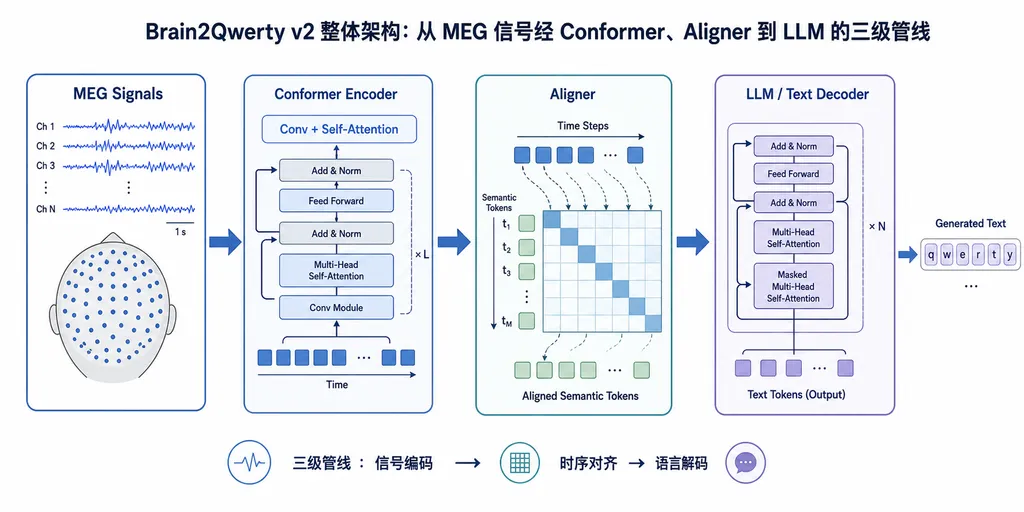
v2 adopted a different approach. The pipeline now has three stages:
- Conformer Encoder – takes continuous MEG signals and extracts temporal features. Conformer was originally used in speech recognition, so “continuous signal → discrete symbols” is its specialty.
- Aligner – aligns brain‑signal segments with character/word boundaries. This replaces the hard constraint in v1 that required MEG segments to match key‑press timestamps, enabling more natural continuous input.
- LLM Decoder – performs final language modeling and correction at word and sentence level.
The three modules are jointly trained, matching data at letter, word, and sentence granularity. Together with a ten‑fold increase in training data per participant, the model evolved from “per‑character hopping” to “whole‑sentence output.”
An example in the paper illustrates it: a participant typed ek benefucui syoera kis ruesgis—obviously full of typos—but the LLM module, using brain‑signal context, corrected it to el beneficio supera los riegos (“the benefit outweighs the risks,” in Spanish). The model not only decoded the brain’s intent but also fixed the user’s typing errors. This shows the language model acts as a bridge between the brain’s high‑level semantics and concrete keystrokes, not merely passive transcription.
How far is it from invasive BCI
This comparison is unavoidable. Invasive schemes such as Neuralink or Synchron achieve over 90 % word accuracy in ALS patients; a recent UC Davis study even reached 97 %. So 78 % still trails behind.
But consider the cost difference:
| Approach | Best Accuracy | Installation | Long‑term Stability | |-----------|---------------|--------------|---------------------| | Invasive (Utah array, Neuralink) | 90 %+ | Craniotomy and electrode implantation | Electrodes become encapsulated, signal decays | | Non‑invasive MEG (Brain2Qwerty v2) | 78 % | Helmet, no surgery | No biological rejection | | Non‑invasive EEG | 30–40 % (motor‑imagery tasks) | Scalp electrodes, no surgery | Poor SNR, many limits |
In other words, Brain2Qwerty has raised non‑invasive methods from “barely recognizing a few imagined commands” to “decoding free‑form sentences,” narrowing what once seemed an unbridgeable gap with invasive approaches. For patients unwilling or unable to undergo craniotomy, this presents a truly viable path.
Of course, MEG’s Achilles heel is hardware. Current magnetoencephalography machines use low‑temperature superconducting sensors cooled by liquid helium, fill half a room, cost over a million USD each, and only work in magnetically shielded labs. “Non‑invasive” here means skin‑intact, not convenient.
Meta notes the next step: OPM (optically pumped magnetometer)—a new MEG sensor that needs no liquid helium and can be made wearable. Academia has made steady progress in recent years; if its sensitivity catches up to traditional superconducting systems, the Brain2Qwerty algorithms could leave the lab. If that happens, BCI form‑factors may shift from “cranial implant” or “lying in a giant tank” to simply “wearing a helmet.”
Technical highlights worth noting
Reading through the paper and repository, several points stand out for developers.
1. Training data is critical
The leap in v2 largely stems from “ten‑fold data per participant.” This exposes a classic BCI problem: brain‑signal individuality is huge—cross‑subject generalization basically fails, each person needs separate data collection and training. Gathering tens of hours of MEG per subject is costly.
Meta’s open‑sourced Spanish BCBL dataset (hosted on Hugging Face, collected by the Basque Center on Cognition, Brain and Language) provides a starting point, but building English, Chinese, or other language versions will require fresh data collection from scratch.
2. Conformer + Aligner isn’t entirely new
This architecture is already familiar in end‑to‑end speech recognition. Meta’s main contribution is showing that MEG signals can be treated with the speech‑ASR paradigm—since MEG is a continuous temporal signal targeting a continuous symbol sequence, treating it as “brain‑magnetic speech” makes sense.
That insight for other BCI research: rather than reinventing the wheel, migrate mature sequence‑modeling tools from speech or vision directly.
3. The LLM layer is small‑scale
From the released code, the final language‑correction model isn’t huge—it acts more like an enhanced n‑gram, performing statistical correction at the sentence level. If a powerful modern LLM (e.g., Llama series) were used, accuracy could still improve notably. This is likely a future direction for the community.
4. Still not real‑time
Meta admits in the paper: the current model isn’t streaming; both Transformer and LLM operate at sentence level, requiring the whole signal before decoding. Clinically, that means users can’t see immediate feedback like typing—it feels awkward. Turning the pipeline into streaming decoding is an obvious to‑do.
What this means for developers
For those working in BCI, neuroscience, or medical AI, this release effectively hands you a SOTA baseline toolkit:
git clone https://github.com/facebookresearch/brain2qwerty
cd brain2qwerty
pip install -e .
Dataset can be pulled from Hugging Face:
from datasets import load_dataset
ds = load_dataset("bcbl190626/SpanishBCBL")
If you’re outside the BCI community but follow decoding multimodal signals into natural language, Brain2Qwerty sends a clear message: combining biological signals (magnetic, electrical, ocular) with LLMs for end‑to‑end decoding is becoming a paradigm. Similar ideas will gradually spread to sign‑language translation, sub‑vocal speech recognition, and wearable interaction.
Some perspective
Meta’s AI strategy these past two years is interesting: unable to outgun OpenAI or Anthropic in mainstream large models, it boosts influence by open‑sourcing cutting‑edge but niche tech. Brain2Qwerty won’t sell ads or push Llama directly, but it’s a “memorable” study in pure research. Strategically, Meta keeps betting on next‑generation human–machine interaction—Ray‑Ban Meta glasses, Orion AR, EMG wristbands—with brain–computer interfaces as the endpoint. Even if consumer‑grade is ten years off, the foundation needs building now.
For the BCI field, Brain2Qwerty v2 isn’t a paradigm revolution, but it marks the first time a non‑invasive approach has delivered respectable performance in “free‑sentence decoding,” the most crucial metric. Together with open‑sourced code and data, we can expect extensive follow‑up work in the coming year. Definitely worth watching.
References
- facebookresearch/brain2qwerty (GitHub) — Official repository for Brain2Qwerty v2, including models, training scripts, and evaluation tools
- SpanishBCBL dataset (Hugging Face) — Spanish MEG typing dataset collected by Meta and BCBL
- “Brain2Qwerty: From Brainwaves to Text” article (Zhihu) — Chinese technical interpretation of v1 paper, useful for understanding the evolution of its architecture


