
Google Releases TabFM: Tabular Data Now Has Its Own Foundation Model

Google Research has introduced TabFM, a zero-shot foundation model designed specifically for tabular data that can make predictions directly without fine-tuning on specific datasets. This fills the long-standing absence of a "GPT moment" in the tabular domain, but there is still a tough battle ahead before it can truly challenge XGBoost’s dominance.
The Foundation Model for Tabular Data Has Finally Arrived
On July 1, Google Research officially introduced TabFM (Tabular Foundation Model) in a blog post — a zero-shot foundation model designed for tabular data. The core selling point is straightforward: give it a table it has never seen before, with no fine-tuning, no hyperparameter tuning, and no training samples, and it directly outputs predictions.
That sounds like something the vision and NLP worlds have long taken for granted, but for tabular data, this has actually been stuck in limbo for years. Anyone who has worked on tabular modeling knows the "standard toolkit" in this field is still XGBoost, LightGBM, and CatBoost plus a mountain of feature engineering. Deep learning’s low penetration in this space stands in sharp contrast to its dominance in CV and NLP.
The significance of TabFM is not that it can replace GBDT today, but that it pushes the idea of a "tabular foundation model" from academic papers into industrial-grade usability.
Why Tabular Data Is So Hard for Foundation Models
First, it’s important to clarify one thing: why did pretrained large models work for images and text, while tabular data has lagged behind for so long?
The answer is: heterogeneity.
No matter which camera an image comes from, it is fundamentally a 2D arrangement of RGB pixels, with strong spatial correlations between neighboring pixels. Text, regardless of language, is still a sequence of tokens, and corpora in the same language share a common vocabulary. These modalities naturally provide a "unified semantic space."
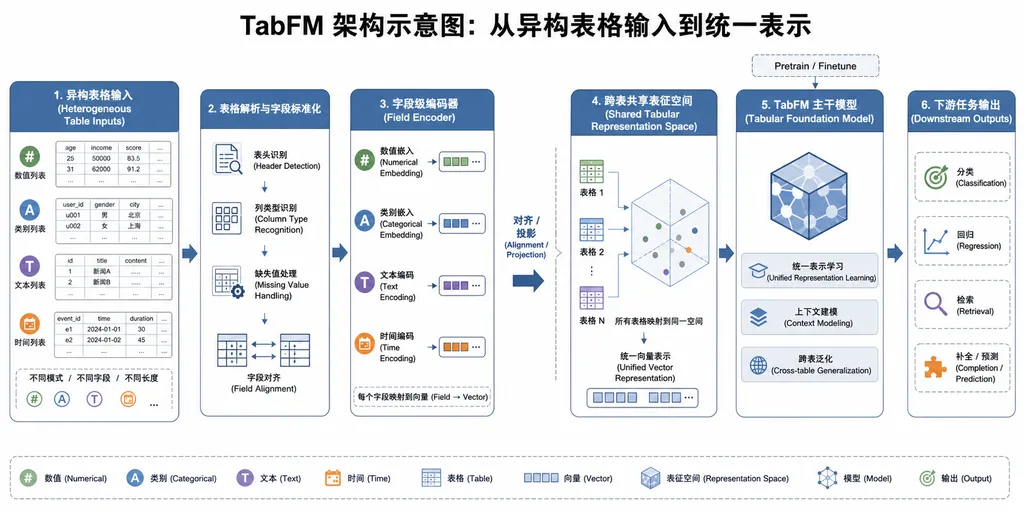
Tabular data does not. Two medical tables may both record patient information, but the third column in one might be called "blood pressure," while the third column in another is "BMI." One table may store "age" as an integer, while another writes it as strings like "25 years old." Column order has no semantic meaning (reordering columns does not change the data), the number of columns is variable, and numerical and categorical features are mixed together. If you want one model to directly consume all tables, you first have to solve a philosophical question: what exactly do these tables share in common?
Over the past few years, academia has explored many approaches around this problem. TabPFN followed an "in-context learning" route, pretraining a Transformer on a massive synthetic dataset and directly feeding training samples into the context during inference. Methods like TabLLM serialize each row into natural language and feed it into an LLM. There are also cross-table pretraining approaches such as UniTabE and TP-BERTa. Each path has its own ceiling — early versions of TabPFN could only handle small datasets with fewer than 1,000 samples and 100 features; LLM serialization approaches consume enormous numbers of tokens, raising concerns about scalability.
How TabFM Works
According to information released by Google Research, the core idea behind TabFM is to use a pretrained large language model as the backbone, then perform secondary training on specially designed tabular learning objectives.
This is an interesting choice. Instead of training a dedicated architecture from scratch like TabPFN, it reuses the semantic understanding capabilities already learned by LLMs — especially for semantically meaningful fields such as column names and categorical values. When you have columns named age and income, the LLM already "understands" these words. It knows age is usually a positive integer and income is usually a relatively large numeric value. This prior knowledge can significantly accelerate adaptation to new tables.
On top of that, it adds two key design elements:
- Unified table tokenization: heterogeneous rows, columns, numerical values, and categorical values are all mapped into a unified representation space, allowing the model to consume tables with arbitrary dimensions and column names.
- Zero-shot prediction objectives: during pretraining, the model is trained by using part of the rows as context to predict other rows, naturally aligning with zero-shot inference scenarios.
The result of this combination is that users can take an entirely new table, feed it directly into TabFM, specify which column to predict, and immediately get results. There is no need to construct train/validation/test splits, run Optuna hyperparameter searches, or choose loss functions.
Compared with traditional pipelines, the simplification is substantial. A typical tabular modeling workflow includes: data cleaning → feature engineering → encoding transformations → model selection → hyperparameter search → cross-validation → ensembling. Every step contains pitfalls. TabFM attempts to compress all of this into a single forward pass.
How Strong Is Its Zero-Shot Capability?
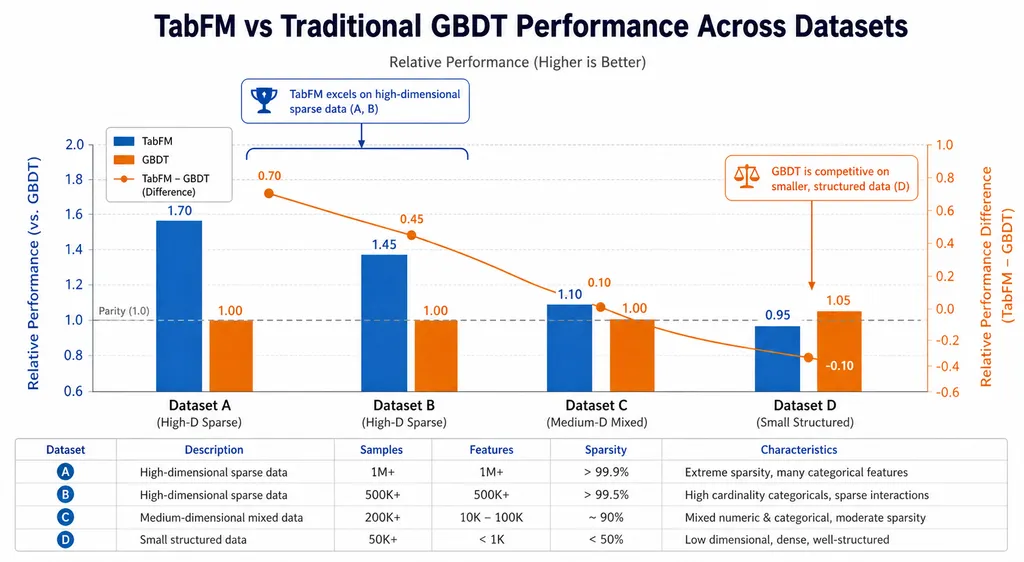
This is the most critical question. In its blog post, Google presented benchmark results across multiple datasets, showing that under zero-shot settings, TabFM can already compete with fully tuned GBDT models, and even surpass them on some tasks.
But these numbers need context. The tabular field has a long-standing issue: benchmarks are inconsistent, and results are extremely sensitive to dataset selection. McElfresh et al. conducted large-scale evaluations on 176 classification datasets and concluded that TabPFN performed best on average, but in specific domains (such as high-dimensional sparse data or extreme class imbalance), tree-based models still dominated. TabFM’s current results look impressive, but whether they hold up under independent third-party evaluations on custom datasets remains to be seen.
A tabular learning survey released last month by a team from Nanjing University made a point I strongly agree with: the value of general-purpose tabular models is not solely about surpassing specialized methods in accuracy, but about reducing the marginal cost of obtaining a usable model to nearly zero. When you need to quickly perform preliminary analysis across hundreds of tables, or provide baselines for dozens of prediction tasks in a business system, the value of TabFM’s zero-shot capability becomes very clear.
In other words, it may not appear in Kaggle championship solutions, but it could become the "first model people run" in every data scientist’s notebook.
Will It Replace XGBoost?
Not in the short term. In the medium term, it may capture part of the market.
First, TabFM’s natural advantages:
- Cold-start scenarios: when datasets are small and there are not enough samples for hyperparameter search, pretrained priors are essentially free gains
- Multi-task / multi-table environments: one model serving dozens or hundreds of tables has far lower operational cost than training a separate GBDT for each table
- Semantically rich tables: tables whose column names carry clear business meaning allow the LLM backbone to leverage semantic priors
- Rapid prototyping: generating a baseline in seconds, even product managers could use it
Now the scenarios where it is unlikely to beat GBDT anytime soon:
- Massive-scale data: for datasets with tens of millions of rows and hundreds of features, GBDT still has superior training and inference efficiency
- Extreme accuracy requirements: top Kaggle leaderboard positions are still dominated by GBDT ensembles, and TabFM’s zero-shot accuracy ceiling may not reach that level
- Pure numerical data with meaningless column names: anonymous features like
f1, f2, f3provide no semantic prior for the LLM to exploit - Latency-sensitive inference scenarios: Transformer inference costs versus a single tree traversal are on completely different scales
My view is that TabFM and similar future models will first establish themselves in the "long-tail scenarios of tabular data" — businesses where datasets are small, tasks are numerous, accuracy requirements are moderate, but rapid deployment matters. Replacing XGBoost in core production systems will likely require several more generations of iteration.
A Bigger Signal
Taking a step back, the release of TabFM sends a broader signal: the progression from "specialized models → transferable models → general-purpose foundation models" is spreading from vision and language into every data modality.
Time series already has foundation models like Chronos and Moirai. Molecular structures, proteins, and graph data are all experimenting with their own foundation models. Tabular data — one of the most common industrial data formats — had long been considered "too heterogeneous" for this approach, but that barrier is now beginning to crack.
Several future directions are worth watching for developers:
- Scaling effects: TabFM is only the beginning — how far can zero-shot capabilities go as pretraining data and parameter counts increase?
- Inference cost optimization: how can Transformer-based tabular inference approach GBDT-level efficiency while maintaining accuracy?
- Multimodal fusion: real-world business tables often include images, text, and time series; a tabular foundation model capable of consuming all these modalities simultaneously would be a major next target
- Open-source ecosystem: TabPFN is already open source, while TabFM is currently an internal Google model. Whether it becomes open source or offers APIs will determine the speed of community adoption
Google has not yet announced plans for public access to TabFM. The blog post only mentioned that more details will come later. We will continue tracking developments, and once APIs or weights become available, we will adapt them on OpenAI Hub as soon as possible.
For developers who regularly compare different models, OpenAI Hub already aggregates mainstream models such as GPT, Claude, Gemini, and DeepSeek. With a single key, users can switch between them through a unified OpenAI-compatible interface with direct access from mainland China. When new foundation models like TabFM eventually expose APIs, the integration experience will remain consistent.
References
- Zhihu Column - llm Retrieval rag-2: TabFM for Tabular Data - A Chinese interpretation of TabFM’s early technical approach, including discussion of LLM backbone fine-tuning details
- BAAI Community - Understanding Deep Tabular Data Representation Learning in One Article - A systematic survey by the Nanjing University team on tabular representation learning, with a clear categorization of technical paths for general-purpose tabular models
- GitHub - LAMDA-Tabular/Tabular-Survey - Companion repository for the above survey, including a complete evaluation framework for tabular learning methods


