
After a Three-Week Shutdown, Anthropic’s Fable 5 Returns Tomorrow
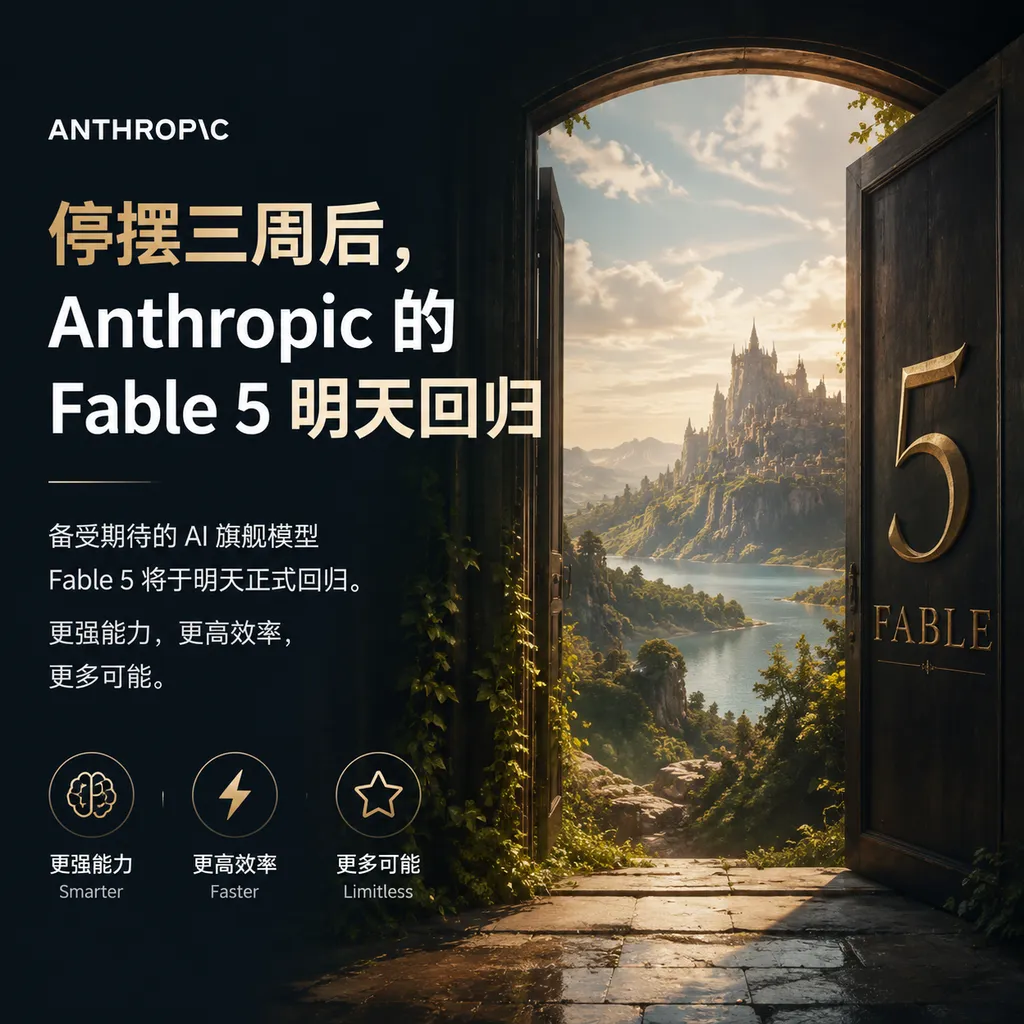
Anthropic announced that Fable 5 will be relaunched globally on the Claude platform tomorrow (July 2), with integrations for AWS, GCP, and Microsoft Foundry also to be restored as soon as possible. The export control controversy triggered by a phone call from Amazon’s security team has, for now, come to an end.
Anthropic announced today (July 1) on its official website that Fable 5 will relaunch globally on the Claude platform tomorrow, with access through AWS, Google Cloud, and Microsoft Foundry to be restored as soon as possible. It has been exactly 19 days since the rushed takedown on June 13.
For developers who have been waiting nearly three weeks, the news is timely — though the restoration comes with clear transitional restrictions: Pro, Max, Team, and Select Enterprise users will regain access, but weekly usage limits will initially be cut to 50% through July 7. As for Mythos 5, which is intended for government and enterprise customers, Anthropic said it will continue coordinating with the U.S. government to expand access under the Glasswing program, allowing more domestic and international partners to obtain permissions.
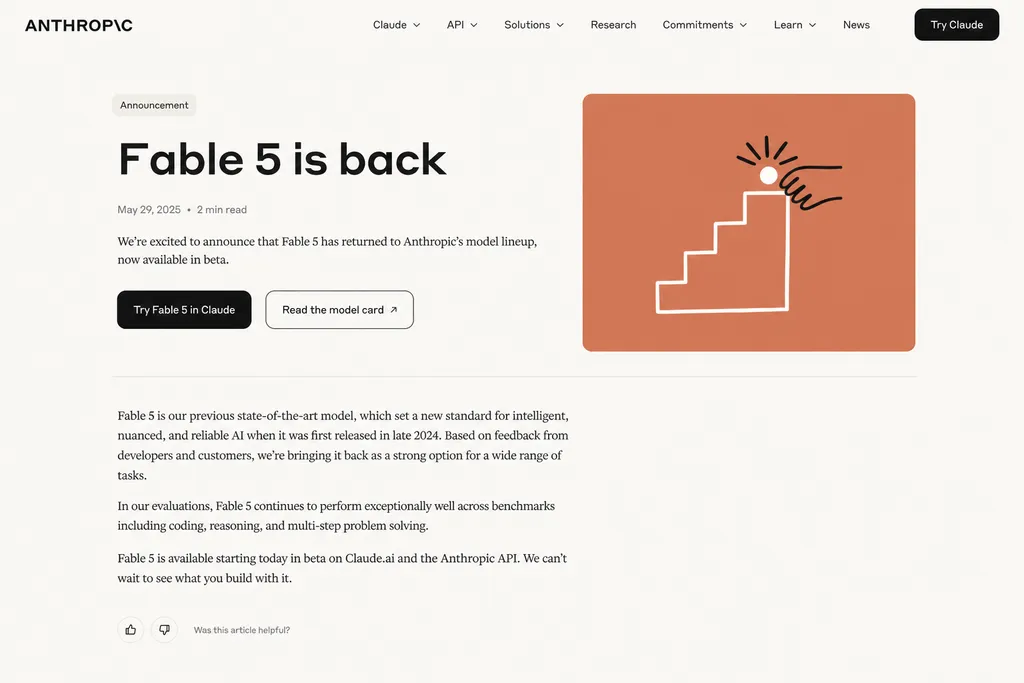
Looking Back at the Three-Week Controversy
The story began on June 9. That day, Anthropic released Fable 5, calling it the first frontier-level model “safe enough for broad use,” simultaneously launching it on the Claude API, AWS Bedrock, Google Cloud, and Microsoft Foundry. This was the first public version of the Mythos series — essentially Mythos 5 wrapped in an additional layer of safeguards for cybersecurity, biological, and chemical scenarios, while both models shared the same underlying foundation.
Three days later, things unraveled. Amazon’s security team reportedly discovered a way to bypass Fable 5’s safety guardrails and get it to output information usable for cyberattacks. According to The Information, Amazon CEO Andy Jassy did not follow the usual path of “privately notifying Anthropic first,” and instead directly contacted Treasury Secretary Scott Bessent. On June 13, the Department of Commerce issued export-control directives on national security grounds, requiring suspension of access to Fable 5 and Mythos 5 for all foreign nationals. To ensure compliance, Anthropic disabled both models for all customers altogether — because it could not distinguish foreign nationals in real time, even foreign employees inside the company were locked out.
The disagreement behind this was fairly clear. Anthropic consistently argued that the government had exaggerated the risks, and several security researchers publicly supported that position, saying Mythos-class models are indeed highly capable at vulnerability discovery and exploit weaponization, but those capabilities are not unique to Anthropic — many foundational and open-source models can do the same. Restricting Fable 5, they argued, was equivalent to “taking tools away from defenders.” Meanwhile, the White House side, including AI advisor David Sacks, explicitly stated that the government wanted Anthropic to fix the safety issues and restore full release afterward — implying that negotiation was possible, but the problems had to be addressed first.
Judging from today’s announcement, the two sides have reached an agreement.
What Kind of Model Is Fable 5?
For developers who missed the initial three-day launch window, it’s worth revisiting the model’s positioning.
In terms of specifications, Fable 5 supports a default context window of 1 million tokens and can generate up to 128,000 tokens in a single request. Pricing is $10 per million input tokens and $50 per million output tokens — exactly double the price of Claude Opus 4.8. That pricing makes it clear this is not intended for casual chat use, and Anthropic never positioned it that way.
Its real selling point is long-duration autonomous execution. When running inside agent frameworks such as Claude Code or Claude Managed Agents, Fable 5 can continue operating for hours at a time, planning across stages, dispatching sub-agents, validating its own outputs, and determining whether tasks are truly complete. Claude Code developer Boris Cherny described it as “the first model with rigorous logic and extremely high operational precision” — it evaluates first, fills in logs, verifies the issue is genuinely resolved, and only then marks the task complete. The model is clearly tuned for “letting AI independently handle several hours of work.”
AWS product documentation highlights several capabilities:
- Long-cycle asynchronous execution
- Advanced visual parsing for charts, images, and tables within PDFs
- Proactive self-verification
Supporting these capabilities is another rule: both Fable 5 and Mythos 5 are classified by Anthropic as “Covered Models,” requiring mandatory 30-day data retention with no zero-retention mode available. Anthropic says running safety classifiers requires cross-request visibility to identify patterns such as best-of-N jailbreaking, nation-state espionage activity, and large-scale data extortion — behaviors that single-request detection cannot reliably catch. Retained content is not used for training and is deleted after 30 days unless compliance obligations require longer retention.
This rule already caused friction at launch — on June 10, Microsoft acknowledged publicly that Fable 5 had been removed from its internal Copilot model selector because it conflicted with Microsoft’s own zero-retention policies, though customers could still access the model directly. That is also one reason why Microsoft Foundry integration now needs to be “re-enabled as soon as possible” — the compliance chain has to be realigned.
The Practical Impact of Restored Access
For developers, several changes are worth noting.
First, quotas are temporarily cut in half. From tomorrow through July 7, Pro, Max, Team, and Select Enterprise users will only receive 50% of their normal weekly Fable 5 usage limits. This kind of gradual reopening resembles standard post-regulatory rollout procedure — Anthropic is likely observing real-world usage patterns while giving infrastructure time to scale.
Second, access to Mythos 5 will still proceed at the pace dictated by government coordination. Expansion under the Glasswing program requires negotiating qualifications partner by partner, and Anthropic does not control that timeline alone. Mythos 5 reportedly identified tens of thousands of high-risk vulnerabilities within a month when used for critical infrastructure code auditing, making it highly attractive to national-level partners — but precisely for that reason, its access boundaries will remain politically sensitive.
Third, AWS Bedrock and Google Vertex AI integrations are only described as being restored “as soon as possible,” without specific timelines. Teams deploying production workloads on Bedrock may need to wait several more days and should monitor announcements from the cloud providers.
Looking at competitors, the three-week gap was not wasted. OpenAI previewed the GPT-5.6 lineup — Sol, Terra, and Luna variants — on June 26, while Chinese AI vendors also used Anthropic’s absence to attract developers. Whether Fable 5 can regain lost mindshare after its return remains uncertain in the short term — but one thing is clear: Anthropic’s previous rhythm of “release first, let the market adapt later” has been disrupted. Future Mythos-class model launches will almost certainly involve earlier and more proactive coordination with the White House. Other AI labs have received that signal as well.
How to Use Fable 5
For developers in China, OpenAI Hub already supports Fable 5 with OpenAI-compatible formatting, allowing access with a single API key instead of maintaining separate SDKs for different vendors. Using Python as an example:
from openai import OpenAI

client = OpenAI(
    api_key="your-openai-hub-key",
    base_url="https://api.openai-hub.net/v1"
)

response = client.chat.completions.create(
    model="claude-fable-5",
    messages=[
        {"role": "system", "content": "You are a senior software engineer. Plan before you write code."},
        {"role": "user", "content": "Help me refactor this Flask service into FastAPI and add complete pytest test cases."}
    ],
    max_tokens=32000,
)

print(response.choices[0].message.content)
If you want to fully leverage its long-duration agent capabilities — whether using Claude Code or implementing your own loop — remember to increase max_tokens. Fable 5 can generate up to 128,000 tokens in a single response, and many agent workflows stall because the default max_tokens setting is too conservative. Also make full use of the 1M-token context window: feeding relevant project files all at once often works better than repeatedly retrieving embeddings.
One Observation
In the short term, Anthropic clearly took a hit from Fable 5’s three-week suspension — the launch window was squandered, developer trust was damaged, and Bedrock and Foundry integrations now need renegotiation. But in the long term, the incident forced a previously vague issue into the open: how deeply must frontier model releases be tied to government coordination beforehand?
Anthropic is one of the leading labs most focused on AI safety. Fable 5 launched with guardrails already in place, including mandatory 30-day retention, Covered Model classification, and over 1,000 hours of external bug bounty testing — yet within three days, a phone call from a cloud provider’s security team effectively reversed the release. This was not a failure of safety capability; it was a failure of release process and government communication cadence. Going forward, any Mythos-class or GPT-5.6-class model release will require careful calculation of the “government awareness window” in advance.
For developers, though, this does not necessarily need to be viewed too dramatically. The model is back, the capabilities remain, and the pricing has not changed. The remaining question is whether this three-week suspension becomes one week next time, or one day after that. That is what will ultimately determine whether frontier models can be treated as stable production tools.
References
Current reporting on this topic mainly comes from Anthropic’s official site, 36Kr, WIRED, InfoQ, and other media outlets. Chinese-accessible technical discussions can also be followed through the following channels:
- Anthropic discussions - Linux.do: A Chinese developer community where users share practical experiences and API integration feedback for Claude-series models
- Anthropic Claude topics - Zhihu: Searching for “Claude Fable 5” or “Mythos” reveals multi-perspective analysis from Chinese technology professionals regarding this incident


