
Domestic LoopWM Tops HF: Teaching World Models to "Think for a Few More Rounds"

Chinese startup FaceMind has proposed the Looped World Model, which uses a parameter-shared recurrent Transformer to iteratively operate in latent space. It claims to achieve up to 100× parameter efficiency at around the 1B-parameter scale. The paper topped Hugging Face Daily Papers and received endorsements from Nvidia, Zhou Hongyi, and Lu Qi.
A Chinese Startup Pushes the Scaling Axis of World Models One Step Further
In the early hours of July 1, the top spot on Hugging Face Daily Papers was occupied by a paper from a Chinese team: “Looped World Models.” The authors are from a startup called “FaceMind,” whose investor list includes Zhou Hongyi and Kai-Fu Lu. Nvidia’s official account also reposted and liked the paper on X.
For the world model track, this is not just another routine “state-of-the-art benchmark refresh.” What it proposes is more fundamental: a new scaling axis for world modeling — iterative latent depth. In plain language, instead of endlessly making models larger or feeding them more data, the model learns to “think for a few more rounds” when needed.
The Old Problem of Traditional World Models: One-Shot Computation
To understand what LoopWM is solving, you first need to see the structural awkwardness of traditional world models.
The core task of a world model is to simulate environmental evolution — given a current state and action, predict what will happen in the next moment. It sounds similar to next-token prediction in language models, but the difficulty is on an entirely different level: language models only need to predict one token, while world models must predict the unfolding of an entire set of physical dynamics over time.
Previous approaches mostly followed two paths: either scale the model larger or increase the amount of training data. But world models face a unique contradiction — long-horizon simulation requires deep computation, while deep models are expensive and prone to accumulating errors. You can stack a Transformer to 100 layers, and each forward pass may indeed become more precise, but every rollout step must still run through all 100 layers. After hundreds of steps, latency explodes, and errors compound autoregressively.
Even more awkwardly, traditional architectures allocate a fixed amount of computation to every state transition. Whether the step is something simple like “an apple falling off a table” or something complex like “multi-object chain collisions,” the network depth is the same. That clearly does not reflect how the real world works — environmental evolution naturally varies in difficulty.
LoopWM’s Approach: Repeatedly Applying the Same Parameters
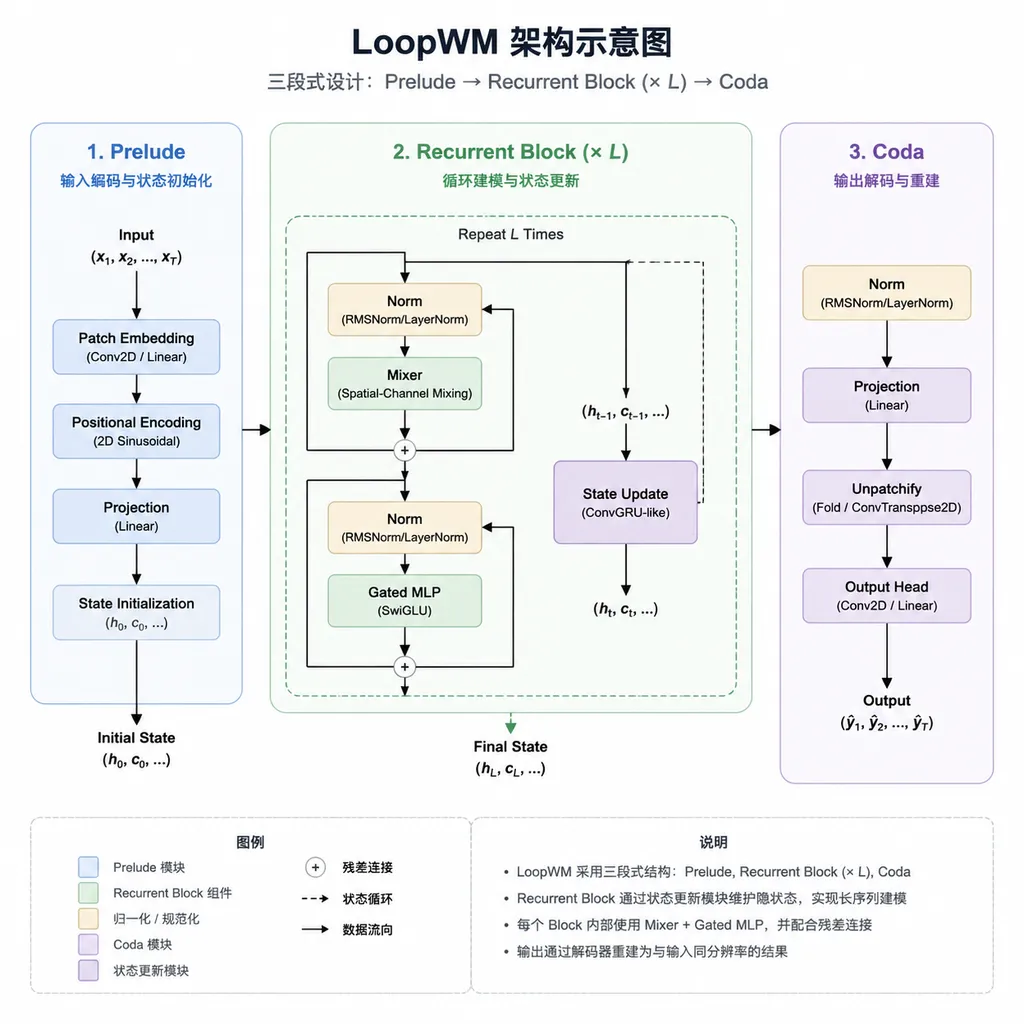
FaceMind’s solution is to bring the looped transformer into world modeling for the first time. The overall architecture consists of four parts: an observation encoder, an action embedder, a Looped Dynamics Core, and a prediction head. The first and last parts are fairly standard; the real innovation lies in the middle.
The Looped Dynamics Core is further divided into three stages:
- Prelude: organizes the previous state, current observation, and current action into an initial representation suitable for reasoning
- Recurrent Block: the core component, where a group of shared-parameter Transformer blocks repeatedly iterates and updates the latent state
- Coda: after the loop ends, reshapes the final latent representation into an output that the prediction head can decode
The most counterintuitive aspect of this design is parameter sharing in the Recurrent Block. In other words, if you let the model iterate 8 times, it is not running through 8 different Transformer layers — it is repeatedly invoking the same set of weights 8 times. The parameter count stays the same, but the effective computational depth increases.
This may sound like an engineering trick, but FaceMind’s argument is deeper: real-world evolution itself is the repeated application of stable dynamics. Repeatedly applying a shared update operator to latent states makes the model’s computation graph more closely aligned with the iterative structure of environmental dynamics. This is an “architectural prior,” not simply brute-force scaling.
Two Key Designs: Deferred Decoding and Early Exit
Loops alone are not enough. In long-horizon rollouts, two additional mechanisms are what make the system actually work.
Deferred Decoding: During multi-step rollout, the model no longer rushes to reconstruct latent states into explicit observations after every step. Instead, it performs continuous reasoning in latent space and only decodes when output is actually needed. The logic is straightforward — constantly translating back into observation space interrupts computation and makes long-term structure modeling more difficult. Experiments in the paper show that the longer the rollout horizon, the greater the benefit from Deferred Decoding.
Early Exit: This is what enables the model to “think on demand.” A lightweight gating mechanism evaluates after each iteration whether the latent state has already converged. If the transition is simple enough, the model exits the loop early; if the interaction is complex, it performs more iterations. This adaptive computation mechanism allows LoopWM to truly optimize inference cost — spending compute where necessary and saving it where possible.
Put these four ingredients together — shared parameters, iterative refinement, stable looping, and adaptive computation — and LoopWM becomes a complete system.
Experimental Results: A 1B-Parameter Model Beats Closed-Source Giants
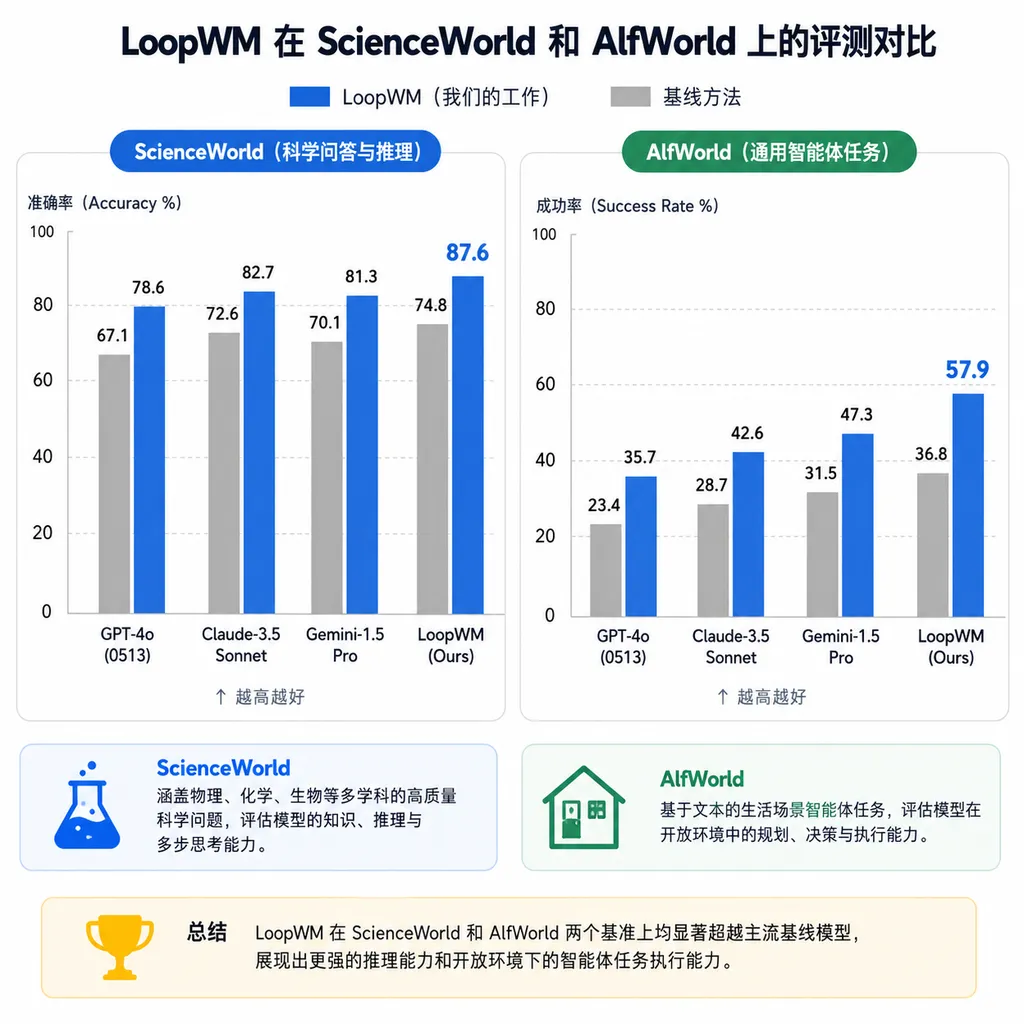
For evaluation, FaceMind tested LoopWM on the classic embodied-task environments ScienceWorld and AlfWorld. Competitors included top-tier closed-source models such as Claude-opus-4-6-max, Qwen-3.5-flash, and Gemini-3-flash-preview-thinking.
On ScienceWorld, the roughly 1B-parameter LoopWM achieved:
- EM: 68.4% (vs. Claude-opus-4-6-max at 47.2%)
- Token F1: 85.3% (vs. 72.8%)
- BLEU-4: 80.7%
- Entity: 83.9%
Even more striking was the Lifespan subtask, where the paper reports that LoopWM improved the score from 0% to 100%. This is not a marginal improvement — it suggests that iterative latent depth may produce a structural leap in capability for certain long-horizon reasoning scenarios. Previous models were not merely slightly worse; they fundamentally could not solve the task.
On AlfWorld, it achieved: EM 51.6%, Token F1 80.4%, and BLEU-4 71.6%, with particularly strong BLEU performance.
All of this was achieved with only about 1B parameters. This is where the eye-catching claim of “up to 100× parameter efficiency” comes from.
The Real Story Is Not “100× Parameter Efficiency,” but the New Scaling Axis
It is easy to get distracted by the “100×” figure after reading the abstract, but the real significance of this paper is that it introduces “iterative latent depth” as a scaling dimension orthogonal to both parameter count and training data.
Over the past few years, from GPT-3 onward, the industry’s conception of scaling has largely revolved around two things: model size and data volume. OpenAI’s o-series later added a third dimension — test-time compute — but that mostly involved “thinking a few more steps” at the output level. LoopWM pushes this idea deeper into the architecture itself: the same parameterized operator repeatedly acts on latent states to improve simulation quality.
This direction is especially valuable for resource-constrained deployment. What it offers is not merely “a more expensive capability ceiling,” but “a smarter way to allocate computation” — saving compute for simple scenarios and spending extra iterations on complex ones, extracting more capability from the same parameter budget. For embodied AI, robotics, autonomous driving, and other applications that require both long-horizon planning and low latency, this may matter far more than yet another general-purpose LLM benchmark victory.
That said, caution is warranted. The beauty of recurrent models is that they can iterate repeatedly; the danger is exactly the same. Once state updates become even slightly unstable, hidden states can explode across multiple iterations. This is also why looped transformers were explored early in NLP but never achieved widespread adoption. FaceMind spends a substantial portion of the paper discussing how to maintain loop stability — whether this stability can hold at larger parameter scales and longer rollout horizons remains to be seen.
A Different Kind of Chinese Startup
FaceMind previously had relatively little visibility in China’s AI community, but two details are worth noting:
First, the investor list — both Zhou Hongyi and Kai-Fu Lu are involved. Their judgment carries considerable weight in China’s AI investment scene, especially Kai-Fu Lu, who rarely publicly backs embodied AI or world model projects.
Second, Nvidia reposted the paper on X. Nvidia sharing papers is not unusual in itself, but the company typically highlights work that it sees as valuable for GPU deployment paths or indicative of a paradigm shift. LoopWM’s adaptive computation properties are likely one reason it attracted attention.
There are not many teams in China working on world models, and even fewer that receive recognition simultaneously from Hugging Face rankings and Nvidia’s official channels. Reaching the top of the charts is not the finish line. The real question is whether this architecture can hold up at larger scales and in more complex environments, and whether other teams will successfully reproduce and extend it.
Regarding model weights and inference access, if FaceMind open-sources the LoopWM checkpoints in the future, OpenAI Hub plans to integrate them into its model pool immediately, accessible with a single API key and compatible with the OpenAI format. Since world models and LLMs differ significantly in their invocation paradigms, we are also preparing dedicated integration documentation.
References
- Looped World Models — Hugging Face Papers: Original paper page, top-ranked on Daily Papers
- World-in-World: World Models in a Closed-Loop World: Related work discussing world model evaluation in closed-loop environments
- Top 10 Most Noteworthy Papers of the Week — Hugging Face Blog: Weekly roundup of trending papers, including work on world models


