
AWS Spends $1 Billion to Station Engineers On-Site, Competing for the Last Mile of Agent Deployment

AWS has officially established the FDE (Forward Deployed Engineer) division, investing $1 billion to place engineers inside client offices and help enterprises get AI Agents truly up and running. This is the cloud giant’s version of the Palantir playbook, and one of the few genuine growth tracks in the current AI industry.
AWS Has Started Selling “People” Too
On July 1, at AWS’s customer summit in Washington, the company unveiled a new organization: Forward-Deployed Engineers (FDEs). AWS is investing an initial $1 billion and scaling the team to several thousand people, with one mission only: send engineers directly into customer companies, embedded on-site in 5–6 person teams for 45-day rotations, helping clients push AI Agents from PoC into production.
At first glance, this news may seem minor, but the implications are significant. One of the world’s largest cloud vendors is beginning to sell engineers as a product instead of continuing to pile on EC2 and Bedrock SKUs. The signal behind this move is clear: the battle at the model layer is largely settled, and Agent deployment is the real cash cow for the next two years—a territory the tech giants still haven’t fully claimed.
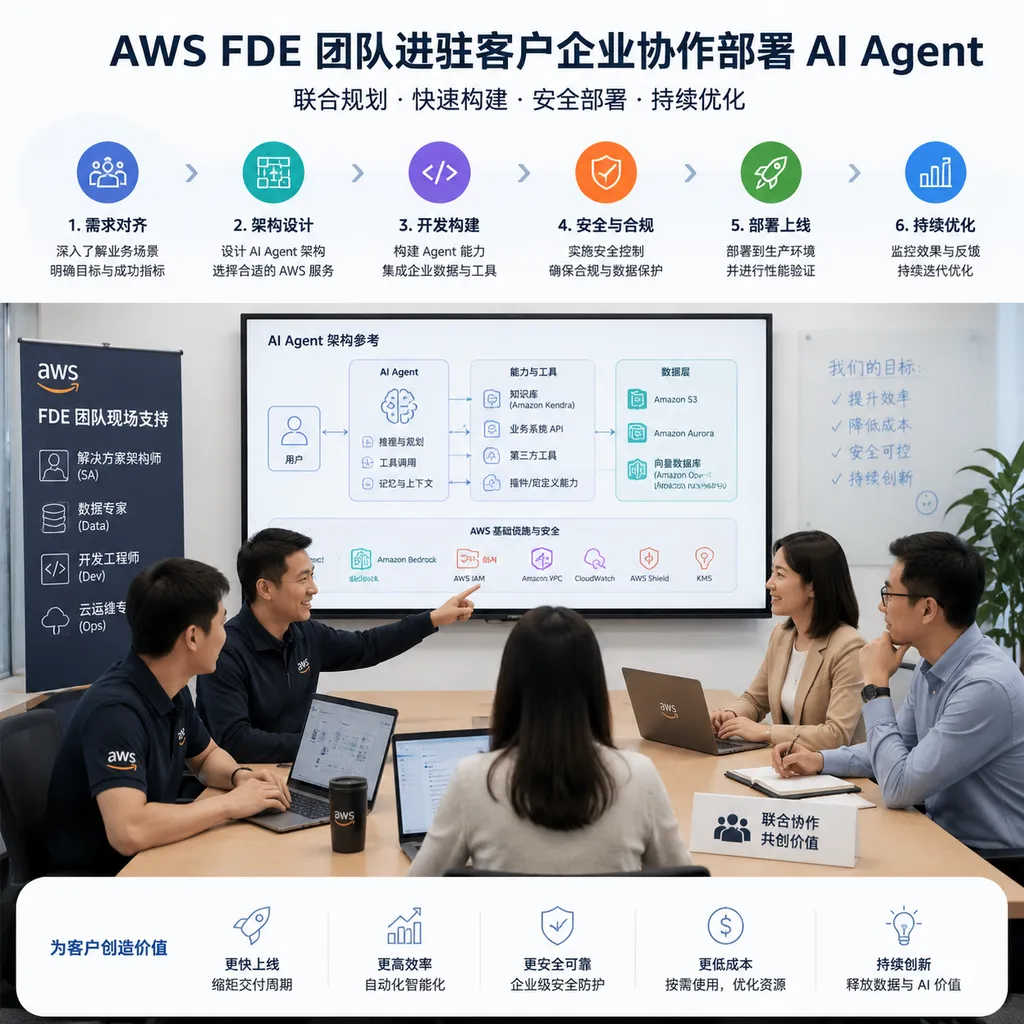
What Is an FDE? A Playbook Palantir Has Used for More Than a Decade
Anyone familiar with Palantir probably recognizes the term FDE. From day one, Palantir never followed the traditional “sell software licenses” SaaS route. Instead, it embedded engineers directly inside the offices of the CIA, military organizations, and major pharmaceutical companies, sitting alongside client business teams while simultaneously understanding workflows, writing code, and training models. What they sold wasn’t software—it was “solutions that actually work.”
The business results of this model have been remarkable: extremely high switching costs, combined with a hybrid revenue structure of service fees plus licenses, have accelerated Palantir’s revenue growth over the past 10 quarters. At one point, Wall Street valued it even more aggressively than many pure SaaS companies.
Now the entire AI industry is copying this strategy:
- OpenAI: FDE initiative in partnership with private equity firms, reportedly around $4 billion in scale
- Anthropic: Similar mechanism, approximately $1.5 billion
- Salesforce and Google Cloud: Both have launched comparable embedded service models
- AWS: Entering with $1 billion—not the largest in scale, but backed by the strongest cloud infrastructure distribution capability
AWS AI executive Francessca Vasquez framed it officially: “Customers leave FDE engagements not only with a solution, but also with reusable engineering methods, workflows, and AI practices.” Translated more plainly: we won’t just build it for you—we’ll teach you how to do it, so you’ll keep spending on AWS in the future.
Why Now? Because Agents Are Stuck at the “Last Mile”
Over the past two years, enterprise AI adoption has shown a strange split: PoCs move fast, but production deployments fail en masse.
Model capability has long been sufficient. Claude 3.5, GPT-4o, Gemini 2.5, DeepSeek V3, and other mainstream models all perform well on standard benchmarks. The real problems are elsewhere:
- Understanding business processes: Internal approval chains, data silos, and permission systems are unknown both to models and often to engineers
- Data accessibility: Enterprise data is messy, fragmented, or locked inside SAP/Oracle systems—if Agents can’t access it, they’re effectively blind
- Reliability tuning: Agents work in demo environments but drift, hallucinate, or time out in production, requiring extensive prompt/tool/evaluation engineering
- Organizational resistance: Business teams fear Agents will replace jobs, while IT departments see high risk and accountability
Customers cannot realistically navigate all these pitfalls alone. Traditional consulting firms like Accenture and Deloitte move slowly, charge heavily, and often lack sufficient technical depth; pure software vendors, meanwhile, don’t want to get their hands dirty with implementation work. The FDE model fits perfectly in the middle: technically capable, business-aware, able to write production code, and optimized for rapid project delivery.
A LinkedIn report earlier this year showed that demand for FDE and similar roles increased by an astonishing 42x between 2023 and 2025. Box CEO Aaron Levie said in May that FDEs are “about to become one of the highest-demand roles in tech.” That’s not an exaggeration—compensation packages for FDE positions in Silicon Valley are now roughly on par with senior ML engineers, and some elite client projects reportedly offer seven-figure compensation.
AWS’s Strategy: Bypass Consulting Firms and Bind Customers Directly
Several details of AWS’s move are worth examining.
First: where the money comes from. The $1 billion is not new budget—it’s a reallocation of internal resources. Since October last year, Amazon has laid off more than 30,000 corporate employees while the new division plans to hire thousands of people through both external recruitment and internal transfers. In other words: cut costs from traditional businesses and feed them into AI services. A classic strategic resource reshuffling.
Second: why not outsource to partners. Traditionally, AWS has relied heavily on its Partner Network, with implementation work handled by SIs such as Accenture, Deloitte, and Slalom. By stepping in directly, AWS is effectively acknowledging that partners cannot keep up with the speed and delivery demands of the Agent era. Enterprise Agent deployments are short-cycle and highly iterative, with models updating every few months. The traditional “bill by person-month” SI model simply doesn’t fit anymore.
Third: how KPIs are defined. Vasquez was very direct: success is measured by “how quickly customers can build new products and master new technologies with the help of embedded engineers.” Notice what’s missing: revenue and project count. The real KPI is the customer’s time-to-value. It’s a smart setup:
Rapid business value delivery → exponentially stronger customer dependence on the AWS ecosystem → natural growth in Bedrock, SageMaker, S3, and EC2 consumption.
A $1 billion service investment ultimately drives long-term cloud infrastructure spending.
First customers: the NBA and Ricoh. One represents sports entertainment (likely involving data analytics, content generation, and fan interaction Agents), while the other is a legacy electronics/office equipment company (predictive maintenance, supply chain optimization, and customer service automation are likely targets). The logic behind choosing these two as showcase customers is obvious: one is highly visible and media-friendly, the other highly traditional and broadly representative.
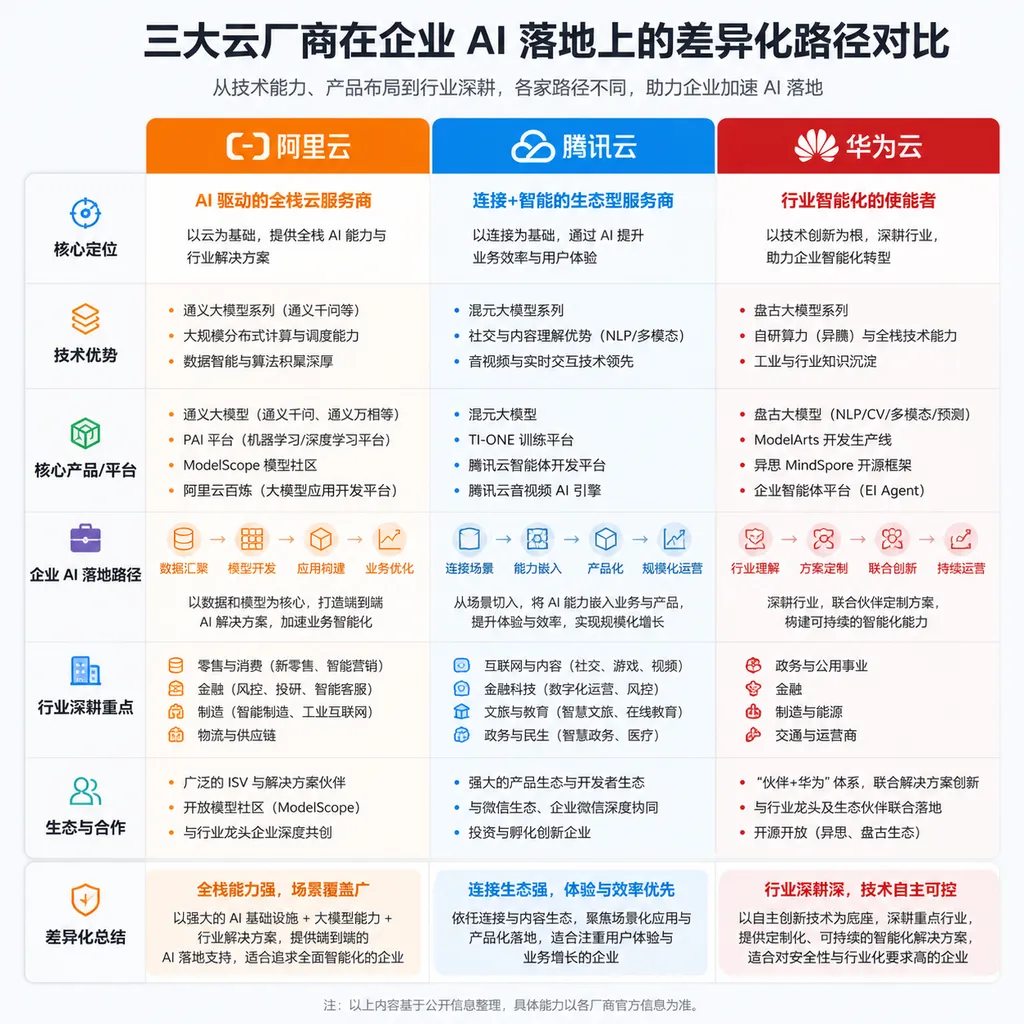
Different Strategies Among Cloud Giants
Comparing the enterprise AI deployment strategies of the three cloud giants reveals very different personalities:
- Microsoft Azure: Leverages Copilot + Office ecosystem lock-in, pursuing a “productization” route that gets employees using AI daily
- Google Cloud: Builds around Gemini + Vertex AI + Agentspace, pursuing a “platformization” strategy focused on developer tooling
- AWS: With FDEs, it is taking the “service-oriented” route—sending people directly into the field to solve problems
AWS’s choice actually aligns perfectly with its DNA. Azure has the natural distribution advantage of Windows and Office. Google has user familiarity through Search and Workspace. AWS has always been deeply rooted in B2B enterprise IT, with customer relationships built around deep integration. Sending engineers on-site is simply an extension of its existing “high-service, tightly coupled” operating model.
What This Means for Developers
If you are an AI engineer or architect on the front lines, this news carries at least three important signals.
1. FDE Will Become a Formal, High-Paying Career Path
Previously, engineers moving into “customer success” or “solutions architect” roles often felt they were stepping away from core technical work. FDE is different. It requires the ability to write production code (Agent orchestration, tool calling, RAG pipelines, evaluation frameworks), understand business workflows, and communicate with client executives. Technical depth isn’t reduced—if anything, the role demands broader capabilities. Compensation is also rapidly catching up with, or even surpassing, pure R&D positions.
If you’re considering your next career move, FDE roles deserve serious evaluation.
2. Agent Deployment Will Drive a New Wave of Standardized Tools and Platforms
An on-site organization with thousands of engineers cannot rewrite everything from scratch for every engagement. AWS will almost certainly launch more managed services for Agent orchestration, evaluation, monitoring, and observability to support scalable FDE delivery. Bedrock Agents will likely gain an “Enterprise” or “Advanced” tier in the future. Developers who familiarize themselves early with these toolchains will effectively secure a position in the ecosystem ahead of time.
3. Multi-Model Strategies Will Remain the Norm
The core of the FDE model is not locking customers into a single model—it’s selecting the best model for each scenario. Enterprise clients are extremely sensitive about model selection:
- Legal and compliance workflows may favor Claude’s cautiousness
- Code generation may use GPT or DeepSeek
- Multimodal and retrieval-heavy tasks may rely on Gemini
- Cost-sensitive scenarios may directly use open-source models
This demand for “scenario-based model composition” is exactly why aggregation platforms like OpenAI Hub exist: one API key providing access to GPT, Claude, Gemini, DeepSeek, and other mainstream models, with direct connectivity in China and OpenAI SDK compatibility, making Agent prototyping and multi-model comparison much more convenient for developers.
A More Skeptical Perspective: Will FDEs Stay Hot Forever?
A dose of skepticism is warranted. The FDE model is booming today largely because Agent deployment is still in its “manual era,” requiring heavy engineering involvement. But this window won’t last indefinitely.
As Agent platforms become more mature—with automated tool generation, workflow orchestration, and evaluation loops—many tasks that currently require a 45-day on-site FDE engagement may eventually be completed by a mid-level engineer using platform tools in just a few days. Palantir maintained its moat for 15 years because its domains (military intelligence, finance) are inherently highly customized. But many enterprise AI use cases are ultimately standardizable.
So whether AWS’s $1 billion investment succeeds depends on whether it can turn FDE delivery experience into reusable products and platforms. If it merely sells manpower, it will eventually fall into the same trap as traditional consulting firms: limited gross margins, high attrition, and constrained scalability.
That’s why Vasquez emphasized “exporting reusable engineering methods, workflows, and AI practices.” If AWS can hold that line, the $1 billion is an investment. If not, it has simply bought itself a staffing company.
The next year will be interesting to watch. The key question is whether AWS can make embedded engineering feel like cloud computing itself: high leverage, high margin, and highly sticky.
References
- Amazon AWS Invests $1 Billion to Send Engineers Into Customer Companies - IT Home: The primary Chinese-language report on this event, covering the scale of the FDE initiative, deployment cycles, initial customers, and other core details.


