
Nairui Radar Releases the "Ruichen" Meteorological Large Model: An AI-Based Attempt at Short-Term Nowcasting
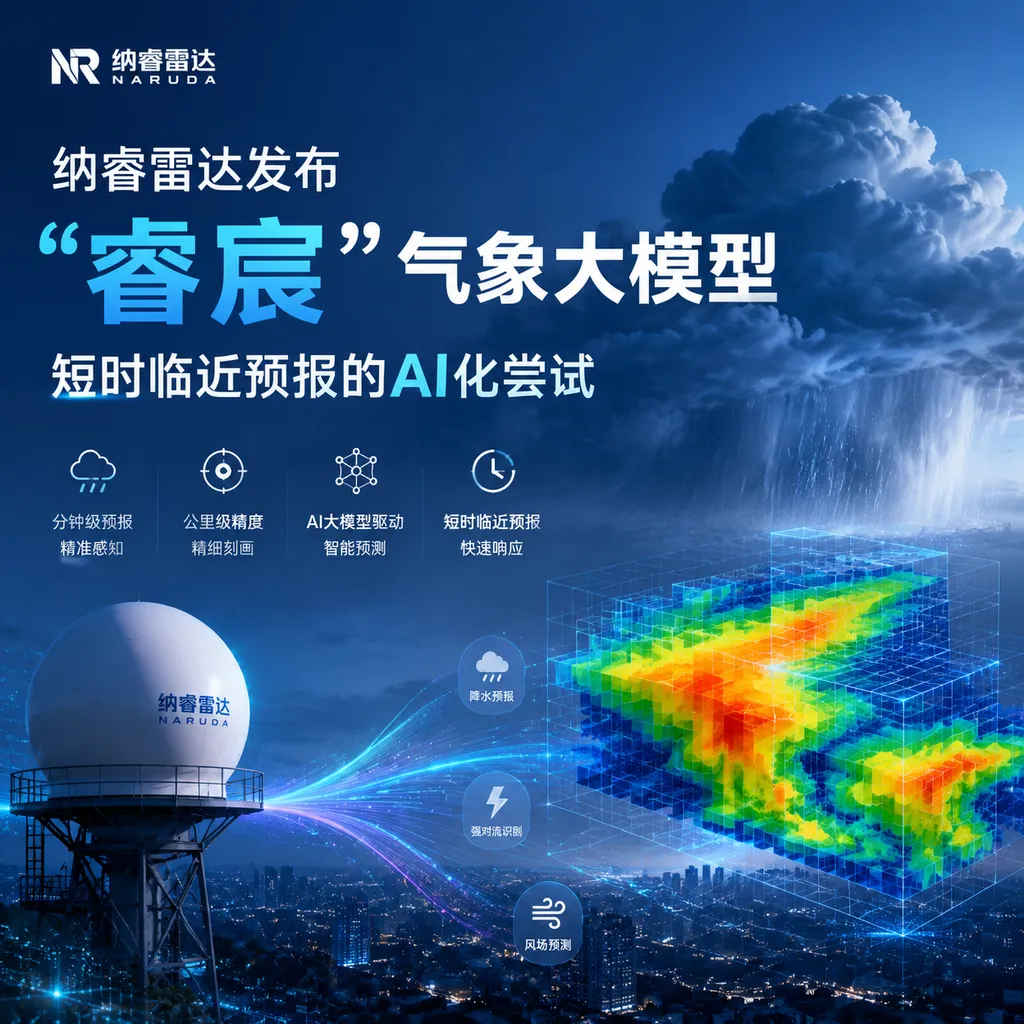
On July 1, Naradar officially unveiled its S-band full-polarization phased array radar and the "Ruichen" AI meteorological large model, entering the ultra-fine short-term nowcasting field. Following Huawei’s Pangu and Shanghai AI Lab’s Fengwu, this marks another Chinese company betting on meteorological AI, though commercialization is still in its early stages.
On the evening of July 1, A-share listed company Nav Radar (688522.SH) disclosed an announcement, officially unveiling for the first time its self-developed “WDSPT0152” S-band fully polarimetric multifunction active phased-array radar, along with the accompanying “Ruichen” ultra-fine short-term nowcasting AI weather foundation model. The line in the announcement stating that “the new products are still in the early stages of development, have not yet obtained customer orders, and future revenue remains uncertain” was refreshingly candid. But what the market is paying attention to is not the orders—it is why a company originally focused on radar hardware chose this moment to launch a weather foundation model.
Short-Term Nowcasting: The Window Opened by AI
First, what does “ultra-fine short-term nowcasting” actually mean? In meteorology, forecasts are generally divided by time horizon: 0–2 hours is called nowcasting, 0–12 hours is short-term forecasting, and beyond that comes short-range, medium-range, and long-range forecasting. The hardest part of nowcasting is that traditional numerical weather prediction (NWP) models take anywhere from tens of minutes to several hours to run once. By the time the results come out, severe convective weather such as thunderstorms, hail, and tornadoes may already have occurred.
As a result, over the past two decades, nowcasting has mainly relied on radar extrapolation—treating radar echoes as images, using optical flow methods to calculate motion vectors, and then linearly extrapolating 30 minutes to 2 hours ahead. This approach works reasonably well for uniformly moving stratiform clouds, but fails when confronted with the formation, dissipation, merging, and splitting of strong convection systems. That is why the industry felt that “AI had finally reached the threshold of nowcasting” when DeepMind released DGMR in 2021 and Tsinghua University published NowcastNet in Nature in 2023.
Nav Radar positions “Ruichen” in this track, with an approach quite similar to the NowcastNet lineage: using generative models to learn the spatiotemporal evolution of radar echoes, rather than explicitly solving fluid dynamics equations. The advantage of this path is fast inference—it can generate forecasts for the next two hours at kilometer-level or even hundred-meter-level spatial resolution within seconds. The downside is weak interpretability and the risk of “collapse” when encountering extreme events outside the training distribution.
The announcement itself did not disclose the model architecture, but judging from the naming and the “ultra-fine” positioning, it is most likely an implementation of a diffusion model or Transformer variant on radar grid data. This has been the mainstream paradigm in weather AI since 2024.
The Hardware + Model Combination Is the Real Strategy
What truly differentiates “Ruichen” from the open-source weather foundation models out there is the radar system it is tied to.
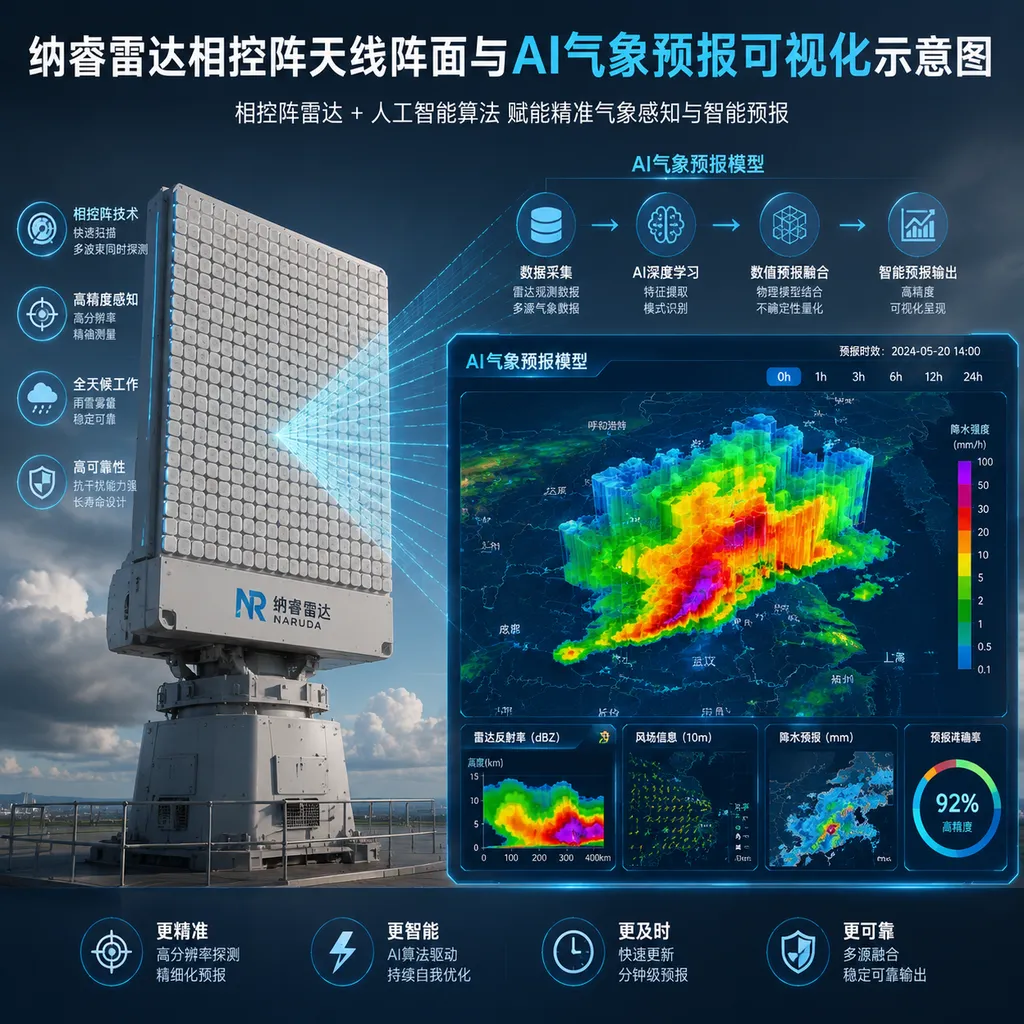
Released alongside “Ruichen,” the WDSPT0152 is an S-band (10 cm wavelength) fully polarimetric active phased-array radar. All three keywords here matter:
- S-band: Long wavelength, strong penetration capability, and low attenuation in heavy rainfall, making it suitable for long-range detection and storm monitoring. China’s new-generation weather radar network (CINRAD) is primarily based on S-band systems.
- Full polarization: Simultaneously transmits horizontal and vertical polarized waves, allowing it to determine raindrop shapes and infer precipitation phase states and particle size distributions for rain, snow, and hail. Traditional single-polarization radar cannot do this.
- Active phased array: Electronic scanning replaces mechanical scanning, reducing full-scan time from 5–6 minutes to under 1 minute. The order-of-magnitude increase in data refresh rate gives AI models sufficiently dense time-series data to learn from.
You can see Nav Radar’s underlying judgment here: competition in weather foundation models will ultimately come down to data sources. Huawei’s Pangu Weather, Shanghai AI Lab’s Fengwu, and DeepMind’s GraphCast were all trained on ERA5 reanalysis data, targeting global mesoscale forecasting at kilometer-level resolution and timescales from 6 hours to 10 days. But for hundred-meter-level, minute-scale nowcasting, ERA5 resolution is insufficient—radar data is required instead. Since there are only limited S-band dual-polarization radar systems nationwide, companies that can build their own radar systems, collect their own data, and train their own models naturally possess barriers to entry in this niche scenario.
This also explains why Nav Radar bundled the radar and model release together. Selling the model alone has no moat—open-source weather models are everywhere. Selling radar alone is an old business with a visible ceiling. Packaging hardware + algorithms + services into a single solution for civil aviation, meteorological bureaus, and local emergency management agencies is where the story becomes compelling.
Competitive Landscape: This Track Is No Longer Empty
Looking at the domestic and international landscape, weather AI can roughly be divided into three layers:
| Layer | Time Horizon | Representative Models | Data Source | | --- | --- | --- | --- | | Medium-range numerical forecasting | 1–14 days | Huawei Pangu Weather, Shanghai AI Lab Fengwu, DeepMind GraphCast, GenCast, Microsoft Aurora | ERA5 reanalysis | | Short-term forecasting | 0–12 hours | Google MetNet-3, Fuxi Nowcasting | Satellite + radar + observation fusion | | Nowcasting | 0–2 hours | DeepMind DGMR, Tsinghua NowcastNet, Nav Ruichen | Primarily radar echoes |
At the upper end, Nav Radar clearly does not intend to compete with Huawei or Microsoft in medium-range forecasting—that is a field involving trillion-parameter models, thousands of H100 GPUs, and global reanalysis datasets. At the lower end, academic models like NowcastNet lack hardware integration and are difficult to directly commercialize. Nav Radar positions itself at the nowcasting layer, building something with a higher degree of productization and more vertically focused scenarios.
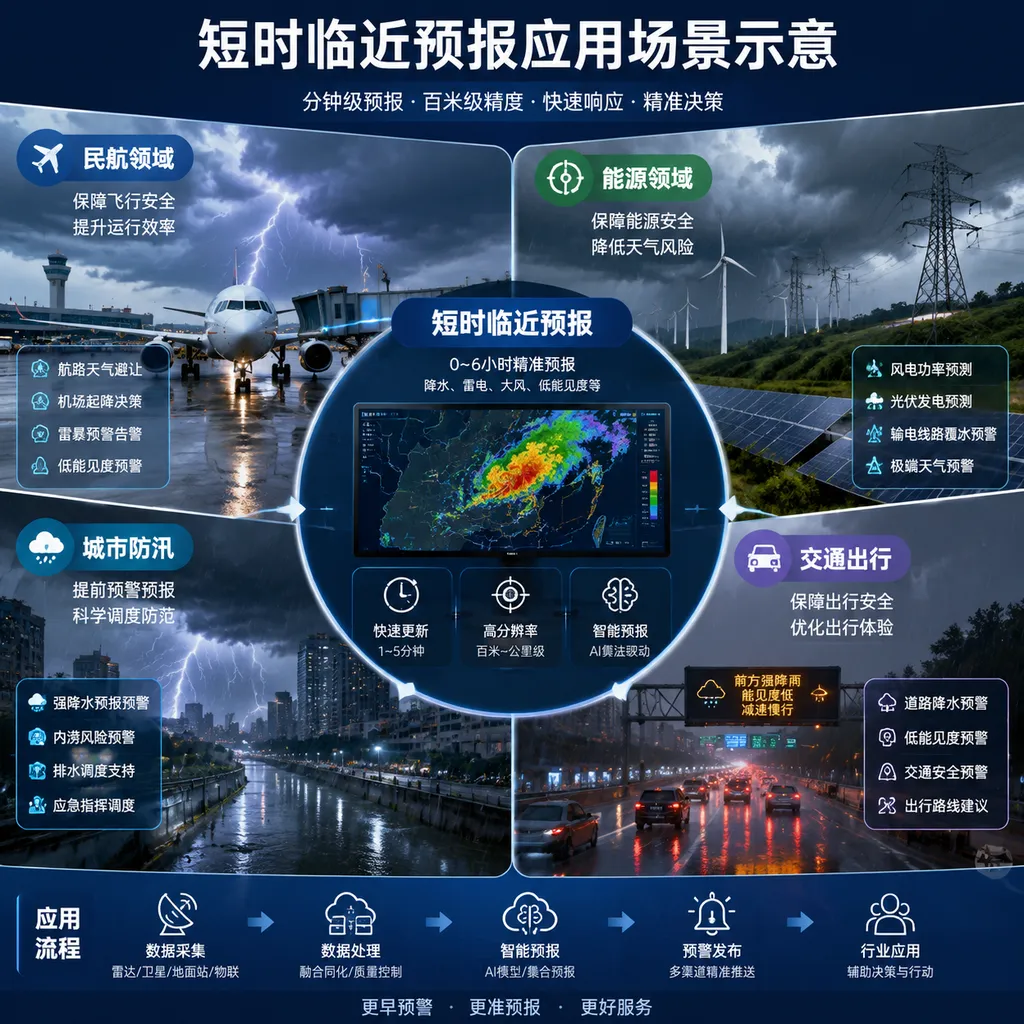
The use cases are not hard to imagine: whether thunderstorms will pass over airport runways in 15 minutes, whether highway visibility will drop below 200 meters in the next 30 minutes, irradiance changes at photovoltaic plants over the next two hours, or rainfall intensity in flood-prone urban districts over the next 90 minutes. These are all scenarios beyond the granularity of traditional NWP outputs, and they are also sectors with customers willing to pay directly.
Commercialization: The Phrase “No Customer Orders Yet” Is Critical
This is where cold water needs to be poured.
Nav Radar explicitly stated in the announcement that it “has not yet obtained customer orders.” This is not boilerplate language—it reflects reality.
The downstream customer structure for weather services is highly fixed: the China Meteorological Administration system, civil aviation meteorology, the military, and industry-specific weather services (energy, transportation, agriculture, insurance). Each of these markets has its own entry barriers and procurement cycles. National weather radar networks led by meteorological authorities are procured through bidding processes; civil aviation meteorology requires CAAC airworthiness certification; industry weather services are the most market-driven but require accumulated case studies and reputation. A newly launched radar + model system generally takes 12–24 months from demonstration to actual order fulfillment.
So this “Ruichen” release looks more like a strategic positioning move—establishing the label “we also have an AI weather foundation model.” What matters next is whether the product can demonstrate real-world performance, integrate into formal meteorological bureau operational systems, and secure pilot projects with major industry customers. This is the conventional path for radar equipment manufacturers entering the software services market, similar to the route taken over the past decade by internet weather service providers such as Moji Weather and Seniverse, except that Nav Radar is entering from the hardware side.
From a secondary market perspective, Nav Radar has mainly been valued as a “domestic substitution play for civil aviation weather radar” since its listing. AI weather foundation models provide a new layer of imagination. But meaningful revenue contribution is unlikely to materialize before 2027 at the earliest.
Observations for Developers
For developers building industry applications, several signals are worth watching:
- Weather AI is moving from research into engineering. Huawei Pangu and Fengwu have already been open-sourced or partially open-sourced, and with ECMWF officially launching AIFS, you can now run a medium-range forecasting model on your own servers. The open-source ecosystem for nowcasting is not mature yet, but it probably will be within one or two years.
- Data acquisition is harder than model building. Medium-range forecasting has public datasets like ERA5, but obtaining high-quality radar data for nowcasting is difficult. Companies like Nav Radar that generate their own data are scarce resources at this layer.
- Industry weather services are an underestimated opportunity. Sectors such as renewable energy, logistics, insurance, and agriculture are increasingly willing to pay for high-precision, high-frequency weather data. Startups building industry weather SaaS struggled with fundraising in previous years, but AI may now reduce costs enough to make the business model viable again.
If you are building applications around weather data yourself—for example integrating forecast results into business systems, creating anomaly alerts, or building time-series models—you typically still need a general-purpose LLM for the natural language layer, from intent parsing to alert text generation. These general capabilities are now very inexpensive. Through aggregation platforms like OpenAI Hub, a single API key can access GPT, Claude, Gemini, and DeepSeek simultaneously, making benchmarking and fallback easier. As for weather models themselves, proprietary deployment or data-service delivery remains the more realistic path in the short term; general API gateways are unlikely to cover this layer anytime soon.
Conclusion
Meteorology is a classic vertical domain for AI deployment for a simple reason: highly structured data, clear objective functions, stable paying customers, and significant social value. Over the past two years, research institutions and major tech companies have already validated the momentum of this field. What comes next is direct competition among equipment manufacturers, industry service providers, and data platforms.
The release of Nav Radar’s “Ruichen” signals a transition for China’s weather AI industry from algorithm competition toward engineering and productization. It will not ignite public discussion the way GPT-5 does, but for developers in meteorology, civil aviation, energy, and related downstream sectors, it is a product line worth watching closely over the next one to two years.
The announcement’s statement that “future revenue remains uncertain” is a short-term risk disclosure, but in the long term it is also an honest footnote to this path—good technology still has to prove itself in the market.


