
Parsewise Launches Cross-Document Reasoning API: An Alternative Path Beyond RAG
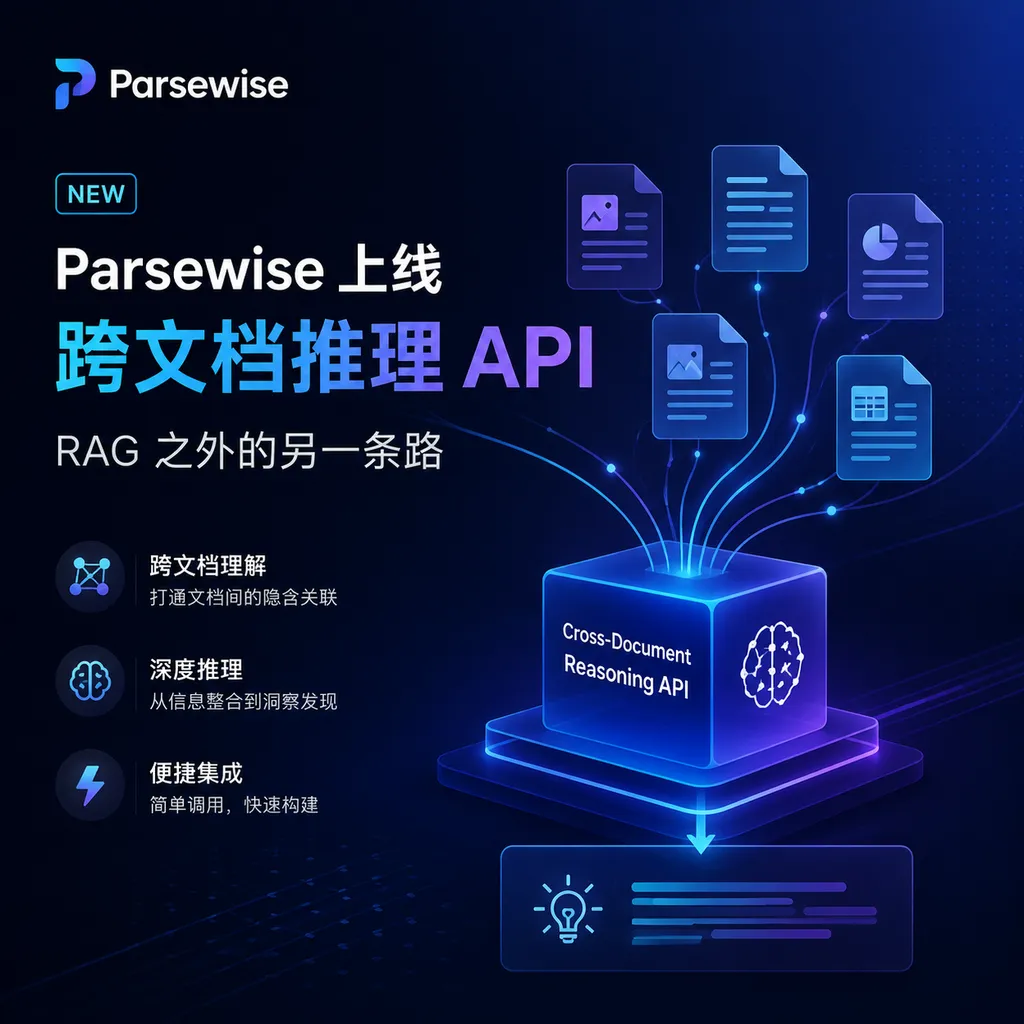
Parsewise, from YC’s P25 batch, released a document reasoning API yesterday, focused on cross-document reasoning across multiple files, entity linking, and contradiction detection. This is not another RAG wrapper, but a complete rethinking of the task of “reading a stack of documents to answer a question.”
Another Document AI Startup, but This Time the Approach Is Different
YC P25 startup Parsewise posted its Launch thread on Hacker News yesterday, officially releasing its document reasoning API. The team’s positioning is straightforward: not a single-document parser, and not yet another RAG wrapper, but a system specifically built to solve one thing — cross-document reasoning.
Sounds like another product wrapping an LLM? Not so fast. Over the past two years, document AI startups have exploded in number: Unstructured, LlamaParse, Reducto, Chunkr, plus every cloud vendor’s Document AI offering. The space is crowded to the point of suffocation. But if you look closely at Parsewise’s angle, you’ll notice they’re not focused on “parsing PDFs more cleanly.” They’re targeting a problem that anyone who has built RAG systems has suffered through: once an answer needs to be assembled from multiple documents, RAG starts to fall apart.
The Ceiling of RAG Starts with Multi-Document Workflows
Developers who have worked on enterprise document systems have probably encountered requirements like this: in a loan application, the borrower’s information is scattered across an application form, a W-2, bank statements, and a credit report. Document A says “John Smith, borrower,” Document B says “J. Smith,” and Document C only includes the last four digits of the SSN. To answer the question “What was this borrower’s average monthly income over the past 12 months?”, you first need entity alignment, then numerical extraction, and finally cross-document aggregation.
Traditional RAG systems usually collapse at this point. The reasons are not complicated:
- Vector retrieval measures similarity, not relevance. Once documents are chunked, semantic relationships across files get fragmented.
- Entity disambiguation becomes guesswork. The same person is referred to differently across documents, and Top-K retrieval cannot reliably distinguish them.
- Contradiction detection is nearly impossible. Document A says monthly income is 8,000, while bank statements in Document B show actual deposits of 6,500. RAG will simply pick one and stuff it into the context.
- Poor traceability. The answer is produced, but you can’t precisely identify which document, page, or line it came from.
This is the layer Parsewise is trying to solve. Their API output is not a block of natural language, but a structured unified response containing cross-document entity links, field provenance, and evidence tracing annotated with bounding boxes. Their homepage states it clearly: “cross-document reasoning with full traceability and no false negatives.” The key phrase is the latter half — no false negatives. In compliance, finance, and legal scenarios, that matters even more than accuracy.
Several Notable Technical Decisions
After looking through their website and Launch thread discussions, a few strong technical choices stand out.
1. Using an Agent Instead of a Pipeline
Parsewise explicitly says the API is powered by an agent architecture that can write code, execute code, and access the web to fill missing fields and verify extracted data. This is a smart design choice. Traditional document extraction follows a fixed pipeline: OCR → Layout → NER → Structuring. If one stage fails, everything downstream breaks.
With an agent approach, when the model notices “the annual income on this W-2 doesn’t match the bank statements,” it can proactively investigate the source of both numbers, and even run Python code to calculate pre-tax versus post-tax values. It resembles OpenAI’s Code Interpreter applied to document workflows, but with a clearer objective — not chatting with documents, but squeezing a trustworthy structured result out of a pile of files.
2. Using Claude as the Foundation Model
There’s a small line on their homepage: “Built with Claude on Parsewise.” Choosing Claude instead of GPT likely comes down to three reasons: long context windows (which multi-document workflows naturally require), strong instruction following (important for stable structured outputs), and the fact that Claude has consistently outperformed GPT on document understanding benchmarks over the past six months. The choice itself also reflects their belief that this is fundamentally a reasoning task rather than a generation task — whichever model has the more stable reasoning chain wins.
3. Providing a UI Toolkit
This is easy for developers to overlook, but it’s actually important. In addition to the API, Parsewise open-sourced a set of UI components for displaying bounding boxes, jumping to source locations, and highlighting contradictions. Why does this matter? Because for nearly every enterprise document extraction product, 80% of the time ultimately gets spent on manual review workflows. No matter how accurate the API is, users still need to verify results. Providing a ready-made review UI can save customers months of frontend development effort.
A Multi-Document Pipeline in 60 Seconds?
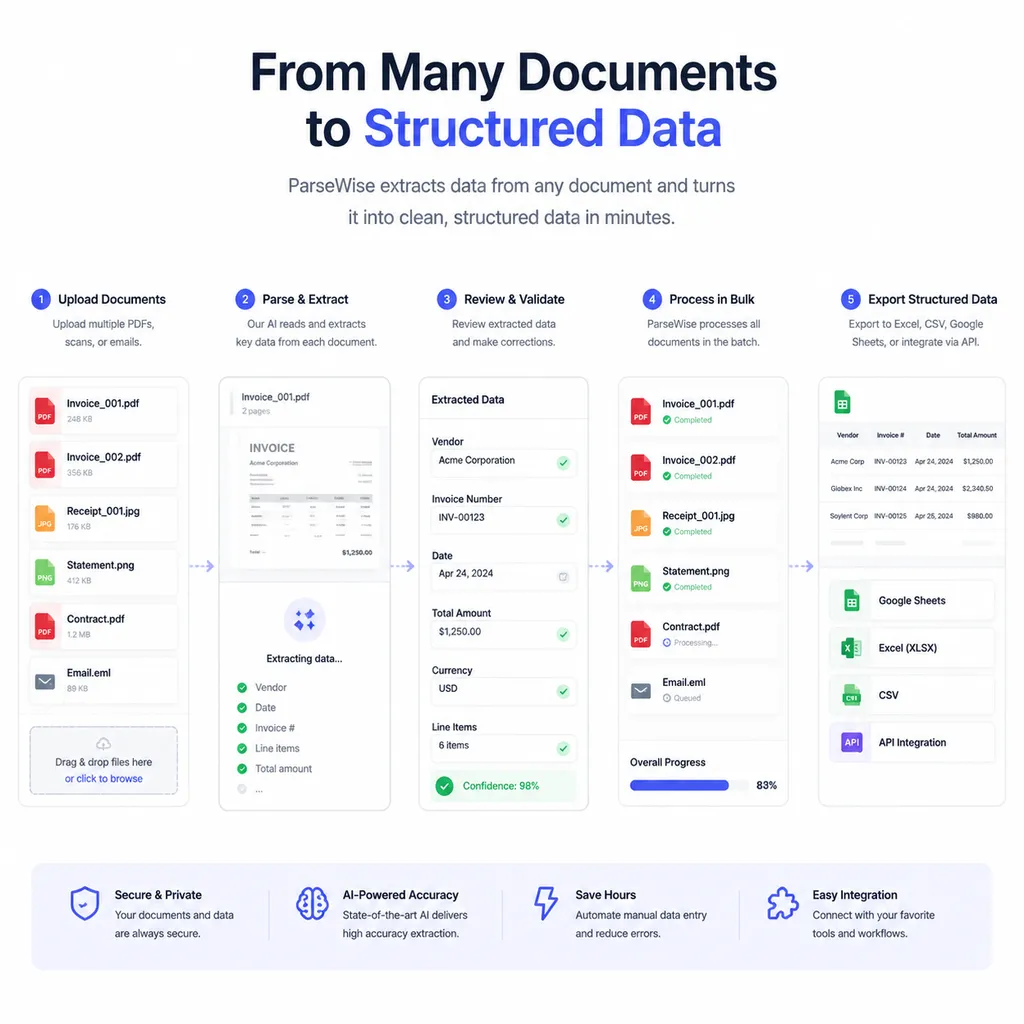
Parsewise emphasizes “Build a multi-document pipeline in 1 minute” on its website. The workflow they envision seems roughly like this: upload a batch of files, specify the schema to extract, and let the API handle entity alignment, contradiction detection, and provenance annotation automatically.
The differences become clearer when compared with other approaches on the market:
| Solution | Single-Document Extraction | Cross-Document Entity Linking | Contradiction Detection | Evidence Traceability | |------|-----------|--------------|---------|---------| | LlamaParse / Unstructured | ✅ | ❌ | ❌ | Partial | | Google Document AI | ✅ | ❌ | ❌ | ✅ | | Self-Built RAG | ✅ | Model-dependent | ❌ | Weak | | Parsewise | ✅ | ✅ | ✅ | ✅ |
If your use case is simply “extract fields from one contract,” Parsewise offers little advantage — cheaper solutions are enough. But once you enter the mode of “answer one question using a stack of documents” — loan underwriting, KYC, due diligence, insurance claims, legal e-discovery — the gap becomes obvious.
Who Will Pay for This
Judging from the discussions on Hacker News, the earliest adopters are unsurprisingly developers in finance and legal industries. One commenter building lending SaaS said their team tested it internally for two weeks, and the biggest value wasn’t extraction accuracy, but the fact that contradiction detection directly filtered out a batch of falsified bank statements. That’s an interesting signal — Parsewise’s value may not just be about efficiency gains, but also about discovering things that are invisible at the single-document level.
Several obvious application areas emerge:
- Financial compliance: KYC, AML, loan underwriting, entity identification and cross-validation across multiple supporting documents
- Legal due diligence: consistency checks and obligation alignment across hundreds of contracts in M&A projects
- Medical insurance claims: cross-file consistency verification between medical records, prescriptions, and invoices
- Supply chain auditing: three-way matching between invoices, customs declarations, and logistics documents
Historically, these workflows relied either on armies of human reviewers or on awkwardly stitched-together rule engines. Parsewise is attempting to abstract this “cross-document reasoning” layer into an API so upstream product teams can simply call it.
A Few Concerns Worth Raising
As an editor, it’s also important to point out a few reasons for caution.
First, latency and cost. An agent architecture combined with Claude and large multi-document contexts will inevitably result in high token consumption and slower response times. Their website does not disclose pricing, but it’s safe to assume it won’t be cheap. Teams building real-time systems should think carefully about the tradeoff.
Second, whether the “no false negatives” claim really holds up. That’s an extremely strong statement. Anyone who has worked on document extraction knows there are unavoidable sources of information loss: OCR errors, poor scan quality, handwritten signatures. Achieving “no false negatives at the cross-document reasoning layer” is very different from “no false negatives from raw files to final output.” Marketing language should not be over-interpreted.
Third, controllability. Agents that can write code, execute code, and browse the web are both a capability and a risk for enterprise customers. Financial and healthcare clients have strict audit requirements around “what exactly the model autonomously executed.” Parsewise will inevitably need to strengthen observability and guardrails.
A Broader Industry Observation
In the first half of 2026, the document AI space has clearly begun to split in two directions. One side is moving downward into infrastructure (OCR, layout analysis, structuring), while the other is moving upward into vertical agents (contract review, financial analysis). Parsewise has chosen the difficult but potentially most imaginative middle path — building a generalized cross-document reasoning layer.
The LongDocURL benchmark released earlier by the Chinese Academy of Sciences and Alibaba also reinforces the importance of this direction: multimodal long-document understanding, cross-element localization, and numerical reasoning are widely recognized in academia as the next major challenge. Parsewise has already packaged these capabilities into a commercial API, moving much faster than academia in terms of commercialization.
One thing worth watching is that Parsewise currently uses Claude as its core reasoning engine. Whether they eventually allow model choice and support GPT or domestic Chinese models as backbones remains an open question. For developers in China who need similar capabilities but are constrained by access to Claude, aggregation platforms like OpenAI Hub can be used for prototyping with Claude — one API key for all major models (GPT, Claude, Gemini, DeepSeek), direct connectivity in China, and OpenAI-compatible formatting. For multi-document reasoning workflows that require frequent model switching and comparison, this removes the burden of maintaining multiple SDKs.
One final summary sentence: Parsewise is not a replacement for RAG — it fills in the part RAG has never really solved. If your product includes a workflow step that requires “reading a stack of documents, producing a structured answer, and clearly explaining where the answer came from,” this company is worth paying attention to.
References
- Launch HN: Parsewise (YC P25) – Reason Across Documents with an API — Parsewise’s Hacker News launch thread, with extensive firsthand feedback from developers in finance and legal industries in the comments section


