
Fable Open-Sources NanoClaw: Build an Agent Pipeline for $800
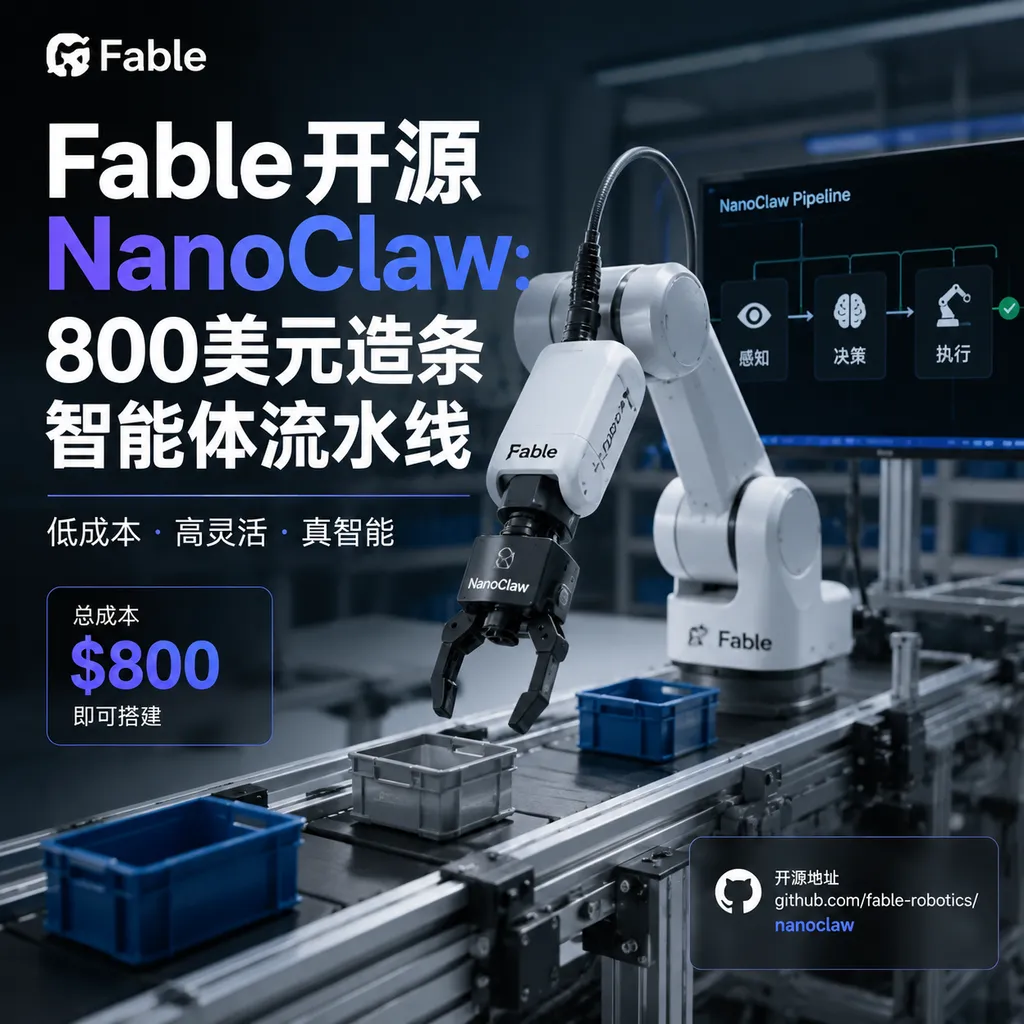
The Fable team has fully open-sourced its internal agent factory, NanoClaw, with the complete replication cost coming in at only $800. A codebase you can read through in 8 minutes becomes, once running, a software pipeline that can write its own PRs and merge them automatically.
Fable Open-Sources NanoClaw Agent Factory: Reproducing an AI Agent Production Pipeline for $800
Early yesterday morning, Fable engineer Gavriel Cohen dropped a single sentence on X: "We open-sourced NanoClaw’s agent factory. Cost: $800." No launch event, no long-form blog post—just a repo link. Within hours, the project had passed 4,000 stars.
For people building agents, this news was more exciting than last month’s Claude Fable 5 release. Because for the first time, it compresses the "AI software factory" concept that companies like Every and Cognition have been talking about for half a year into a minimal viable version you can run on your own machine tonight—and one that can actually do work and submit PRs on its own.
What Did $800 Actually Buy?
First, let’s clarify where the $800 went. Cohen later broke down the costs in replies: the majority—about $620—went to Anthropic API calls, used for self-dialogue during training, tool invocation testing, and end-to-end regression runs. The remainder covered sandbox container runtime on Fly.io plus a small embedding expense. No GPU rental, no fine-tuning—pure API-driven development.
In other words, the $800 was not the cost of "training a model." It was the cost of "getting an agent factory pipeline stable enough to self-iterate." That distinction matters. Over the past year, discussions around agent costs have focused either on token pricing or the per-task execution cost in cents. Very few people have isolated the one-time cost of making the entire pipeline reliable and production-ready. Fable provides a useful reference point.
Why NanoClaw Instead of Yet Another AutoGPT
The 2023 wave of AutoGPT and BabyAGI is long dead, and everyone knows why: infinite loops, exploding context windows, cascading tool-call failures. NanoClaw takes a completely different approach. It doesn’t aim for a "general-purpose agent." It aims for a "reproducible software factory."
You can feel that restraint just by reading the GitHub README:
- One process, a few files. According to the authors, the entire core codebase can be read in eight minutes. No LangChain, no CrewAI, no abstraction layers stacked on top of each other.
- Real filesystem-isolated containers. Agents run inside Docker, not "pretend isolated" subprocesses. An
rm -rfwon’t destroy the host machine. - OneCLI credential registration. A single script,
nanoclaw.sh, installs everything from scratch—Node, pnpm, Docker, whatever’s missing—and gets a named agent online and messaging-capable.
The philosophy behind this is closely aligned with what Kieran Klaassen described in Every’s "Compound Engineering" piece earlier in June—not optimizing for how smart a single model call is, but engineering the feedback, batching, and review loops so the system keeps producing output while you sleep.
A Pipeline That Can Truly Self-Iterate
The best way to understand NanoClaw is to compare it with the factory pipeline behind Cora (Every’s AI email app), which has already been running in production for a month:
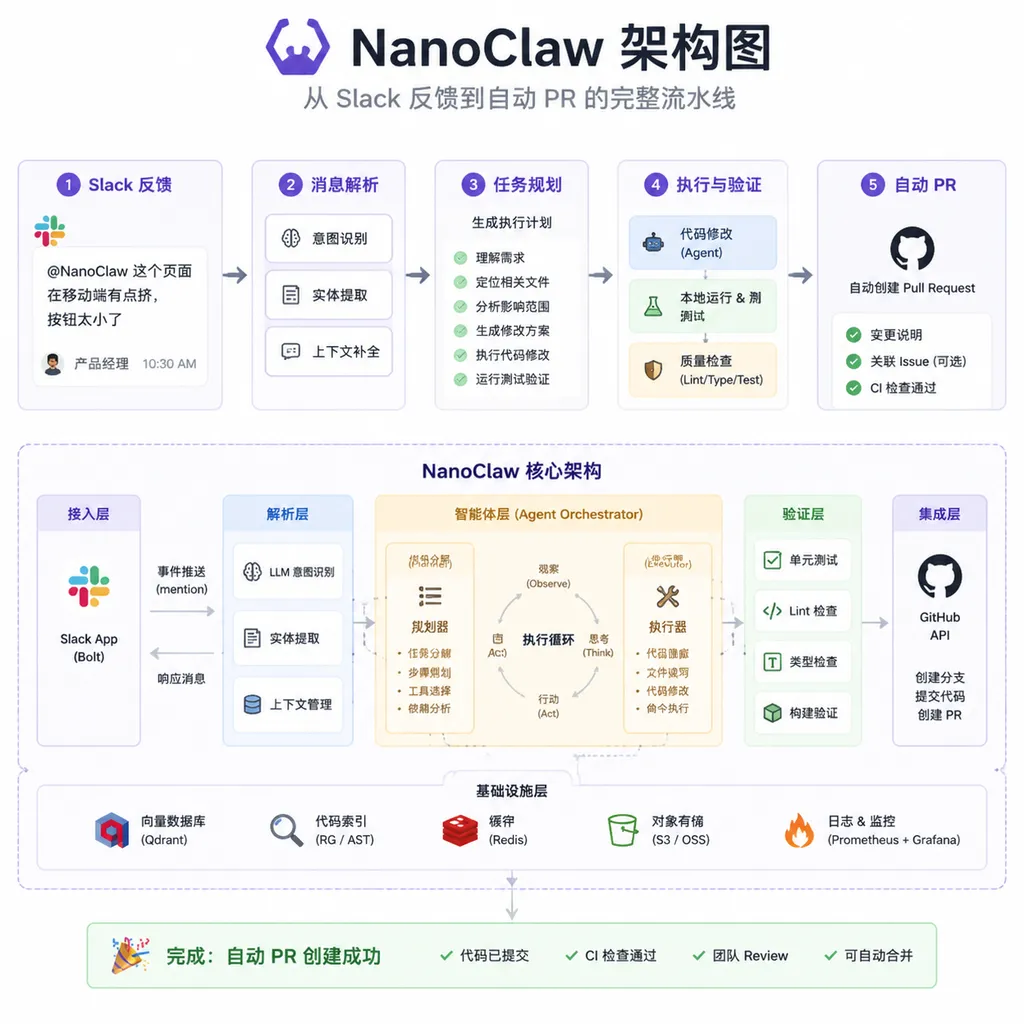
- Feedback intake: User complaints in Slack are collected in structured form
- Scheduled Claude Cowork tasks: Feedback is analyzed daily—clustered, deduplicated, and prioritized
- Automatic PR generation: Not issues—actual pull requests with code changes
- LFG batch workflows: One PR may contain fixes for 17 separate feedback items
- Video walkthrough review: The agent records screen demos explaining what changed
- Merge while asleep
NanoClaw extracts the skeleton of this workflow. It doesn’t assume you use Slack or build email apps, but it gives you the core trio: "named agents + isolated containers + feedback-driven PRs." You can think of it as Fable packaging the "meta-pipeline" distilled from six months of hard-earned lessons from the Cora team.
Compared with Devin and SWE-agent: Where It Falls Short and Where It Wins
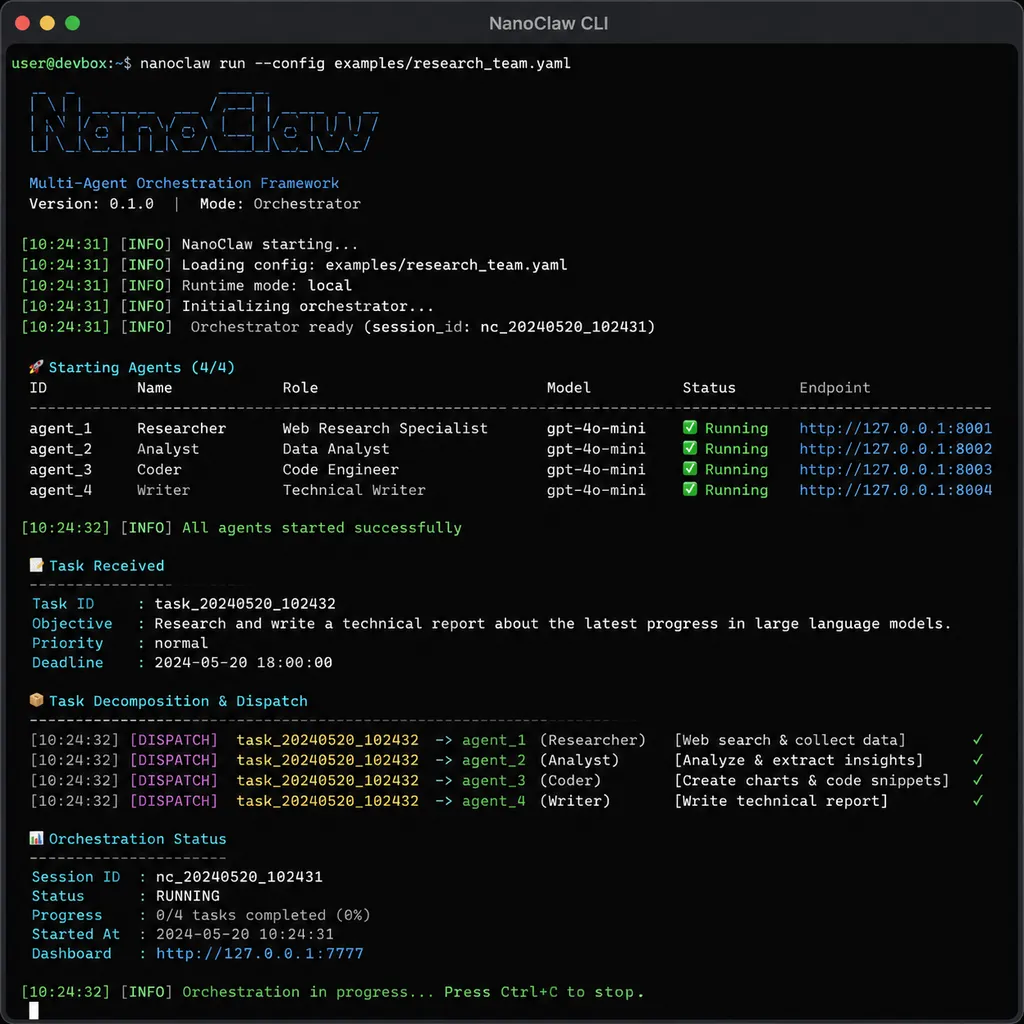
A reality check is necessary: NanoClaw is not trying to compete with Devin. It doesn’t have fancy planner-executor architectures, memory graphs, or complex multi-agent orchestration. It also hasn’t been benchmarked on SWE-bench yet. The author’s exact words were: "We don’t care about benchmarks. We care whether it fixes bugs for Cora every day."
But its strengths are precisely in being "good enough":
- Readable: Eight minutes to understand vs. Devin’s black box
- Controllable: Container isolation means you know exactly what files it touches
- Modifiable: It’s not a framework—it’s a template. Fork it and make it your own
- Economically understandable: $800 is psychologically accessible for startups
Compare that to Cognition’s Devin, which costs hundreds of dollars per seat per month, or the hidden per-task costs of Cursor Composer. NanoClaw takes the opposite approach: Fable gives you the factory, you burn your own tokens, Anthropic charges the API fees, and Fable charges nothing.
That also explains why this was open-sourced now. Claude Fable 5 launched in early June, and Mythos-class model inference costs dropped to around $10 per million tokens. For the first time, heavy agent workflows became economically viable. Six months earlier, this same architecture would have cost far more than $800 to run.
Some Concerns Worth Noting
A few things stand out when reading the code:
The security model is somewhat optimistic. Although filesystem isolation exists, lateral permission management once an agent gets Anthropic credentials is implemented rather loosely. If you plan to connect this to a production repository, you’ll need your own layer of secret isolation and audit logging. The documentation explicitly states: "This is a starting point for your fork, not a product ready for direct deployment."
Strong dependency on Anthropic. The entire factory is tightly coupled to Claude Fable 5’s tool-calling format. In theory, GPT or Gemini could work too, but substantial prompt modifications would be required. In the era of multi-model systems, this isn’t ideal—especially if you already use an aggregation layer like OpenAI Hub, where switching models is normally just a one-line configuration change. NanoClaw doesn’t yet benefit from that flexibility.
No UI. It’s entirely CLI and Slack-based. Want non-technical colleagues to track progress? Build your own dashboard.
The Broader Signal Behind This
Stepping back, NanoClaw’s open-sourcing happened at a very interesting moment. Within the first month of Claude Fable 5 bringing long-chain agent workflows into economically viable territory, the Fable team open-sourced its internal tooling. The timing feels deliberate.
My read is this: the Anthropic ecosystem is intentionally democratizing the idea of the "agent factory," pushing developers to build their architectures on top of Claude. OpenAI may still be preparing major moves with Codex Cloud, but it currently has no comparable open-source asset. DeepSeek and Qwen ecosystems are still at the stage of "tool-capable agents" rather than offering a mature factory paradigm.
For developers in China, NanoClaw is worth forking and running at least once—not necessarily to use directly, but to understand what an "agent factory" actually looks like. Reading the whole thing in eight minutes is more useful than reading thirty WeChat articles.
And when you do run it, if you’d rather not connect directly to Anthropic’s official APIs (network issues, account access, exchange rates—all potential headaches), using an aggregation gateway like OpenAI Hub to access Claude Fable 5 is a simpler route. The API format is compatible anyway: configure the base_url, and everything else works the same as a direct connection.
References
- nanoclaw/README_zh.md at main - GitHub — Official Chinese documentation for NanoClaw, including installation scripts, architecture descriptions, and security boundary explanations
- Complete NanoClaw Documentation (Usage, Architecture, Security, and Development) - Zhihu — A full Chinese community breakdown of the NanoClaw codebase and runtime mechanisms


