
LangChain Open-Sources OpenWiki: Letting Agents Maintain Codebase Documentation Themselves
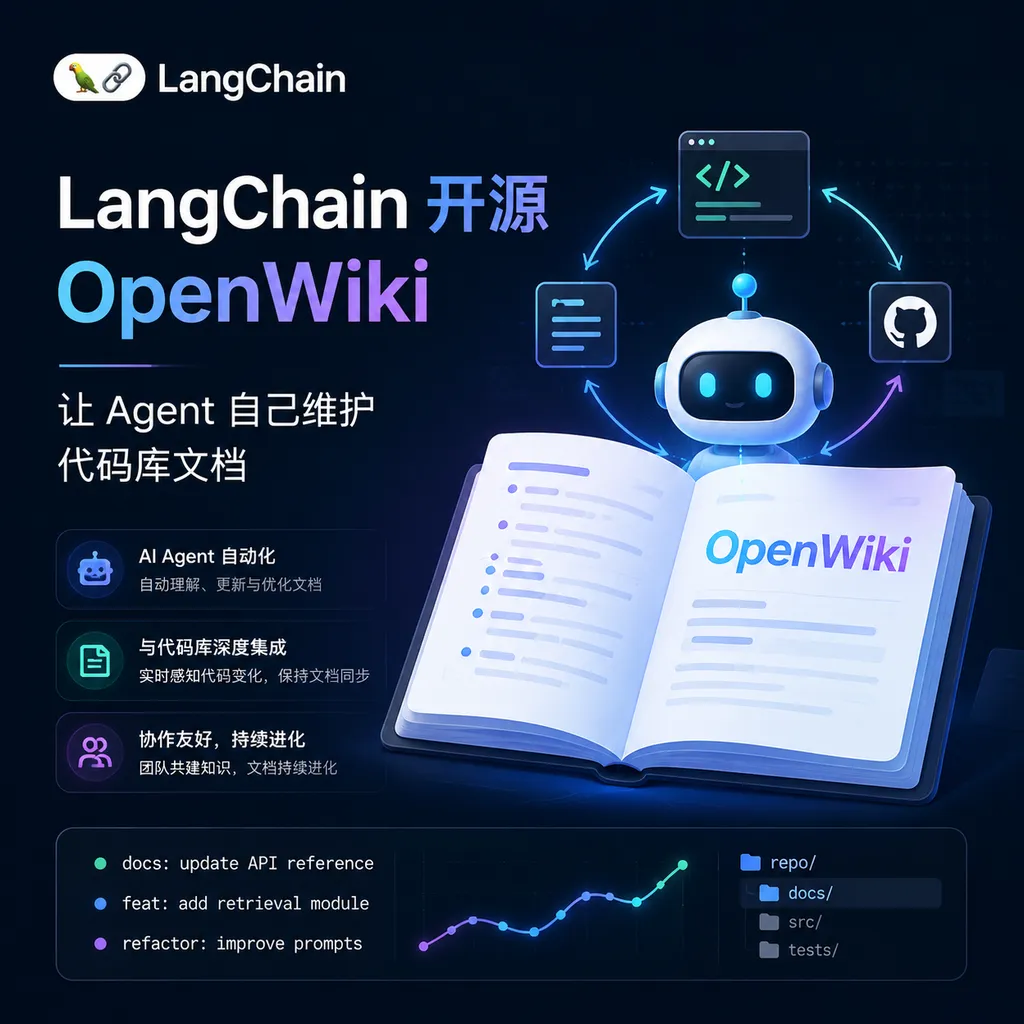
Yesterday, LangChain open-sourced OpenWiki, a CLI tool that can automatically generate and continuously maintain documentation for codebases. It treats the "documentation drift" problem — one of the biggest headaches in the agent era — as its core challenge, and its approach is worth examining for anyone building AI programming tools.
LangChain quietly released a new project on GitHub yesterday called OpenWiki, a CLI tool dedicated to doing one thing: automatically writing and maintaining documentation for your codebase—and that documentation is meant for Agents to read.
The positioning of this tool is a bit subtle. It’s not Cursor, not Copilot, not a sequel to LangGraph, nor does it belong to the LangSmith product matrix. It feels more like a side product born out of the LangChain team scratching their own itch while building Agent products. But ironically, these kinds of “internal tools turned public” often reflect real frontline pain points more accurately than carefully designed commercial products.
The Starting Point: Agents Can’t Understand Your Code
If you’re still working on AI coding-related products in 2026, you’re probably already familiar with a phenomenon: context windows for large models have grown into the millions of tokens, yet Agents still perform poorly on medium-to-large codebases.
The reason isn’t complicated. The more tokens you stuff in, the easier it is for the model to get lost; meanwhile, RAG is too crude—retrieved snippets are detached from architectural context, so even with a pile of fragmented information, the Agent still can’t reconstruct the full picture. The industry consensus is that we need a “map for Agents,” what people now call agent-facing documentation.
Anthropic’s Claude Code has long been pushing CLAUDE.md, Cursor has .cursorrules, and everyone is moving in this direction. But the problem is obvious: these documents are written and maintained by humans. Developers write one version, the code continues evolving, and a month later the docs are outdated. Then the Agent reads obsolete architectural explanations and starts confidently hallucinating changes into the codebase.
OpenWiki aims to solve exactly this problem: let Agents write and maintain the documentation they themselves consume.
What OpenWiki Actually Does
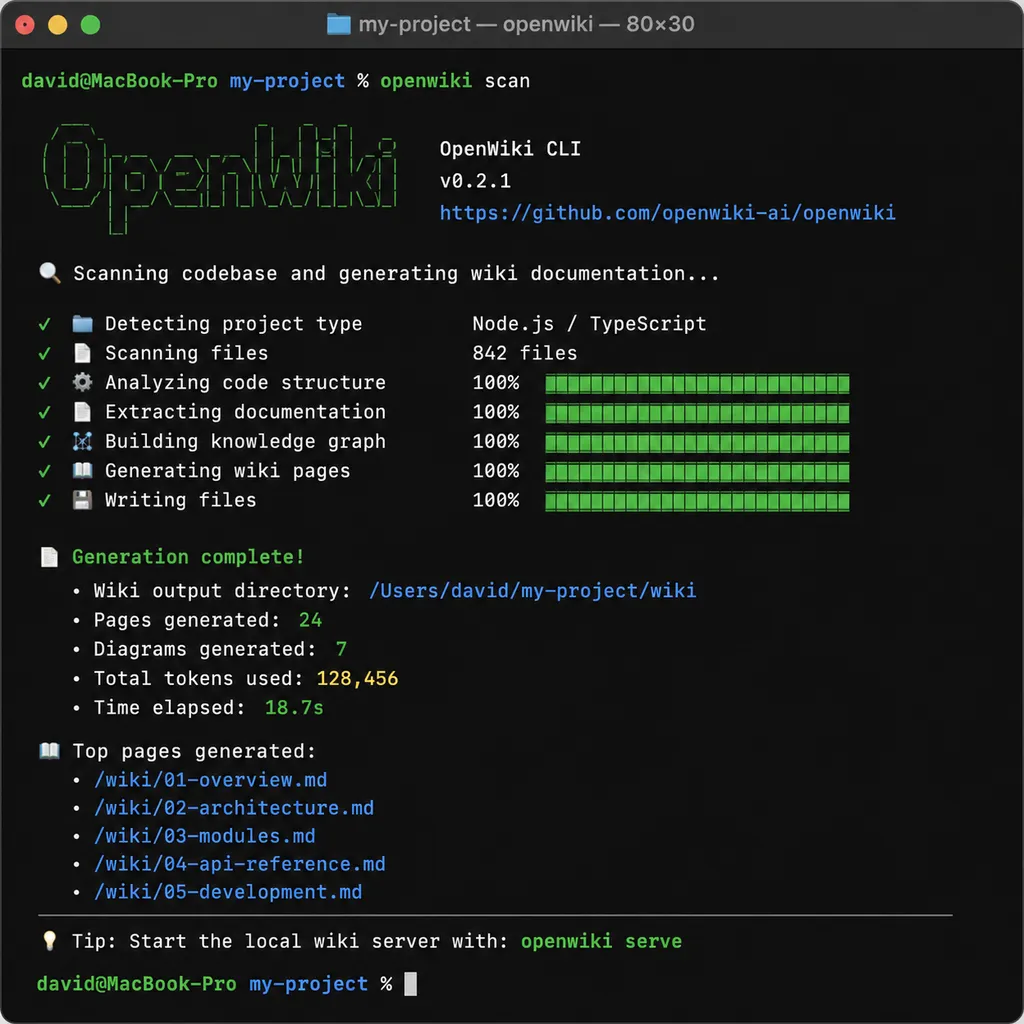
Based on the repo documentation, OpenWiki’s workflow is fairly straightforward. You run openwiki init in the project root, and it does several things:
- Scans the codebase structure: not just traversing files, but first analyzing module boundaries, dependency relationships, and entry files to build a conceptual project graph
- Generates layered documentation: one project-level overview, separate docs for each module, and further breakdowns for key classes and interfaces. The hierarchy isn’t for aesthetics—it allows Agents to retrieve information on demand. If handling an authentication-related task, the Agent only loads documentation nodes related to authentication
- Maintains diff-triggered incremental updates: this is the critical piece. Every time you later run
openwiki sync(or hook it into Git hooks), it regenerates only the affected portions of the documentation based on code changes, instead of rerunning the entire generation process
That third point is what separates it from ordinary “code documentation generators.” Tools like DocuWriter and Mintlify focus on “making your README look nice once.” OpenWiki treats documentation as a living artifact that must continuously stay aligned with the code.
The generated output is a set of Markdown files, stored by default in the .openwiki/ directory. The structure looks roughly like this:
.openwiki/
├── index.md              # Project overview
├── architecture.md       # Architecture diagrams and data flow
├── modules/
│   ├── auth.md
│   ├── billing.md
│   └── ...
└── conventions.md        # Coding standards and naming conventions
When an Agent receives a task, it first reads index.md to locate the relevant module, then drills into the specific module docs, and only afterward looks at the actual code. This workflow essentially mimics how an experienced engineer approaches a new project: understand the architecture first, then the modules, and only then dive into implementation details.
Why LangChain Is Building This
What’s worth discussing is that this tool comes from LangChain, not from teams closer to coding Agents like Cursor, Continue, or Aider.
At first glance it feels slightly out of domain, but on closer thought it makes perfect sense. Throughout late 2025 and into 2026, LangChain has consistently focused on one thing: pushing Agents from “can run demos” toward “can run in production.” LangSmith’s observability, LangGraph’s persistent runtime, deepagents’ long-task architecture—all of these address the same problem: making Agents work reliably in real-world environments.
OpenWiki is another piece in that chain. You can have Agents, orchestration frameworks, and observability—but if the Agent still can’t understand a customer’s private codebase, all of that is useless. The documentation layer is the missing puzzle piece.
In other words, LangChain isn’t betting on “building a better coding Agent.” It’s betting on “building the infrastructure that makes everyone else’s Agents stronger.” OpenWiki’s output can feed into Claude Code, Cursor, Devin, or custom Agents users build themselves with LangGraph. It’s a classic “selling shovels during a gold rush” strategy.
Compared to Existing Solutions, What’s Better?
First, the competition. Current tools trying to solve similar problems generally fall into three categories:
The first category is IDE-integrated rule files, such as Cursor Rules or Windsurf’s .windsurfrules. These are more “rules” than “documentation,” usually a few hundred to a few thousand words written manually. They work well for expressing team conventions but are unsuitable for representing complex architectures.
The second category includes things like DeepWiki and Aider’s repo maps, which automatically extract symbols and generate summaries from code. But the output is often either encyclopedia-style content for humans or ultra-minimal tags for Agents—satisfying neither audience particularly well.
The third category is Anthropic’s officially promoted CLAUDE.md model, where humans and AI collaboratively maintain a primary document. The quality is high, but so is the maintenance cost; larger teams simply can’t sustain it.
OpenWiki’s differentiator is this: it acknowledges that documentation must be automatically maintained while still insisting on hierarchical structure instead of flat summaries. From an engineering perspective, it’s closer to what Sphinx is for API docs—except the reader has shifted from humans to Agents.
As for real-world performance, the README includes benchmarks on LangChain’s own langgraph repository: initial generation takes about 6 minutes, while subsequent syncs average just over ten seconds. API costs per run haven’t been disclosed, but based on the descriptions, using inexpensive models (such as Haiku or GPT-5 mini-class models) for incremental updates appears feasible, with only the initial full generation requiring stronger models.
Some Imperfections
Now for some cold water. The current version of OpenWiki still has several obvious shortcomings:
- Limited language support. Parsing quality is noticeably better for Python and TypeScript; Go and Rust work but produce rough output; C++ projects are basically out of the question
- Poor fit for giant monolithic repositories. The README explicitly states that initial generation time scales roughly linearly with repo size, meaning repositories with hundreds of thousands of lines can take nearly an hour
- Heavy dependence on specific models. By default it uses OpenAI or Anthropic. Switching to Chinese domestic models requires manually modifying provider configs; there’s no out-of-the-box support yet
- Thin integration with existing Agent tools. Right now it simply outputs Markdown, and users still need to wire up how Agents consume it. Ideally, it should automatically inject references into
CLAUDE.md,.cursorrules, and similar files
That last point is actually the most important one. If OpenWiki remains merely a “documentation generator,” its upper bound is just “a better README generator.” The truly interesting direction is taking it one step further—turning it into a core component of Agent context management that dynamically injects task-relevant documentation nodes into Agent prompts. Only then would this product direction really come together.
One More Thing: Model Selection
For developers in China who want to run OpenWiki without dealing with proxies and multiple API keys, aggregation gateways like OpenAI Hub are an option—one key for GPT, Claude, Gemini, DeepSeek, all compatible with the OpenAI format, with provider switching requiring only a base URL change. You can use Claude or GPT-5 for the initial full generation, then switch to Haiku or DeepSeek V3.2 for incremental updates to significantly reduce costs.
Signals Worth Paying Attention To
This OpenWiki project itself reveals several broader industry signals:
First, “intermediate representation layers for Agents” are becoming an independent category. Previously, discussions around Agent infrastructure focused on orchestration, observability, and evaluation. Now a new layer is emerging: the Agent cognitive foundation—codebase understanding, documentation, knowledge graphs, constraint systems. This area is still fragmented, and whoever establishes the standard gains strategic positioning.
Second, the paradigm of documentation writing is being disrupted. It used to be “humans write docs → humans read docs,” then evolved into “humans write docs → Agents read docs,” and now we’ve reached “Agents write docs → Agents read docs,” with humans only reviewing them. The next step in this chain will likely involve Agents communicating structured project understanding directly with one another, potentially eliminating the need for Markdown entirely.
Third, LangChain’s ecosystem positioning is becoming increasingly clear. It doesn’t build end-to-end coding Agent products. Instead, it continuously lays down downstream infrastructure: LangGraph is the runtime, LangSmith handles operations, deepagents provides architectural templates, and now OpenWiki forms the knowledge layer. With this full-stack strategy, future customer Agents—regardless of which models or frontends they use—will have a hard time bypassing LangChain in the middle layer.
As a tool, OpenWiki is still rough around the edges, and neither its feature set nor documentation quality are yet at “must-install” level. But the problem it targets is a real one, and its approach is disciplined enough: no gimmicks, just solving documentation drift. Tools this simple are often the ones with the most staying power.
For developers, the worthwhile thing to do now is to clone it, run it against your own projects, evaluate the quality of the generated docs, and hook it into CI so it evolves alongside your code. Whether it’s immediately useful is another matter, but this direction will attract more and more teams over the next year.
References
- langchain-ai/openwiki - GitHub — OpenWiki project repository, including installation instructions and usage documentation
- langchain-ai/langchain - GitHub — Main LangChain framework repository, the upstream ecosystem behind OpenWiki
- LangChain Project Resource Collection - Zhihu — An overview of the LangChain ecosystem, useful for understanding where OpenWiki fits within it


