
Portugal invests €5.5 million to build the European Portuguese language model AMALIA

On July 1, the Portuguese government released AMALIA, the first open-source large language model in European Portuguese. The 9B version is now available, trained on 4 trillion Portuguese tokens, and a 22B Agent version will also be launched within the year.
On July 1, the Portuguese government officially announced the release of the first open-source large model based on European Portuguese (pt-PT): the official launch of the large model platform project named AMALIA. This is a national strategic initiative — involving more than 60 researchers, an 18-month development cycle, and an initial investment of €5.5 million, trained on the Deucalion and MareNostrum 5 supercomputers. The first deliverable is a 9B-scale multimodal model, with an additional €1.5 million planned this year for a 22B Agent version.
The name comes from Portugal’s iconic Fado singer Amália Rodrigues, and the positioning is clear: this is not a technology toy, but a cultural project.
Why European Portuguese needs its own model
First, one thing should be clarified — Portuguese large models do exist, but nearly all well-known Portuguese-language models on the market are primarily optimized for Brazilian Portuguese (pt-BR).
The gap between the two is larger than many people realize. Vocabulary choice, verb conjugation, pronoun placement, and even spelling systems (Portugal only fully adopted the new spelling agreement in 2009) all differ significantly. A simple example: Brazilians say “What are you doing?” as “você está fazendo,” while in Portugal it is “estás a fazer” — not just different words, but entirely different grammatical structures. Asking a Llama or Qwen model trained on massive amounts of pt-BR data to process official Lisbon municipal documents produces fairly predictable results.
This is also why the Portuguese government is willing to spend €5.5 million on a language spoken by a country of just 10 million people. In the era of generative AI, linguistic sovereignty is a real issue. Iceland, Estonia, and Ireland have all launched similar initiatives in recent years — because if they do not, their languages risk being assimilated into larger-language AI corpora.
Technical approach: not training from scratch, but continued pretraining
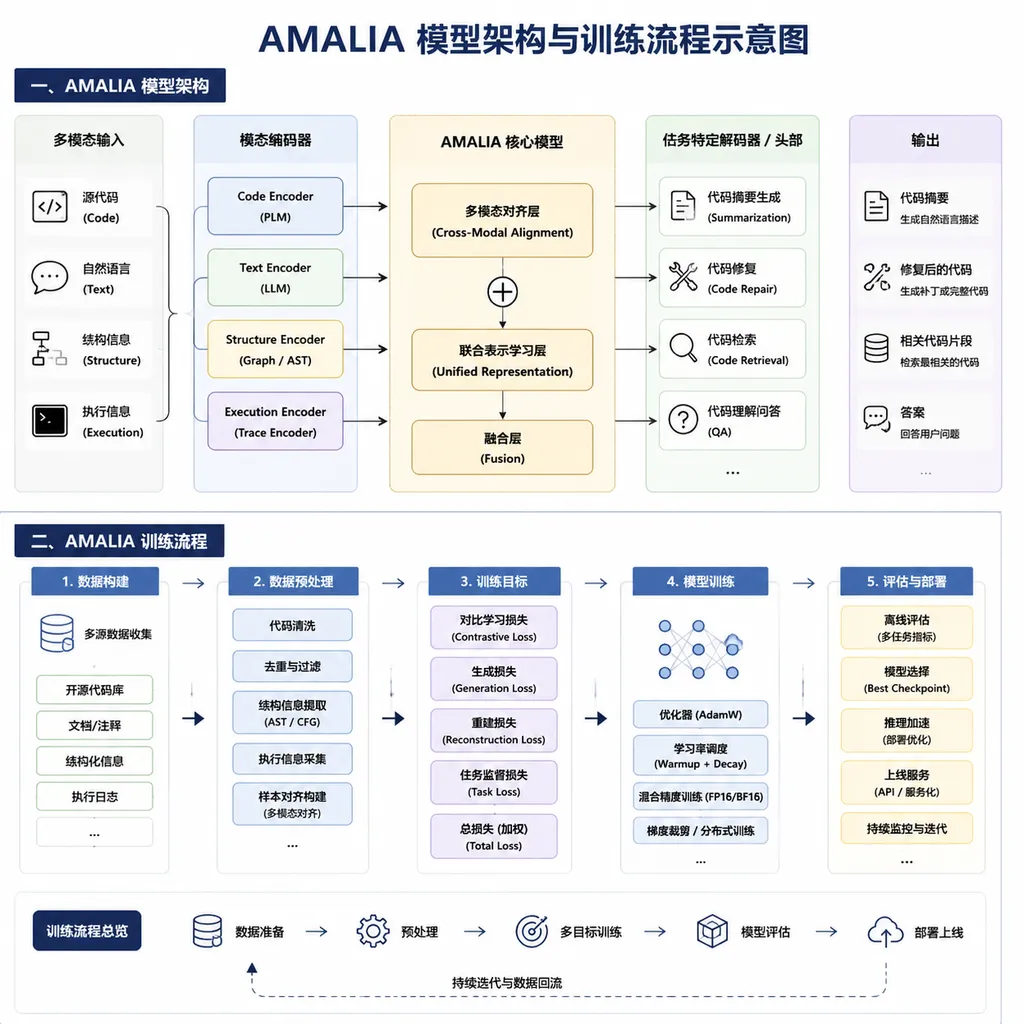
A reality check is necessary here. Officially, AMALIA is positioned as “the first European Portuguese large model,” but strictly speaking, it was not trained from scratch. Instead, it is built through continued pretraining on top of EuroLLM.
EuroLLM itself is a multilingual model project funded by the European Union, and the Portuguese team was already one of its core contributors. What the AMALIA team did was progressively increase the proportion of European Portuguese data at every training stage on top of EuroLLM’s existing weights, ultimately producing a pt-PT-specialized version.
This approach has advantages and disadvantages:
- Advantages: lower compute requirements, lower cost, and faster development. Training a 9B model from scratch with only €5.5 million would simply not be feasible;
- Tradeoff: the model’s underlying world knowledge is still shaped by mixed English and multilingual European corpora. The “native-ness” of pt-PT is reflected more in generation style and localization tasks than in a reasoning architecture fundamentally native to Portuguese.
The first training stage used approximately 4 trillion Portuguese words (with token counts being even higher). For a single Portuguese-language corpus, this is already extremely large-scale. For context, all Portuguese-language content (including Brazilian Portuguese) accounts for only about 4% of Common Crawl, while high-quality pure pt-PT text is even scarcer.
For multimodality, subsequent upgrades enabled the 9B version to jointly understand text, images, and audio. Audio is especially important for Portuguese — European Portuguese phonetics (vowel reduction, consonant clustering) differ greatly from Brazilian Portuguese. An ASR + LLM system capable of understanding Lisbon accents has obvious value in government, healthcare, and education scenarios.
Evaluation: localized benchmarks matter most
The team published a paper at the ACL-affiliated PROPOR conference, and the benchmark design is arguably more interesting than the model itself. Rather than relying only on translated versions of standard suites such as MMLU or GSM8K, they built a complete set of native pt-PT benchmarks:
- ALBA: Portuguese grammar tasks scored by an LLM judge
- PT Exams: Portuguese college entrance exam-level general knowledge questions, including CoT
- PT Completions: pt-PT generation tasks
- P3B3: differentiation benchmark between pt-PT and pt-BR
- FRMT: translation tasks evaluated using the chrF metric
These were combined with standardized benchmarks such as ARC-C, GSM8K, MMLU, TruthfulQA, PIQA, SIQA, IFEval, BBH, plus three multilingual safety evaluations (Simple Safety Tests, XSTest, Multilingual AdvBench).
The paper’s conclusion is straightforward: on translated international benchmarks, AMALIA performs roughly on par with strong baselines; on native pt-PT tasks, it significantly outperforms them.
This result is hardly surprising — a model optimized specifically for a dialect will naturally perform better on benchmarks targeting that dialect. But it also highlights something important: general-purpose benchmarks obscure the real value of small-language models. Without datasets such as P3B3 that can distinguish pt-PT from pt-BR, the differences between AMALIA and general-purpose large models would barely be visible, making the investment difficult to justify.
9B is only the beginning — the 22B Agent version is the real ambition
The Portuguese government smartly divided the project into two phases.
Phase 1 (already delivered): a 9B multimodal foundation model with a €5.5 million budget. This size can run on consumer-grade GPUs (around 6GB VRAM after 4-bit quantization), making it accessible to Portuguese SMEs, municipal institutions, and academic research.
Phase 2 (planned for delivery this year): a 22B version with an additional €1.5 million investment, focused on Agent capabilities.
Why 22B? It is a carefully chosen size:
- Slightly smaller than Mistral Small 24B, but significantly stronger than most 13B models;
- Full fine-tuning is possible on a single A100 80GB GPU;
- Under FP8 inference, it can fit on consumer GPUs with 24GB VRAM;
- For Agent scenarios, 22B is currently a practical balance between reasoning capability and cost.
Placing Agent capabilities in the second phase instead of forcing them into the 9B model shows the team understands the practical realities. Agent systems are not just about model capability — they require tool use, planning, reflection, and long-context handling as a complete stack. A 9B model can technically attempt this, but productization barriers are high. A 22B + Agent combination is far better suited for direct integration into Portuguese government systems or local SaaS platforms such as Unbabel.
Incidentally, Unbabel (one of the project’s core participants) is already a leading European translation SaaS company. Last year, its Tower model outperformed many open-source multilingual models of similar size in translation benchmarks. With Unbabel personnel involved in AMALIA, the project benefits from real engineering experience and product-oriented thinking rather than being purely academic.
Participating institutions: a “national team” style collaboration
The institutional composition of the AMALIA project is notable:
- Instituto de Telecomunicações (Telecommunications Institute, affiliated with Instituto Superior Técnico)
- Unbabel (a translation SaaS spin-off from Instituto Superior Técnico)
- NOVA University Lisbon (especially the FCT faculty)
- Portuguese Foundation for Science and Technology (FCT) (responsible for training and development management)
Combined with compute resources from Deucalion (Portugal’s national supercomputing center) and MareNostrum 5 (Barcelona’s top-tier supercomputer, among Europe’s top ten), this essentially consolidates nearly all available resources in Portugal’s NLP ecosystem.
Compared with other small-language projects in Europe, this four-way structure — “national funding + academia + commercial spin-off + cross-border supercomputing” — is relatively rare. Projects such as France’s CroissantLLM, Finland’s Poro, and Estonia’s EstLLM are mostly academically driven, with weaker commercialization paths than AMALIA.
Some questions worth watching
The money has been spent, and the model has been open-sourced, but from a developer perspective, several issues deserve attention:
-
How open is the weight license really? The project claims to be “fully open source,” but EuroLLM’s license is not entirely permissive. Whether AMALIA, as a derivative model, allows commercial use or redistribution after fine-tuning depends on the exact license terms.
-
Transparency of the data composition: Public materials currently provide limited disclosure about the specific sources of pt-PT corpora, cleaning procedures, and deduplication strategies. For a national project, the expected transparency level should arguably be higher.
-
Direct comparisons with EuroLLM and Sabiá (the Brazilian Portuguese model): The paper provides general benchmark results, but horizontal evaluations against other Portuguese-specialized models should be more comprehensive.
-
The Agent framework choice for the 22B version: Will it use a proprietary tool-use protocol, or be compatible with MCP / Anthropic-style standards? This will determine how quickly it can integrate into existing ecosystems.
What this means for developers
If you are building Portuguese-language products — especially for markets such as Portugal, Mozambique, Angola, or Cape Verde where European Portuguese dominates — AMALIA is a model worth evaluating. Its value is not in competing with GPT-5 or Claude on general capabilities, but in providing cost-controlled localized deployment:
- Government, legal, and healthcare scenarios sensitive to local language nuances;
- Compliance requirements where data cannot leave the country (Portugal enforces GDPR quite strictly);
- Content generation requiring understanding of local culture, slang, and historical context;
- ASR/TTS applications needing European Portuguese accent adaptation.
For developers not working in Portuguese-language markets, the project is more valuable as a methodological reference: how to build a usable open-source model for a small language in 18 months with €5.5 million. This cost-efficiency ratio is far healthier than many “national large model” projects that consume hundreds of millions.
Model weights will be distributed through the PORTULAN organization on Hugging Face, alongside the open-source release of the pheb evaluation framework. The 9B version is already available, while the 22B Agent version is scheduled for delivery sometime in 2026 according to the official roadmap.
At this stage of the open-source model boom, the “long tail” of languages is finally beginning to be addressed. AMALIA will not be the last.
References
- Portugal releases its first European Portuguese open-source large language model AMALIA - IT Home: Original news report including release date, investment scale, parameter size, and other core information
- PORTULAN Organization - Hugging Face: The Hugging Face homepage of the Portuguese NLP team, serving as the official release platform for AMALIA weights and related Portuguese-language models


