
Senior SWE-Bench goes live: Making AI a senior engineer instead of an intern
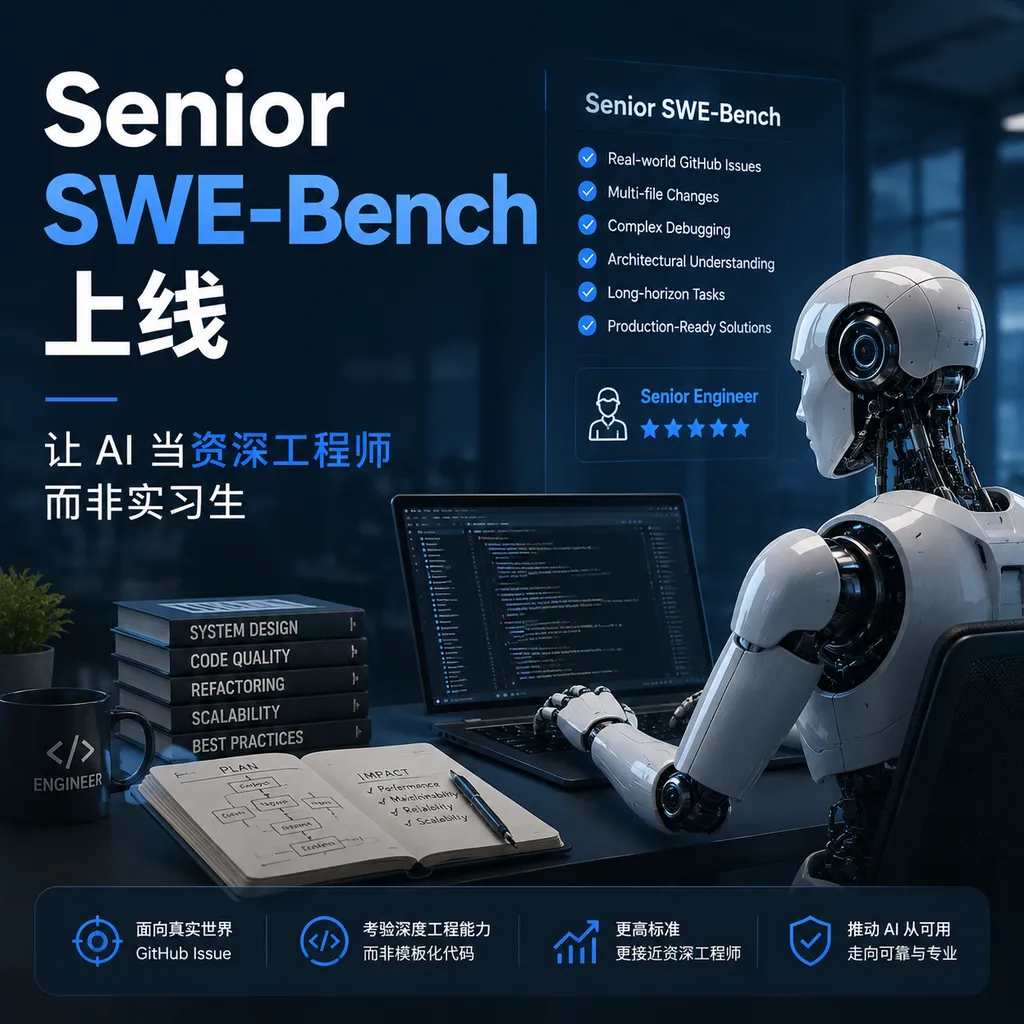
Snorkel AI launches Senior SWE-Bench, directly addressing the long-standing issue of score saturation in the original SWE-Bench — instead of merely having agents fix bugs to pass, it evaluates their design decisions, trade-offs, and code review skills by senior engineer standards.
Senior SWE-Bench Released: The AI Programming Benchmark Finally Starts Testing “Senior Engineers”
On July 1, Snorkel AI, together with several of the original SWE-Bench authors, quietly launched a new project—Senior SWE-Bench. The name says it all: instead of having AI agents play the role of a junior engineer (“pick up issues, fix bugs, submit PRs”), the benchmark now evaluates them as senior engineers—read the architecture, make design decisions, review others’ code, and choose a solution that can hold up through three years of iteration.
This has been brewing for a while. Over the past six months, many in the industry have complained that SWE-Bench Verified scores have become “overfitted and meaningless”: top agents are all above 70%, with only 2–3 points separating first and fifth place—essentially statistical noise. The signs of saturation keep growing more obvious, and Senior SWE-Bench looks like the first serious contender ready to take over.
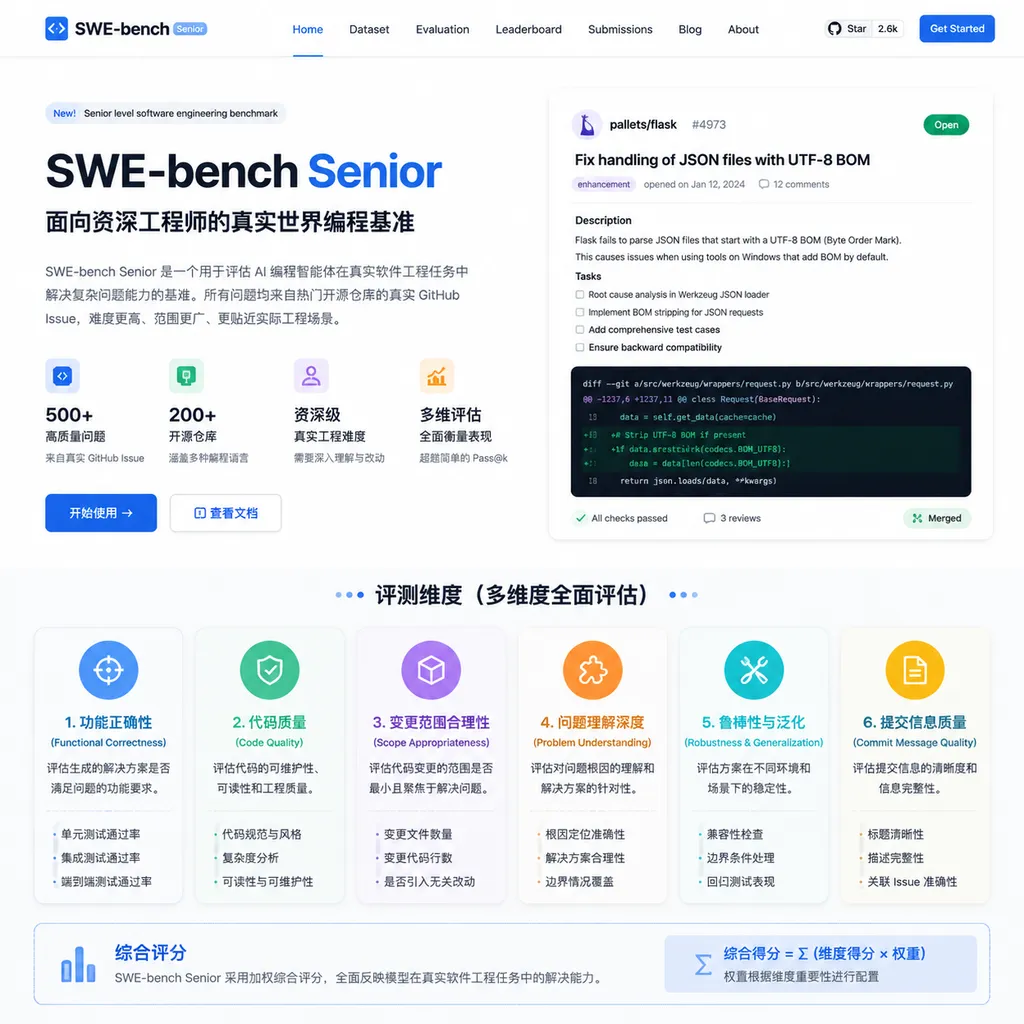
Why the Original SWE-Bench Isn’t Enough Anymore
Let’s review the background. SWE-Bench was created in late 2023 by the group led by Princeton’s Shunyu Yao. It builds a benchmark using real GitHub issues and corresponding PRs, giving models a codebase and a bug description, and asking them to produce a patch that passes tests. The design was brilliant at the time: real data, automated scoring, and coverage across 12 major Python projects. Naturally, it became an industry standard—Devin, SWE-agent, OpenDevin, Cursor Agent, Claude Code, Cognition—all of them benchmarked new releases on it.
But the problems are structural:
- Task granularity is too small. Most issues require only dozens of lines of edits across one or two files—essentially “locate + fix a known bug,” with no cross-module design.
- Single correct answer. Passing the hidden tests means you’re right—the path doesn’t matter. This skips the hardest part of real engineering work: trade-off decisions.
- Data contamination is hard to control. Issues and PRs are public on GitHub, so the models may have already seen them during training. The Verified version cleaned some of this but didn’t solve the root problem.
- Saturation. Flagship models like GPT-5 and Claude Opus 4.5, paired with a decent agent scaffold, achieve stable 75%+ on Verified. Going beyond that no longer reflects genuine capability differences.
Snorkel’s project page put it diplomatically, calling this a case of “diminishing signal.” But the point is the same: it’s time to replace the ruler.
What Senior SWE-Bench Actually Tests
The new benchmark changes its goal from “Can it fix the bug?” to “Can it fix it like a senior engineer?”—dividing tasks into three categories:
1. Architectural Change
Given an issue involving cross-module refactoring—like “migrate this synchronous I/O system to asyncio” or “replace the hard-coded permission model with a plugin-based system.” Evaluation considers not only whether the final tests pass but also:
- Whether changes are confined to a minimal impact area
- Whether new technical debt was introduced (e.g., using a monkey patch just to pass tests)
- Whether breaking changes to a public API were accompanied by documentation or a migration plan
2. Code Review
This one’s the most interesting. The agent is given a real PR and asked to write review comments. The reference answers are the reviews written by senior maintainers, e.g., “there’s a race condition here,” “this abstraction level is wrong—should be extracted to a base class,” or “tests don’t cover edge cases.”
Scoring isn’t by word matching but via LLM-as-judge + human validation: Did the agent identify issues of a comparable severity? Did it hallucinate non-existent problems? Did it propose reasonable alternatives?
3. Design Proposal
Given an open-ended issue such as “We want to add multi-tenancy to this ORM—how should we do it?”, the agent outputs a design doc: solution comparison, trade-off analysis, migration path, and risk points. Reference answers come from actual accepted RFCs or design discussion threads.
The approximate weighting across these three categories is 4:4:2, with architectural changes and reviews being the main focus. The initial dataset has 500 samples, covering 20 large open-source projects such as Django, FastAPI, Pandas, SQLAlchemy, Ray, and DuckDB—deliberately more complex and larger in codebase than the original SWE-Bench.
First Evaluation Results: Everyone Flopped
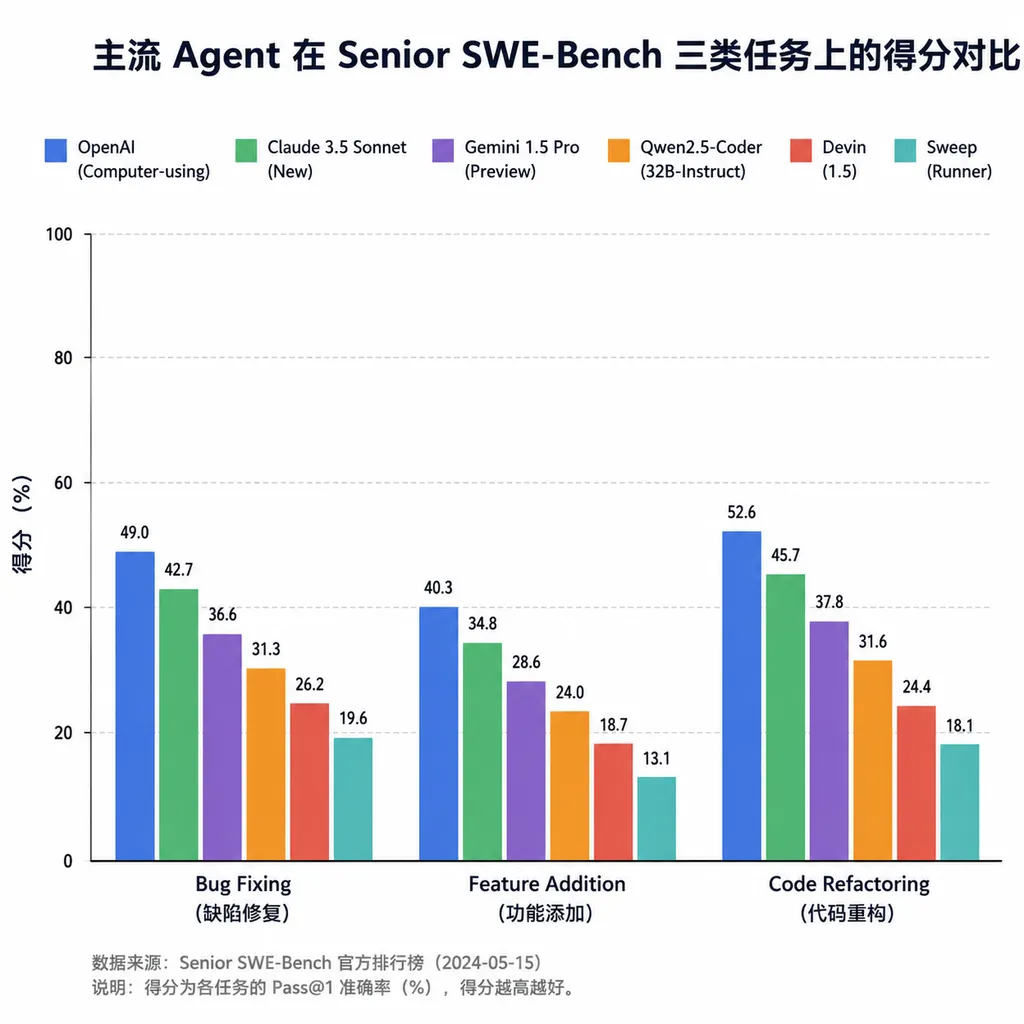
Snorkel ran these benchmarks on mainstream agents. The numbers aren’t flattering:
- Claude Opus 4.5 + Claude Code: Overall 34.2%, with 28% on architectural changes, 41% on code review, 33% on design proposals
- GPT-5 + Codex CLI: 32.8%
- Gemini 2.5 Pro + Jules: 29.5%
- DeepSeek V3.2 + OpenHands: 24.1%
- Qwen3-Coder-480B + SWE-agent: 21.6%
Compare that with the same agents scoring 70%+ on SWE-Bench Verified—the contrast is stark. Also notable: scores vary sharply across task types. Nearly all models perform best on code review and worst on architectural changes—which fits intuition. Reviewing is judgment-based—spotting issues is easier. Architectural change requires actually implementing a maintainable design—any structural mistake will cost points.
The design proposal category yielded middling but highly hallucinated results. Snorkel’s sample annotation showed 35–50% of top models’ design docs contained factual errors like referencing nonexistent APIs or proposing infeasible solutions. That’s a serious red flag—AI agents still talk nonsense, confidently, in open-ended design tasks.
The Value and Limitations of This Benchmark
First, the upside. Shifting from “single-patch tasks” to “system-level engineering judgment” is absolutely the right direction. The biggest difference between a senior and a junior engineer isn’t typing speed—it’s knowing what to do, how to do it, and when to do it. The original SWE-Bench only measured execution; the Senior version adds decision-making, reflecting real-world engineering.
The code review category is especially clever. It avoids the “single correct answer” trap—reviews inherently don’t have one. What’s tested is issue recognition. Using real maintainer reviews as reference also elegantly solves the ground-truth problem.
But there are also clear pitfalls:
- Reliability of LLM-as-judge. Code review and design proposal both use LLM grading. Snorkel claims 82% agreement with human annotation—which is quite high for open tasks—but it still means roughly one in five samples may be misjudged. If two models’ scores differ by only 3–5 points, the conclusion isn’t solid.
- Dataset size is too small. Five hundred samples aren’t enough for a “next-generation standard.” The authors admit this is v0.1; they plan to expand to 2,000 by year-end.
- Still Python-only. A legacy issue from SWE-Bench; multi-language agent evaluation remains a gap.
- The “senior engineer” label is partly marketing. The tasks still center on technical decisions, not stakeholder management, requirements negotiation, or business risk assessment—things real senior engineers deal with daily.
Industry Impact
This benchmark arrives at a delicate moment. Over the past year, valuations in the AI coding space have heavily relied on SWE-Bench scores—companies like Cognition, Cursor, Replit, and Augment all leveraged them in fundraising. With the old benchmark saturated and top scores indistinguishable, investors and users alike need new evaluation standards. If Senior SWE-Bench gains traction, product competition in the next six months will shift toward harder-to-game dimensions like design and review capabilities.
For agent framework developers, this is an early warning: excelling at the original SWE-Bench no longer means much. You’ll need agents that can make reasonable judgments without clear test feedback—demanding stronger planning abilities, mature memory mechanisms, and stricter self-critique pipelines.
For model providers, it’s a new target. Claude Opus 4.5 currently leads here, but a 34% absolute score shows there’s plenty of room to grow. Expect future OpenAI and Anthropic flagship papers to feature this benchmark. Incidentally, mainstream models like Claude Opus 4.5, GPT-5, Gemini 2.5 Pro, DeepSeek V3.2, and Qwen3-Coder are all accessible via unified APIs on OpenAI Hub—making replication or integration with your own agent framework straightforward.
Final Thoughts
Three years ago, SWE-Bench defined the paradigm for evaluating “whether AI can write code.” The next question is “can AI think like an engineer?” Senior SWE-Bench may not be the ultimate answer—its v0.1 has many issues—but it’s heading in the right direction.
The larger trend behind it is notable: AI programming evaluation is shifting from “can it pass tests” to “can it do engineering.” Now that models are already strong at code generation, real differentiation will appear at the judgment layer. Whoever can quantify, evaluate, and optimize judgment first will define the next wave of agent competition.
34% is just the starting line. If that number climbs to 60% in six months, the narrative around AI programming will be rewritten entirely.
References
- SWE-Bench overview and UIUC Agentless approach analysis – Zhihu column: A detailed explanation of SWE-Bench’s evaluation mechanism and mainstream agent comparisons—good background reading for this article.
- SWE-agent GitHub repository: Princeton’s open-source agent scaffold and the foundation of the SWE-Bench ecosystem.
- OpenHands (formerly OpenDevin) GitHub repository: The most active open-source programming agent, also included in Senior SWE-Bench evaluations.


