
SentryCode Open Source: Equipping the AI Coding Agent with a Black Box

A kernel-level auditing tool, **SentryCode**, was recently open-sourced on GitHub. It is specifically designed to monitor the covert behaviors of local AI coding agents—file scanning, network callbacks, and honeypot traps included—directly targeting several “data exfiltration” incidents involving agents that have been exposed in the past six months.
Someone Has Started Installing Surveillance Probes on AI Coding Agents
In early July, a developer with the ID byte271 posted an open-source project called SentryCode on r/MachineLearning—a kernel-level tool specifically designed to audit the behavior of local AI coding agents. The project’s positioning is clear: it doesn’t help you write code; it watches the AIs that help you write code.
The trigger isn’t mysterious. Over the past six months, security researchers have uncovered issues with Claude Code, Cursor, and a series of IDE-embedded local agents. Some quietly scan environment variables and SSH directories at startup; others fingerprint project structures and send them back via seemingly normal API requests. Even more subtly, some inject steganographically encoded cues (prompt fingerprints) into generated prompts, allowing the same model to “recognize” the same machine when invoked again. Developers call this hidden cue fingerprinting, one of the most discussed AI security topics in the first half of the year.
SentryCode was built for exactly these situations.
What It Actually Does
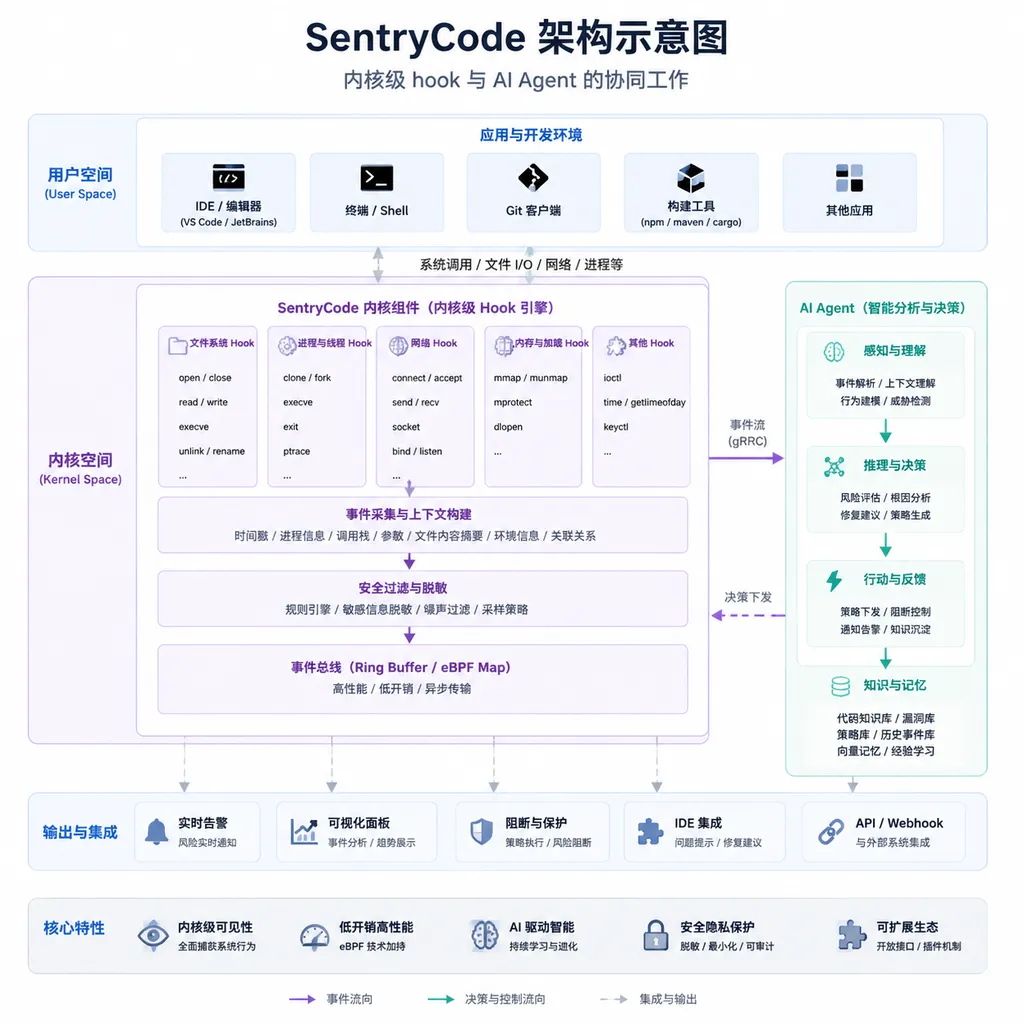
Looking inside, SentryCode performs five main tasks—none of them brand new, but together they form the first open-source solution tailored to AI agents:
- Kernel-level behavior logging: Hooks into the file system, network stack, and IPC channels, recording every syscall of agent processes. It doesn’t operate in user space, so it can’t be bypassed.
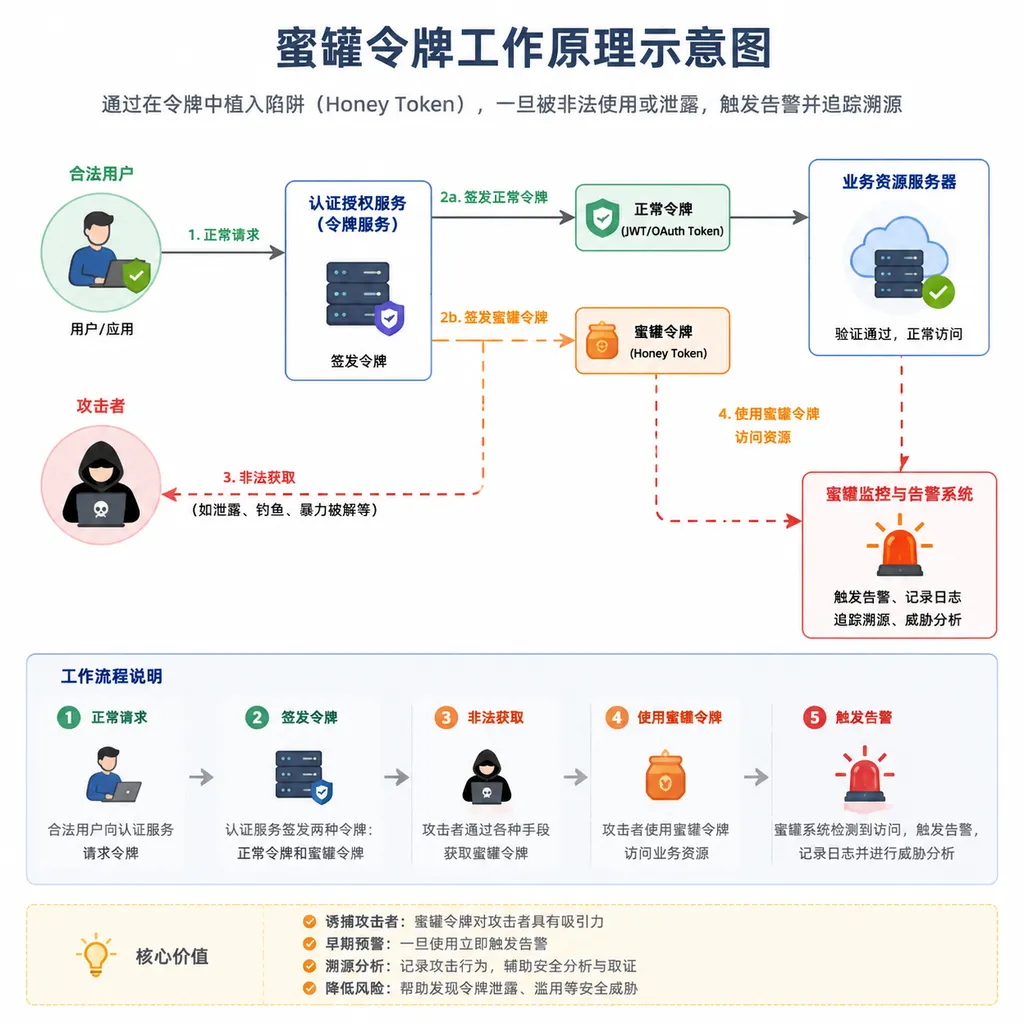
- Honeytokens: Plants realistic-looking fake credentials in the system—AWS keys, GitHub PATs, database passwords in
.envfiles. If the agent reads or transmits any of them, it triggers an immediate alert. The author claims “zero false positives,” which is logically sound since no legitimate program should ever touch these tokens. - Steganographic channel detection: This is the most interesting part. It performs static and entropy-based analysis to detect hidden base64 strings, zero-width characters, and Unicode homograph substitutions in prompts and responses, primarily to counter cue fingerprinting.
- Tamper-proof audit logs: Logs are chained with hashes, similar to a simplified Merkle tree. If an agent tries to erase its tracks, the chain breaks.
- Policy enforcement: Supports writing rules like “forbid the agent process from accessing
~/.ssh” or “block connections toapi.xxx.com.” Common functionality, but its integration completes the system.
The author emphasizes that everything runs entirely locally, with no outbound connections. This “prove-your-cleanliness” stance is almost mandatory today, when everyone suspects local tools of phoning home. The project also conveniently provides precompiled binaries—no environment setup needed to run a demo.
Why This Is Only Happening Now
A bit late, but understandable.
Over the past year, AI coding agents have evolved rapidly—from basic completion plugins to heavy-weight agents that can spawn subagents, call MCP modules, and connect to remote sandboxes. Their permission boundaries have expanded fast. Developers are enjoying the productivity boost but rarely have time to scrutinize what these tools actually do on their machines. Big-company agents like those from Anthropic or OpenAI still carry corporate trust, but hundreds of third-party forks and wrappers—many claiming to be “fully local”—go largely unsupervised.
Existing solutions exist, but they’re misaligned. Tools like Snyk’s DeepCode AI, Sourcery, and Veracode focus on security auditing of generated code—checking for vulnerabilities. Sentry (the company behind the error-monitoring product, unrelated to SentryCode) launched Sentry for AI this year—it tracks execution observability, showing which tools an agent used and where it failed. Neither addresses what an agent secretly does on your machine.
SentryCode fills that gap: is the agent’s own process behavior trustworthy?
Is It Worth Running?
Let’s start with the positives.
The honeytoken approach is well-proven in traditional security and fits AI agents perfectly—since agents naturally “explore” their environment, they’re more likely than standard malware to trigger a honeytoken. The “zero false positives” claim isn’t marketing fluff; it’s inherent to the technique.
The kernel-level hook is the right choice too. User-space monitoring is nearly useless against modern agents that can dynamically spawn subprocesses or invoke shells. That’s also why many EDR products are moving into the kernel.
Now for the caveats.
Performance overhead is очевид. Kernel hooks and full syscall logging, no matter how well implemented, will produce noticeable I/O latency over long runs. The repo currently lacks benchmarks; only real testing will tell.
Cross-platform support currently focuses on Linux. macOS’s Endpoint Security framework might work but would require major rewrites; Windows is even trickier. Many Cursor/Claude Code users on Mac may not benefit in the short term.
Steganographic detection recall is questionable. It can catch low-level tricks like zero-width characters or homoglyphs, but if adversaries watermark prompts semantically—through specific word-choice distributions—entropy analysis becomes ineffective. This remains unsolved academically.
And a deeper issue: the trust-transfer problem. You install SentryCode to watch untrusted agents, but as a kernel-mode program, SentryCode itself holds even higher privileges. Full open-sourcing and reproducible builds are the only real reassurance—but ultimately, you must still review the code yourself or trust the community to have done so.
Who Will Use It?
My guess: two early adopter groups.
First are enterprise security teams, already exploring how to regulate internal use of AI agents. SentryCode offers both a policy engine and auditable logs—it’s easy to hook into SIEM systems. That’s a clear use case.
Second are agent researchers. If you’re analyzing agent behavior or conducting adversarial testing, SentryCode is a strong observational foundation.
Will ordinary developers install it? Probably not—unless a popular agent gets caught misbehaving and the community outrage surges. Tools like this tend to gain traction only after a scandal or two.
The project is still early-stage, and its README openly invites feedback from local-agent users. How much authentic telemetry it gathers from users of Claude Code, Cursor, and Aider will likely determine its next iterations.
A Side Note
For developers using multiple AI coding agents simultaneously, model aggregation can also help decouple things. Platforms like OpenAI Hub let one API key access GPT, Claude, Gemini, and DeepSeek, even offering OpenAI-compatible endpoints in China—eliminating the need to configure each agent’s provider separately. From an auditing standpoint, converging all outbound calls through a single known endpoint is much cleaner than letting each agent connect to different clouds.
Toolchains are consolidating; monitoring tools are closing the gap. The AI coding-agent arms race is shifting from “who codes faster” to “who is trusted.” SentryCode might not be the final answer, but it’s put the right question on the table.
References
- SentryCode: Real-time Auditor + Honeytokens for AI Coding Agents (Reddit) — Original post by the author on r/MachineLearning, including project positioning and design motivation
- byte271/sentrycode (GitHub) — Main SentryCode repository with source code, precompiled binaries, and demo
- lintsinghua/DeepAudit (GitHub) — Related open-source project: multi-agent system for vulnerability discovery, useful for comparison


