
Kimi K2.7 Code Makes Its Way into GitHub Copilot, Marking the First Time a Chinese Model Secures Distribution in a Mainstream IDE
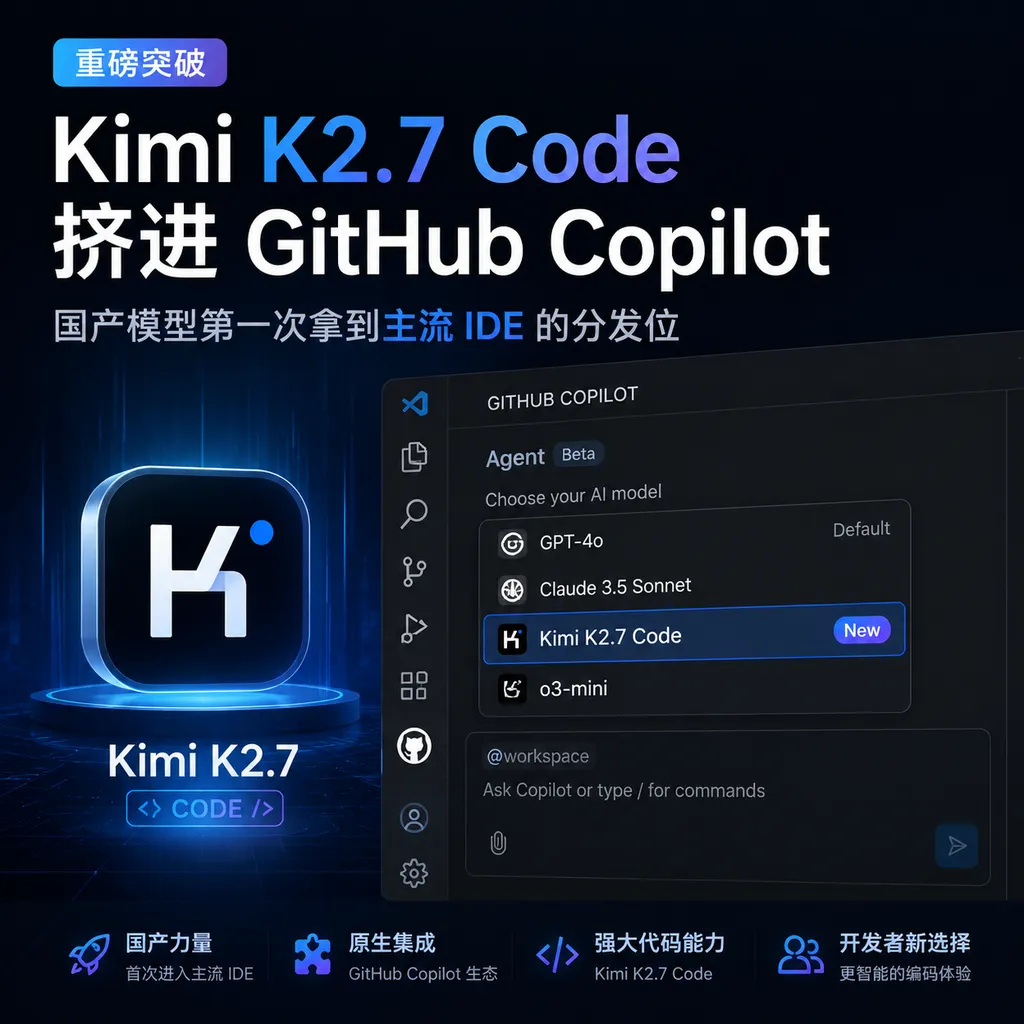
On July 1, GitHub announced that Moonshot’s Kimi K2.7 Code is officially GA in Copilot, becoming the first domestically developed programming model to enter the Copilot model selector. This marks a milestone for Moonshot and also signifies that Copilot’s model pool is evolving from an "OpenAI + Anthropic duopoly" into a truly open marketplace.
In its July 1 Changelog update, GitHub quietly announced something significant under an unassuming headline: Kimi K2.7 Code is now generally available in Copilot. No launch event, no joint poster — just a routine product update. Yet the impact of this update far outweighs how it was presented.
This is the first Chinese large model to enter GitHub Copilot’s model selector and be open to all paid users. Until now, Copilot’s model pool held the GPT family, Claude Sonnet/Opus, Gemini, and a few xAI models. Moonshot has now taken a seat at the main table rather than entering indirectly through a third‑party provider plugin.
A Quiet Announcement, a Not‑So‑Quiet Change in Standing
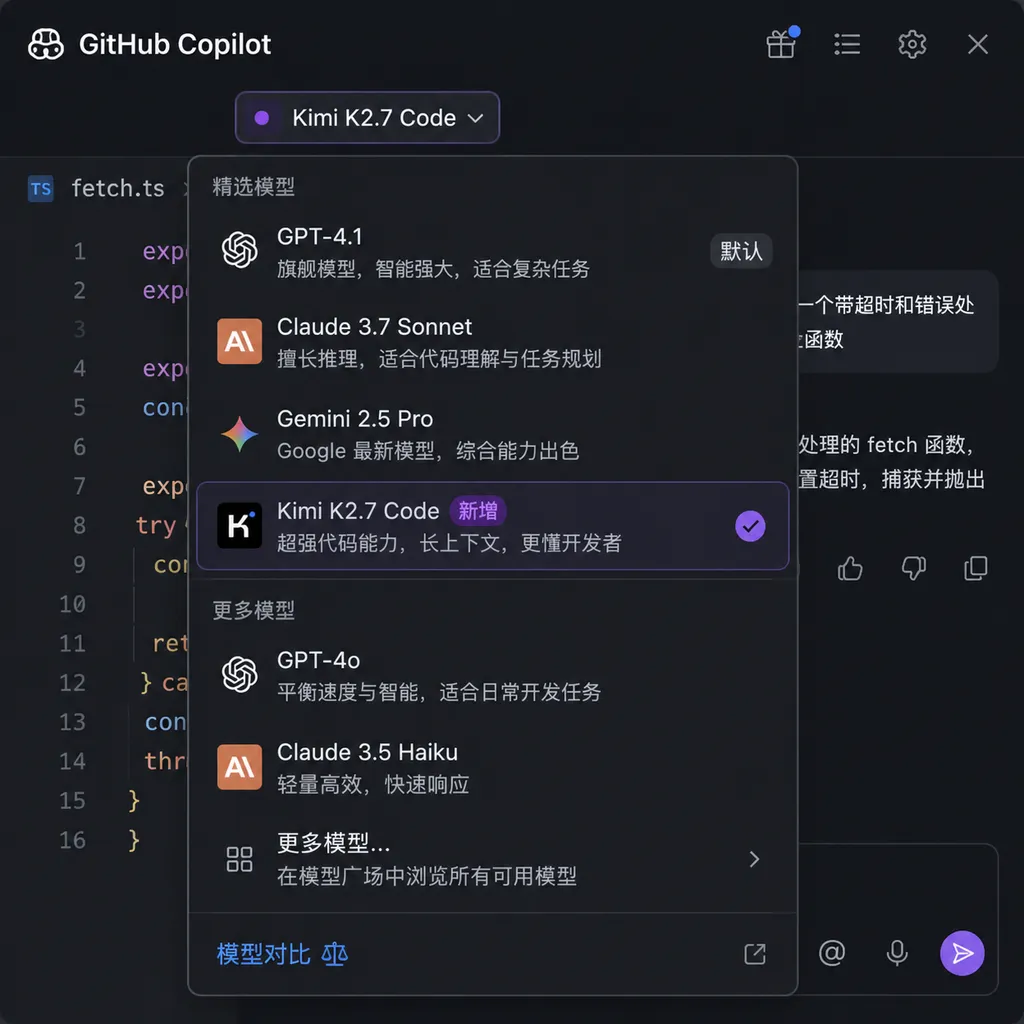
For developers, the most visible change is simple: when you open VS Code, JetBrains, or Copilot Chat, Kimi K2.7 Code now appears alongside Claude Sonnet 4, GPT‑5.1, and Gemini 3 Pro in the model dropdown. You can switch to it for Agent Mode, Edit Mode, or code completion. In Enterprise and Business editions, admins can enable it organization‑wide through policy.
Everyone who has worked on software distribution knows what this “seat” means. Copilot currently enjoys the world’s highest developer penetration as an AI coding assistant, with tens of millions of paid seats. Gaining entry to its default model pool is like unlocking a distribution channel that requires no self‑built IDE ecosystem and no extra user education. Over the last two years, Chinese models haven’t lacked capability — they’ve lacked position. DeepSeek, Qwen, and GLM have all scored highly in open‑source benchmarks, but for developers to pull them up “naturally” in daily work, they still had to rely on custom plugins or third‑party clients.
Moonshot has skipped that extra layer this time.
What Kind of Model Is K2.7 Code
Now to the model itself. Kimi K2.7 Code is a version that Moonshot released on June 15 specifically for programming and agent tasks. Architecturally, it continues the K2 series’ MoE design: one trillion total parameters, thirty‑two billion active parameters, and a 256 K‑token context window. The license is Modified MIT, with openly downloadable weights available on Hugging Face and GitHub.
Compared with the previous K2.6, K2.7 Code shows clear improvements in three areas:
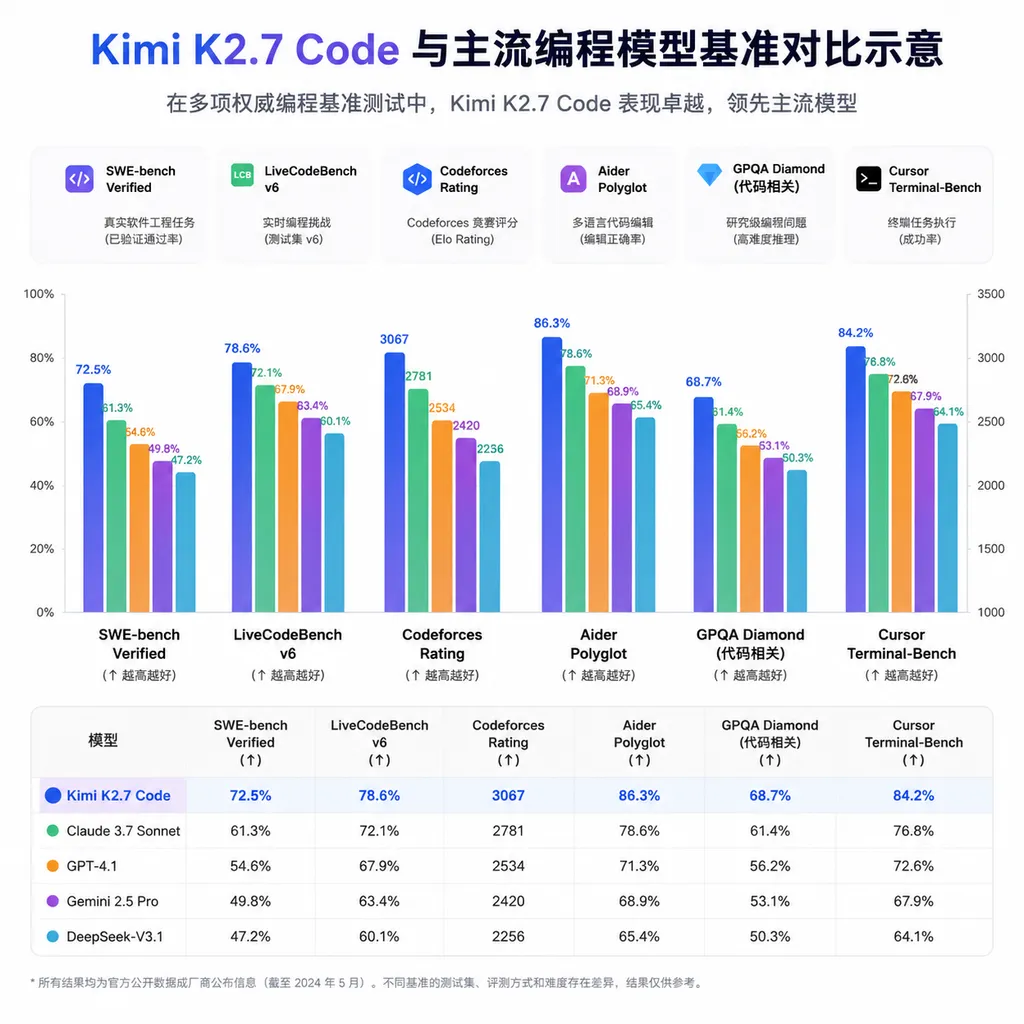
- Kimi Code Bench v2 increased from 50.9 to 62.0, a rise of over 21 %
- SWE‑Bench Verified from 48.3 to 53.6
- Multi‑SWE‑Bench Lite from 26.7 to 35.1, the largest gain
But more noteworthy than the scores is another figure: average token consumption down 30 %. According to Moonshot, this is due to “reduced overthinking in long‑range tasks.” In plain language: the K2.6 version had reasoning chains that were too long — a moderately complex task could trigger thousands of tokens of intermediate thinking. It looked smart but ran slow and expensive. K2.7 Code shortens that chain yet improves the benchmark score.
That’s unusual among inference models. Most vendors trade “thinking more” for higher scores; Moonshot achieved better scores by “thinking more precisely.” This is critical for agent scenarios: an agent essentially performs multi‑round tool calls, and every round that costs 30 % more tokens multiplies total cost across many rounds.
One note in advance: K2.7 Code only has a thinking mode — no non‑thinking mode. This differs from GPT‑5 or Claude Sonnet 4, which can turn reasoning on or off. Every call to K2.7 Code invokes a reasoning chain. That makes it better suited to complex tasks, not millisecond‑level code completion. GitHub’s integration into Agent Mode and Edit Mode takes advantage of exactly that characteristic — it’s meant for longer work, not instant autocompletion.
Why Copilot Would Adopt a Domestic Model
From GitHub’s perspective, the reasoning isn’t hard to guess.
Over the past year, Copilot has been deliberately uncoupling itself from the idea that “Copilot = OpenAI.” Last year it added Claude; early this year, Gemini; mid‑year, xAI. The pattern is clear — Copilot aims to become a multi‑model distribution platform, not just the frontend for one vendor.
That strategy is pragmatically motivated. First, bargaining power — with a huge user base, Copilot needs leverage on the model‑supplier side. Second, scenario coverage — different models excel in different coding tasks: Claude is strong in refactoring, GPT steady for debugging, Kimi excels at long‑context tasks; developers genuinely need to switch models. Third, agentification costs — token usage grows exponentially in agent workflows; multiple suppliers make cost management possible.
K2.7 Code happens to tick the right boxes: open‑source weights, 256 K context length, low token cost, and coding scores rivaling top‑tier models. For GitHub, adding a capable, price‑flexible, open‑source option leaves almost no reason to say no.
What This Means for Developers in China
A practical reality must be mentioned: GitHub Copilot’s payment and network experience inside China have never been smooth. Many teams rely on alternatives such as Cursor, Continue, Cline, or Roo Code with their own model selection. So “K2.7 Code joining Copilot” benefits domestic users indirectly — it proves the model’s capabilities are endorsed by a mainstream platform, but real adoption will depend on stable, affordable, direct APIs.
That’s also the hottest area in China’s AI infrastructure race lately. PPIO integrated K2.7 Code on June 15, the very day the model launched; Moonshot’s official platform exposes an API as well. Aggregators like OpenAI Hub have already added K2.7 Code to their unified model pools, so one OpenAI‑compatible key can call K2.7 Code, Claude, GPT, Gemini, and DeepSeek through domestic connectivity without code changes — handy for teams testing multiple coding models versus separately applying for accounts and setting up dedicated connections.
For individual developers, the practical choices are roughly:
- If your main IDE is VS Code or JetBrains and Copilot works for you: simply switch to Kimi K2.7 Code in the model selector and use it within your Copilot quota.
- If you use Cursor / Cline / Roo Code / Claude Code or similar third‑party clients: just plug in an OpenAI‑compatible API endpoint — Moonshot’s official docs clearly cover configuring the K2 series in Claude Code, Roo Code, or Cline.
- If you’re in a team setting needing audits or multi‑model comparison: unified entry points from aggregator platforms make cost control far easier.
A Longer‑Term Signal
Seeing this merely as “one more model added to Copilot” would be an underestimate.
Over the past two years, Chinese large models have chased benchmarks aggressively, but their real challenge was never scores — it was distribution. A model can be powerful, but if developers must install special plugins, alter toolchains, or visit specific websites to use it, it will remain stuck among early adopters instead of entering mainstream workflows. GitHub Copilot is one of the world’s largest entry points into daily developer workflows; Kimi’s seat there marks the first real breakthrough for a domestic model in clearing that distribution hurdle.
Looking ahead, Anthropic’s Claude Code, ByteDance’s Trae, Cursor’s model‑switching feature, and open‑source agent frameworks like Cline and Roo Code are all explicitly pursuing “multi‑model interchangeability.” On the flip side of that trend, model‑level brand barriers are thinning — developers care less about whose model they’re using and more about which one runs faster, cheaper, and performs better for the task at hand. As models become pluggable components, distribution channels and inference services rise in importance.
Moonshot clearly understands this. Only half a month passed between K2.7 Code’s release and its integration into Copilot, showing this is not a single‑point win but a coordinated effort across model, license, API service, and channel partnerships. With open source, cost control, top‑tier capability, and mainstream platform inclusion combined, Kimi has evolved from “a strong domestic model on benchmarks” to “a credible option for technical stack selection.”
For the broader Chinese model ecosystem, the case proves that this path is viable. Whether DeepSeek, Qwen, or GLM will follow into Copilot or Cursor integrations in coming months will be worth watching. For now, Kimi moved first.
References
- Kimi K2 official GitHub repository: Moonshot AI’s open‑source codebase for the Kimi K2 series, including K2.7 Code model description, evaluation results, and deployment guide.
- Reddit discussion on Kimi K2.7 Code: LLMDevs community discussion on K2.7 Code benchmark scores, token usage, and real‑world experience.


