
Alibaba Cloud Meoo Launches Nighttime Plan: Qwen3.7 usage at up to 80% off
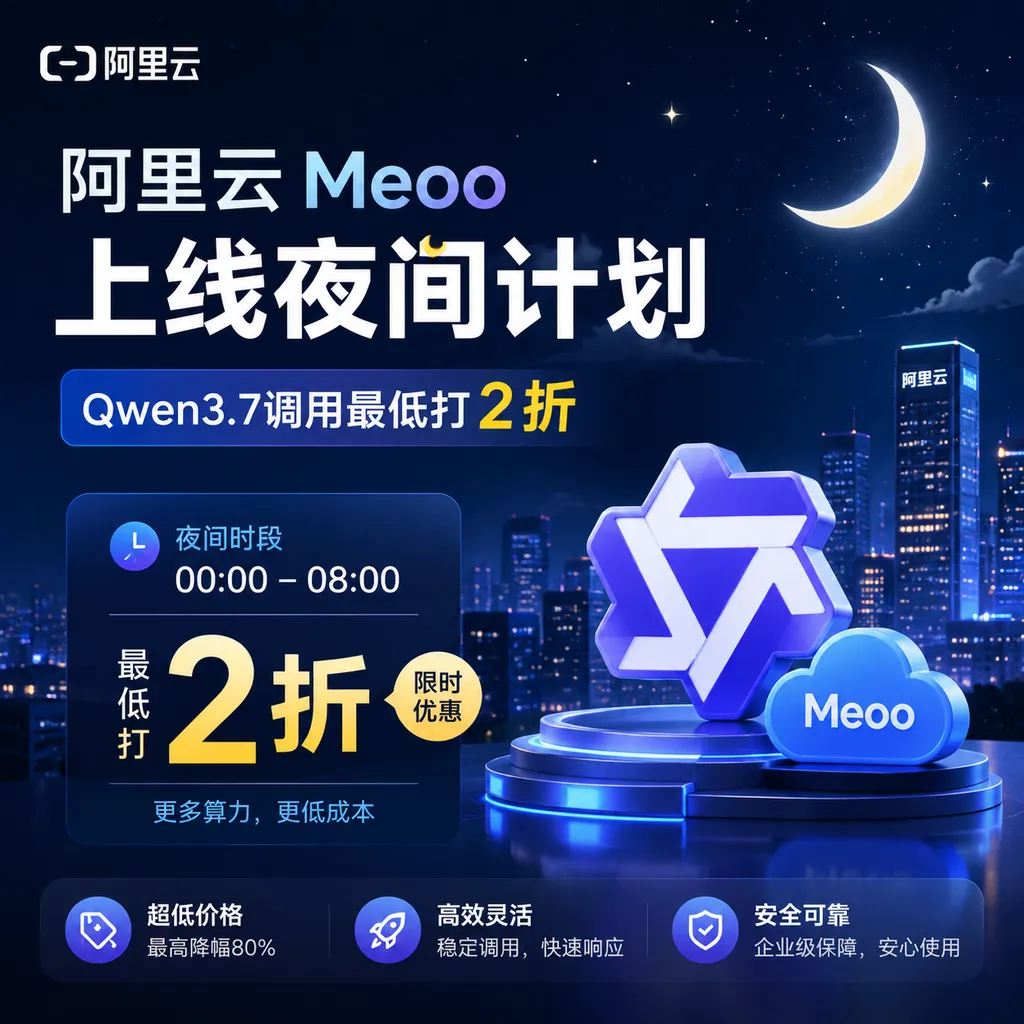
Alibaba Cloud launches the **Night Plan off-peak billing** for **Miaowu Meoo** and **Qoder**. From **10:00 PM to 8:00 AM**, calls to **Qwen3.7-Max** are **80% off** and to **Qwen3.7-Plus** are **60% off**, saving up to **80% in computing costs**.
Alibaba Cloud Starts Selling “Night Power”
On July 2, Alibaba Cloud launched a time-of-use billing plan called Night Plan for its two AI productivity tools, Qoder and Meoo. The rules are simple: between 22:00 and 08:00 Beijing time, users calling Qwen3.7-Max in these products get an 80% discount (pay 20% of the original price), and for Qwen3.7-Plus they get a 60% discount (pay 40% of the original price). According to the official numbers, users can save up to 80% of their costs.
This kind of model isn’t new in cloud computing—AWS Spot Instances and Alibaba Cloud ECS preemptible instances essentially sell idle compute resources cheaply to users less sensitive to latency. But applying this model to large-model API calls—especially for end users of AI programming and low-code tools—is the first time a domestic vendor has done this publicly.
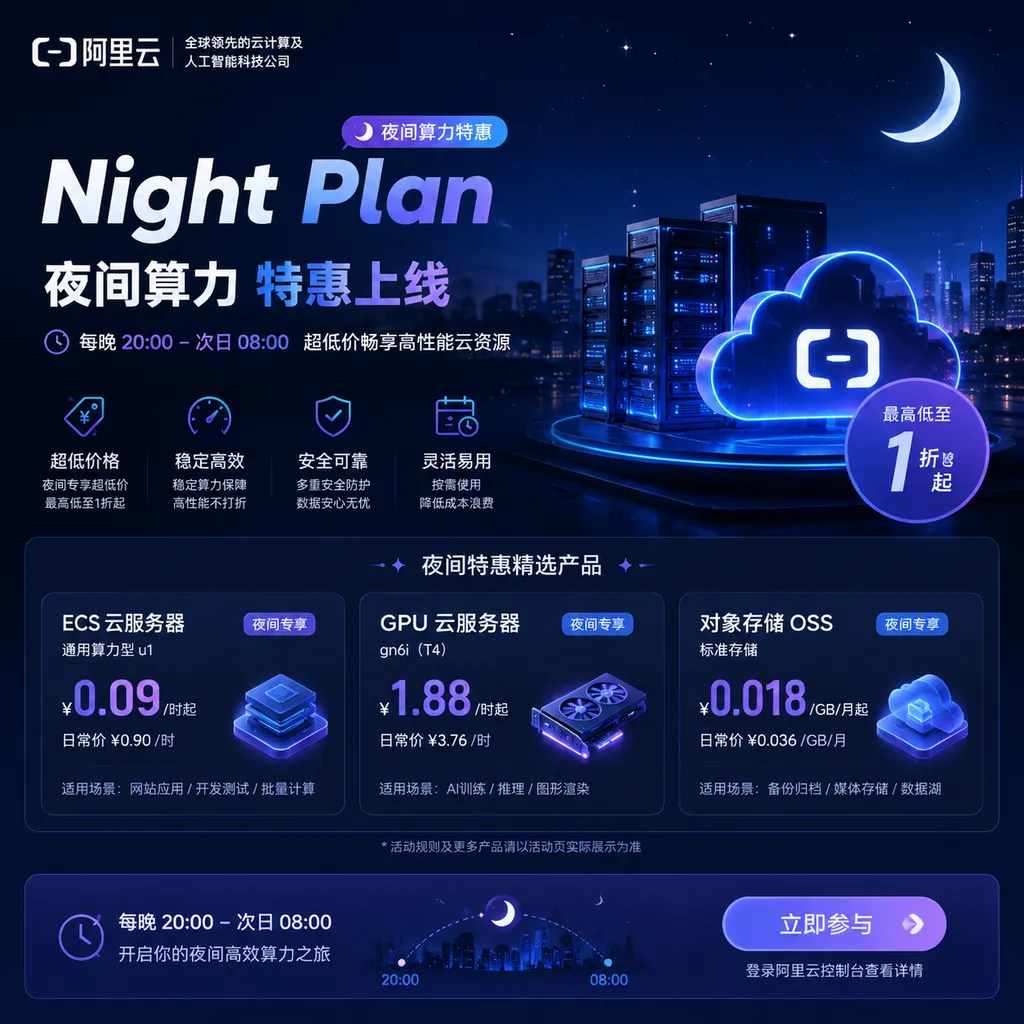
Who Can Benefit and How to Trigger It
Let’s clarify the rules first, as there are a few potential pitfalls.
Applicable Products: All Qoder versions (Qoder Desktop, QoderWork CN, Qoder CLI, JetBrains Plugin, QoderWake) and the full-featured Meoo (zero-code generation, swarm Agents for parallel generation, one-click mini-program/H5 deployment). Note that for Meoo, only Pro or Max plan users are eligible; trial users follow the Qoder plan.
Applicable Models: Only the two flagship models, Qwen3.7-Max and Qwen3.7-Plus, qualify. Other Qwen3.7 variants and all Qwen3.6 or earlier versions are excluded.
Trigger Method: Fully automatic. The system determines eligibility based on the task request submission time. Any request submitted between 22:00 and 08:00 gets the discounted rate automatically. No need to switch plans, enter codes, or register for the program. This is more user-friendly than cloud preemptible instances, where users must define scheduling strategies manually.
Billing Scope: The discount affects only credit consumption, not model quality, context window, or response speed. In other words, a job run at night yields the same results as during the day—only billing differs.
A detail worth noting: Qoder CN (formerly Tongyi Lingma) is not included in the Night Plan discount, only QoderWork CN, Qoder CLI CN, and similar products qualify. This division reveals Alibaba’s intent—to encourage migration to its new agent-oriented products, while legacy code-completion scenarios receive no subsidies.
Why Nighttime, and Why Now
At first glance, this looks like a marketing campaign, but in essence, it’s a redistribution of computing supply and demand.
The utilization curve of large-model inference clusters closely follows human working hours. Between 9:00 and 22:00 utilization peaks—particularly for programming and office scenarios—reaching over 80% GPU usage. From late night to 8:00 a.m., load plummets to one-third or less of daytime levels. Yet GPU depreciation and electricity costs are incurred 24/7, so idle compute equals pure loss.
Alibaba’s time window of 22:00 to 08:00 conveniently spans 10 hours—41.7% of a day. Selling compute at 20% of the price during that time, as long as marginal cost is covered, turns idle time into profit. It’s the same principle as power utilities offering off-peak pricing or ISPs selling idle bandwidth.
More importantly, Qwen3.7-Max incurs high inference costs. When it launched, even a temporary 50% discount was considered substantial. Now with an additional 80% off at night, the flagship model’s effective price drops to that of, or even below, the Plus tier. For Agent-based applications—tasks requiring dozens or hundreds of tool calls over several hours—the difference in cost is massive.
Who Benefits Most: Agent-Based Batch Processing
The real target users of this plan aren’t developers waiting for code completion inside an IDE—those interactions are real-time and happen during the day.
The real beneficiaries are those running asynchronous batch jobs:
- Repository-level code refactoring: Submit the job in QoderWork’s Quest Mode, let it decompose and process dozens of files automatically. What used to cost too many credits during daytime can now run overnight.
- Batch unit test generation: Generating tests for an entire project is mechanical work—perfect for night runs.
- Bulk document generation/translation: Full rewrites of technical or API documentation.
- Data analysis reports: Timed jobs are naturally suited for overnight runs.
- Meoo swarm Agent parallel generation: Multiple Agents simultaneously building mini programs or H5 pages spend massive credits—the absolute savings from an 80% discount are huge.
In other words, the Night Plan encourages users to reorganize their workflows: make decisions and do reviews during the day, then let Agents handle heavy asynchronous tasks overnight. This represents the mainstream trend in AI coding over the next year or two—from “AI help me write” to “AI do it for me.” Only by decoupling tasks from synchronous interaction can the cost model truly work.
Pricing Comparison: How Big Is This Discount?
An 80% discount sounds dramatic, but we need to view it in the context of the model API pricing ecosystem.
At full price, Qwen3.7-Max competes with Claude Opus and GPT-4 Turbo. If the base price is X yuan per million tokens, an 80% discount brings it to 0.2X—nearly equal to or even below Qwen3.7-Plus’s daytime price. That means using the flagship model at night costs less than using the mid-tier model during the day.
For comparison, DeepSeek V3’s off-peak pricing (half price from midnight to 08:30) equals 50% of daytime pricing. Alibaba’s 20% pricing goes even further. However, DeepSeek’s discount applies to all use cases, while Alibaba’s is limited to its Qoder/Meoo ecosystem—this distinction matters.
For API-based developers using aggregation platforms like OpenAI Hub that mix Qwen, Claude, and GPT models, the Night Plan discount does not apply—it’s exclusive to Alibaba’s client products. To enjoy the discount, users must migrate their workflows into the official clients. This “price-locking the ecosystem” tactic has become common among domestic cloud vendors in recent years.
Hidden Issues
It looks good, but a few points deserve consideration before practical use:
1. Is the 10-hour window long enough for your task?
If you submit a job at 21:55, is billing based on submission or execution time? Alibaba says discounts apply based on “task request time,” meaning submission time counts. So to get the full discount, submit after 22:00. But if a task runs past 08:00, how will the excess be billed? The announcement doesn’t specify.
2. Will there be enough nighttime compute resources?
With the plan launched, many users will flood in at night. If the queue grows and tasks start executing during the day, how is billing handled? This is a classic issue with time-based discounts, dependent on Alibaba’s scheduling and capacity planning.
3. Meoo’s 10,000 bonus credits and 2,000 daily credits.
Meoo gives new users these bonus credits, and combined with an 80% discount, the trial cost becomes negligible. This is Alibaba’s move to win users for its agent-based zero-code platform—Meoo directly competes with Devin and Manus, and with no clear leader yet in China, now is the time to capture the market.
4. No impact on pure API users.
Developers calling Qwen3.7 directly via the Bailian platform are unaffected; their pricing remains unchanged. Night Plan is a product-level benefit, not a model-wide price cut.
A Broader Signal
Viewed more broadly, this may signal that domestic large-model pricing is entering a stage of fine-grained operations.
For the past two years, model price wars have been horizontal—across-the-board reductions to gain scale. Now we’re seeing vertical segmentation by time, scenario, user type, and task. Qwen3.6’s 55% discount was one wave, Qwen3.7-Max’s time-limited 50% another, and now Qoder/Meoo’s 20% night discount adds yet another tier. Pricing dimensions keep multiplying.
This is both an opportunity and a headache for developers: the good news is there’s always a cheaper combination; the bad news is figuring out which one fits your workload best.
For teams, what’s worth doing next quarter is re-evaluating your AI workflows: which tasks must run instantly, which can be deferred overnight; which truly require the flagship model, and which can use mid-tier ones. After this restructuring, cost savings could be significant.
After all, having GPUs idling at night while overloaded during the day is inherently inefficient. The Night Plan at least brings that inefficiency into transparent pricing.
References
- ITHome: Alibaba Cloud Meoo Launches Night Plan – detailed report on event rules and applicable scope


