
A single 3080 running for 15 hours: An independent developer hand-built a 216M-parameter LLM from scratch
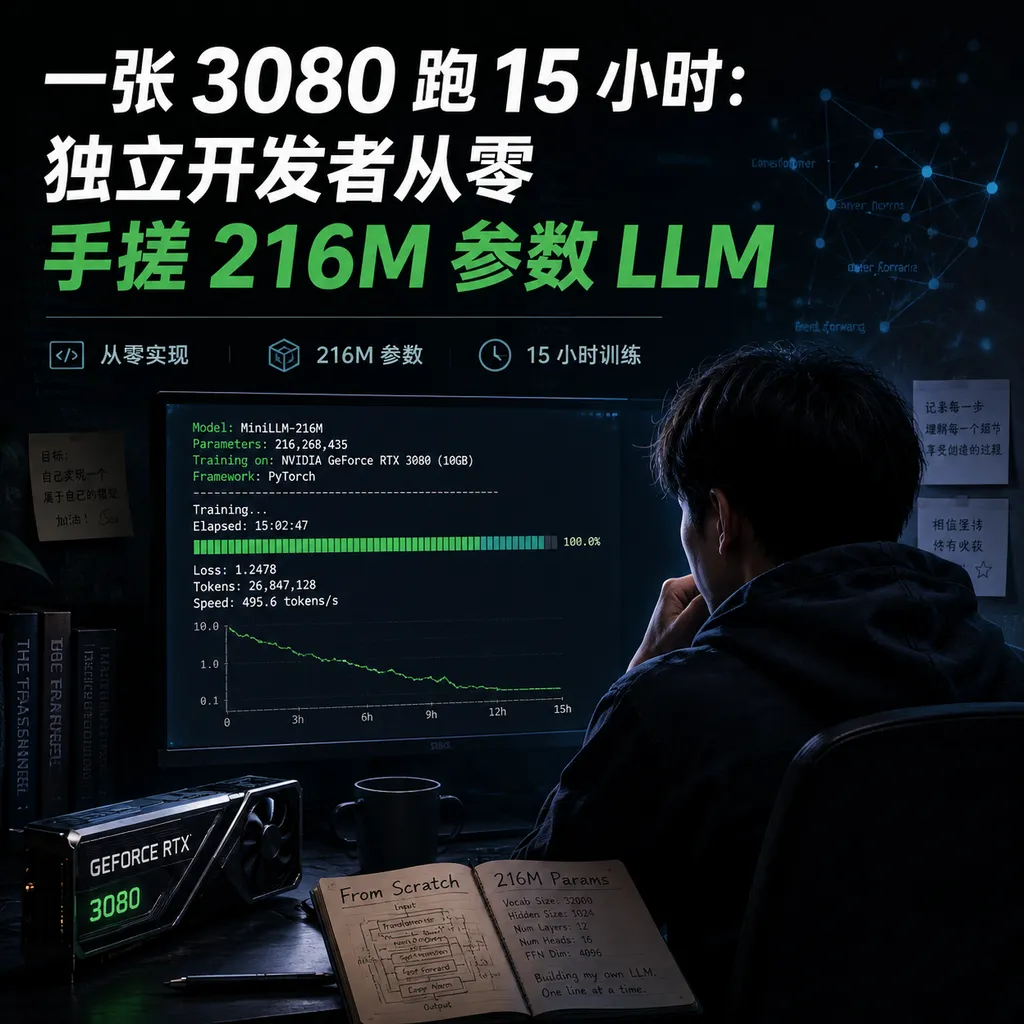
An independent developer showcased on Reddit a 216M-parameter small language model they built completely from scratch. It was trained for 15 hours on a single RTX 3080, with Attention, RoPE, and SwiGLU all implemented manually, without using any ready-made HuggingFace modules.
Last weekend, a seemingly unremarkable but highly technical post appeared on Reddit’s r/MachineLearning forum. An independent developer showcased a small language model that they had built entirely from scratch—216.5M parameters, 10 decoder layers, fully written by hand from tokenizer to attention. Training took 15 hours on a single RTX 3080 GPU.
In this era of trillion-parameter models and thousands of H100s, such a post wouldn’t normally make waves. But after examining the architecture and training details, you realize this might be one of the most “textbook-level” reproduction cases worth serious attention from developers lately.
Not a Wrapper—Truly Built from Scratch
Let’s be clear first—there are plenty of projects claiming “trained from scratch,” but most just swap configs on HuggingFace’s AutoModelForCausalLM or fork nanoGPT and tweak hyperparameters. This developer is different—even the attention layer is self-implemented.
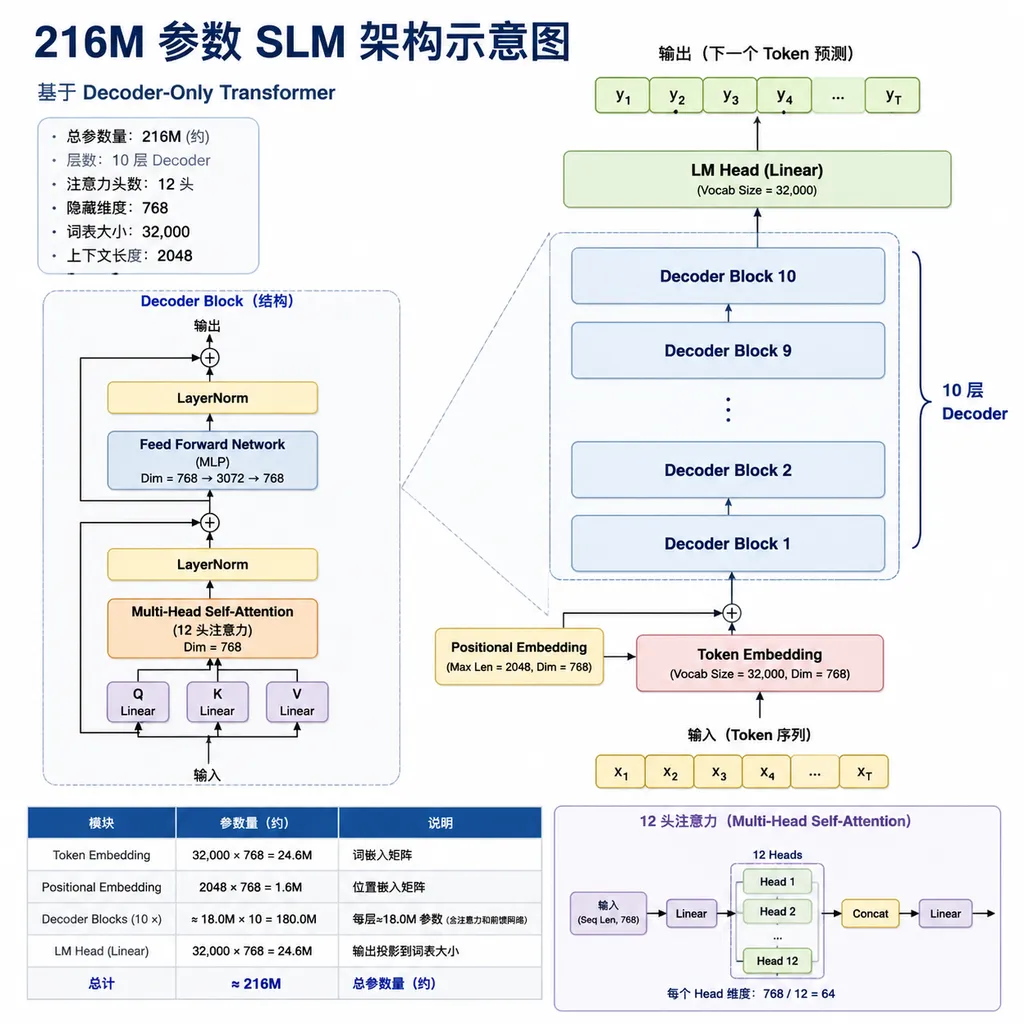
Here’s the architecture overview:
- Parameters: 216.5M
- Layers: 10
- Attention: 12-head multi-head self-attention, RoPE positional encoding, SDPA acceleration
- Structure: Decoder-only, Pre-Norm, RMSNorm + SwiGLU, shared input/output embeddings
- Hidden dimension: 1032, head_dim 86, FFN intermediate 4416
- Tokenizer: Custom-trained 36k SentencePiece unigram; case-sensitive, byte fallback, special tokens for chat roles and memory
- Context length: 768
This configuration essentially reproduces the modern best practices of the LLaMA-series decoder in a compact model: RMSNorm is faster than LayerNorm, SwiGLU is more expressive than ReLU, RoPE generalizes better than learnable positional encodings, and tied embeddings save parameters—all optimized and proven choices over the past two years.
The hidden size of 1032 and head_dim of 86 deserve special mention. 1032 isn’t a power of two, nor is 86. This means the author didn’t just copy numbers from some open-source model—they actually computed the parameter count and GPU memory usage under a 10GB limit, selecting them carefully. Anyone who’s done fine-tuning knows that such nonstandard dimensions usually come from battling against hard memory constraints.
Training Configuration: Squeezing Every GB Out of the 3080
The training setup is even more interesting: one RTX 3080, 10GB VRAM, bf16 precision, finished in 15 hours.
Details:
- Dataset size: ~551M tokens
- Optimizer: AdamW, β = 0.9/0.95
- Learning rate: 3e−4, 1000-step warmup
- Weight decay: 0.1
- Gradient clipping: 1.0
- Effective batch size: 16384 tokens/step (micro batch 4 × grad accum 8 × seq len 512)
- Total steps: 33,650
Key details: micro batch of 4, sequence length reduced to 512 for training (can reach 768 in inference), accumulated over 8 steps to simulate a batch of 16384 tokens. This is the classic “memory too small, accumulate gradients” trick—essentially the only viable path to train an LLM on a consumer GPU.
β₂ = 0.95 instead of Adam’s default 0.999 is the classic GPT-3 recipe for stability. The 3e−4 learning rate with 1k warmup is another proven configuration—clearly the author has studied papers, not just trial and error.
Compute the data-to-parameter ratio: 551M tokens vs. 216M parameters = roughly 2.5:1, well below Chinchilla’s recommended 20:1—so the model is definitely undertrained. But for a test validating architecture correctness rather than maximizing benchmark scores, it’s fine. The goal was to make the loss converge and achieve human-readable output, not to compete on leaderboards.
Well-Chosen Datasets
The pretraining used Wikipedia, TinyStories, and OpenWebText2. TinyStories, from Microsoft, is a synthetic dataset of simple stories designed specifically for training small models, helping those around the 100M scale learn fluent English—showing the author knows exactly what kind of data small models need.
The SFT stage further demonstrated skill:
- SmolTalk: curated by HuggingFace’s SmolLM team for small-model dialogue
- UltraChat: high-quality multi-turn dialogue dataset from Tsinghua University
- Magpie: high-quality instruction data “fished” from alignment models
- AM-DeepSeek-R1: reasoning-chain data, borrowing R1’s reasoning behavior
- Orca-Math: mathematical reasoning data
This combination covers all major directions in small-model SFT: everyday conversation, multi-turn dialogue, instruction-following, reasoning chains, and math—and all of them are open datasets, fully reproducible with no compliance risks.
Why Developers Should Care
You might ask: with Qwen, Llama, and Gemma all offering small open-source models far stronger than this self-built 216M version, what’s the point?
Three reasons.
First, the learning value is irreplaceable. Deriving Attention, RoPE, RMSNorm, and SwiGLU from formulas to PyTorch implementation teaches more than reading a hundred blog posts. Similar projects exist in China, such as Datawhale’s Happy-LLM (215M scale, replicating LLaMA2 architecture and pretraining process) and wdndev’s tiny-llm-zh (92M Chinese small model, covering tokenizer training to llama.cpp deployment). They share the same goal—connect all the technical dots of LLMs in a complete, runnable case executable on a consumer GPU.
Second, real engineering trade-offs under constraints are invaluable. Training a model across eight H100s is a completely different game from doing it on one 3080. The former lets you design freely; the latter makes every choice a battle with memory and time. The author’s decisions—context length 768, training length 512, tied embeddings—are pure constraint-driven trade-offs. Teams building domain-specific small models can learn far more from this experience than from a “we trained with 1024 GPUs for three months” corporate report.
Third, SLMs are becoming a real track. Look at 2024’s trajectory: Microsoft’s Phi series has advanced, Google’s Gemma 3 Nano targets on-device scenarios, Apple Intelligence is built on a 3B model, HuggingFace’s SmolLM series has reached 1.7B. Demand for small models in edge, offline, and privacy-sensitive environments is exploding. A design trainable in 15 hours on a single 3080—a bit more data and parameters—and you’ve got a commercial prototype.
What Can a 216M-Parameter Model Actually Do
Let’s be practical. What can a model with 216M parameters and 551M training tokens do—and not do?
Can do:
- Simple chat (greetings, small talk, formatted replies)
- Short text classification and intent recognition
- Text generation in a specific domain (e.g., TinyStories-style short prose)
- Act as a draft model for speculative decoding with larger models
- Lightweight NLP tasks on edge devices
Cannot do:
- Complex reasoning
- Long document understanding (context only 768)
- Code generation (no code data provided)
- Multilingual tasks (English-only corpus)
- Factual Q&A (551M tokens can’t carry much world knowledge)
The author explicitly states it’s a “test SLM” intended for experimentation and pipeline validation, not performance comparisons. In today’s ecosystem of overhyped “GPT-4-level” open-source claims, this honest attitude is refreshing.
An Observation
Over the past year, the barrier to training LLMs from scratch has visibly dropped. Two years ago, just understanding how Attention works could take days of papers; one year ago, nanoGPT simplified pretraining but full SFT pipelines were still hard; now by 2026, one developer with a 3080 can train a conversational model over a weekend.
This reflects the maturing infrastructure: PyTorch 2.x SDPA makes accelerated attention plug-and-play, bf16 training is steady, open datasets are vastly richer in quality and quantity, and tokenizer tools like SentencePiece are fully mature.
For developers, this means two things:
First, the democratization of knowledge. Pretraining is no longer a game reserved for OpenAI or Google researchers—any engineer willing to invest some time can join. You don’t need to train a model yourself, but walking through that whole pipeline once gives deep insight into how and why LLMs behave the way they do.
Second, a window of opportunity for vertical small models. The general-purpose model wars are over; next comes the battle of specialized small models. Whoever can solve a specific problem with a 100M–1B parameter model will claim territory across edge, offline, and privacy-sensitive markets.
Of course, most real-world teams will still use APIs—self-training an LLM has nontrivial costs and continuous investment in tuning, deployment, and iteration. For developers rapidly validating product ideas, platforms like OpenAI Hub aggregating GPT, Claude, Gemini, and DeepSeek behind one key are often far more practical. Once your business model and scenario stabilize, you can consider distilling your own small model.
In Conclusion
In the Reddit thread, someone asked the author: “Why did you do this?”
The author simply replied: “I wanted to see if I could really build something that talks, from scratch.”
It reminds me of how people learning microcontrollers years ago insisted on writing their own “hello world” to light up an LED. Today, training a conversational LLM from zero might just be the new “lighting up the LED.”
The technical threshold is falling, but the demand for solid fundamentals remains unchanged. Whoever takes the time to understand every line of Attention code will be the one who walks steady in the next wave of AI applications.
References
- Original Reddit post: Looking for feedback on a small test SLM — Discussion thread where the independent developer published the full architecture and training details of the 216M model
- tiny-llm-zh project — A similar Chinese small-parameter LLM built from scratch, covering tokenizer training through llama.cpp deployment
- Independent Developer AI Product Landscape in the LLM Era — Overview of indie developer opportunities in the AI age
- HuggingFace SmolLM Datasets — Includes SmolTalk and other datasets designed for small-model training


