
Alibaba Cloud Databridge Agent will start charging in August
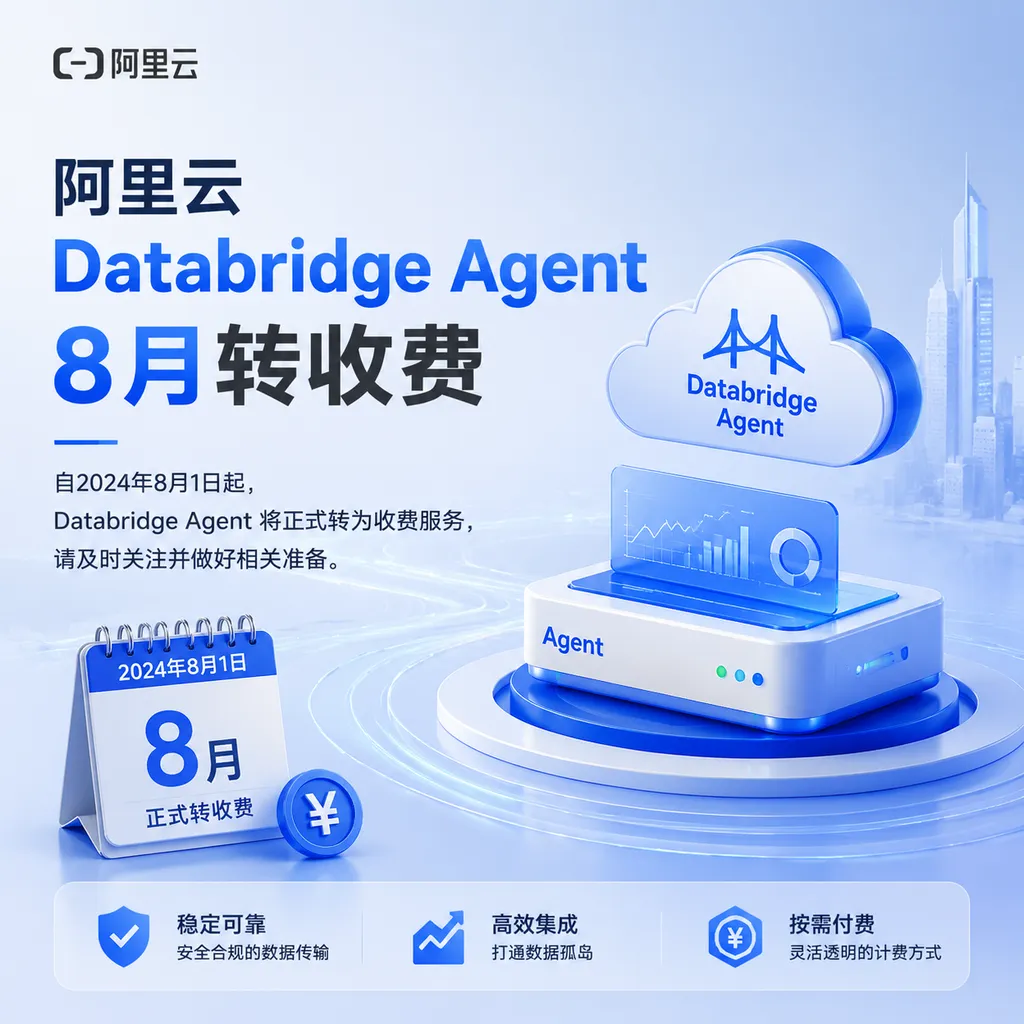
Alibaba Cloud announced that the core component of its AI-native database service, **Databridge Agent**, will officially transition to commercial pricing on **August 1, 2026**, marking the shift of enterprise-grade Agent data infrastructure from a free trial stage to full commercialization.
Alibaba Cloud Databridge Agent to Start Charging in August: The Agent Era of Data Infrastructure Begins Monetization
Alibaba Cloud has announced that the core component of its AI-native database service, Databridge Agent, will transition to a commercial billing model on August 1, 2026. This marks the domestic cloud industry's first commercialized infrastructure product specifically targeting Agent-based data access scenarios. It also signifies that, with AI coding tools like Cursor, Claude Code, and Coze widely adopted in enterprises, the once-overlooked areas of data security and access management are now gaining commercial value.
Why Start Charging Now
Over the past year, scenarios where enterprise AI Agents access production data have surged. Developers use Cursor to write SQL directly against databases, product managers use Coze to query business data, and data analysts ask data warehouse questions in natural language—these actions improve efficiency but simultaneously render traditional database permission models obsolete.
Traditional database permission models were designed for humans: give Zhang San a read-only account, restrict access to specific tables. But Agents aren’t humans. One Cursor plugin might be used by 20 developers, each with different permission requirements; a data analysis Agent might need to join data across 10 sources—something traditional models cannot handle.
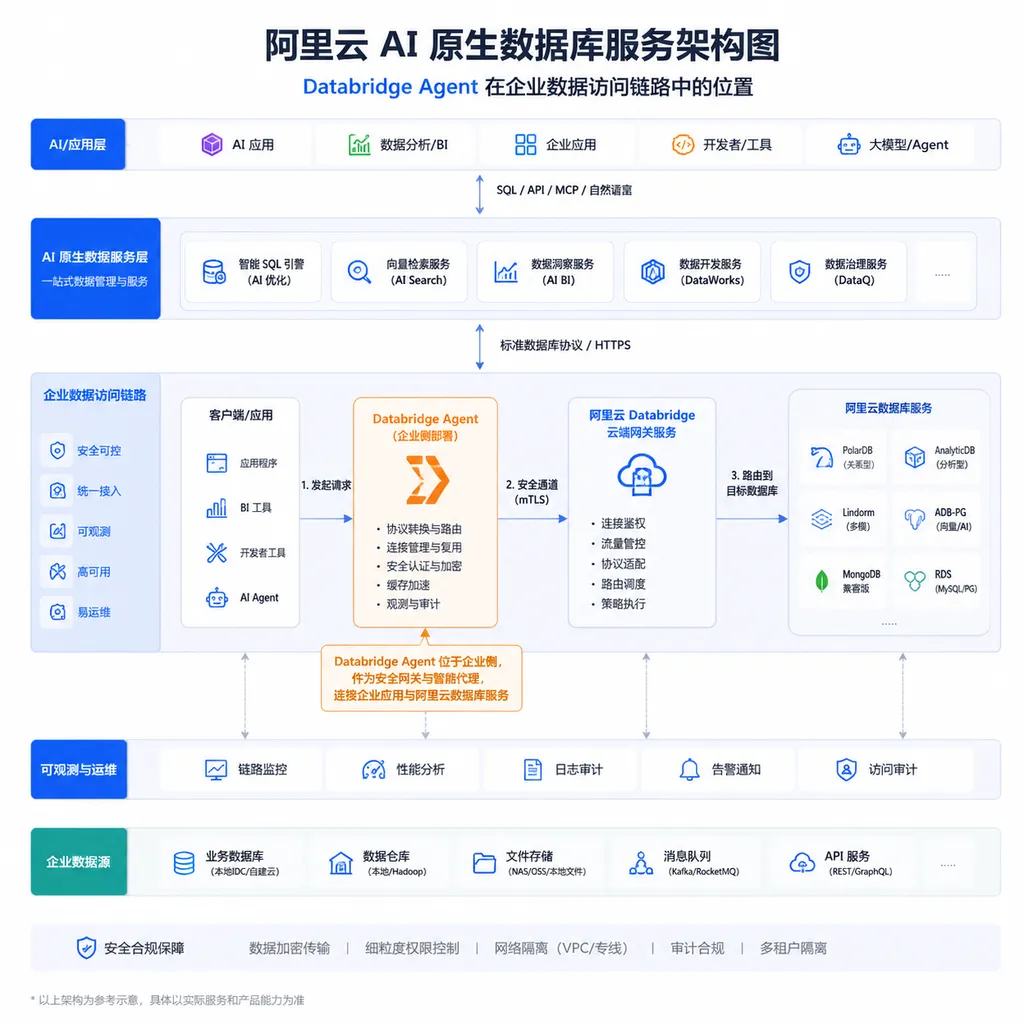
Databridge Agent aims to solve this. Essentially, it’s a gateway deployed between all AI Agents and enterprise data sources, taking over permission verification, SQL rewriting, sensitive data masking, and operation auditing—security logics previously scattered across databases and applications. From an architecture perspective, it’s a redesign of the traditional “bastion host + DLP + audit log” stack into an Agent-Native form.
Alibaba Cloud’s timing for commercialization is quite subtle. On one hand, by the second half of 2025, AI programming tools like Cursor and Claude Code will have surpassed adoption tipping points in Chinese enterprises—many teams can no longer function without them. On the other hand, incidents of data leaks, accidental deletions, and permission misuse have increased, and enterprises are now more willing to pay for Agent data security.
What Exactly Is This Product Selling
From Alibaba Cloud’s published capabilities, Databridge Agent is not just a simple database proxy—it’s a redesigned data access layer tailored for Agents. Its core features include:
1. Agent Data Gateway
This is the product’s foundation. All Agent data access must pass through this gateway, which performs:
- Identity Verification: Not just verifying the human user, but also the Agent itself. For instance, the same developer using Cursor vs. an internal Agent may have entirely different permissions.
- Semantic Understanding: Through the DataWiki module, Agents can understand business semantics. For example, when the Agent asks “What was last month’s GMV?”, the gateway automatically maps “GMV” to the correct tables/fields, rather than letting the Agent guess between
order_amountortransaction_value. - SQL Rewriting: Automatically rewrites SQL based on permission rules. For example, if an Agent may only see masked phone numbers, the gateway applies desensitization functions; if an Agent is limited to its department’s data, filters are automatically appended.
- End-to-End Auditing: Records every query—time, raw SQL, number of rows returned, whether sensitive fields were accessed. This supports traceability and behavioral analysis.
2. AI Data Preparation
This module addresses Agents accessing unstructured data. While databases store structured data, much enterprise knowledge resides in PDFs, Word files, emails, and meeting recordings. Databridge Agent provides Agent-Ready data preparation capabilities:
- Multi-source Connectors: Supports Web Channel (crawl websites), DB Channel (connect to databases), and File Channel (parse docs), among others. These connectors are AI-driven: for example, File Channel automatically detects tables, charts, and formulas in PDFs and structures them for Agents.
- Real-time Data Streams: Supports real-time data change access. For instance, if an Agent monitors an orders table, Databridge offers an Agent-friendly Streaming API instead of traditional polling or CDC queue setups.
3. Enterprise Knowledge Management
A particularly interesting direction: Alibaba Cloud integrates OneMeta (its metadata management product) with Databridge Agent to create an Agent-oriented knowledge service that enables:
- Automated Data Asset Inventory: Scans all enterprise data sources to auto-generate data catalogues, lineage, and business semantics.
- Knowledge Graph Construction: Combines documents, databases, and business rules into knowledge graphs, enabling semantic search for Agents.
- Cross-Agent Knowledge Sharing: Business semantics and mappings learned by one Agent can be shared with others, so each Agent doesn’t start from scratch.
4. Ready-to-Use Data Agents
Besides platform functions, Alibaba Cloud also offers a few prebuilt Agents:
- Analytics Agent: Conversational data analysis. Ask “What was the week-over-week growth in new users last week?”, and it writes SQL, runs queries, and visualizes results.
- DAS Agent: Intelligent database operations—handles slow SQL diagnosis, index recommendations, capacity forecasting, fault response. Alibaba Cloud’s goal: “turn DBAs from firefighters into digital architects.” Marketing aside, automated SQL optimization is indeed valuable.
- Meta Agent: Metadata management assistant. Helps understand data lineage, find field definitions, and view change history.
How It’s Charged
Alibaba Cloud will offer tiered pricing, with both subscription and pay-as-you-go options. Though full pricing isn’t released, the product appears to be positioned as a mid-to-high-end enterprise solution rather than a low-cost option.
Likely billing dimensions include:
- Service Tiers: Different tiers support varying numbers of connectors, concurrent Agents, and data sources.
- Functional Modules: The Agent Data Gateway, AI Data Preparation, and Enterprise Knowledge Management may be priced separately.
- Data Processing Volume: Under usage-based pricing, fees may depend on number of SQL executions, data scanned, or documents parsed.
Current public beta users must complete purchase before August 1, or their instances will become unavailable. Though strict, this makes sense—this is a mission-critical component of enterprise data access, and Alibaba Cloud can’t provide it free indefinitely.
Where Its Competitive Edge Lies
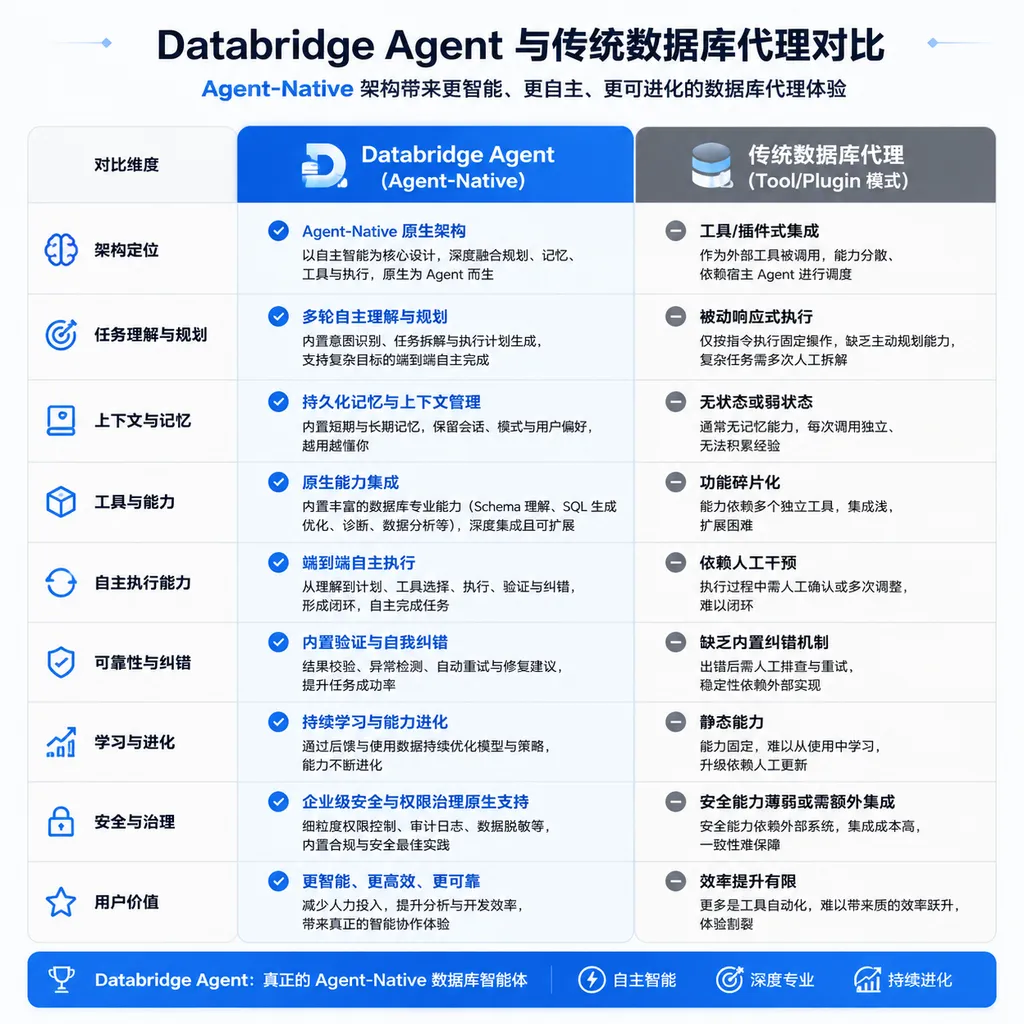
From a market perspective, Databridge Agent isn’t competing with traditional database proxies (e.g., ProxySQL, MaxScale) or data integration tools (e.g., Airbyte, Fivetran). It defines a new category: Enterprise Data Access Infrastructure for the Agent Era.
This is still a very early field, with no mature products globally. Some startups abroad focus on LLM data access security, but most tackle narrow problems (e.g., SQL injection protection or data masking only). Alibaba Cloud’s advantages include:
1. Ecosystem Integration
Alibaba Cloud already has a full database product ecosystem (RDS, PolarDB, AnalyticDB, DTS). Databridge Agent directly leverages those capabilities—for instance, DTS, originally for synchronization, now powers Agent-friendly streaming APIs; OneMeta, originally metadata management, is repurposed for Agent knowledge services.
Such integration is hard for startups. A standalone Agent security product would have to build its own connectors for dozens of databases, implement metadata management, and lineage analysis—heavy engineering only big cloud vendors can sustain.
2. Deep Understanding of Agent Scenarios
From its design, Alibaba Cloud clearly asked: “How is Agent data access different from human data access?” For example:
- Dynamic Permissions: Agent permissions are context-dependent; Databridge supports task-context-based authorization instead of static role bindings.
- Semantic Understanding: Agents know business concepts, not table names. DataWiki bridges this gap, mapping natural language to schema.
- Observability: Agents behave less predictably than humans, necessitating stronger audit and monitoring. Databridge provides complete Agent behavior analytics—identifying accessed data and abnormal actions.
3. Addressing Real Enterprise Pain Points
Data security has always been a must-have, but traditional tools (DLP, audit, masking) were human-centric, unfit for Agent-related challenges. Alibaba Cloud leverages this timing window to introduce an Agent-Native approach to these new issues.
The market entry is clever: instead of replacing databases or warehouses, it layers on top of existing infrastructure. Enterprises don’t need to migrate data or rewrite apps—just reroute Agent data access through the gateway. Migration and decision costs stay low.
Potential Challenges
Of course, challenges remain:
1. Performance Overhead
Adding a gateway introduces latency. For OLTP scenarios (high-concurrency, low-latency transactions), this could be an issue. Alibaba Cloud must prove Databridge latency is acceptable (e.g., P99 < 10ms).
2. Learning Curve
Concepts like DataWiki, Meta Agent, and dynamic permissions are new to many DBAs and data engineers. Using the platform effectively requires training and configuration. A steep learning curve could deter potential users.
3. Fragmented Agent Ecosystem
Agent frameworks vary widely—LangChain, AutoGPT, Microsoft Semantic Kernel, and more. Databridge’s compatibility with mainstream frameworks will determine adoption scope. Official info states Databridge supports Skill/MCP (Model Context Protocol) development, a good sign—MCP, promoted by Anthropic, could ensure strong compatibility.
4. Pricing Strategy
If priced too high, SMEs will hesitate; too low, Alibaba Cloud’s profit margins shrink. Moreover, designing proper Agent data access billing is inherently tough—per-Agent, per-data-volume, or per-request pricing each affects enterprise cost differently.
The First Year of Agent Infrastructure Commercialization
The commercialization of Databridge Agent is symbolic—it shows cloud providers are now seriously addressing the proposition of “infrastructure for the Agent era.”
For the past two years, all eyes were on foundation models—GPT-5, Gemini, DeepSeek R1—who has more parameters, better performance. Now the industry recognizes that models are just the visible tip of the iceberg. To truly deploy Agents in enterprises, you need full-stack infrastructure—data access, permission management, observability, knowledge systems, tool calling—painstaking but highly valuable work.
Alibaba Cloud may not be the first to build Agent infrastructure, but it could be the first major cloud provider to run it as a standalone product line. If the model works, others—AWS, Google Cloud, Azure—will likely follow.
For developers, this means that “using AI Agents to access enterprise data” is moving from a free-form experiment into an engineered, regulated phase. No more quick scripts or shared database credentials—you’ll have to use unified gateways, comply with access control, and leave audit trails. It adds mental overhead but strengthens security and governance.
Whether this product succeeds depends on months of market feedback: Will enterprises pay for Agent data security? How much? Can Alibaba Cloud deliver matching pricing and service quality? Those remain unknowns—but it’s clearly a direction worth watching. In an era full of Agents, whoever controls data access controls the key infrastructure.
References
- 36Kr – Alibaba Cloud Announces Paid Features for its AI-native Database Service Databridge Agent – First release
- Alibaba Cloud Product Updates – AI-native Database Service Officially Commercialized – Official product introduction
- Alibaba Cloud Docs – Databridge Agent Commercialization Notice – Timeline and impact
- Alibaba Cloud Docs – AI-native Database Service Billing Overview – Billing mode and pricing system


