
DAMO Academy AI Verifies Real Superconducting Material for the First Time

Alibaba DAMO Academy has launched ElementsClaw, an AI agent for superconducting material discovery. It predicted 68,000 candidate materials from 2.4 million crystals, four of which have been experimentally verified. This marks the first time an AI agent has completed a full closed loop from prediction to synthesis in the field of materials science.
Alibaba DAMO Academy's AI Verifies Real Superconducting Materials for the First Time
On July 3, Alibaba DAMO Academy, together with Renmin University of China and the University of the Chinese Academy of Sciences, released ElementsClaw — an intelligent agent for discovering superconducting materials. This AI system screened 2.4 million crystal structures and identified 68,000 potential superconductors, four of which have already been synthesized and experimentally confirmed to exhibit superconductivity. This marks the first time an AI agent has completed a full closed loop — from prediction and screening to experimental verification — in the field of materials science, with all data fully open to the public.
To put this in perspective: the international SuperCon database, the mainstream superconductivity database, has accumulated about 2,000 materials over several decades. ElementsClaw completed the screening of 2.4 million crystals in just 28 GPU hours, and its predicted candidate materials are 34 times larger than the existing database.
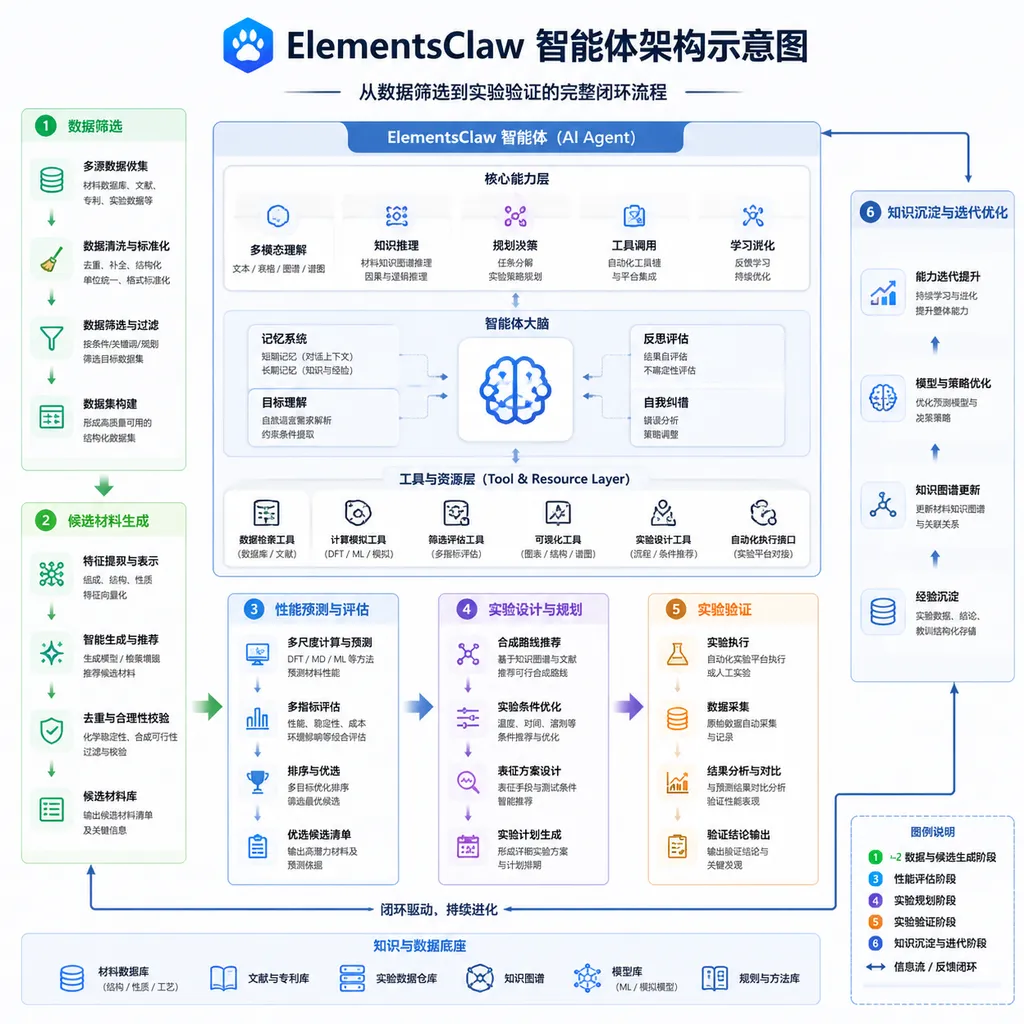
More Than a Prediction Model — a Hands-On Intelligent Agent
What makes ElementsClaw special is that it’s not merely a prediction model but a complete intelligent agent system. Like a human materials scientist, it can read papers, assess synthesis feasibility, design experimental plans, and even “self-evolve” by uncovering new clues from literature.
Technically, ElementsClaw adopts a “specialized-general fusion” architecture:
Specialized Model Layer: Based on a database of 125 million molecular and crystal structures, a 1-billion-parameter atomic foundation model called Elements was pre-trained. The model achieves an AUC of 0.996 for determining whether a material is superconducting, and predicts the critical temperature with an average error of less than 1K — approaching the margin of experimental measurement accuracy.
General Agent Framework: Implements a full set of autonomous workflows for tool generation, process orchestration, and literature review. This means it can not only compute but also read papers, make decisions, and adjust strategies.
The advantage of this architecture is that the specialized model provides domain depth, while the general framework offers flexibility. When encountering new material systems or synthesis paths, the agent can autonomously adjust strategies without retraining the entire model.
Four New Materials, Each with a Unique Origin
The research team has experimentally synthesized and verified four superconducting materials, each discovered through different routes:
-
Hf21Re25: A “missed catch” from existing databases. This material had already existed in databases but was overlooked due to incomplete labeling or noisy data that masked its superconducting properties.
-
Zr4VRe7: A material “corrected” after fixing structural errors in the original database. The compound’s recorded crystal structure was incorrect, leading to inaccurate predictions. ElementsClaw discovered the issue through cross-validation, corrected the data, and confirmed its superconductivity.
-
HfZrRe4: A wholly new material generated de novo by AI — a true “AI original,” not a modification of an existing material.
-
Zr3ScRe8: A material inferred by analogy from similar structures, with a critical temperature as high as 6.5 K. While 6.5 K (~–266.65°C) may seem low, it’s quite respectable for conventional superconductors and can be practically valuable for low-temperature applications.
These discovery paths — data mining, error correction, de novo design, and structural transfer — represent typical scenarios in materials R&D, demonstrating that ElementsClaw is not a “one-trick pony” but a general system with multiple discovery strategies.
A New Paradigm for AI for Science
Superconducting materials are just the beginning. According to Rong Yu, head of Scientific Intelligence at Alibaba DAMO Academy, ElementsClaw validates the potential of AI-agent frameworks in material discovery, with many candidate materials awaiting exploration. Huang Wenbing, Associate Professor at Gaoling School of Artificial Intelligence, Renmin University, believes this methodology could extend to discovering new materials such as solid-state battery electrolytes, multiphase catalysts, and thermoelectric materials.
In a broader context:
In 2023, Google DeepMind used deep learning to discover 2.2 million new crystal materials, but most remained “theoretically possible,” with slow experimental validation. In early 2025, Microsoft released MatterGen, claiming it could generate inorganic materials from scratch, but critics soon found that some predicted materials had already been synthesized as early as 1972 — and even appeared in its training data.
The value of ElementsClaw lies in completing the full loop from prediction to verification. Four synthesized and validated materials may sound modest, but this marks the first time an AI agent in materials science has proven it can not only “compute” but also “act” — a key step for AI for Science moving from “assistant tool” to “independent research entity.”
Open Data, Accelerating Industry Exploration
DAMO Academy has opened the database of all 2.4 million stable crystal predictions from ElementsClaw for free academic use — a significant decision.
On one hand, open data enables more labs to participate in verification, accelerating the screening of candidates. Experimental validation of superconductors often takes months; it would take a long time for DAMO Academy and its partners to test all 68,000 candidates alone. With open data, materials labs worldwide can choose candidates aligned with their research interests.
On the other hand, open data serves as a stress test for prediction accuracy. If many labs find the results less accurate than claimed, it reveals model limitations. The willingness to open data reflects confidence in prediction quality.
Such openness is increasingly common in AI for Science. AlphaFold opened its protein structure prediction database, ESM released its protein language models, and OpenLAM shared its large atomic model. The essence of science is collaboration and verification — regardless of AI’s power, its results must ultimately withstand experimental scrutiny.
The Gap Between Prediction and Verification
A huge gap exists between AI prediction and real-world synthesis.
First, synthesis feasibility: AI can predict theoretically stable element combinations, but real-world synthesis may face issues — insufficient raw material purity, extreme reaction conditions (e.g., ultra-high temperature or pressure), unstable intermediates, or side reactions. Many “theoretically possible” materials stay on paper because they’re too difficult to synthesize.
Second, performance verification: Even after successful synthesis, one must test whether it performs as predicted. Superconductivity testing requires ultra-low temperatures and precise resistance measurements. Impurities, imperfect crystal structures, or small sample sizes can all affect results.
Lastly, reproducibility: Scientific discovery demands independent replication. A single lab’s success isn’t enough — others must achieve the same synthesis and performance to confirm it’s a real material, not an experimental anomaly.
ElementsClaw’s agent architecture narrows this gap by considering synthesis feasibility during prediction — reviewing literature for viable synthesis methods and prioritizing materials likely easier to make. This prediction–screen–validation loop is far more practical than producing raw prediction lists.
China’s Strategy in the AI + Materials Field
Broadly speaking, ElementsClaw marks another move in China’s “AI + New Materials” roadmap.
In early 2025, Beijing issued the Action Plan for Accelerating the Innovative Development of ‘AI + New Materials’ (2025–2027), targeting global leadership in new materials and AI application by 2027. That same year, the Ministry of Industry and Information Technology, Ministry of Finance, and National Data Bureau jointly launched a National New Materials Big Data Center, co-led by Beijing and Suzhou.
The OpenLAM large atomic model project, initiated by the Beijing Institute for General Artificial Intelligence and DP Technology, already covers over 90 elements across the periodic table. Their UniMol molecular model ranks second only to AlphaFold 3 for protein prediction, at just 1/400 of its development cost.
Companies like DianNaoTech and DeepSeek are building “dark labs” — fully automated materials R&D facilities where AI systems prepare samples, test performance, and collect data 24/7, boosting efficiency by hundreds of times.
These developments share a clear logic: materials science underpins manufacturing — from chips to batteries to structural components, every hardware innovation ultimately depends on materials. Traditional R&D is time- and cost-intensive; AI moves the “trial-and-error” process into computers, drastically reducing both. Whoever builds the leading “AI + Materials” R&D infrastructure first will gain an advantage in the next manufacturing race.
Of course, infrastructure isn’t just models and compute power — data matters, too. Materials data are far rarer than text data, scattered among labs, companies, and databases, with inconsistent formats and variable quality. The New Materials Big Data Center aims to solve issues of data aggregation, standardization, and trustworthy circulation. Only with solid data foundations can AI models deliver value.
Controversies and Limitations
AI in materials science isn’t universally praised. Critics argue that some AI-predicted materials lack originality or practical value.
For example, DeepMind’s GNoME predicted over 18,000 compounds, including rare radioactive elements like promethium and actinium, limiting usefulness. Microsoft’s MatterGen suggested materials synthesized decades ago. Some MOF materials predicted by metaverse companies and Georgia Tech were shown by computational chemists to overestimate CO₂ binding due to inaccurate training data.
These controversies point to one core issue: AI model quality depends on training data quality. If the database contains errors, omissions, or biases, the model learns flawed knowledge. ElementsClaw’s choice to fully open its prediction data, inviting community validation, is thus a more responsible approach.
Another limitation: even with excellent AI predictions, the path from lab discovery to industrialization remains long. Optimizing manufacturing, reducing costs, scaling production, and integrating materials into products are challenges AI can’t yet solve. Firms like Citrine focus on using AI to optimize existing processes — potentially offering more near-term commercial value than discovering completely new materials.
In Conclusion
Returning to ElementsClaw: four verified materials may not sound like many, but it’s a beginning. Materials science isn’t like coding — results can’t be tuned by changing a few parameters. From prediction to synthesis to validation, each step demands time and resources. Achieving full-loop verification of four materials within months already demonstrates the potential of AI agents.
More importantly, it validates a methodology: AI is no longer just a predictive tool but an agent capable of reading literature, designing experiments, and iteratively improving itself. If extended to solid-state batteries, catalysts, and thermoelectric materials, this paradigm could truly accelerate the pace of materials research.
Of course, AI won’t replace materials scientists. Experimental skill, intuitive understanding of phenomena, and mechanistic insight remain beyond AI’s reach. But AI can handle the repetitive screening work, freeing human scientists to focus on critical decisions and creative insights.
By opening the predicted data for 2.4 million crystals, DAMO Academy has given a gift to the global materials science community. The next question is: how many labs will join the verification — and how many truly useful materials will emerge?
References
-
Alibaba DAMO Academy: AI Agent Discovers and Experimentally Verifies 4 New Superconducting Materials – IT Home
Official source detailing ElementsClaw’s technical architecture and the four verified materials -
Agentic Fusion of Large Atomic and Language Models to Accelerate Superconductor Discovery
Technical details and experimental data on ElementsClaw


