
Meta “Watermelon” revealed: internally claims to rival GPT-5.5
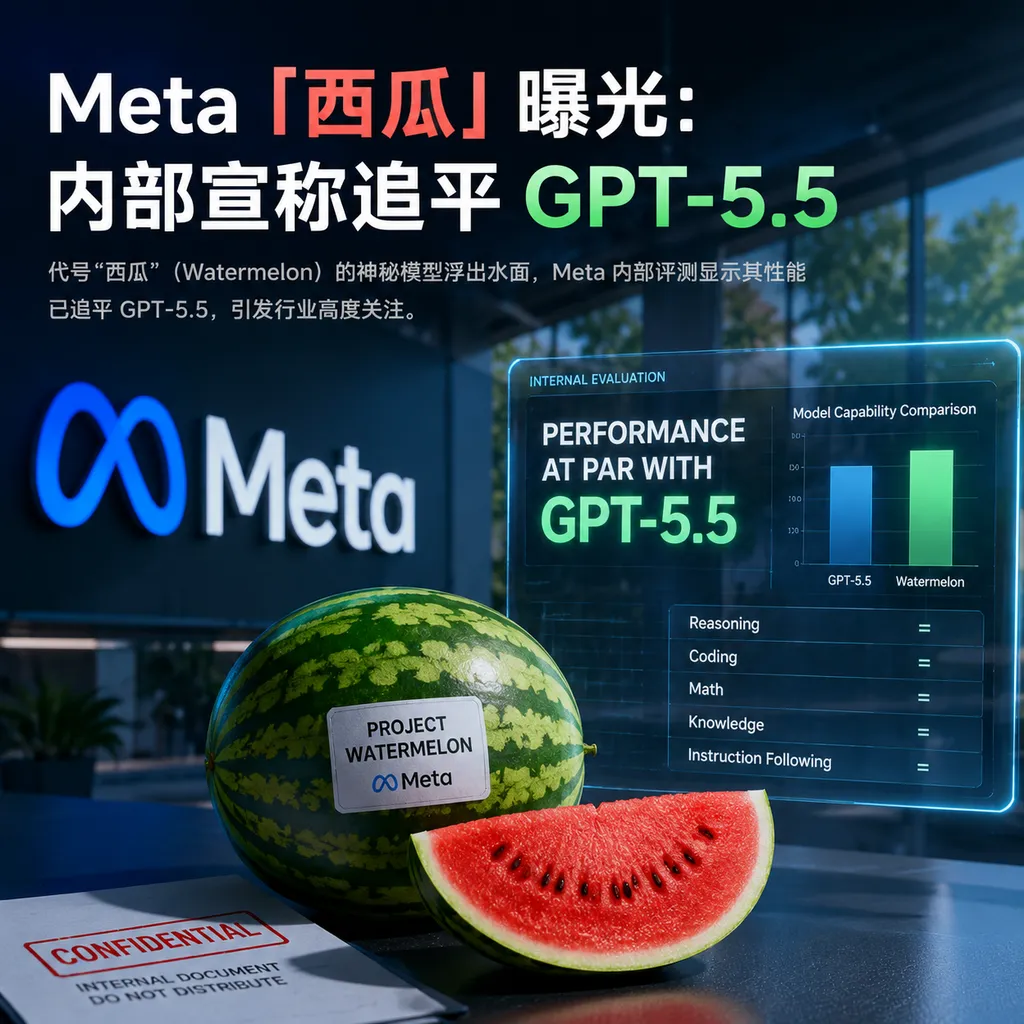
At an internal all-hands meeting, Wang Tao, head of Meta’s superintelligence division, revealed that the next-generation large model Watermelon has matched OpenAI’s GPT-5.5 on key benchmark tests, with training compute increased by an order of magnitude compared to the previous-generation Avocado.
Meta Internal Leak on Next-Gen Model Watermelon: Matches GPT-5.5, Computing Power Up Tenfold Over Previous Generation
On July 3, 2026, according to Business Insider citing two insiders, Meta’s Head of Superintelligence, Alexandr Wang, revealed during an internal All-Hands meeting that Meta’s next-generation flagship large model Watermelon, currently under training, has caught up with OpenAI’s April release GPT-5.5 across several closely watched benchmarks. While Wang did not specify which tests were referenced, the news immediately sent shockwaves through Silicon Valley and the global AI circles—marking Meta’s first clear indicator of parity since Zuckerberg’s heavy investment in the “Superintelligence Labs” initiative last year.
I. From “Avocado” to “Watermelon”: Meta’s Fruit Codename System Levels Up Again
Wang’s exact words in the meeting were: “Watermelon is the next-generation model after Avocado, and it’s still in training. Watermelon uses computing power an order of magnitude higher than Avocado.”
Key details to unpack:
- Avocado: Meta’s internal codename for its Muse Spark model launched in April 2026. Muse Spark performed well on benchmarks but did not match or surpass the flagship models from OpenAI, Anthropic, or Google, failing to overturn the perception that Meta’s models lag behind the first tier.
- Watermelon: The next-generation model following Avocado, trained with roughly 10× more compute. Given Meta’s recent GPU and data center investments, this scale jump is credible.
- Leaked plans suggest Meta’s “fruit sequence” follows Avocado → Mango → Watermelon, with Watermelon as the third generation—implying that Meta isn’t merely chasing GPT-5.5, but positioning for a showdown with GPT-5.6 and GPT-6.
As one insider put it: “For two years Meta was branded as a follower; Watermelon is the first time we’ve seen the internal curves meeting.”
II. The Timing of Catching Up to GPT-5.5: Why “Now” Matters
To grasp the weight of “catching up to GPT-5.5,” we must look at the timeline:
| Date | Event | | --- | --- | | April 2026 | OpenAI launches GPT-5.5, setting the benchmark as the strongest closed-source model at the time | | April 2026 | Meta launches Muse Spark (Avocado), solid benchmarks but lagging behind the top tier | | Late June 2026 | OpenAI launches GPT-5.6, currently the strongest model, but not fully open to the public due to U.S. government compliance requirements | | July 3, 2026 | Wang announces internally that Watermelon equals GPT-5.5 |
In other words, Meta took about three months to move from “chasing” to “matching.” Such speed is rare in recent years’ model races—but it also underscores the reality: Meta has matched the ceiling of three months ago, not today’s. GPT-5.6 currently sits at the peak, though restricted from public access.
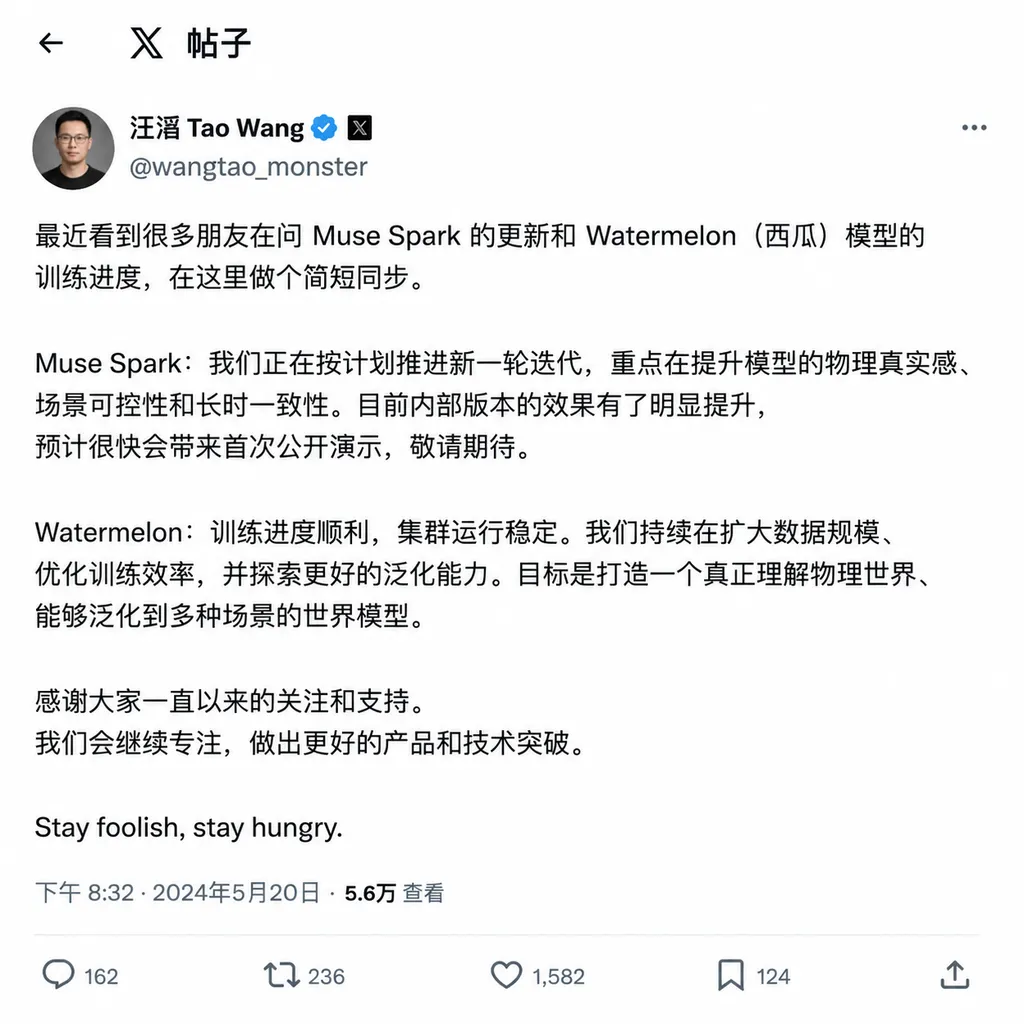
After the meeting, Wang posted on X (formerly Twitter), stating that Muse Spark will soon receive a major update, greatly improving coding and Agent capabilities, aiming to reduce gaps with competitors. When asked “when Meta will release a model comparable to Anthropic’s Claude Opus,” Wang replied cautiously but confidently:
“Soon. You’re going to like what we’re bringing next.”
III. Compute Power Up Tenfold: Meta’s Capital Warfare
“Watermelon uses computing power an order of magnitude higher than Avocado”—behind this line lies Meta’s record-breaking capital expenditure this year.
At the start of this year, Meta revised its investment guidance upward:
- Original forecast: Chip, data center, and infrastructure spending $115B–$135B
- Updated forecast: $125B–$145B (approx. ¥849.5B–¥985.5B RMB)
The main drivers are rising component and data center costs. A tenfold compute increase implies Meta has upgraded its training clusters across generations—whether by advancing its in-house MTIA chips or expanding NVIDIA GPU cluster scale, this means single procurements worth billions.
From industry perspective, this aligns with several key judgments:
- Compute remains the primary scaling variable—Meta’s choice to lean heavily on brute-force scaling shows belief that the Scaling Law still applies for the GPT-5.5 / 5.6 generation.
- Data centers evolving toward gigawatt scale—Meta is building Prometheus and Hyperion-class mega data centers, tailored for Watermelon’s training size.
- Higher tolerance for “over-training”—The fruit codenames Avocado → Mango → Watermelon suggest multi-generation parallel training, similar to OpenAI’s approach.
IV. Is Zuckerberg’s “Talent Blitz” Paying Off?
If Wang’s claim stands up under independent benchmark verification, it would signify the first positive payoff of Zuckerberg’s dual strategy: “aggressive talent acquisition + massive compute investment.”
Context:
- Last year, Zuckerberg rebranded Meta AI as Superintelligence Labs, appointing Wang as director.
- Wang heads the elite AI research team TBD, overseeing hardware and other core projects.
- Reports say Meta offered hundreds of millions of dollars per person to lure top talent from OpenAI, Anthropic, Google DeepMind, and xAI.
- Zuckerberg repeatedly emphasized “no expense spared for AGI / superintelligence” in investor calls.
For a long time, doubts loomed:
- Can money truly buy model breakthroughs? Research culture, teamwork, data quality, and evaluation all play critical roles.
- Will Meta’s open-source heritage slow closed-source commercial models? Many developers still equate Meta with “open Llama,” questioning Spark’s competitive potential.
- Do Meta’s products—AI assistant, smart glasses, social platforms—actually need GPT-5.5-level models?
If Watermelon truly holds up under independent replication, the doubts could flip into confidence:
“Huge capital + 10× compute + elite team” = at least a model equal to three-month-old SOTA.
Analysts note that Watermelon at GPT-5.5 level would immediately boost Meta’s competitiveness across these spheres:
- Meta AI Assistant: powering chat entry points across Facebook, Instagram, WhatsApp, Threads—crucial to DAU metrics.
- Ray-Ban Meta smart glasses: multimodal edge-cloud collaboration demands strong foundation models.
- Social platform creation & recommendation tools: performance here defines content moat thickness.
- Enterprise AI & ad systems: ad efficacy highly relies on comprehension/generation capabilities.
V. “Selling One’s Own Melon”? Skepticism Remains
Overseas and Hong Kong/Taiwan outlets framed the story with a playful headline—“Selling Your Own Melon?”. It’s not just wordplay—it reminds readers: this news is essentially “an internal meeting + executive’s own social media statement,” lacking third-party benchmark backing.
At least three caveats:
- No benchmark details disclosed—Wang only referenced “popular benchmarks” without specifying MMLU-Pro, GPQA, SWE-Bench, ARC-AGI, or private datasets. Given recent benchmark ranking volatility, this is a crucial missing piece.
- Compared against GPT-5.5, not current SOTA—GPT-5.6 is already out but not fully accessible, meaning Meta chose a “reachable target.”
- Watermelon is still training—This implies current results may reflect interim checkpoints, not final releases.
In essence, Watermelon’s current status is “training-phase parity with a three-month-old model,” not “stable surpassing of the strongest model.” The distinction matters to developers, investors, and enterprise clients alike.
VI. Implications for Developers and Ecosystem: Three Key Signals
For the developer community watching model updates, three signals stand out behind the Watermelon news:
1. Muse Spark Major Update Imminent
Wang stated on X that Muse Spark will soon receive a major update enhancing coding and Agent capabilities. Given Meta’s usual pattern of small iterations before large launches, we can expect a significant refresh before Watermelon’s official debut—possibly releasing progress between Avocado and Mango.
For developers, this may mean:
- Coding assistant applications (Cursor, Cline, Continue, etc.) soon gain a stronger backend option.
- Agent frameworks (LangGraph, AutoGen, CrewAI, etc.) may need adaptation for the new Muse Spark.
- Meta AI’s performance inside Threads/WhatsApp could publicly signal Muse Spark’s new capabilities.
2. Official Flag for “Claude Opus-Level” Coding Model
When asked by users, “When will we get a model comparable to Claude Opus?”, Wang took the flag head-on, replying “Soon.” This reveals:
- Meta views coding ability as a decisive battleground for next-gen models.
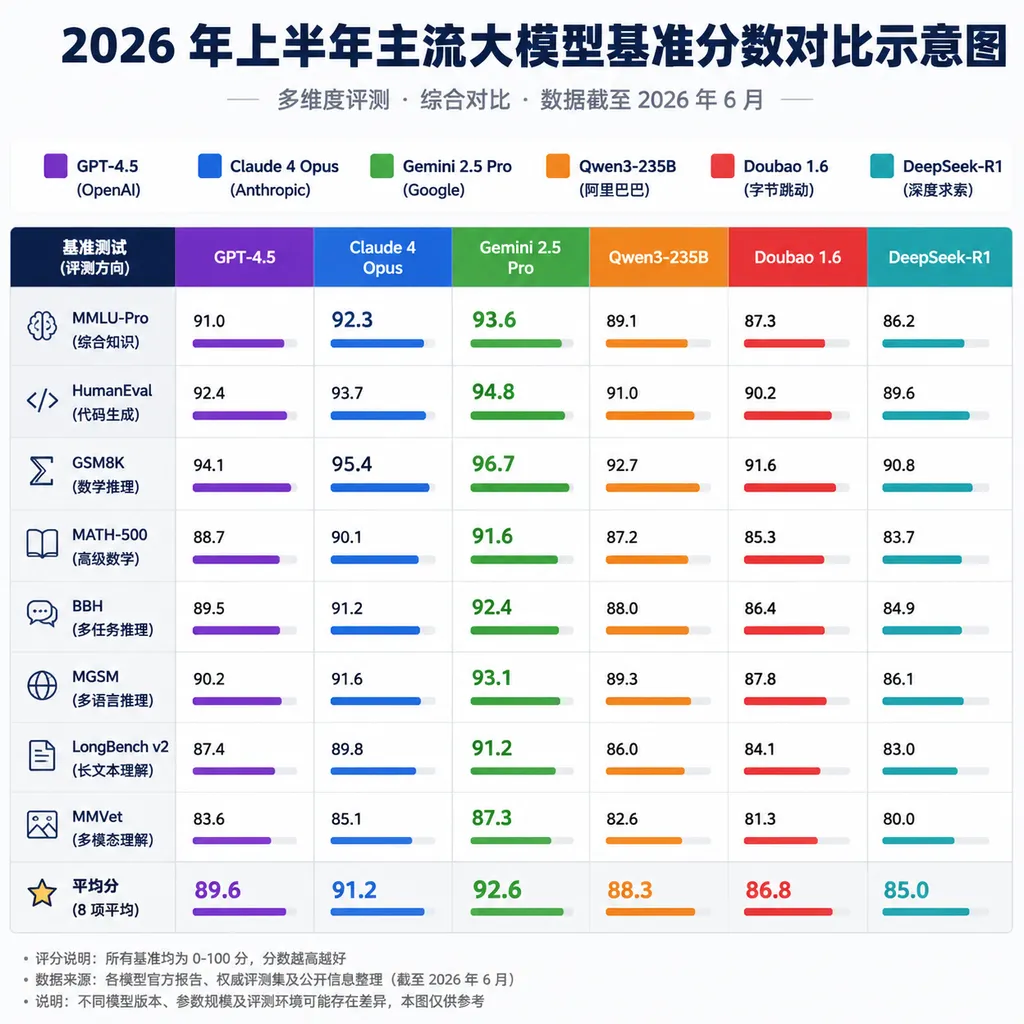
- The benchmark is shifting beyond GPT-4o/GPT-4.5 toward Claude Opus—suggesting Anthropic now defines the industry’s coding/Agent high bar.
3. Parallel “Fruit Codenames” Mean Faster Iteration
From Avocado → Mango → Watermelon, we infer a multi-generation parallel training setup. Mirroring OpenAI’s three-month iteration pace from GPT-5.5 to GPT-5.6, Meta may follow this cadence:
- Short term (weeks): Muse Spark major update (possibly Mango or Avocado-Refresh).
- Mid term (months): Watermelon official launch or closed preview.
- Long term (within the year): next “fruit” codename surfacing, aimed at GPT-5.6 / 6.0 level parity.
VII. In Short
Watermelon is a melon yet to be sliced.
From what’s public, Meta has delivered its most convincing “catching-up signal” so far: a model still in training, with compute 10× larger than before, internally claiming parity with three-month-old SOTA benchmarks. That alone recalibrates market expectations of Meta’s AI trajectory and puts Muse Spark back on developers’ watchlists.
But until independent benchmarks appear, “catching up to GPT-5.5” remains an internal commitment. Wang’s “You’ll like what’s coming next” is both confidence and pressure—over the coming months, updates to Muse Spark, Watermelon’s reveal, and its face-offs against GPT-5.6 and the next Claude Opus will determine how sweet this “melon” truly tastes.
For Chinese developers, three things to watch:
- Actual coding and Agent performance in the next Muse Spark update.
- Whether Watermelon’s official release will include full benchmarks and technical documentation.
- Whether Meta continues partial open-sourcing—determining if Watermelon becomes a closed in-product model or a ripple-maker in open-source ecosystems like Llama.
The melon isn’t ripe yet, but the knife is already in hand.
References
- Wang: Meta’s Next-Gen AI Model “Watermelon” Has Caught Up to GPT-5.5 — IT Home: Full Chinese retelling of the Business Insider story about Watermelon, Avocado, compute scale-up, and Meta’s capex growth.
- Meta’s Trillion-Dollar Model Codename Plan and Delay Discussion — Zhihu Column: Earlier Chinese analysis mentioning the Avocado → Mango → Watermelon sequence, useful for background comparison.


