OpenAI’s first hardware product, Codex Micro, goes on sale today: a keyboard that works for AI.
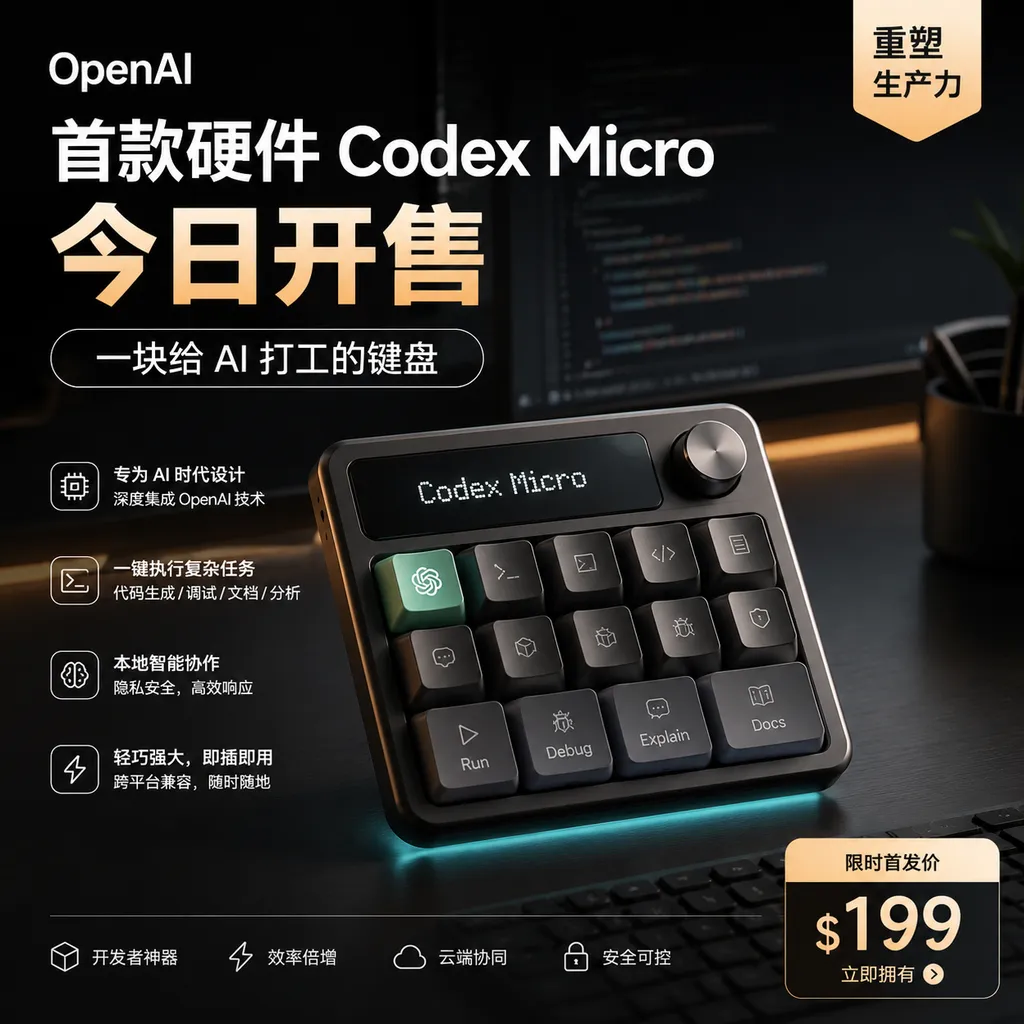
The Codex Micro, a programmable macro keyboard co-branded by OpenAI and Work Louder, officially goes on sale on July 15, deeply integrated with the Codex programming agent. This isn’t Jony Ive’s mysterious device, but a highly practical peripheral for developers.
OpenAI’s First Hardware Codex Micro Goes on Sale Today: A Keyboard That Works for AI
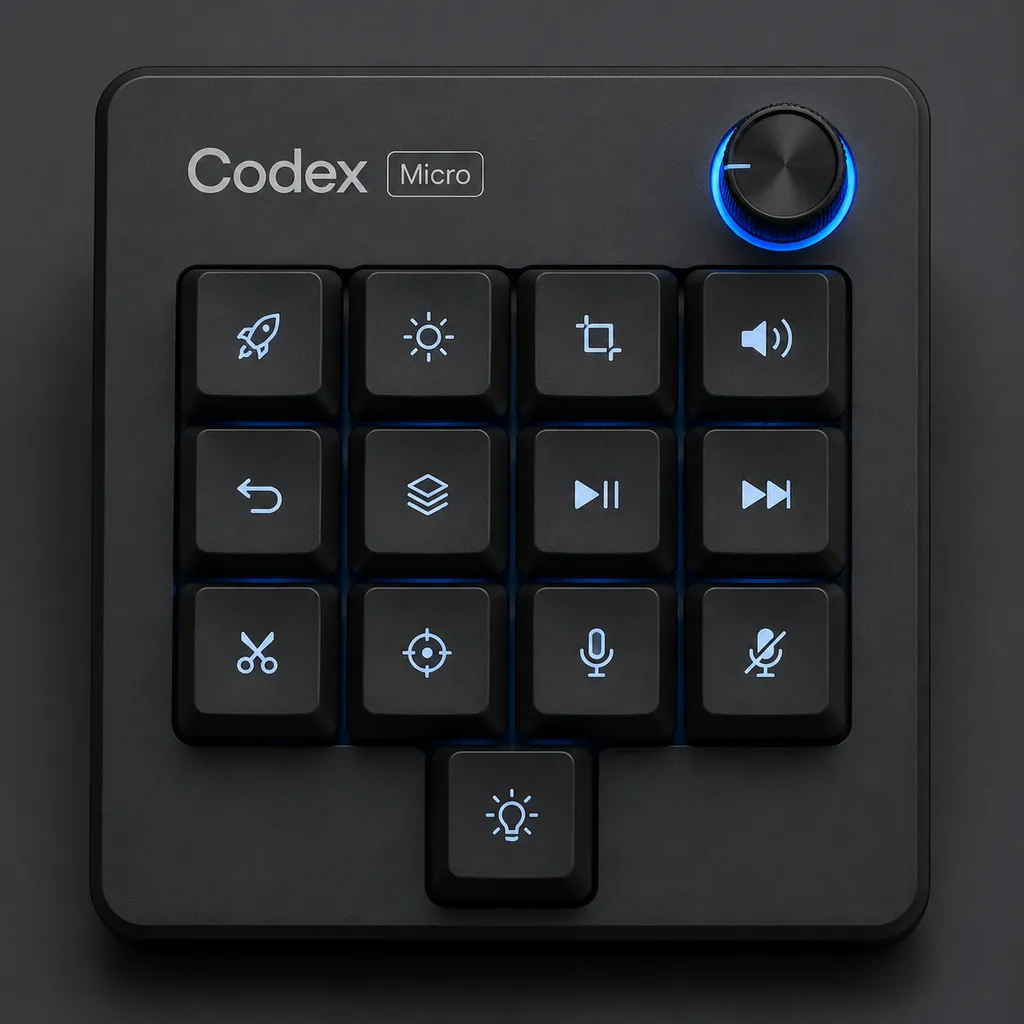
On July 15, OpenAI’s first hardware product under its own brand, Codex Micro, officially goes on sale. News of this had already leaked a few days earlier from the scene of the San Francisco AI Engineers World Expo — a square programmable macro keyboard featuring 13 low-profile mechanical keys, a clickable rotary encoder, a capacitive touch sensor, and a 2D analog joystick. That’s right — the highly anticipated first hardware from OpenAI is not the AI-native consumer terminal that Sam Altman and Jony Ive have been tinkering with for months, but rather an auxiliary peripheral for developers’ desks.
On the day the news broke, The Verge’s reporters couldn’t resist some sarcasm: “OpenAI finally launches hardware… for Codex.” Ars Technica was even more blunt: “OpenAI’s first branded hardware… is a glowing keyboard?” But if you’re a developer who uses Codex every day, the story looks completely different.
Not a New Terminal, but a “Shortcut Board” for Codex
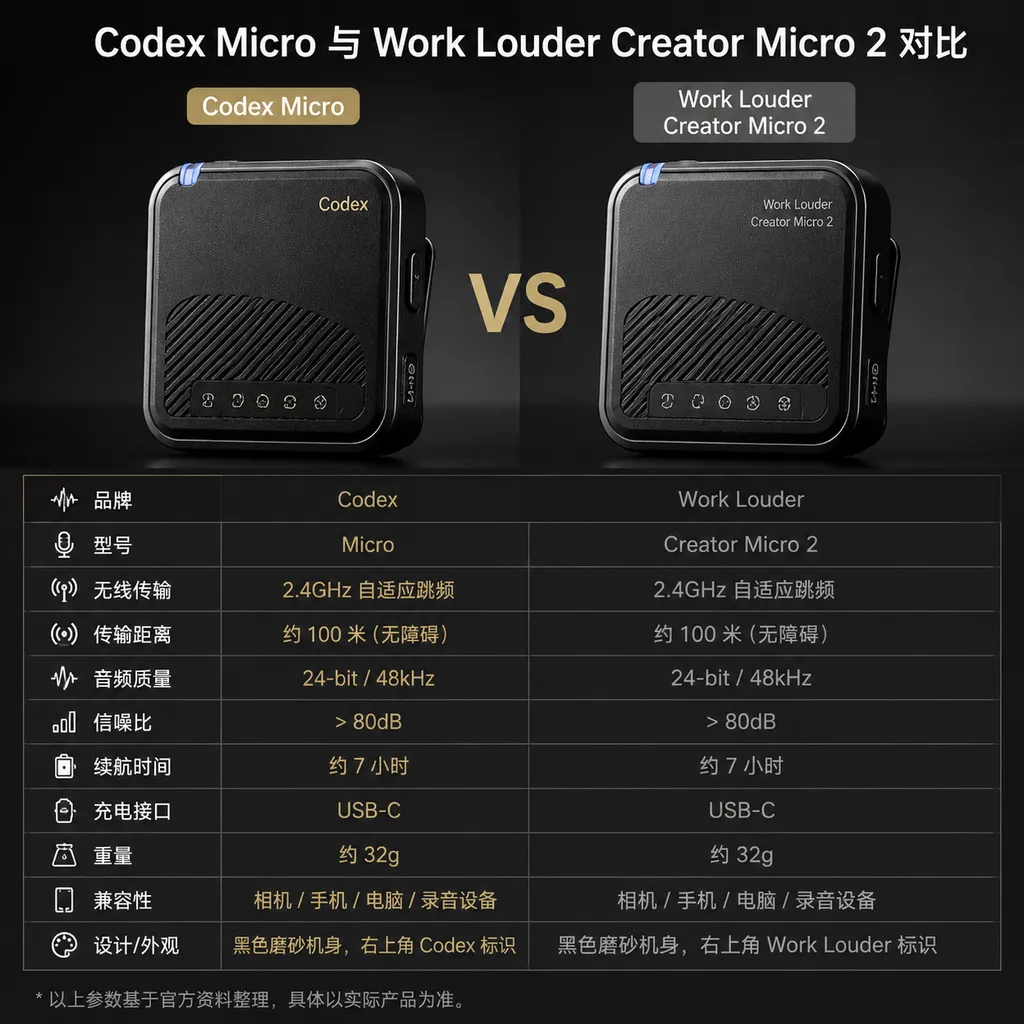
Let’s be clear: Codex Micro doesn’t run any models, has no microphone, no screen, and isn’t what you’d call an “AI device.” It’s a macro pad — a category that’s been sold for years in the custom keyboard community. The hardware foundation is almost certainly Work Louder’s own Creator Micro 2 — same 13-key layout, same rotary encoder, same touch strip, same joystick. The base model starts at $144, and the Pro version at $174 (adding Bluetooth LE and a 2100 mAh battery), so Codex Micro will likely be priced within this range, capped around $200.
The key difference lies in the software. OpenAI has implemented a full set of default mappings optimized for the Codex workflow:
- Physical keys trigger Codex commands: Accept suggestion, reject and rewrite, switch agent threads, jump to next diff, approve PR… Actions that used to hide behind key combos and menus are now one press away.
- Rotary encoder adjusts the temperature: In the official demo video, one use of the knob is for real-time adjustment of the code generation temperature. Turn left for more conservative outputs, right for more creative ones.
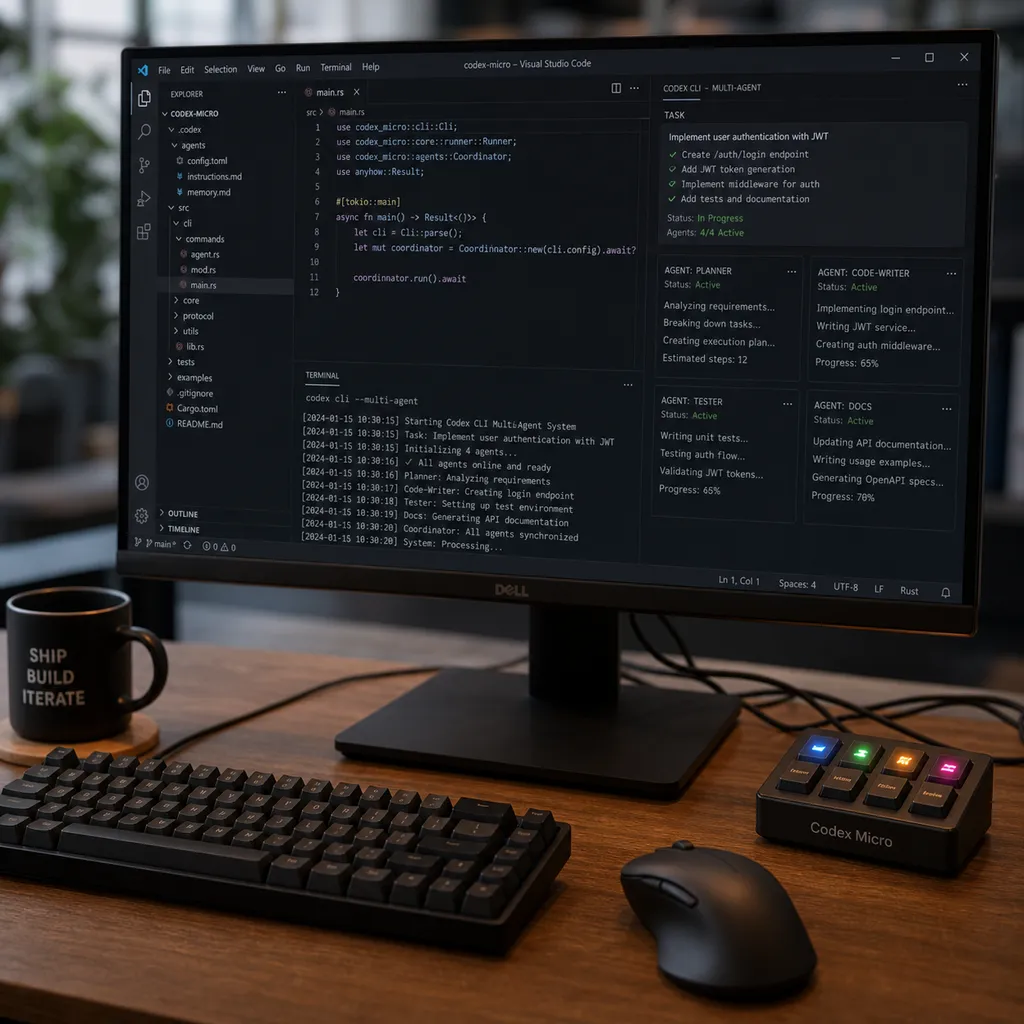
- Touch strip switches agent contexts: Codex now supports multiple parallel agent threads, and the touch strip allows you to switch horizontally between them, with the LEDs above the keys indicating the active one.
- Multiple layers of mapping: Creator Micro 2 natively supports 6 key layers, so Codex Micro probably retains this capability, allowing the same 13 keys to cover dozens of actions.
That’s the true meaning of a “real-time visual terminal” — each key’s LED changes color to reflect the corresponding agent’s state. Green means idle, yellow means waiting for confirmation, red means error, breathing light means generating. No need to switch windows: a quick glance tells you which agents are busy or frozen.
Why a Keyboard, and Why Now
In terms of product form, Codex Micro is not sexy at all. But zoom out over the past three years — the AI hardware race is littered with failures — and OpenAI’s move looks both conservative and smart.
Humane’s AI Pin sold fewer than 10,000 units and was eventually acquired by HP for $116 million. Rabbit R1 shipped 100,000 units but suffered such high return rates that it has its own Reddit threads. Both aimed to “leapfrog the smartphone” and define the next computing terminal. Two years later, keyboard and mouse remain the most efficient input devices, and screens the highest-bandwidth outputs.
By targeting the most unexciting yet pragmatic scene — the developer desktop — OpenAI essentially acknowledges this reality: the physicalization of AI is not about replacing existing interactions but augmenting them with a tactile shortcut layer. Codex already has 5 million weekly active users and continues to grow rapidly — a user base this large interacts with Codex dozens, even hundreds of times a day; any high-frequency action made physical yields real efficiency gains.
Compared to Jony Ive’s still-in-litigation, not-yet-public project, Codex Micro looks more like OpenAI’s hardware MVP: low risk, ready supply chain, clear target users, fast validation cycle. If it succeeds, it’s a brand extension; if not, no big loss — custom keyboards are a niche business anyway, and a $144+ price point isn’t meant for mass sales.
The Big Technical Question: HID or Proprietary Protocol?
This is the first question any developer who’s integrated peripherals would ask. Neither OpenAI nor Work Louder has confirmed yet, but based on the product’s positioning, Codex Micro will likely go dual-mode:
Base layer using standard USB HID protocol. That way, it can plug into any Mac, Windows, Linux, or even iPad and be recognized as a regular keyboard, working through OS-level key mappings. You can rebind the 13 keys in Cursor, JetBrains, or tmux. Work Louder’s previous collaborations with Figma and Framer used the same approach, retaining full VIA configuration freedom.
Enhanced layer via native integration with Codex CLI and desktop app. The features that actually make the keyboard “come alive” — LED state sync, multi-agent switching, temperature control — require Codex’s client to actively read the hardware state and write it back. This will likely be implemented via WebHID or a background companion app, requiring the latest Codex version to unlock.
If OpenAI decides to open-source this communication protocol (not impossible since the hardware is a Work Louder design), the community could easily build adapters to connect Codex Micro with Claude Code, Cursor Agent, or local tools like Aider. That’s the real value of a macro keyboard — it shouldn’t belong to a single platform.
# Hypothetical Codex Micro command-line interface (based on publicly available details)
codex hardware pair                    # Pair the keyboard
codex hardware bind key-01 "accept"    # Bind key 1 to “accept suggestion”
codex hardware layer switch --to 2     # Switch to layer 2
Does It Actually Help Developers?
I’ve used Stream Deck, Loupedeck, and Work Louder’s own general models. Honestly, macro keyboards have one unavoidable learning curve: you first need to decide which actions deserve physicalization, and then train muscle memory. The first week feels redundant — “I already know Cmd+Shift+A by heart!” — but by the second week, you’ll realize that removing even a fraction of a second’s focus switch makes your workflow fundamentally different.
What makes Codex Micro interesting is that it skips the “deciding what’s worth physicalizing” step — OpenAI has already done that for you, based on behavioral data from 5 million weekly active users. If the default keymap truly covers 80% of high-frequency Codex actions, then for most users, the “out-of-box” efficiency gain already justifies the price.
The real concern is lock-in. The keyboard’s logic is deeply tied to Codex’s workflow, so if you switch to another AI coding assistant, half the physical semantics vanish. Sure, you can remap the keys yourself, but the smart layers — LED indicators, knob functions — disappear. That’s by design: OpenAI is effectively using a sub-$200 keyboard to lock in developers’ tool habits for the next few years.
The Bigger Signal: OpenAI Starts Entering Physical Workspaces
Viewed within OpenAI’s broader product map, Codex Micro sends a clear signal. For the past two years, OpenAI’s expansion stayed purely in software: ChatGPT is web/app, Codex is CLI/IDE plugin, Sora is browser-based. This hardware — even if just a rebranded macro keyboard — means OpenAI is now seriously thinking about how AI integrates into developers’ physical desktops.
This path runs parallel to Jony Ive’s consumer AI device project:
| Dimension | Codex Micro | Jony Ive Project | | --- | --- | --- | | Target Users | Developers, power users | General consumers | | Interaction Mode | Physical/tactile buttons | Voice-first, possibly with screen | | Price | < $200 | Unknown, likely several hundred dollars | | Launch Date | July 15, 2026 | H2 2026 | | Hardware Base | Work Louder off-the-shelf design | Fully custom |
In other words, OpenAI has figured it out: AI hardware doesn’t have to bet everything on redefining the “next-gen computing terminal.” Adding value to existing workflows is just as legitimate a path for hardware. The former is revolution, the latter is infiltration — and both can coexist.
One More Thing
For developers who use multiple model APIs, Codex is just one part of the OpenAI ecosystem, but in day-to-day work you likely also use Claude, Gemini, or DeepSeek. If you don’t want to manage a separate API key and billing for each provider, platforms like OpenAI Hub become handy — one key connects you to all major models with OpenAI-compatible formatting, works smoothly from China, and saves you significant integration effort when building agent-based apps.
Is It Worth Buying?
Straight to the verdict:
- If you use Codex for more than 2 hours a day, especially for multi-agent parallel tasks, it’s worth a try. The default mapping delivers immediate efficiency gains, and under $200 isn’t a bad deal.
- If you’re a light Codex user or mainly use other AI coding assistants, wait. See if the community reverses the protocol and builds adapters for Claude Code / Cursor first.
- If you just want to collect OpenAI’s first hardware, that’s another story — limited edition, collaboration branding, unboxing for the shelf — no explanation needed.
One final note: Codex Micro is a limited-edition collaborative product. Orders open on Work Louder’s website starting July 15, with batch shipments and delivery schedules depending on launch response. No official channels in mainland China; buyers will need to use forwarding services.
References
- OpenAI’s First Hardware Codex Micro Revealed — A Developer-Customized Programming Keyboard - Zhihu — Zhihu feature summarizing Codex Micro’s hardware details and a comparison to Creator Micro 2.