
NVIDIA Cosmos 3 Edge Debuts: A World Model Integrated into the Robot Itself
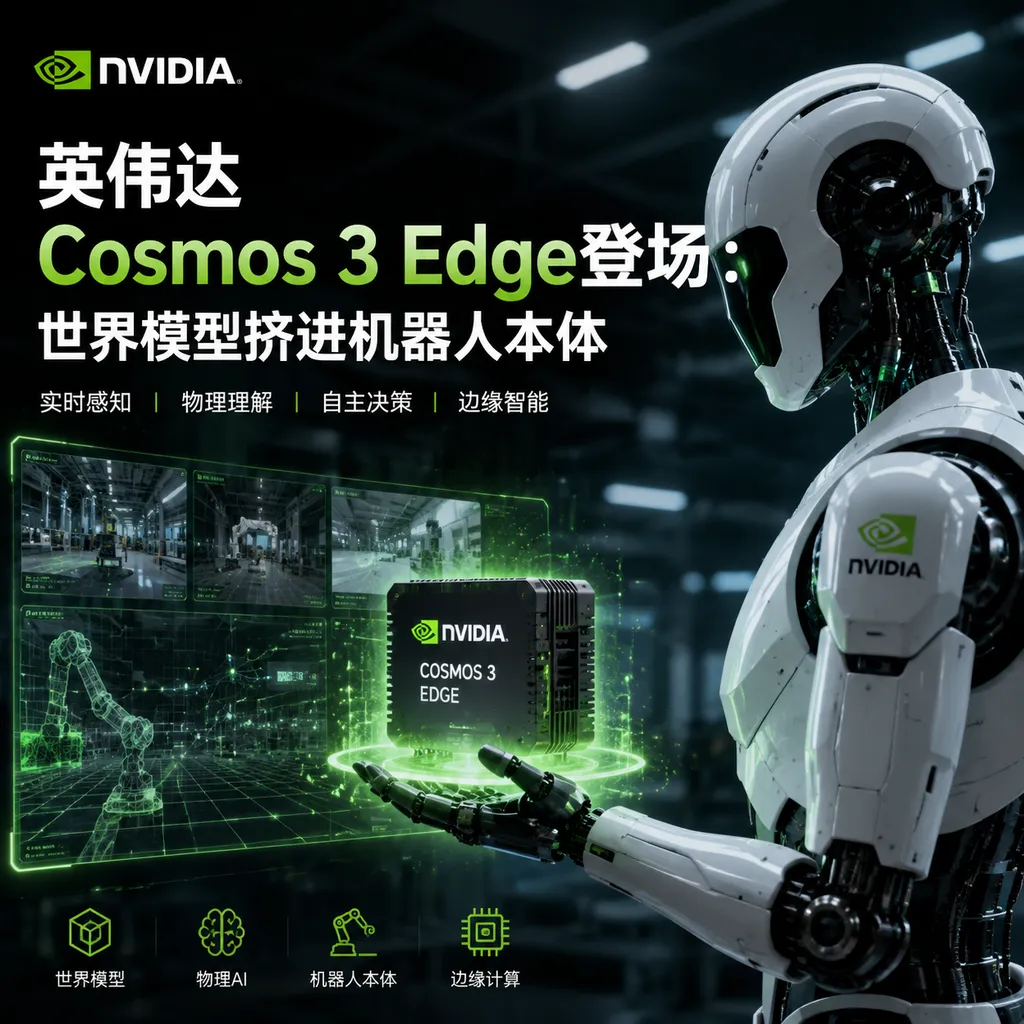
On Wednesday, NVIDIA launched Cosmos 3 Edge, bringing the physical AI world model into robots for real-time inference, while also strengthening Japan’s embodied intelligence ecosystem. This completes the most crucial piece of the puzzle on the edge side, following Super and Nano.
NVIDIA fired another shot on Wednesday—this time aiming at the computation‑limited chip inside the robot’s head.
The new model is called Cosmos 3 Edge, part of the World Model family, designed specifically for real‑time on‑device inference. Its launch cadence follows the base version of Cosmos 3 that debuted at the Taipei GTC in May—at that time, the Super and Nano editions became available first, while Edge was listed as “coming soon.” Now it’s finally here. At the same event, Jensen Huang also announced an expansion of NVIDIA’s physical AI ecosystem in Japan, tying giants such as Toyota, Fanuc, and SoftBank more tightly into NVIDIA’s hardware‑software loop.
This is not an isolated model release. By extending the Cosmos 3 line from the cloud all the way to edge devices, NVIDIA is making a bigger strategic move: to reclaim the stage for physical AI—a track previously overshadowed by LLMs in the generative‑AI conversation.
World Models and Large Language Models Are Fundamentally Different
Let’s clarify the definition first, or readers may confuse this with models like GPT or Claude.
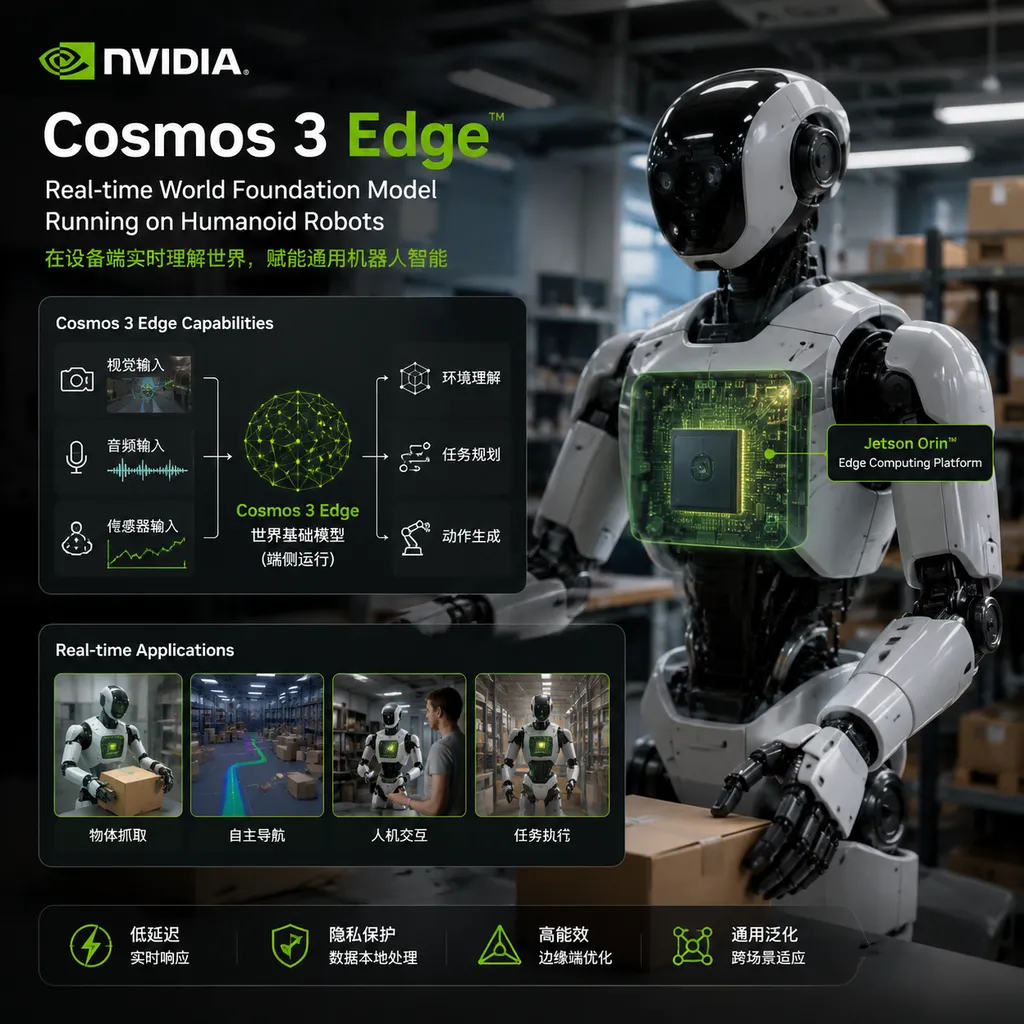
An LLM’s input and output are both tokens; essentially, it performs conditional probability prediction within language distributions. A world model’s input has far higher dimensionality—RGB video, depth maps, point clouds, IMU data, torque and motion sequences can all be fed in. Its outputs aren’t limited to text either—they can be the next video frame, a trajectory, ambient sound, or even direct joint‑angle commands for a robotic arm.
Think of it this way: an LLM learns the world by reading novels; a world model like Cosmos learns it by watching dash‑cam and first‑person robot footage. The former “knows” a cup will shatter when it falls because countless texts have said so; the latter has actually seen 100 000 cups fall—learning about initial velocity, rebound angles, and so on.
For embodied intelligence, that difference is crucial. A robot doesn’t need Shakespeare; it needs to know whether a glass will slip when it reaches 30 cm forward.
Cosmos 3’s Dual‑Transformer Architecture: A Pragmatic Choice
The base Cosmos 3 released in June follows a clear technical route: a Reasoning Transformer + Generative Transformer two‑module setup.
- Reasoning Transformer – understands how objects interact, their motion trajectories, and spatiotemporal relationships;
- Generative Transformer – based on that reasoning layer, outputs video frames, action trajectories, environmental sounds—multi‑modal generation.
This “think first, then draw” structure isn’t new in the diffusion‑model era—Sora, Keling, and Gen‑3 all use similar hierarchies. But Cosmos 3 treats “action” as a first‑class citizen—it doesn’t interpret motion as mere pixel changes in a video but directly produces native control sequences capable of driving joint actuators. That demands extremely rich training data, which NVIDIA can achieve thanks to simulation data generated in Omniverse.
NVIDIA calls Cosmos 3 “the world’s first fully open general‑purpose physical‑AI model,” releasing weights, code, and data pipelines together. This “fully open” label sparked debate back in June—it goes a step further than Meta’s practice of releasing weights without training data. Open sourcing means Toyota’s engineers can modify it, and domestic players like Unitree, UBTech, and Galbot can build secondary training directly atop Cosmos 3. For NVIDIA, it’s the classic “give up exclusivity to lock in the ecosystem” strategy—akin to CUDA’s free rollout years ago.
The Edge Version: The True Game‑Changer
If Super targets data‑center training and Nano handles cloud inference, then Edge focuses on whether robots can actually run reliably.
Picture the real scenario: a humanoid robot navigating a warehouse, avoiding stacks of boxes to fetch an item. It must judge box stability, floor texture, lighting shifts impacting vision, and incoming carts that may collide. Routing every judgment through the cloud adds at least 200 ms of latency—enough for a crash.
Cosmos 3 Edge’s key metric is shrinking the “perception–prediction–action” loop to the millisecond level while remaining runnable on edge chips like Jetson Thor. NVIDIA hasn’t revealed parameter counts, but based on Nano’s positioning, Edge is likely 3 B–7 B parameters, paired with dedicated quantization and inference optimizations—small enough for a robot’s torso, unlike 70 B‑ or 400 B‑scale LLMs.
Importantly, NVIDIA doesn’t see Edge as a “lite” version but a “scenario‑specific” one. Documentation says Edge supports on‑device incremental learning—after months in a factory, a robot can fine‑tune itself on its own material, lighting, and layout data without sending everything back to the cloud. That’s critical for Japan: Toyota’s factory data can’t leave premises. So NVIDIA’s Japan push and the Edge launch are essentially two sides of the same plan.
Competitors: Who’s Challenging NVIDIA Here
Few serious players currently pursue world‑model research, but none are weaklings:
- Google DeepMind Genie 3 – a similar path, but oriented toward entertainment / content generation, weaker in robotics;
- Wayve GAIA‑2 – a vertical world model for autonomous driving; deep but narrow compared to Cosmos;
- World Labs (Fei‑Fei Li’s team) – radical architecture focusing on 3‑D scene reconstruction and interaction, not yet commercial scale;
- 1X and Physical Intelligence (π0 / π0.5) – follow the VLA (Vision‑Language‑Action) paradigm, parallel to world models; outcome still uncertain.
Cosmos’s edge isn’t the model itself but the full stack—Model + Omniverse Simulation + Isaac Robot Framework + Jetson Hardware—no rival matches that pipeline. Just as CUDA beat OpenCL not through prettier language design but through a seamless experience from driver to cuDNN to TensorRT. In practice, engineers find that choosing another vendor may save license fees but multiplies workload.
Its weakness is equally clear: NVIDIA provides a universal base; fine‑tuning for specific robot morphologies (humanoid, quadruped, manipulator) is left to clients. Hence Cosmos 3 must be open source—only openness entices hundreds of robotics firms worldwide to invest incremental effort atop it.
Expanding the Japanese Ecosystem: Both Defense and Offense
NVIDIA’s simultaneous Japan initiative deserves special note.
Japan has the world’s largest installed base of industrial robots and, due to population aging, one of the strongest future demands. Yet over the past two decades, Japanese robot makers—Fanuc, Yaskawa, Kawasaki—have been conservative in AI, stuck with traditional motion‑planning + visual‑servo control. SoftBank tried Pepper, but commercialization failed.
NVIDIA now bundles Japanese‑localized training for Cosmos 3, Omniverse‑based digital‑twin factories, and Jetson Thor’s local supply chain—a clear logic: Japan has scenarios and hardware but lacks an AI foundation; NVIDIA provides the base so locals can focus on mechanics and deployment. It mirrors NVIDIA’s playbook in the Middle East and Europe—localization not by shipping servers but by embedding the entire software stack into domestic industries.
At a deeper level, this is NVIDIA’s answer to losing sparkle at the AI‑application layer to OpenAI and Anthropic. For LLMs it sells the shovels; for physical AI it wants to own the land. And once embodied intelligence commercializes, its market could rival cloud AI in scale.
What Developers Get
For developers, here are the concrete takeaways:
- Cosmos 3 Super and Nano are already downloadable on NVIDIA NGC and Hugging Face; the Edge release is expected within weeks, bundled with the next JetPack update.
- Inference interfaces align with standard PyTorch—no new SDK required; TensorRT‑LLM is the recommended path for quantized deployment.
- Integration with Isaac Sim and Isaac Lab works out of the box, allowing simulation validation before real‑hardware rollout.
- Licensed under the NVIDIA Open Model License—commercial use permitted, but redistributed derivative models must comply with the same terms. It’s slightly more permissive than Llama’s but not as free as Apache 2.0.
If you just want to test Cosmos 3’s multi‑modal reasoning—say, giving it a video clip to predict the next second—you don’t even need to set up an environment. Aggregation platforms like OpenAI Hub are gradually adding Cosmos inference endpoints, accessible with a single API key alongside GPT, Claude, or Gemini. For domestic embodied‑AI teams, that removes overseas‑deployment friction. But running the model on a robot itself still requires the Jetson route.
A Final Take
The term physical AI has been hyped since 2024, yet real commercial examples remain scarce. The significance of Cosmos 3 Edge is not in what it can do today but in how it transplants the verified “cloud‑training → edge‑deployment” pipeline from LLMs into robotics for the first time.
Whether 2027 becomes embodied AI’s “ChatGPT moment” is anyone’s guess. But NVIDIA has clearly decided that even if that moment hasn’t arrived, it will have the whole infrastructure ready—and open‑sourced. That will leave many shortcut‑seekers uncomfortable for a long time.
References
- NVIDIA Cosmos series on Hugging Face — official repository for Cosmos 3 Super / Nano weights and inference demos
- NVIDIA Cosmos GitHub repository — official open‑source code, training pipeline, and Isaac integration examples
- Isaac Lab official repo — framework for robot policy training and simulation validation with Cosmos 3

