
Tencent Hunyuan Hy3 Open-Sourced Today: Price Slashed to 1 Yuan, Taking Aim at Flagships
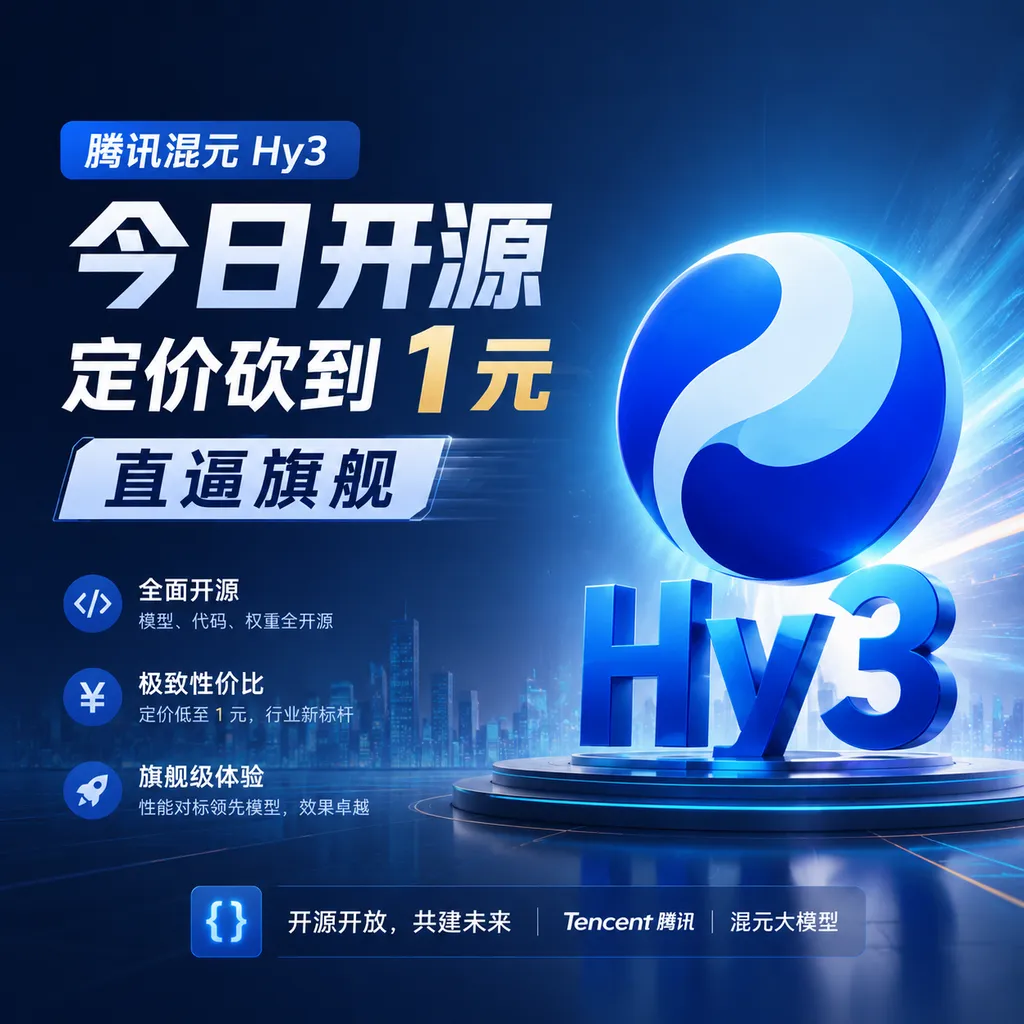
Tencent officially open-sourced Hunyuan Hy3 today, featuring 295B total parameters with 21B activated. It delivers comprehensive upgrades in reasoning, agents, and long-context capabilities. API input pricing has been reduced to 1 RMB per million tokens, and it is now available on Tencent Cloud TokenHub.
Tencent Open-Sources Hunyuan Hy3 Today: Another Price Cut, Targeting Flagship Models with 2–5× the Parameters
On July 6, Tencent officially released the full version of Hy3, open-sourced it simultaneously, and launched it on Tencent Cloud TokenHub. More than two months have passed since the preview version released at the end of April. This time, it is no longer a "test run," but the first complete delivery after Yao Shunyu took over Hunyuan and rebuilt its pretraining and RL infrastructure.
Here’s the conclusion first: Hy3 is currently one of the most aggressively cost-effective MoE models in China’s open-source ecosystem — 295B total parameters, 21B active parameters, 256K context length, and API input pricing cut directly to RMB 1 per million tokens, even lower than the RMB 1.2 pricing of the preview version. Tencent’s goal this time is clearly to make developers actually able to afford using it, not simply to chase benchmark rankings.
What Was Upgraded Compared to the Preview
Tencent itself described the April preview release as merely the "first step of reconstruction," mainly intended to gather feedback. Over the past two months, the Hunyuan team focused on three things: significantly improving the quality and diversity of post-training data, expanding RL compute scale, and systematically fixing usability issues reported by both the community and Tencent’s own product teams.
What was the result? Among the official metrics, the most telling one is a blind evaluation conducted by 270 experts based on real-world work scenarios rather than benchmark farming. Hy3 scored 2.67/4, while GLM5.1 scored 2.51/4. The absolute gap may not seem huge, but in detailed categories, Hy3 showed especially clear advantages in frontend development, data and storage, and CI/CD. These happen to be some of the most common and demanding developer workflows — whether code actually runs, whether SQL is correct, whether pipeline scripts pass cleanly. Models cannot fake their way through these tasks.
More notably, Tencent explicitly stated that Hy3 is "comparable to domestic and international flagship models with 2–5× the parameter scale." If a model with 21B active parameters can genuinely compete with models activating hundreds of billions of parameters, it further validates the efficiency advantages of MoE architectures under real production workloads.
Three Main Directions: Reasoning, Agents, and Long Context
Reasoning: Not Just Olympiad Benchmarks, but Generalizable Strong Reasoning
The Hy3 preview already performed well on hard STEM-oriented benchmarks such as FrontierScience-Olympiad and IMOAnswerBench, and was even tested on Tsinghua Qiuzhen Academy’s mathematics qualifying exam and the CHSBO 2025 biology competition. The official release doubles down on this direction. Hunyuan’s strategy is clear: instead of maximizing scores on isolated benchmarks, the focus is on achieving stable reasoning performance across disciplines and scenarios.
For developers, this means that whether you use it for financial modeling, data analysis, or multi-step agent decision chains, the model is less likely to suddenly "lose intelligence" midway through a workflow.
Agents: 495-Step Workflows Were Actually Executed
This figure was already disclosed during the preview phase — stable execution of complex agent workflows up to 495 steps long, covering document processing, data analysis, knowledge retrieval, and MCP toolchain orchestration. The official release continues refining these capabilities. Tencent’s own products, CodeBuddy and WorkBuddy, serve as the most direct testing ground, with first-token latency reduced by 54%, end-to-end completion time reduced by 47%, and success rates exceeding 99.99%.
Hy3 also achieved competitive scores on coding-agent benchmarks such as SWE-Bench Verified and Terminal-Bench 2.0, as well as search-agent benchmarks like BrowseComp and WideSearch. Terminal-Bench 2.0 is especially worth highlighting — it evaluates a model’s ability to complete tasks within real terminal environments, making it far more difficult than traditional "write a function for this problem" tasks because it must interact with shells, file systems, error logs, and other messy real-world components.
Long Context: 256K Is Not Just a Numbers Game
A 256K context window is no longer unusual in 2026 — Gemini and Claude have already pushed context lengths into the million-token range. However, Hy3 introduces its own evaluation dimension for long-context capability: CL-bench and CL-bench-Life, internally developed benchmarks specifically designed to test a model’s ability to follow complex and changing instructions within noisy, lengthy contexts. This aligns more closely with real business use cases: feeding the model large volumes of product documentation, codebases, and chat logs, then expecting it to operate according to specific rules — not merely performing simple "needle-in-a-haystack" retrieval.
Pricing: RMB 1 / 4 / 0.25
Here are the prices directly:
| Item | Price (per million tokens) | |------|------| | Input | RMB 1 | | Output | RMB 4 | | Input (cache hit) | RMB 0.25 |
Compared with the preview version’s RMB 1.2 / 4 / 0.4 pricing, both input and cached-input costs have been reduced further. What does RMB 0.25 for cache hits mean? If your application frequently reuses system prompts or repeatedly queries long documents, actual costs could drop dramatically. For teams building knowledge bases, agents, or long-conversation products, this is a very tangible benefit.
Tencent attributes this to "hardware-software collaborative optimization." During the preview phase, full-stack optimization of inference frameworks, operator performance, and quantization algorithms had already improved overall inference efficiency by 40%. The official release likely squeezes out another round of optimization gains.
Productivity Scenarios Are the Real Battlefield
Tencent specifically emphasized Hy3’s improvements in productivity-oriented tasks such as software development, office productivity, financial modeling, frontend design, and game production. This strategic direction is actually quite smart — open-source models have already converged heavily on general capabilities, and chasing one or two extra points on benchmarks like MMLU or GPQA no longer matters much. What truly determines commercial value is whether a model can operate reliably, stably, and cheaply in concrete productivity scenarios.
Tencent’s own product lineup has already fully integrated Hy3: WorkBuddy, CodeBuddy, Yuanbao, Marvis, and ima. These products are not only Hy3 users, but also its co-design partners. This "co-evolution of models and products" has been a central theme of Hunyuan since Yao Shunyu took over.
Open-Source Ecosystem and Integration
Hy3 has simultaneously launched on GitHub, HuggingFace, ModelScope, and GitCode, with support for mainstream inference frameworks such as vLLM and SGLang, allowing developers to deploy it directly.
- GitHub:
Tencent-Hunyuan/Hy3 - HuggingFace:
tencent/Hy3 - ModelScope:
Tencent-Hunyuan/Hy3
On the API side, Tencent Cloud TokenHub is the initial launch channel, with additional overseas API platforms to follow. OpenAI Hub has already added support for Hy3, enabling teams to switch between GPT, Claude, Gemini, DeepSeek, and Hy3 using a single key — making multi-model comparisons and staged rollouts significantly more convenient.
Some Observations
Several signals from this Hy3 release are worth paying attention to:
First, the cost-effectiveness path of MoE architectures continues to be validated. If a 21B active-parameter model can genuinely compete with flagship models activating hundreds of billions of parameters, then the position of the MoE approach in productivity scenarios becomes even more solid. DeepSeek, Qwen, GLM, and Hy are all pursuing this route now, and the real competition will come down to data quality, RL scale, and hardware-software inference optimization.
Second, Tencent is clearly committed to being pragmatic. Since the preview phase, Yao Shunyu has repeatedly emphasized three principles: systematic capability building, realistic evaluation, and cost-effectiveness. Hy3 translates these principles into actual products and pricing instead of relying on hype. This is completely different from Hunyuan’s earlier pattern of "peak at launch, then disappear after release."
Third, its real appeal to developers will depend on specific use cases. If you are building coding assistants, agent applications, or enterprise internal tools, Hy3’s pricing and long-workflow capabilities deserve serious evaluation. If you are building consumer chatbots or content-generation products, you will still need direct comparative testing against similarly priced models from DeepSeek, GLM, and Qwen.
Competition among open-source models has become relentless over the past year. With Hy3 entering the field today, the next decisive factor will be real-world feedback from the developer community — especially from teams that ignore marketing materials and care only about production-environment performance. Their verdict will determine whether Hy3 can truly secure a place in the top tier.
References
- ITHome: Tencent Releases and Open-Sources Hunyuan Hy3 Model - Coverage of the Hy3 official release, including pricing and open-source links
- GitHub: Tencent-Hunyuan/Hy3 - Official open-source repository for Hy3
- HuggingFace: tencent/Hy3 - Hy3 model weights download page


