Alibaba has brought Bailian and Damo Lingchu together into the WAIC.

At the WAIC opening on July 17, Alibaba will showcase the Bailian Reasoning Platform and the DAMO Lingchu Scientific Research Intelligent Agent Platform. The former has served 5 million users worldwide, including 1.2 million paying users, while the latter has assisted research teams in screening 4 brand-new superconducting materials from 68,000 candidates.
On July 17, the 2026 World Artificial Intelligence Conference (WAIC) opened at the Shanghai World Expo Exhibition & Convention Center. This time, Alibaba didn’t go for the “new model debut” hype, but instead showcased several fully operational AI agent platforms all at once — the Alibaba Cloud Bailian Inference Platform and the DAMO Lingshu Scientific Agent Platform took center stage, with the former serving diverse industries and the latter focused on frontier research.
This combination is quite interesting. In the past two WAIC events, Alibaba’s narrative was dominated by the open‑sourcing pace of Tongyi Qianwen, from Qwen 2 to Qwen 3, then to trillion‑parameter Qwen3‑Max and multimodal Qwen3‑Omni, with iterations coming so fast it was hard to keep up. But this time, the spotlight clearly shifted from “releasing models” to “releasing platforms” — one for developers, one for researchers — both serving as the mid‑layer to turn model capability into concrete productivity.
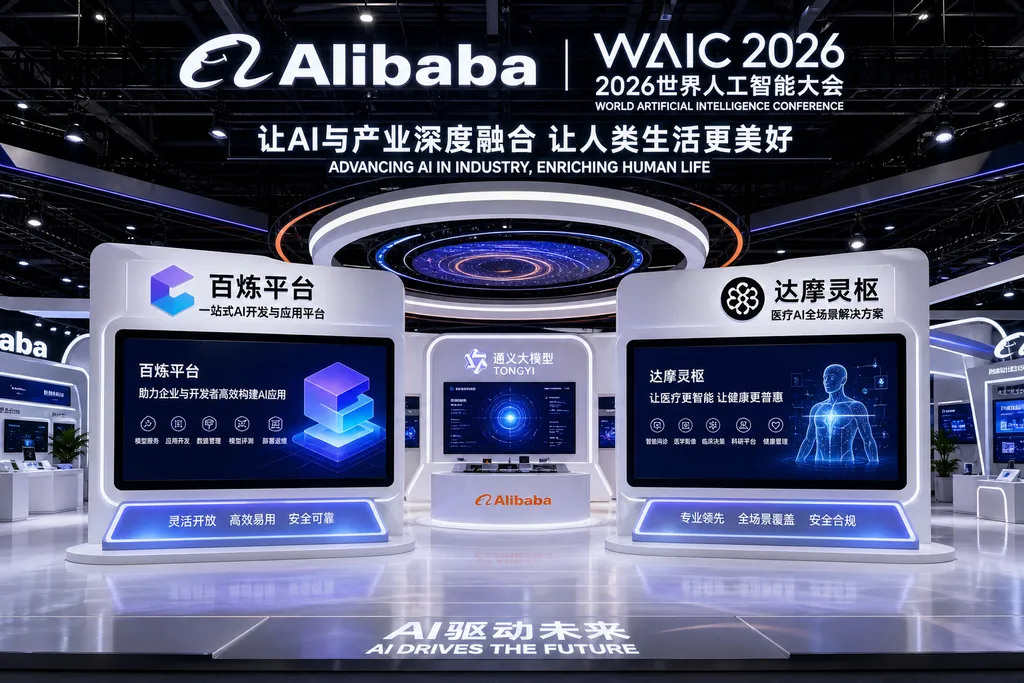
Bailian: From Model Service Platform to Agent Production Line
Let’s start with Bailian. The platform was already featured last year at WAIC as one of the “hall masterpieces.” Back then, its positioning was a “full‑chain large‑model service and agent‑application development platform.” Its main selling point was packaging API services for models like Tongyi Qianwen, DeepSeek, and Llama, then adding a full toolchain for RAG, fine‑tuning, and evaluation — so enterprises wouldn’t have to set up their own MLOps systems.
A year later, Bailian’s new data tells a clear story:
- Global users exceed 5 million
- 1.2 million paying users
- Model‑service calls grew 15‑fold in 12 months
- Some models now reach 100 TPS in generation speed
What does 1.2 million paying users mean? Compared with the early developer scale figures disclosed by OpenAI, Bailian is no longer a “domestic AI platform” but solidly in the first tier of global mainstream developer platforms. Of course, ARPU can’t be directly compared — domestic API pricing is much lower — but in penetration terms, Bailian has clearly found product‑market fit.
More noteworthy is its evolving form. Last year, Bailian emphasized “model services.” This year the booth’s new keywords are “Inference Platform” and “Agent Platform.” They carry different weight:
- A model service sells the model as SaaS; clients call its API.
- An inference platform bundles reasoning pipeline, tool invocation, sandbox, and observability so clients can assemble applications.
- An agent platform goes further: clients describe business goals, and the platform decomposes steps, invokes tools and models, and writes data automatically.
At last year’s Cloud Summit, Alibaba Cloud brought the AgentScope (ADK) framework for Bailian Agents fully to the front stage. That setup supports both low‑code drag‑and‑drop and full‑code development, and it natively connects with the MCP protocol — turning internal private APIs into MCP services with one click, allowing agents to invoke them directly. The Bailian Inference Platform shown at WAIC 2026 is essentially the production‑grade embodiment of that stack. So far, over 200 k developers have created more than 700 k agents on Bailian — an overwhelming lead among domestic vendors.
For cross‑reference: ByteDance’s Volcano Ark emphasizes model diversity and low cost; Tencent Cloud’s Yuanqi focuses more on consumer‑end bots; Huawei’s Pangu goes deep into vertical industries. Bailian’s differentiation lies in bundling “model pool + agent framework + cloud infra” into one unified offering, with SKUs covering everyone from individual developers to large enterprises. For developers, this “all‑inclusive” approach is a double‑edged sword — easy to start, but with potential ecosystem lock‑in.
DAMO Lingshu: Why Does Research Need Its Own Agent Platform?
The truly new reveal this time is DAMO Lingshu.
The name comes from Lingshu in The Yellow Emperor’s Inner Canon, hinting at deep medical roots — DAMO Academy’s prior work in medical AI (e.g., the DAMO PANDA pancreatic‑cancer screening model featured on Nature Medicine’s cover) all converge here. But Lingshu’s scope is broader: it’s an AI agent platform for scientific researchers, not limited to medicine.
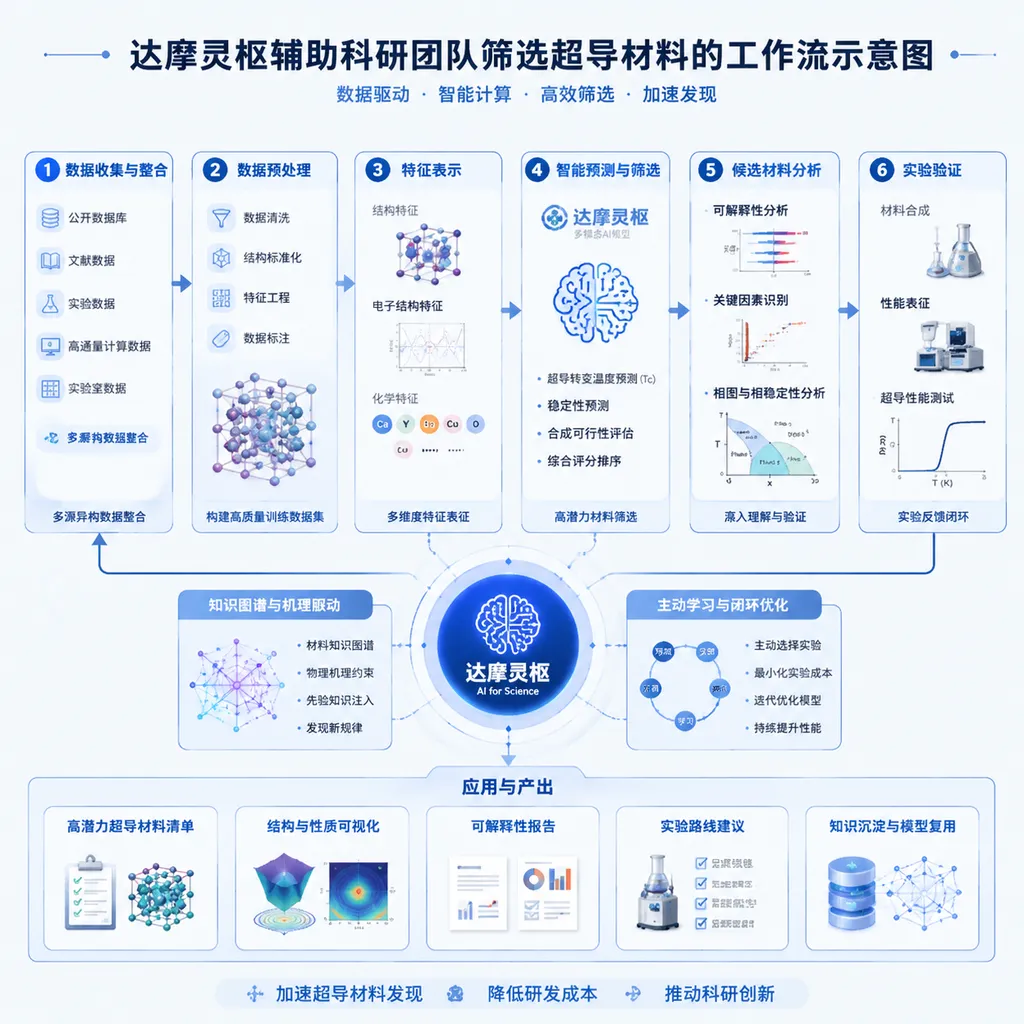
Alibaba’s flagship example concerns superconducting‑materials prediction:
Supported by DAMO Lingshu and the materials‑foundation model Elements, a research team predicted 68 000 potential superconductors, 4 of which have been synthesized and experimentally confirmed to possess superconductivity.
Let’s unpack that. The 68 000 come from the model’s generated candidate space — impossible for humans to test one by one. Identifying 4 never‑before‑reported and experimentally validated new superconductors means the model’s false‑positive rate is within a practical range. In superconductivity research, even a handful of new materials a year worldwide counts as prolific — AI slashes candidate‑generation costs to near zero, freeing human scientists to focus on verification. That’s a paradigm shift.
The differences between research agents and enterprise agents lie mainly in these areas:
| Dimension | Enterprise Agent (Bailian) | Research Agent (Lingshu) | |------------|-----------------------------|---------------------------| | Data sources | Business systems, CRM, document bases | Paper repositories, experimental data, specialized models | | Tool calls | Enterprise APIs, MCP services | Molecular simulation, DFT computation, lab‑instrument APIs | | Output forms | Reports, decisions, automated tasks | Hypotheses, candidate lists, verifiable scientific conclusions | | Evaluation | ROI, business metrics | Reproducibility, publication value |
Presenting both platforms together signals Alibaba’s view of the agent trajectory — the next step for large models isn’t “smarter chatbots,” but “domain‑specific assistants that actually get work done.” And since the technical stacks for these domains differ greatly, a single unified platform is unrealistic — they must be developed separately.
Tongyi Qianwen as the Base, Full‑Stack Capability as the Backbone
Another backdrop at the booth is the scale that the Tongyi Qianwen series has now reached. At last year’s Cloud Summit, Alibaba released seven models in one shot (Qwen3‑Max, Qwen3‑Omni, Qwen3‑VL, Qwen‑Image, Qwen3‑Coder, Wan2.5‑Preview, and Tongyi Bailing). With previous iterations combined, the Tongyi line has now open‑sourced over 300 models, surpassed 600 million downloads, and inspired 170 k derivative models, firmly establishing the world’s largest open‑model matrix.
For Bailian and Lingshu, Tongyi Qianwen serves as the fuel. Qwen3‑Coder powers a large number of coding agents on Bailian; Qwen3‑VL handles OCR and document‑parsing scenarios; Qwen3‑Omni provides a cost‑efficient foundation for speech agents; and models like Elements feed directly into Lingshu’s scientific workflows.
Further down lies the infrastructure layer: Panjiu AI Infra 2.0 with 128 super‑node servers (350 kW per rack), HPN 8.0 high‑performance networking (scaling from tens of thousands to hundreds of thousands of GPUs), and CPFS storage (40 GB/s per client). These components, unveiled last year, are now integrated into a unified “full‑stack AI” exhibit. The planned ¥380 billion (≈ $52 billion) three‑year infrastructure investment was announced months ago; so far, no one else in the industry has matched it.
Some Observations
Putting Alibaba’s WAIC exhibition pieces together reveals a clear rhythm:
- Model layer — Tongyi Qianwen’s continued open‑sourcing has already secured developer mindshare; no need for new releases merely for attention.
- Platform layer — now the focus, with Bailian targeting enterprise developers and Lingshu serving research institutes; two legs supporting one strategy.
- Infrastructure layer — massive investment ensures long‑term competitiveness.
From an industry viewpoint, this sends a clear signal: AI’s value is shifting from “model capability” to “application platforms.” Whoever can offer developers the most complete toolchain and the shortest path to production will reap the next wave of dividends. OpenAI is moving this way through the GPT Store and Assistants API; Anthropic via the MCP protocol; Alibaba through its Bailian + AgentScope + Lingshu combo — different routes, same essence.
For domestic developers, the Tongyi Qianwen family (Qwen3‑Max, Qwen3‑Coder, Qwen3‑VL, etc.) — as one of the major open‑source model series — can also be accessed via API aggregation platforms such as OpenAI Hub (openai‑hub.com), enabling a single key to call GPT, Claude, Gemini, DeepSeek, and Qwen models directly within China, fully compatible with the OpenAI API format — ideal for cross‑model comparisons or dynamic switching.
Ultimately, what defines the substance of Alibaba’s presence at this WAIC isn’t the flashiness of its booth, but those 700 k agents on Bailian and the 4 experimentally confirmed superconducting materials from Lingshu — tangible, verifiable results.
References
- huggingface.co — Qwen3 Series Homepage: Official open‑source page for the Tongyi Qianwen (Qwen) series, including Qwen3‑Max, Qwen3‑Coder, Qwen3‑VL, and documentation.
- github.com — AgentScope: Source repository of Alibaba’s open‑sourced Agent development framework ADK, used as a core component for the Bailian Agent Platform.
- zhihu.com — WAIC and Domestic AI Platform Ecosystem Discussions: Continuous community discussions on WAIC and China’s AI platform ecosystem.