
Moonshot Bilibili Preheat Kimi K3: The Ambition Hidden in a Single Frame
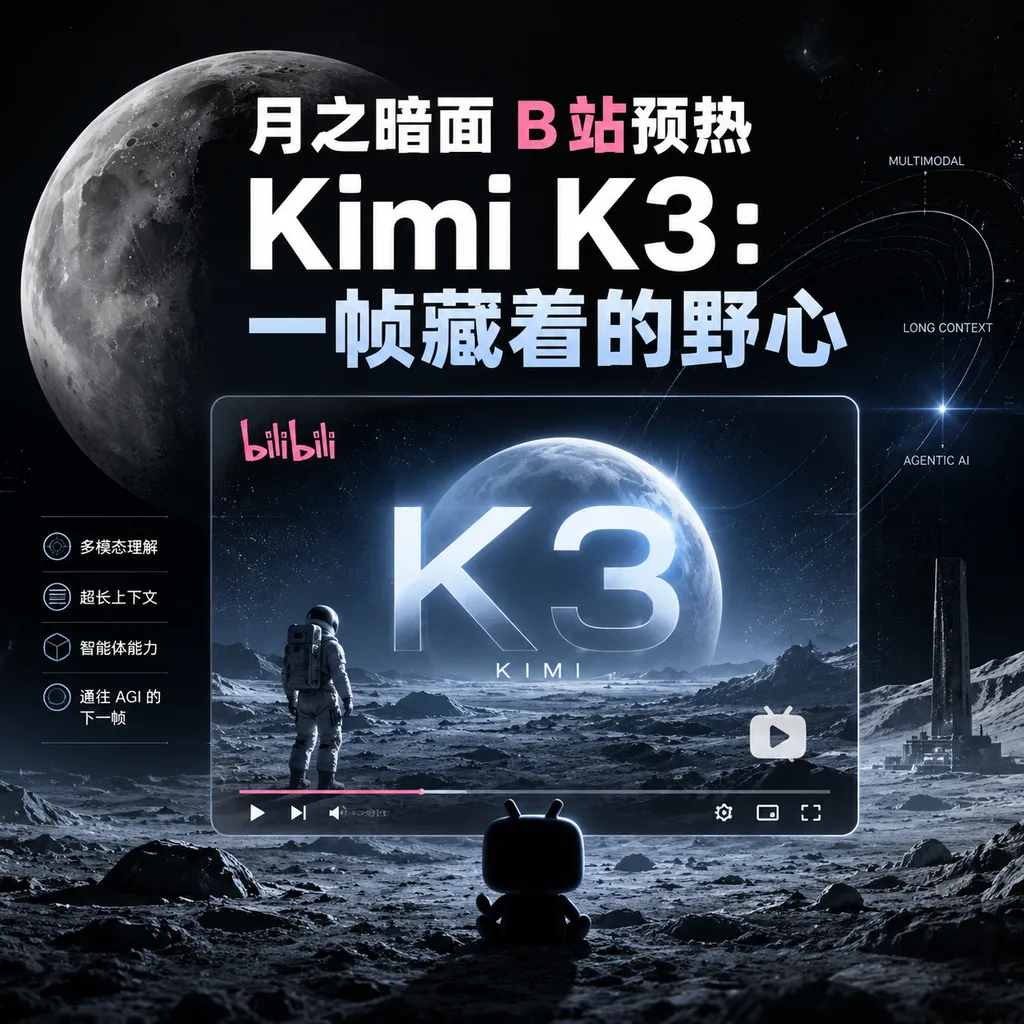
On July 15, Moonshot AI began a prelaunch campaign for Kimi K3 on Bilibili, X, and Xiaohongshu, with the number 3 flashing onscreen in the fourth second of the video. An anonymous model on Arena.ai codenamed **Kivine** is suspected to be related, and comparison videos leaked from online communities placed the K3 directly alongside **Claude Fable 5** and **GPT-5.6-Sol**.
Yesterday (July 15), Moonshot AI dropped a teaser video simultaneously on Bilibili, X, and Xiaohongshu. Around the 4-second mark, a number “3” flashed across the screen—a not‑so‑subtle sign that Kimi K3 is on its way.
This round of teasers looks totally different from a year ago when K2 debuted. Back then, K2 was quietly uploaded to GitHub late at night, followed by a single X post—an “open‑source community first, media later” strategy. K3, however, is going straight to consumer‑facing platforms like Bilibili and Xiaohongshu, paired with a stealthily listed anonymous model called Kivine on Arena.ai. The whole rhythm feels closer to OpenAI’s marketing playbook: “build suspense first, then ignite with precision.” Moonshot AI seems to be returning to its 2024 play of blanketing Bilibili with info‑stream ads—but this time it’s betting not on a consumer chatbot, but on a flagship model built to arm‑wrestle Claude and GPT head‑on.

The “3” in the video and Kivine on Arena.ai
The teaser itself contains very little info—just the typical “fast‑cut montage + deliberate blanks” formula. But what really excites the developer community are two bits of supporting evidence:
First, a new anonymous model with the codename Kivine has appeared on Arena.ai. This platform is where various companies often run prototypes and blind tests before release. Earlier, Kimi K2.6, GPT‑5.6‑Sol, and Claude Opus 4.7 all showed up there under similar codenames. The naming convention also fits Moonshot’s usual “K + element/root” pattern—K2‑era codenames included Kestrel and Kaimana.
Second, multiple alleged comparison clips between K3, Claude Fable 5, and GPT‑5.6‑Sol have leaked on X and Xiaohongshu. While their authenticity is questionable (Kimi has not made any official benchmark or demo announcements), the footage shows K3 handling long codebases and multi‑step agent scheduling in a way consistent with the K2.6 foundation—“hundreds of sub‑agents in parallel + long‑range execution.”
From K2 to K3: A narrowing flagship path
A quick recap of the line so far:
- July 2025: Kimi K2 open‑source release. A 1‑trillion‑parameter total, 32‑billion active parameter MoE architecture focused on code and general agents. Price disruptor—$0.15 per million input tokens, $2.5 output—slashing Claude Opus pricing to one‑hundredth.
- April 2026: Kimi K2.6 released and open‑sourced. The major upgrade: long‑range agents—13 hours of uninterrupted single‑task execution, 4K+ lines of code written, 300 sub‑agents coordinated across 4 000 steps. On xbench, K2.6’s ScienceQA score rose from K2.5’s 63.2 to 65.8; multimodal BabyVision improved from 36.5 % to 40.21 %.
- May 2026: Moonshot announced K2 API shutdown on May 25, forcing migration to K2.6—signaling faster iteration and an end to maintaining old versions.
- July 2026: K3 starts its teaser campaign.
The key question: Will K3 still be open source?
From the promo materials, Moonshot barely mentions “open source” this time—very different from the K2 era, when “Apache 2.0” was proudly stamped on every visual. Combined with industry chatter and current competition, K3 is likely heading for a “closed‑source flagship + open‑source mid‑tier” dual‑track model: keep the top version behind an API, while using a cheaper open version to sustain the developer ecosystem. This pattern has already worked for DeepSeek V4 and Qwen 3.6.
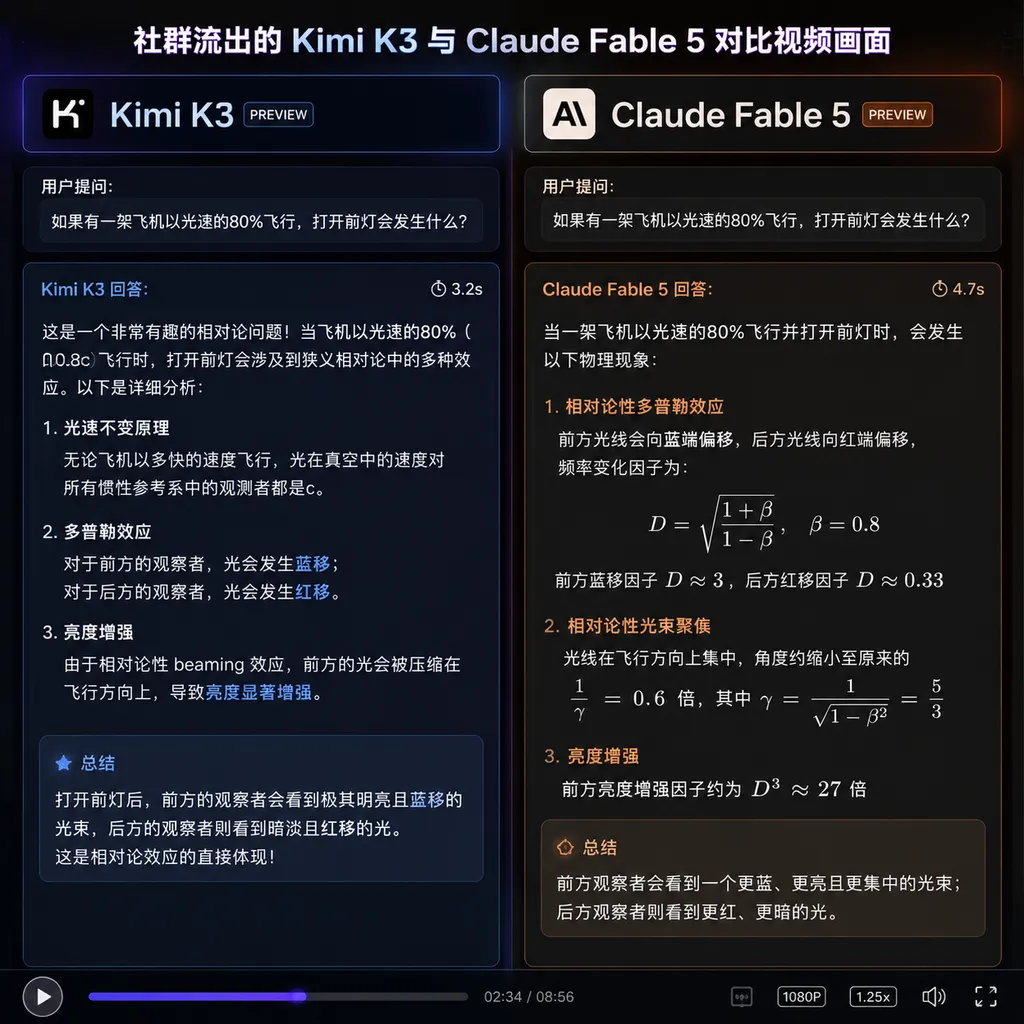
The rivals: Claude Fable 5 and GPT‑5.6‑Sol
Both comparison targets deserve a closer look.
Claude Fable 5 is Anthropic’s internal codename for the next generation after Opus 4.7 (“Fable,” “Novella,” etc., are its traditional internal naming choices). Opus 4.7 already tied GPT‑5.5 on xbench‑ScienceQA with 73.0 points, and boosted multimodal BabyVision accuracy from 14.2 % (4.5 version) to 22.94 %. Fable 5 will likely double down on multimodality and computer‑use capabilities.
GPT‑5.6‑Sol is OpenAI’s flagship within the 5.6 series, alongside Terra and Luna tiers. Notably, GPT‑5.6‑Sol has reportedly replaced Claude Opus 4.8 as the default backend for Anthropic’s Claude Code—an intriguing sign that even Anthropic acknowledges OpenAI’s edge in pure code‑agent execution.
Kimi K3’s bid to join this conversation probably won’t rely on raw benchmark scores—K2.6 already showed it can reach the upper‑mid tier but breaking into the top is tough. The real edge is likely long‑range agent execution + Chinese‑language performance + pricing. During the K2.5 phase, Kimi scored an “A” in Chinese colloquial intent understanding—above Claude Sonnet 4.6 and GPT‑5.4—and K3 will likely amplify that advantage.
Why this line matters now
The first half of 2026 has seen a burst of domestic LLM launches:
DeepSeek V4 trained on Huawei Ascend 950 chips pushed 1 M‑token context into open source, with V4‑Pro pricing output at $3.48 / M tokens;
Alibaba’s Qwen 3.6‑27B (27 billion dense) outperformed its own 397B MoE predecessor;
Tencent’s Hunyuan Hy3 Preview (295B / 21B MoE, 256K context);
ByteDance’s Seed 3D 2.0 made 3D generation production‑ready;
Xiaomi’s MiMo‑V2.5 focused on native full‑modal agents.
Among them, Moonshot AI is the only one making “long‑range autonomous agents” its core narrative. Since K2.6—with 5‑day continuous runs and 300 parallel sub‑agents—it’s clearly diverged from generic chat models toward an “AI employee” approach that’s more engineered and monetizable.
If K3 continues this path, it won’t really be competing with Claude’s conversation strength but with agentic products like Claude Code and Codex—models that can run for days, break down tasks autonomously, call tools, and deliver complete codebases, documents, or presentations.
In this lane, GPT‑5.6‑Sol is dominant (best in Codex), Claude compensates through computer‑vision use, and Kimi K3 aims to seize the intersection of open‑source controllability + long‑term stability + native Chinese fluency.
Key things to watch
The teaser gives no date, but based on Moonshot’s past rhythm (K2.6 took about 3 weeks from teaser to launch), K3 will likely be officially unveiled in mid‑to‑late August. Before release, watch for:
- Kivine’s ranking on Arena.ai. If it stays in the top 3, K3’s general capability may have surpassed GPT‑5.5; if it hovers just below, expect K3 to lean on differentiation rather than head‑to‑head performance.
- API pricing strategy. Kimi’s big weapon for K2 was pricing, but K2.6 had already inched closer to GPT‑5.5 levels. If K3 goes fully closed‑source flagship, expect prices around Claude Sonnet 4.6’s range (~ $3 / M input tokens).
- Context window size. K2.5 was 256K; K2.6 already supported ultra‑long contexts for extended tasks. DeepSeek V4 pushed 1 M open‑source—if Kimi K3 lacks 1 M, it’ll lose some credibility.
- Matching agent products. Integrated agent environments like Claude Code or Codex are key for real‑world deployment. Moonshot’s prior OpenClaw and Hermes Agent frameworks laid groundwork—expect product updates alongside K3’s launch.
What it means for developers
If you build agent‑type apps, long‑running code tasks, or Chinese‑heavy scenarios, K3 deserves a spot on your watch list. With domestic endpoints and OpenAI‑compatible API calls, once K3 launches, the OpenAI Hub will integrate it immediately—letting you benchmark GPT‑5.6, Claude Fable 5, and Kimi K3 under one key, without juggling multiple accounts or proxies.
For most developers, the most practical steps before launch:
- Migrate from old K2 APIs to K2.6 (now deprecated)
- Follow real‑world test feedback for Kivine on Arena.ai
- Prepare your own business‑scenario benchmark prompts—run cross‑tests as soon as K3 drops
Moonshot’s pacing, materials, and chosen rivals all send one clear message:
the “disrupt‑with‑low‑price” Kimi of the K2 era is over; K3 wants to become a genuine Chinese flagship that can sit at the same table as Claude and GPT.
Whether that pivot succeeds—we’ll find out in August.
References
- Challenging the Claude Myth: Kimi K3 Model Teaser Drops, Multiple Comparison Videos Leak – ITHome: First report on the Kimi K3 teaser, with video details and the Kivine clue on Arena.ai
- Hugging Face – Moonshot AI: Official Moonshot AI model repository for K2 and K2.6 weights
- Kimi K2 GitHub Repository: Source code and technical docs for the K2 series, useful baseline for understanding K3’s architectural evolution


