
Mira Murati submits: Thinking Machines open-sources the 975B large model Inkling

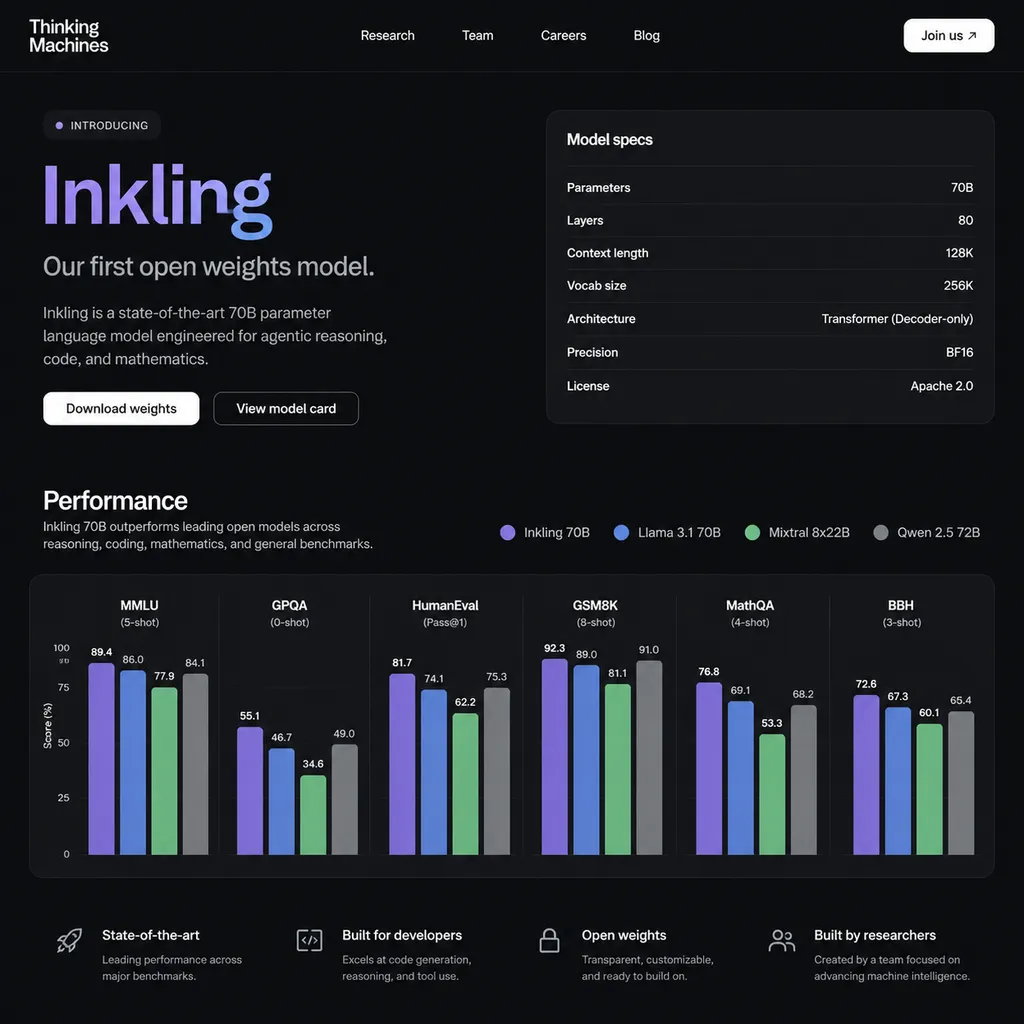
A year and a half after its founding, Thinking Machines—valued at 12 billion USD—has finally released its first model, **Inkling**. With **975 billion parameters** and **open-source weights**, it follows an “anti-general model” approach, emphasizing **customizability** and **reproducible reasoning**.
Mira Murati Hands In the Assignment: Thinking Machines Open-Sources 975B Model Inkling
After keeping a low profile for a year and a half, Thinking Machines has finally delivered.
On July 15 (Beijing time), the company founded by former OpenAI CTO Mira Murati—once valued at up to $12 billion—released its first model, Inkling: 975B parameters, open weights, and commercially usable. This is their first publicly released production-grade result since founding; previously, the public only saw a few research-oriented blog posts (like last September’s piece on uncertainty in LLM inference).
The 975B size is interesting. It doesn’t stack into the trillion-parameter range like Llama 4, nor follow the compact 70B “small but fine-tuned” route, but instead lands at a point “big enough yet still handleable by mid‑sized teams.” Inference on 8 × H200 or 4 × B200 is practical, and with quantization it can even run on a single machine. This size choice reveals Thinking Machines’ product philosophy.
Not Yet Another “General‑Purpose Flagship”
If you assumed Murati and a crew of OpenAI alumni came out to build a GPT‑5 or Gemini 3 rival, you’ve misunderstood Thinking Machines’ positioning.
The TechCrunch headline got it right—“amps up its bet against one-size-fits-all AI.” In other words, they’re betting the general‑purpose model path has reached its limit—the future is “foundation + deep customization.”
Inkling’s design revolves around this premise:
- Fully open weights, including intermediate training checkpoints, to facilitate continued pretraining rather than just fine‑tuning
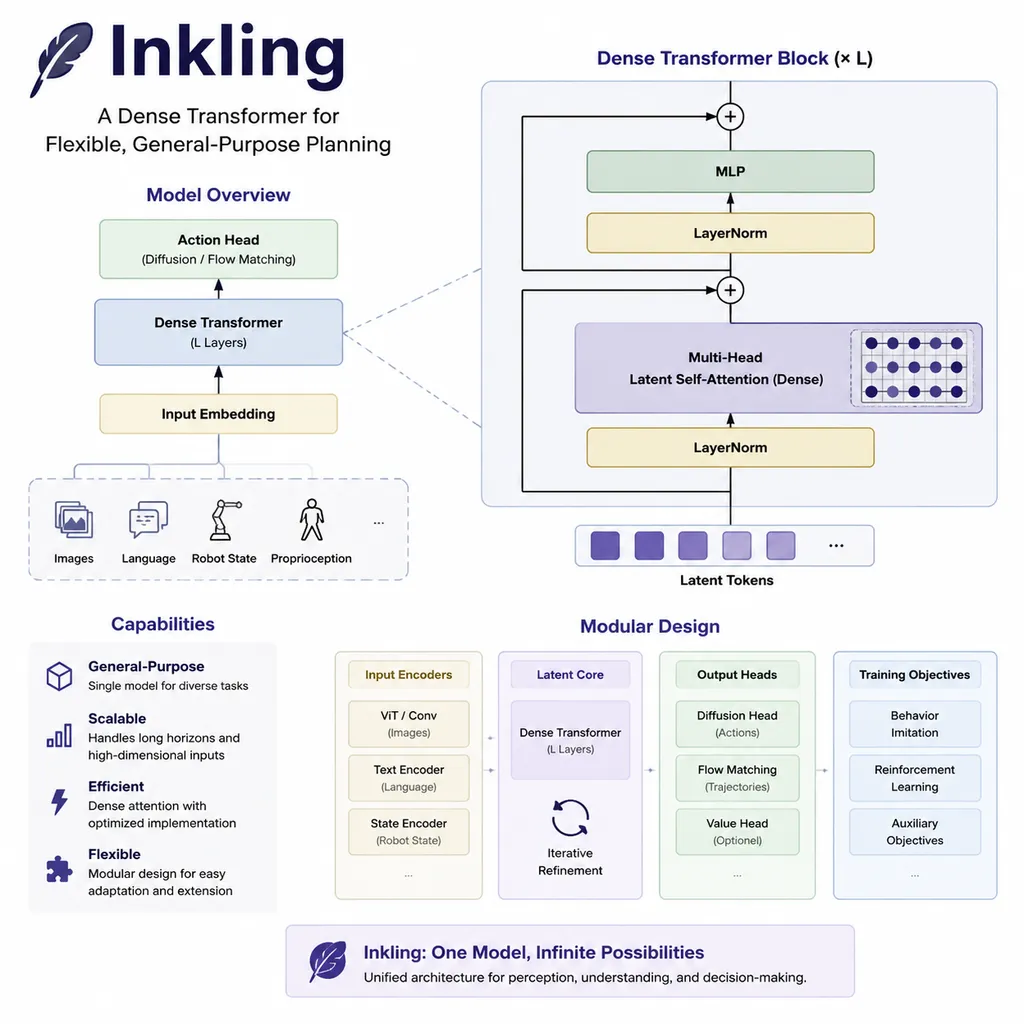
- Modular architecture—official docs say its attention and FFN layers can be independently swapped or distilled
- Deterministic inference mode—a productized outcome of last year’s paper on “ tackling LLM inference uncertainty.” Same input, same seed, multiple runs yield identical outputs
That last feature is essential for Agent and evaluation developers. You’ve likely encountered this: run the same prompt 10 times and get 10 slightly different GPT‑4 outputs, breaking regression testing. Inkling offers a deterministic=true mode: it sacrifices a bit of sampling diversity in exchange for reproducibility, a hard requirement in finance, healthcare, and legal domains.
Architecture and Training: Dense or MoE?
At first glance, 975 B could sound like the total parameters of an MoE model, but per the official technical report, Inkling is dense—975 B active parameters. In 2026, that’s actually counter‑trend: DeepSeek V4 and Qwen3‑Max are leaning toward giant MoE.
Thinking Machines’ reasoning: dense models behave more predictably when continuing pretraining or domain adaptation. MoE routing sparsity can cause “expert collapse” during fine‑tuning—certain domain samples never trigger specific experts, wasting training signal. For a model explicitly meant to be “trained further by customers,” dense is safer.
The trade‑off is inference cost. At the same active parameter count, dense inference costs several times more than MoE. Their workaround: provide an official structured‑sparsity version and FP4‑quantized weights—running the FP4 version on B200 yields 2.3× the throughput of dense FP8.
Training data highlights:
- Training tokens: 18T
- Context window: native 256 K, extended to 1 M via YaRN
- Compute: primarily NVIDIA’s Vera Rubin GPU (announced March collaboration), totaling over 1 GW
That NVIDIA–Thinking Machines partnership had been read as “Jensen Huang finding a backup for OpenAI.” In hindsight, Inkling is what that 1 GW‑scale compute produced.
Benchmarks and Real‑World Tests
According to official evaluations, Inkling performs as follows on key benchmarks:
| Test | Inkling‑975B | Llama 4 Behemoth | DeepSeek V4 | GPT‑5 | |------|---------------|------------------|-------------|-------| | MMLU‑Pro | 82.4 | 80.1 | 84.7 | 87.2 | | GPQA Diamond | 71.3 | 68.5 | 73.1 | 78.4 | | SWE‑Bench Verified | 64.8 | 58.2 | 71.5 | 76.3 | | MATH‑500 | 94.1 | 91.7 | 96.2 | 97.5 |
From this it’s clear: Inkling isn’t SOTA. It’s competitive among open‑source models but trails DeepSeek V4—and of course GPT‑5.
But that might be exactly the point. Their blog states plainly: “foundation models are not the endpoint—they’re the starting point.” Inkling’s value proposition isn’t “strongest out of the box,” but “strongest after you adapt it.”
They showed a demo: an anonymous biopharma client continued pretraining Inkling with 200 B domain tokens and surpassed GPT‑5 on BioASQ and MedQA. It’s a compelling pitch to B2B clients—you don’t need to train from scratch or be locked into OpenAI’s API pricing; just fine‑tune open weights.
The Nuances of Its Open License
Many assume “open weights” means free commercial use, but there’s a catch.
Inkling uses a custom TMI Community License, similar to Llama 4’s community license but stricter:
- Products with over 100 million monthly active users require separate authorization
- Inkling outputs cannot be used to train other foundation models (akin to OpenAI’s terms)
- Fine‑tuned derivatives must credit “Powered by Inkling”
The second clause is particularly subtle. Llama allows distillation; Qwen and DeepSeek largely ignore it. Thinking Machines clearly aims to prevent someone from distilling Inkling into a smaller model and claiming it as original. Understandable, yet it’s an unfriendly signal to open‑source remix developers.
Ecosystem and Deployment
On launch day, mainstream inference frameworks had already caught up:
- vLLM 0.9.2 supports Inkling’s native format
- SGLang offers optimized kernels for deterministic mode
- Hugging Face Transformers main branch merged support
- llama.cpp GGUF conversion script expected within a week
For local runs, minimum setup is 4 × H100 (FP8 quantized); recommended 8 × H200 or 4 × B200. On consumer GPUs, dual RTX 5090 can barely handle 4‑bit quantization but with poor throughput.
For domestic developers, beyond self‑hosting, OpenAI Hub also launched Inkling API access today: it uses the standard OpenAI‑compatible interface—just change model to inkling‑975b to test, avoiding the need to own eight GPUs.
A Small Verdict
Honestly, Inkling’s technical specs aren’t jaw‑dropping—975 B dense isn’t a radical architecture in 2026—but Thinking Machines has played it smart: they don’t need to win on benchmarks.
Murati’s team’s core narrative since leaving OpenAI is “foundation models are commoditized; value lies in applications.” Inkling’s design—open weights, customizability, deterministic inference—targets enterprise clients who say “I want to train my own.” Whether that logic holds will be clear within a year: if we see a flood of “XX‑Inkling‑Domain” forks on Hugging Face, the path worked; if not, that $12 billion valuation looks shaky.
From this first launch, at least, they’ve made the “anti‑general‑purpose‑model” story coherent. The only question left is—who will buy in?
References
- Conquering Uncertainty in Large‑Language‑Model Inference – Zhihu — Thinking Machines’ first technical paper (Sept last year), the theoretical basis of Inkling’s deterministic mode
- Valued at $84 Billion, They Just Released Their First AI Result – Zhihu — a QuantumBit overview of Thinking Machines’ team background and research direction
- Hugging Face – Inkling Model Repository — Inkling‑975B weights and model card (available on release day)


