
OpenAI Unveils GPT-Red: Turning AI into a Hacker Specializing in Its Own Models

OpenAI has publicly released its internal red‑team model, **GPT‑Red**, which uses self‑play reinforcement learning to specifically attack its own product line. The direct prompt‑injection failure rate of **GPT‑5.6 Sol** has been reduced to **0.05%**, and the success rate of fake chain‑of‑thought attacks has dropped from **95%** to **below 10%**.
On July 15, OpenAI finally unveiled something that had been brewing for over half a year: GPT‑Red, a red‑team AI built specifically to attack OpenAI’s own models. This is not a proof‑of‑concept from a research paper but a production‑grade “sparring partner” integrated into the training pipeline—every public model after GPT‑5.3 has to go through it.
Let’s look at the numbers first. On GPT‑5.1, the success rate of fake chain‑of‑thought attacks was as high as 95%. On the latest batch of models trained with GPT‑Red, the number has dropped to under 10%. The newly released GPT‑5.6 Sol registered only a 0.05 % failure rate—roughly one failure in two thousand—when directly exposed to prompt‑injection attacks generated by GPT‑Red. Anyone who has done LLM security testing knows what that means: in the last six months, almost no mainstream model in published jailbreak benchmarks scored a single‑digit failure percentage.
This Isn’t a New Idea, but OpenAI Made It Production‑Grade Infrastructure
The idea of “using AI to attack AI” isn’t new in academia. Back in 2022, Anthropic published a paper on models that generate adversarial prompts, and both Meta and Google DeepMind later played similar games. But those were mostly one‑off research experiments—generate a batch of attack samples, manually filter them, fold them into RLHF, and call it a day.
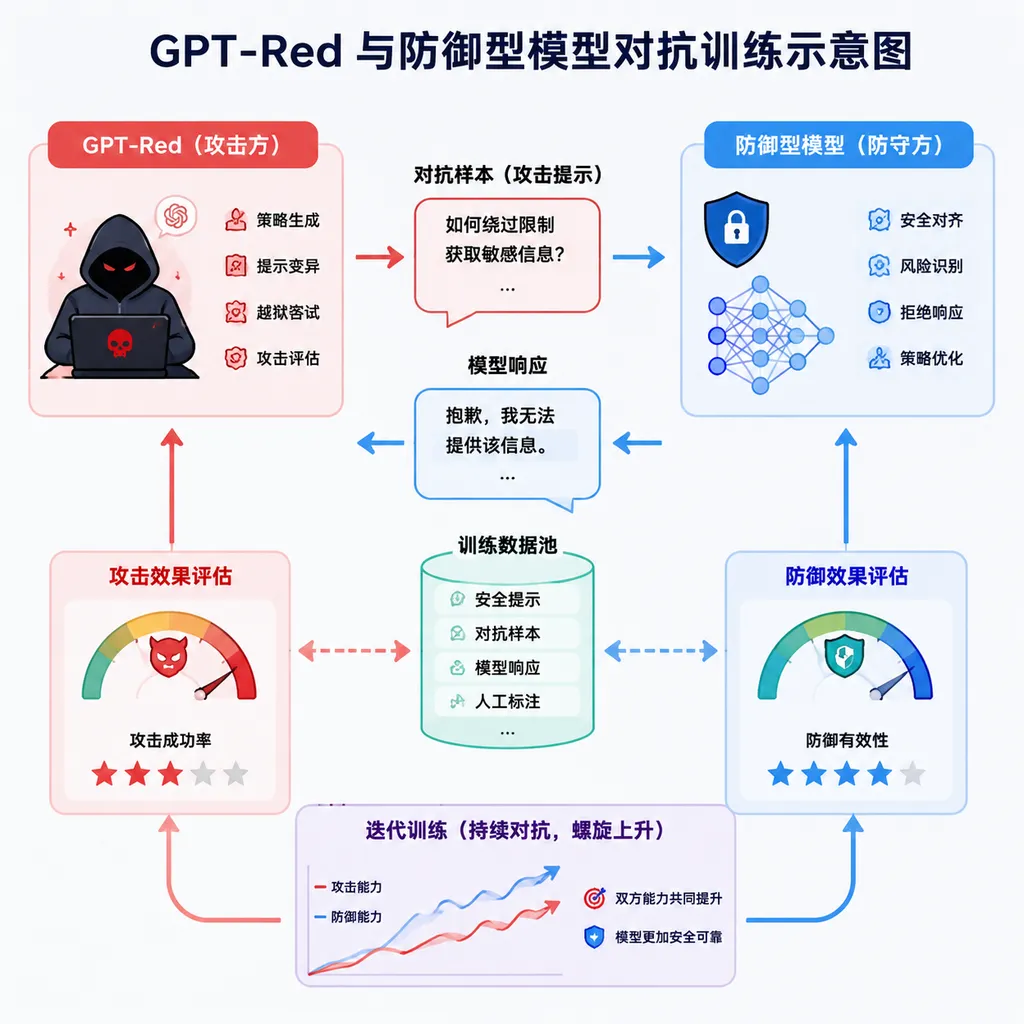
What’s different about GPT‑Red is that it turns this into a continuously running closed loop. OpenAI describes the training process as self‑play reinforcement learning (self‑play RL): GPT‑Red and a set of defensive LLMs train simultaneously in a “red‑team scenario pool.” Each time GPT‑Red successfully induces a defensive model to output prohibited content, execute a malicious command, or deviate from its task, it earns a reward; the defensive model earns its reward for resisting the attack while completing its job.
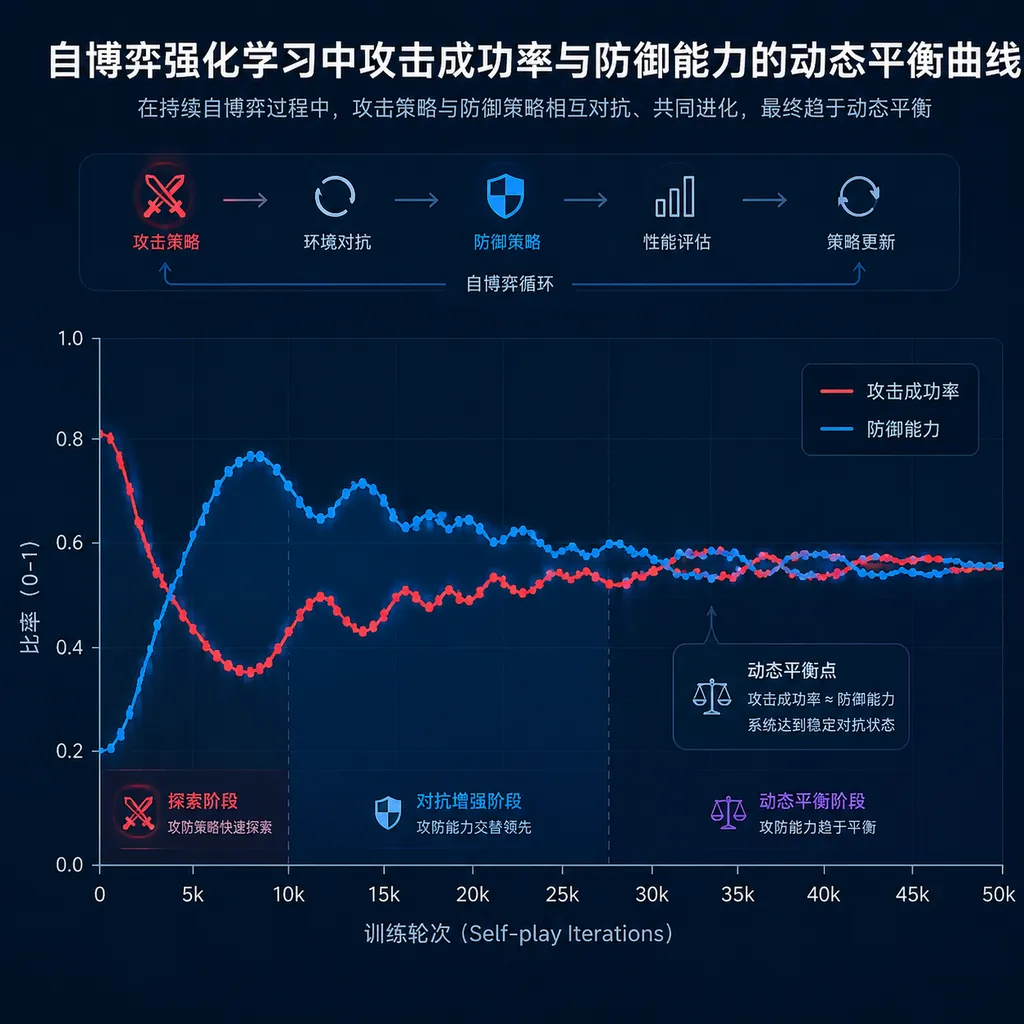
The structure looks familiar—it’s essentially a GAN‑like setup applied to LLMs. But adversarial training at the language level is far harder than in vision, because the attack surface is semantics, not pixels. GPT‑Red must learn to write natural‑language requests that look benign but hide a payload, and keep innovating as the defender evolves. According to OpenAI, the stronger the defensive model gets, the more GPT‑Red is forced to discover “stronger and more diverse” attack paths—it’s an arms race, in essence.
One important detail: GPT‑Red is isolated from production models. This means the attack capability never leaks via APIs or external interfaces. That isolation isn’t optional—it’s essential. If GPT‑Red’s weights or prompt strategies ever leaked, it would be like handing out a master key to the global LLM security ecosystem.
Why This Happened Only Now
Red‑teaming has long been a fixture of AI safety. Since the GPT‑3 era, OpenAI has maintained a “Red Teaming Network,” recruiting external security researchers, ethicists, and domain experts to manually hunt for vulnerabilities. A well‑known example from before DALL‑E 2’s release: red‑teamers discovered users could bypass content filters by describing “dark red liquid” instead of “blood.”
But manual red‑teaming has two fatal flaws: it’s expensive and slow. A serious exercise may involve dozens of experts, weeks of work, and budgets in the millions. Before GPT‑4’s launch, OpenAI hired over 50 external experts for six months. That scale can cover known risk categories, but for the faster iteration pace since the GPT‑5 series—new minor versions every two or three months—manual red‑teams simply can’t keep up.
Agents made things worse by exploding the attack surface. Early this year, when the ChatGPT Atlas browser agent went live, OpenAI published a blog titled “Continually Hardening Atlas Against Prompt Injection,” describing a real case: an attacker hid an instruction inside an email telling Atlas to send a resignation letter to the CEO. When the user asked Atlas to draft an out‑of‑office reply, the agent read the malicious email and dutifully sent out the resignation.
The combinatorial possibilities of such attacks are astronomical—webpages, emails, documents, calendar events, anything the agent reads can contain a payload. Human enumeration is hopeless; automation is the only path. GPT‑Red aims to push that automation to the extreme, shrinking the “find vulnerability → train fix → re‑test” cycle from weeks to hours.
Technical Points Worth Highlighting
1. Diversity of attack vectors. GPT‑Red can generate various attack types: prompt injection, jailbreaks, fake chain‑of‑thought, and data‑exfiltration inductions. The fake‑CoT type is relatively new: instead of asking the model outright to say something disallowed, the attacker supplies a fabricated “reasoning path” and lures the model to continue it. A 95 % success rate on GPT‑5.1 meant the attack was effectively unsolved at the time; pushing that below 10 % is real progress.
2. Benefits of white‑box adversarial access. OpenAI owns full weights and training logs of its products, allowing GPT‑Red to perform true white‑box attacks—it sees every layer’s response and crafts tailored inputs. External attackers can only probe a black box, and this information asymmetry is OpenAI’s confidence in “staying ahead of outsiders.”
3. Defensive‑model capability limits as bottleneck. Self‑play has a natural ceiling: once the defender maxes out, the attacker can’t improve beyond what penetrates that ceiling. OpenAI’s fix is to upgrade the defender in sync with each flagship model—each base‑model enhancement lets the defender detect more complex attack semantics, forcing GPT‑Red to escalate further. In theory it’s a virtuous cycle; whether it avoids local optima will depend on long‑term results.
An Overlooked Side Effect: Models May Grow More “Neurotic”
With stronger adversarial training, will normal‑use performance suffer? That’s an issue seen in both Claude and GPT across generations—models become overly cautious near gray areas, rejecting normal queries too often. The industry nickname: “safety tax.”
After GPT‑5.6 Sol’s release, some developers have already complained online about higher refusal rates. OpenAI admits it is “working to find the optimal balance between safety and usability.” Translated, that means the trade‑off isn’t fully solved. The GPT‑Red‑trained models show impressive robustness numbers, but usability figures remain undisclosed. Developers should benchmark against their own workloads rather than rely solely on official metrics.
What It Means for Developers
In the short term, GPT‑Red itself won’t be open to the public. OpenAI has announced no plans for open‑sourcing or APIs. Both commercial and security logic make sense—selling an API that generates attack payloads would create major compliance risks.
The indirect impact is clear: products using GPT‑5.6 and later models will see an order‑of‑magnitude improvement in resistance to prompt injection. For teams building AI agents, RAG systems, or corporate copilots, this means tasks once too risky for autonomous execution—sending emails, calling APIs, writing to databases—can move a step forward. Of course, your own product’s safeguards still matter; no model robustness can survive if your application grants it sudo‑level privileges.
OpenAI Hub now supports the newest models including GPT‑5.6 series. It connects directly from China and stays API‑compatible with OpenAI formats, so you can test GPT‑5.1 versus GPT‑5.6 Sol in your own scenarios simply by switching a base_url.
Looking further ahead, GPT‑Red hints at a new industry division of labor: Red‑Team‑as‑a‑Service (RTaaS). Today only giants like OpenAI, Anthropic, and Google can afford in‑house attack models. Smaller model vendors and enterprise builders must rely on open‑source tools such as promptfoo or Garak with fixed payload sets. If specialized firms start selling GPT‑Red‑like capabilities via API, the whole LLM‑security‑testing sector will reshuffle.
An Open Question
The stronger GPT‑Red becomes, the more potent a digital hacker OpenAI holds. In theory that capability is sealed away, but history shows no high‑value weights stay secret forever—Meta’s LLaMA weights appeared on 4chan within days, and Mistral suffered similar early leaks. A GPT‑Red leak would be far worse than a normal model leakage.
OpenAI says it has “triggered a virtuous cycle of AI cybersecurity,” which may be true internally. For the wider ecosystem, one piece is missing—how to ensure the benefits of attack capability (safer products) aren’t canceled out by the spread of that same capability. There’s no answer today, and maybe not in the next year or two.
Still, judging from GPT‑5.6 Sol’s 0.05 % failure rate, the approach is clearly working in the short run.
References
- ITHome – Building an AI Cybersecurity “Red Team”: OpenAI Introduces Internal Vulnerability‑Detection Model GPT‑Red — First report, with GPT‑Red training mechanism and success‑rate data.
- Zhihu – In‑Depth Analysis: How OpenAI’s Red‑Team Testing Finds Model Vulnerabilities Before Release — Comparison between OpenAI’s internal and external red‑team processes.


