
Xiaomi unveils Xiaomi-Robotics-1: a robot base trained with 100,000 hours of real machine data
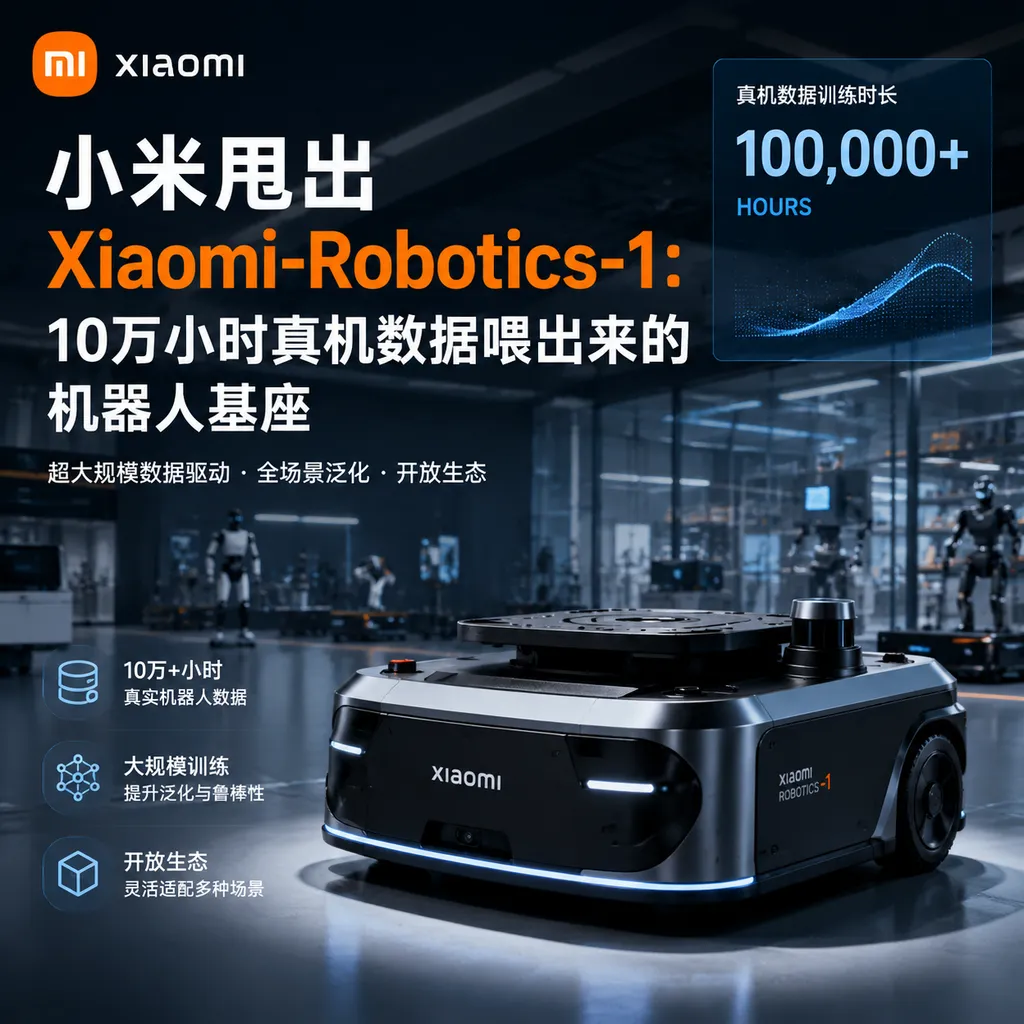
On July 16, Xiaomi Technology released its embodied base model **Xiaomi-Robotics-1**, pretrained with 100,000 hours of real UMI operation data and an additional 10,000 hours of cross-embodiment post-training. It is described as "ready to use out of the box," achieving an average success rate of **57.4%** on RoboCasa365. The code and weights will be open-sourced soon.
Xiaomi Releases Xiaomi-Robotics-1: A Robot Foundation Trained on 100,000 Hours of Real Data
On the morning of July 16, Xiaomi’s official technology account dropped a rather big announcement — the embodiment foundation model Xiaomi-Robotics-1 was officially released. In short: pretrained on 100,000 hours of real-world operation data, then post-trained on about 10,000 hours of cross-embodiment data, featuring "ready-to-use" functionality, with source code and model weights to be open-sourced “soon.”
This isn’t just another “general-purpose robot” demo video project. Xiaomi has openly disclosed its training scale, data sources, two-stage paradigm, and benchmark results — clearly signaling its intention to seriously establish its position in embodied intelligence. After all, earlier this year, Figure 02, Physical Intelligence’s π0.5, and several Chinese players such as Zhiyuan and Unitree have been moving fast. If Xiaomi didn’t act, it would soon be left only telling stories.
How 100,000 Hours of Real Data Were Gathered
Let’s start with the data, because it’s the most substantial part of this release.
In embodied intelligence, the biggest bottleneck isn’t model architecture — it’s data. Internet videos are plentiful, but they’re not first-person robot operation trajectories. Simulations can be fast, but the sim-to-real gap remains brutal. A 100,000-hour real-world operation trajectory dataset is one of the largest disclosed so far. For comparison, Physical Intelligence’s π0 used about 10,000 hours of robot data, and Google’s RT-2 never disclosed such scale.
Data was collected using the UMI (Universal Manipulation Interface) — originally developed at Stanford. Essentially, it’s a handheld gripper with a GoPro mounted up front, allowing a human operator to “act out” real interactions in the physical world. You can think of it as a human performer wearing mocap gloves to “work for the robot,” generating body-agnostic trajectories that can later be mapped to any robot embodiment.
Xiaomi collected UMI data across diverse scenarios:
- Home: kitchens, living rooms, bedrooms — high-frequency interaction spaces
- Commercial: convenience stores, restaurants, and similar settings
- Industrial: workshops and warehouses — structured environments
- Offices: desktops, drawers, printers, etc.
- Outdoors: less common, suggesting an intent to tackle unstructured environments
Getting UMI data isn’t enough though. Annotating 100,000 hours of video manually would be impossible. Xiaomi built an automatic annotation pipeline — slicing long trajectories into fixed-length clips and using a Vision-Language Model (VLM) to describe how the gripper’s state and the interacted objects’ states change. Essentially, the VLM becomes the annotator, attaching a short descriptive sentence to each segment of action.
They claim annotation of all 100,000 hours was completed in about two weeks. That throughput implies significant compute resources and a well-tuned pipeline — anyone who has done multimodal data processing knows that even stabilizing the process of slicing videos, extracting frames, feeding VLMs, and post-processing is nontrivial.
The Two-Stage Paradigm: First “Change the World,” Then “Understand Humans”
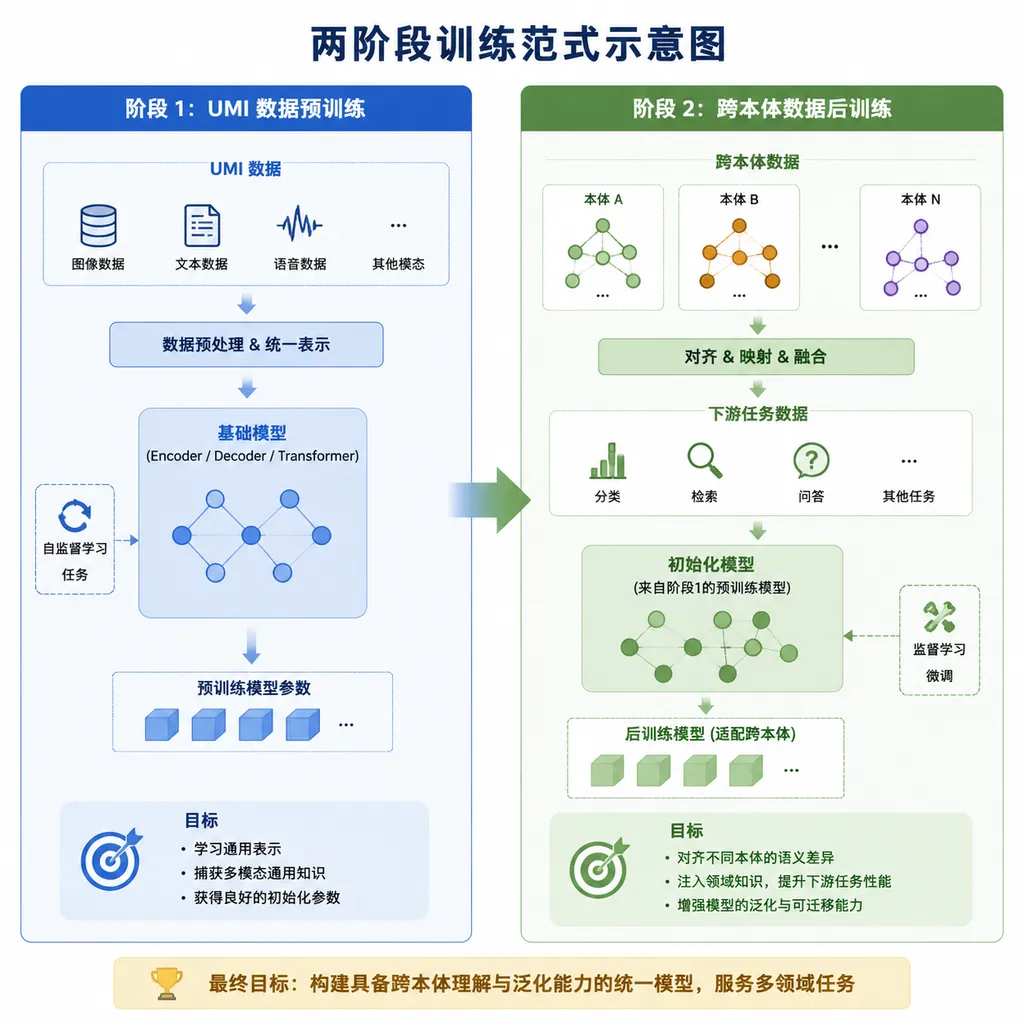
Xiaomi-Robotics-1 follows the contemporary mainstream framework for embodied foundation models — pretraining + posttraining, but Xiaomi separates the two stages quite cleanly.
Pretraining: Learning “General Action Generation”
Given a visual observation (what the robot currently sees) and a language description (auto-generated annotation such as “the gripper opens then grasps a cup”), the model predicts a sequence of actions that moves the scene from current to target state.
Note that this language description is not a human instruction, but a state change description. This is a clever design choice: if you start by teaching the model to “act on human instructions,” you’d need expensive “instruction-action” pairs. Replacing that with “state change–action” pairs makes it possible to automatically generate millions of samples using a VLM.
At its core, the model learns the combination of a world model + inverse dynamics: it observes a current state and a target-state description, and infers the necessary actions to achieve it. This is embodiment-agnostic since UMI’s action space itself is embodiment-agnostic.
Posttraining: Solving Two Alignment Problems
After pretraining, the model knows how to “change the world,” but not how to “understand humans” or operate real robots. The posttraining stage addresses two alignments:
- Embodiment alignment: transferring learned UMI actions to real robot bodies. UMI’s gripper control differs from real robot joints and needs mapping.
- Instruction alignment: translating from “state change description → action” to “human natural language instruction → action.” This is similar to SFT in LLMs, training the model to respond to phrases like “hand me the cup on the table.”
The posttraining dataset totals roughly 10,000 hours, including:
- 7,200+ hours of mobile-manipulator and dual-arm robot data (collected by Xiaomi itself)
- 1,000+ hours of manually annotated UMI data (for high-quality instruction alignment)
- The rest comprised Bridge V2, RT-1, DROID, and other public robot datasets
These three are standard picks: DROID (Stanford et al.), Bridge V2 (UC Berkeley), and RT-1 (Google). Leveraging public datasets during posttraining helps the model generalize to a variety of robot embodiments.
How Good Are the Results? What 57.4% Means
Xiaomi’s reported 57.4% average success rate on the RoboCasa365 benchmark is the key number. The release also mentioned “Composite-Unseen” tasks (text truncated in the original), but those full results await their technical report.
RoboCasa, led by NVIDIA, is a simulation benchmark covering 365 everyday manipulation tasks. A 57.4% average success rate is upper-mid-tier among embodied foundation models. It’s hard to declare “high or low” in absolute terms since evaluation protocols, sampling strategies, and few-shot fine-tuning vary greatly across teams. Meaningful comparison needs models tested under identical benchmarks — though RoboCasa365 still lacks many public baselines.
The most significant line in the post reads:
On complex, dexterous manipulation tasks, the model can be efficiently fine-tuned with a small amount of real-world robot data instead of learning from scratch.
In plain terms: once the foundation is trained, new tasks don’t require massive data collection. That’s the true meaning of a “foundation model.” If each new task still needs dozens of hours of demonstrations, it’s no better than a task-specific model, and not commercially viable. Xiaomi’s emphasis on “efficient fine-tuning with small data” suggests its target customers are robot product teams, not researchers — teams that could purchase the foundation, fine-tune on their limited scene data, and deploy directly.
In the Competitive Landscape
China’s embodied foundation model scene has intensified rapidly over the past year. Zhiyuan’s GO-1, Galaxy General’s GraspVLA, Unitree’s policy models, and Tsinghua-affiliated RDT are all pursuing general manipulation models. Overseas, Physical Intelligence’s π0.5, Skild AI’s general policy, and Figure’s Helix are key references.
Xiaomi’s points of differentiation are clear:
- Massive data scale — if the 100,000-hour real-data claim holds and is open-sourced, it sets a new baseline for the community.
- UMI approach proven feasible — this validates at scale that “human-collected body-agnostic trajectories” actually work, a big deal since classic teleoperation data collection is costly while UMI is cheap.
- Commitment to open source — “code and weights to be open-sourced soon.” If they truly release them, that’s far more accessible than competitors who only publish papers (like π0.5).
Caveats remain:
- RoboCasa365 is a simulation benchmark; few details are given on real-world generalization results.
- The term “ready-to-use” may be overstated — whether users can literally run it without fine-tuning awaits third-party tests and real-scene videos.
- Distribution of the 100,000-hour dataset (home vs. industrial ratios, etc.) hasn’t been disclosed, which affects transfer effectiveness by scene.
What This Means for Developers
If you develop robot applications, once Xiaomi-Robotics-1 is open-sourced, it could save you from:
- Collecting data and training a foundation from scratch — saving millions in cost.
- Spending months instead of weeks on engineering — only small demonstration sets needed for fine-tuning.
- Designing your own UMI interface — a ready reference implementation for scalable data collection.
The key moment to watch is the release of weights. Xiaomi says “soon,” which for a Chinese tech company usually means 2–4 weeks. When that happens, pay attention to:
- Whether full or distilled weights are released
- Whether the license permits commercial use
- Whether inference framework and hardware adaptation docs are provided
- The minimum data and compute required for fine-tuning
Project homepage: robotics.xiaomi.com/xiaomi-robotics-1.html
Final Thoughts
The biggest shift in embodied intelligence from last year to this year is the transition from “everyone showing demos” to “true foundation models and ecosystems.” In that context, Xiaomi’s move is a step aligning with the mainstream pace yet differentiating itself through dataset scale. Whether it becomes the “Android of robots” remains to be seen — but this release certainly provides far more substance than last year’s “we’re making robots too” slides.
The real test comes after open-sourcing: can the community run it successfully, can third parties reproduce comparable success in new environments, and can other robot manufacturers adopt it as their underlying foundation? The answers to these will determine whether Xiaomi-Robotics-1 is just another tech report — or the first truly open-sourced foundation model for embodied intelligence.
References
- Xiaomi launches truly “ready-to-use” robot foundation model Xiaomi-Robotics-1, trained on 100,000 hours of data – IT Home — First report, covering dataset scale, training paradigm, and post-training data composition.


