
Baidu Wenku Cloud will provide financial professionals with an AI workstation; GenFlow will begin internal testing next month.
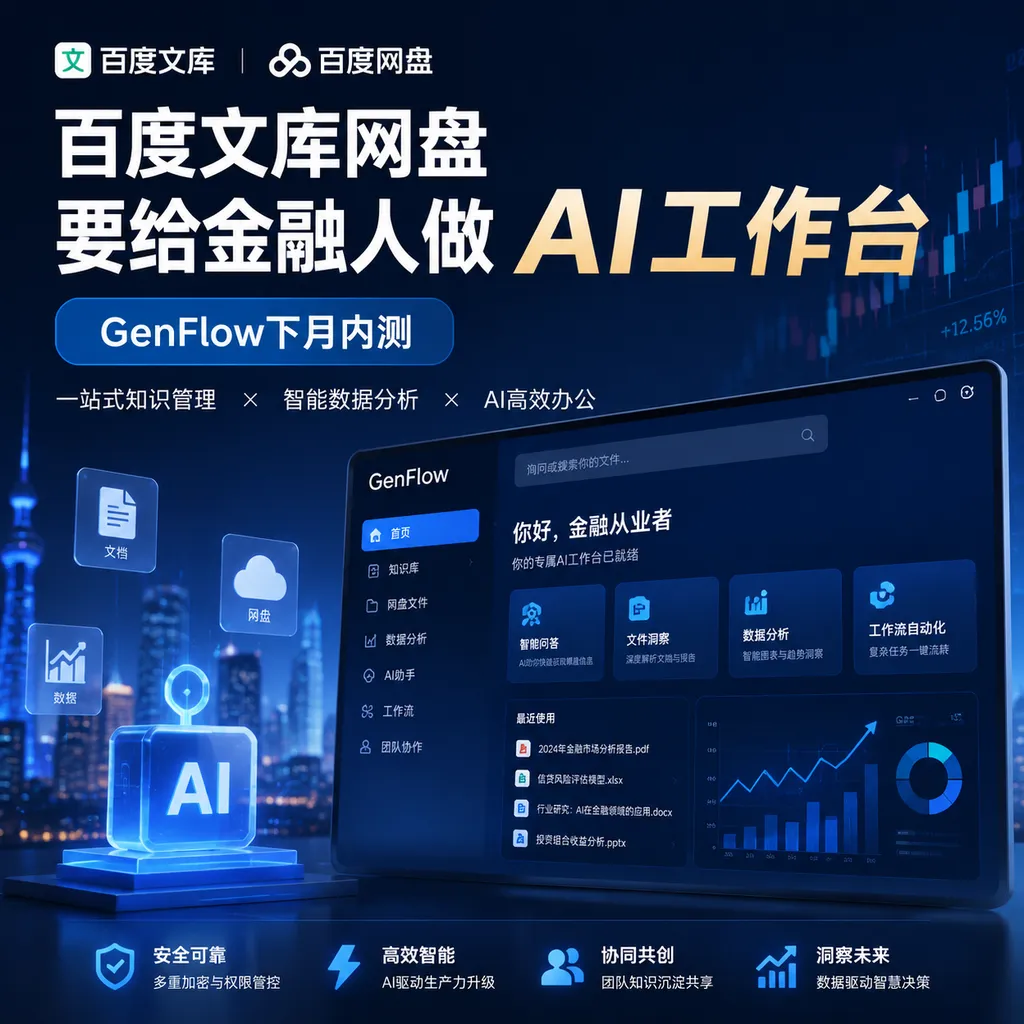
Baidu Wenku and Baidu Cloud will undergo a major upgrade at the end of July. GenFlow will launch its first batch of vertical capabilities for the financial industry, including in-depth research, financial modeling, and AI meeting assistant functions, with support for skill-based encapsulation. More progress will be revealed at WAIC 2026.
On the morning of July 16, Baidu insiders confirmed to Sina Technology that Baidu Wenku and Baidu Netdisk will launch a major upgrade at the end of July. Alongside this, independent web and client versions for professional users in finance, education, and business will go live. GenFlow will also receive another upgrade, first entering the financial industry, offering a full suite of capabilities such as in-depth research, financial modeling, AI meeting assistant, and cloud storage. It will also allow these professional capabilities to be packaged as skills so practitioners can build their own AI workbenches. Internal beta testing will begin at the end of July, with more details to be announced at WAIC2026.
This is a predictable shift. Looking at the past 15 months of GenFlow’s updates, it’s clear that this product line is pivoting from a “general-purpose agent” toward an “industry workbench.”
From 1.0 to Today: The Road GenFlow Has Traveled
A quick look at the timeline helps to appreciate the weight of this upgrade:
- April 2025: Baidu Wenku and Netdisk, based on the “Cangzhou OS” content operating system, launched GenFlow 1.0, focused on general-purpose Agents.
- August 2025: GenFlow 2.0 debuted at Baidu AI Day, its highlight being a self-developed Multi-Agent engine that could call over 100 expert agents simultaneously, turning traditional serial “waterfall” workflows into “parallel” ones, delivering tasks in minutes.
- April 2026: GenFlow 4.0 was released, with a full upgrade to the Office Agent suite (PPT/Excel/Word), compatible with third-party agent frameworks like Lobster. It allowed one-click deployment for individuals and teams. At that time, Baidu announced it had 100 million monthly active users (MAU) and 200 million task deliveries per month.
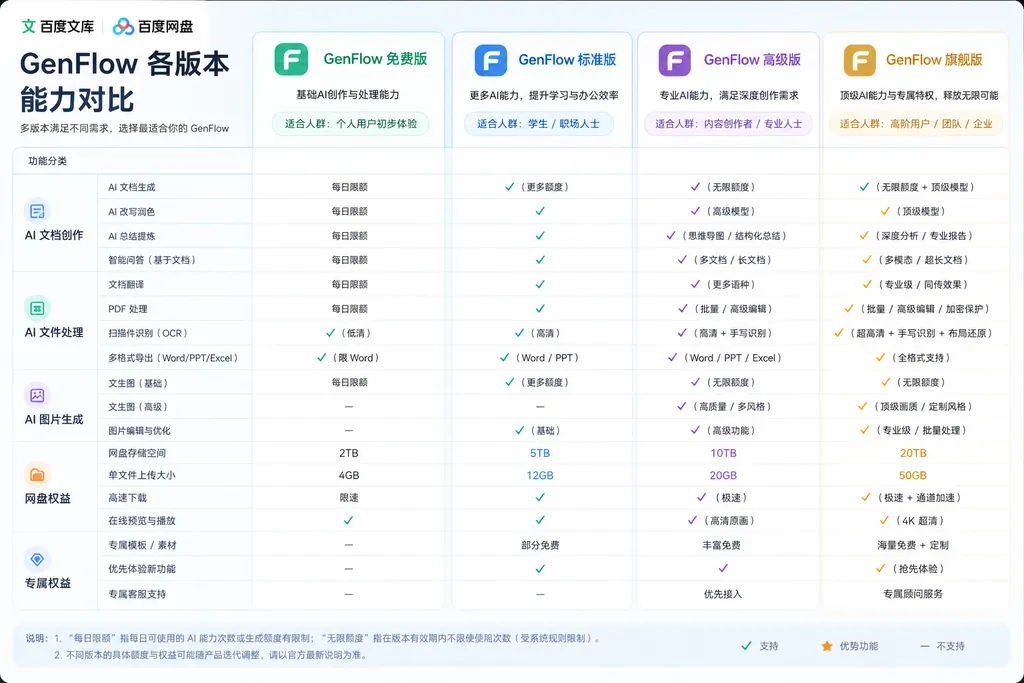
From 1.0 to 4.0, it’s evident that Baidu has been exploring one key question: How can a general-purpose Agent be sold—and to whom?
1.0 solved “Can it be done?”, 2.0 solved “Is it fast enough?”, and 4.0 solved “Is it easy to use?”—fully embracing Office scenarios for both individuals and teams. By this point, the user growth of general-purpose Agents had reached 100 million MAU. However, relying on free usage, an ecosystem, and user migration from Wenku and Netdisk, the ceiling has started to show.
To keep growing, there are two paths: continue expanding in the consumer market with entertainment and lifestyle features (like AI albums or AI videos) to boost engagement, or pivot toward professionals and the B2B market to make the concept of a “workbench” real. This upgrade clearly takes the latter path—with its first focus decisively on finance.
Why Finance First
Anyone familiar with AI product deployment will guess why: finance sits at the “golden triangle” of willingness to pay, strong use cases, and content density.
Breaking down the four modules for the finance release:
- In-depth research: Self-explanatory—sell-side research, buy-side due diligence, and company analysis are all document-heavy tasks, naturally suited for Agents. As early as GenFlow 2.0, research Agents could already produce tens of thousands of words of professional reports in minutes. The upgrade simply adds industry data sources, specialized templates, and compliance checks.
- Financial modeling: A more demanding task. Building DCF models, M&A models, and sensitivity analyses is essentially “Excel-based programming.” GenFlow 4.0’s Excel Agent already supports “multimodal data filtering + complex formulas + chart generation,” but financial modeling’s accuracy, auditability, and formula transparency are an order of magnitude higher. Whether GenFlow can meet that bar will be a key test for this upgrade.
- AI meeting assistant: This field is crowded—Feishu Minutes, Tencent Meeting AI, DingTalk AI, Tongyi Tingwu, and GPT-based products all compete here. Baidu’s advantage could only come from integrating “meeting content + Wenku/Netdisk data,” such as automatically pulling company reports mentioned during meetings or linking action items to project folders in Netdisk.
- Cloud storage: Baidu Netdisk’s core business with a base of 1 billion users. Its significance here isn’t just “to store files” but to serve as the Agent’s memory base—persistent context, so you don’t have to re-upload or restate information each time.
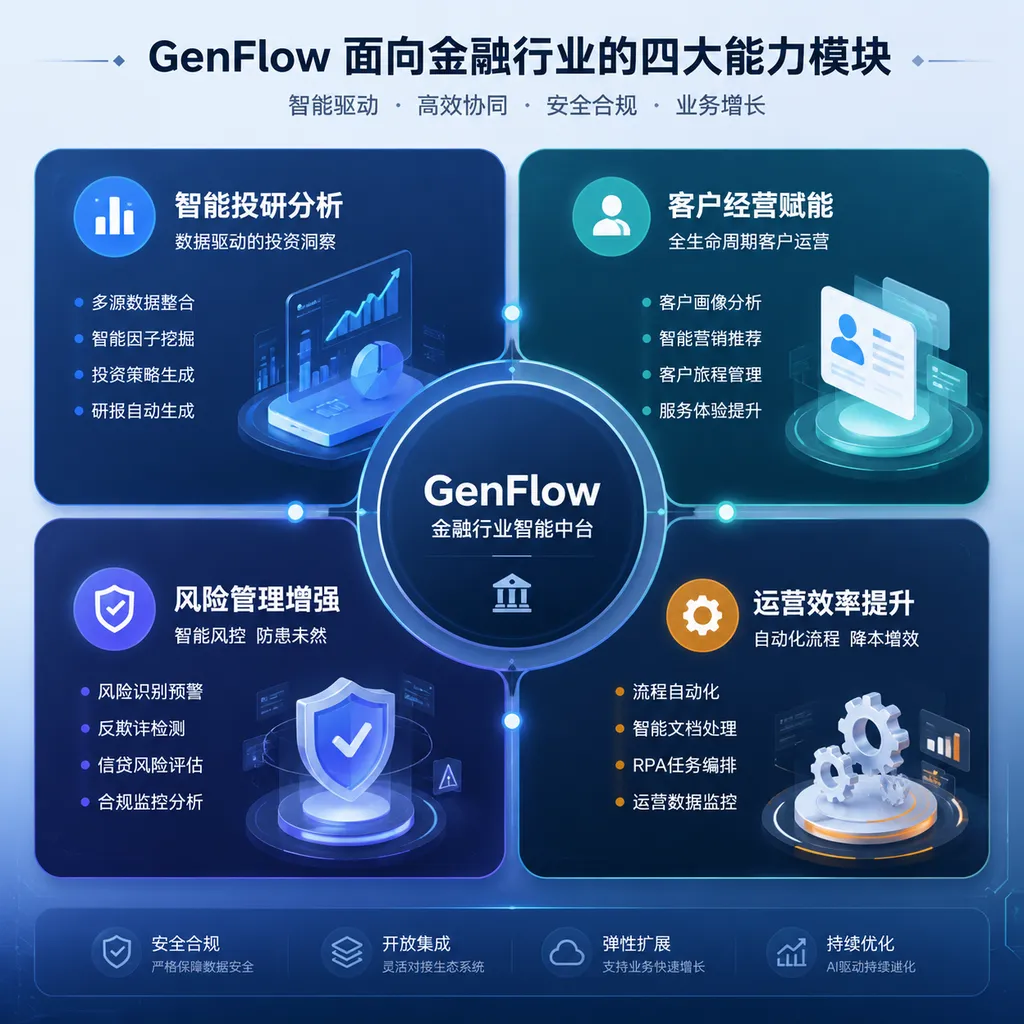
The real keyword here is “skill-ization.”
Skill-ization: Turning Professional Capabilities into Plug-and-Play Modules
Baidu’s official statement says: “Support the skill-ization of relevant professional capabilities to create a dedicated AI workbench.” It may sound like marketing fluff, but from an engineering perspective, it marks a major philosophical shift in product direction.
Here’s an analogy:
- Before skill-ization: GenFlow was like a general-purpose assistant that could handle many different tasks—you described your need, and it planned and called multiple Agents to do it.
- After skill-ization: Financial analysts can package their go-to “industry research templates,” “financial modeling processes,” and “quarterly report analysis routines” into individual skills that others (or themselves) can call directly.
This model sounds familiar—it closely mirrors Anthropic’s Claude Skills mechanism, OpenAI’s GPTs, and the broader Agent Store concept across the industry. The difference is that Baidu is starting from vertical industries rather than launching a general consumer-focused marketplace like GPTs.
For developers, this needs special mention. Back in the GenFlow 2.0 era, Baidu announced upgraded developer benefits, open access to over 100 optimized capabilities, and full compatibility with the MCP protocol. If skill-creation is now being opened up to developers and enterprises, GenFlow effectively becomes an AI middleware for industry: models underneath (self-developed MoE + third-party), a Multi-Agent engine and memory core in the middle, and an industry skill marketplace on top. If this architecture holds, Baidu can replicate the same logic when it expands into education, law, and healthcare.
In other words, the late-July internal beta will showcase “an AI productivity operating system for professionals”, not just a stronger assistant.
Competitors
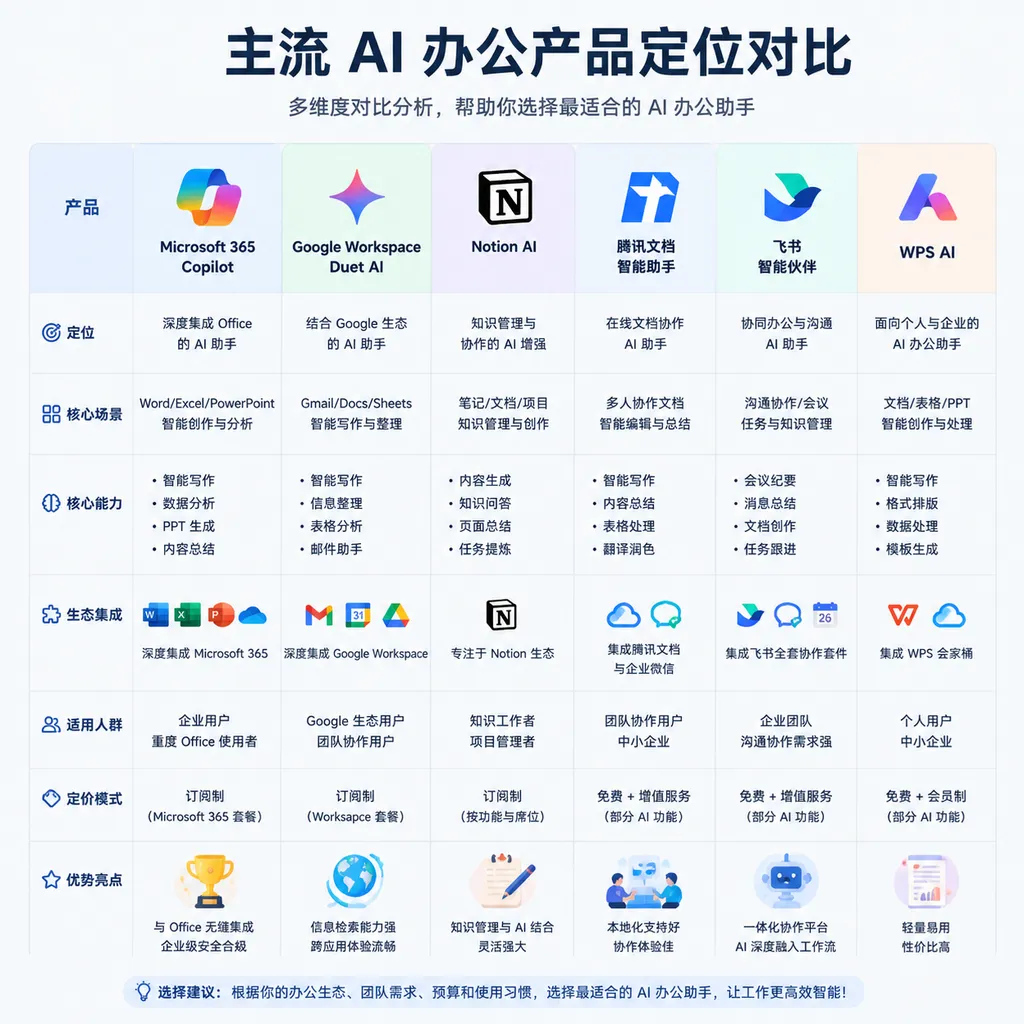
At least three unavoidable comparisons:
- WPS AI + Kingsoft Office: A native player in the office domain with high client penetration. Recently it’s been pushing AI agents and enterprise solutions aggressively. Its advantage lies in a full Office ecosystem; its weakness, a smaller volume of research and industry knowledge content compared to Wenku.
- Feishu + ByteDance Agents: A strong B2B offering integrating Feishu Docs, Multi-dimensional Tables, and the Doubao/Kouzi AI combo, replacing a lot of Excel + BI work in many tech firms.
- Tongyi Qianwen + Alibaba Cloud Bailian: More infrastructure-oriented, strong in enterprise agent deployment and cloud compute; its industry solutions are mainly delivered through partners, with less polished direct user experience for professionals.
Baidu is essentially targeting the “desktop of professionals”—not making you use an Agent platform backstage, but enabling your daily work directly inside the GenFlow workbench. The decision to build standalone clients underscores the ambition: not to live inside a browser, nor just as a mobile app, but to sit on the desktop.
For financial professionals, a straightforward benchmark is: “Can it automatically generate a usable morning briefing 15 minutes before the daily meeting?” Including overnight financial news, company announcements, key data changes, sell-side summaries—and ideally, turn it into a ready-to-present PPT with one click. Whoever achieves this first wins this audience.
Open Questions
Since the internal beta begins only in late July, much is still speculation. A few suspense points to watch for at WAIC2026:
- Data compliance in finance: In-depth research and modeling both involve non-public data. Will there be an on-premise deployment option for institutions or only public cloud with data masking?
- Pricing model: GenFlow previously offered free consumer use with paid memberships. Will the professional version charge “per skill” or “per team seat”?
- Relationship with Baidu Cloud and the ERNIE model family: GenFlow has long emphasized its MoE multi-model scheduling—will the professional version be bound to a finance-tuned ERNIE model or stay open to multiple models?
- Skill revenue sharing: If skill-creation becomes central, will there be a GPTs Store–style marketplace with revenue sharing, or will it remain an internal enterprise tool first?
In the longer term, GenFlow’s direction aligns with today’s industry consensus: general-purpose Agents are saturated; industry-specific Agents are where the money is. By the second half of 2026, China’s general assistant market will likely enter a price war and cognitive saturation phase, pushing everyone toward vertical industries.
Baidu’s advantage lies in its massive assets—1.4 billion+ professional documents in Wenku and 1 billion Netdisk users. Starting with finance allows it to test monetization in the most lucrative field. The key post-July question will be whether professionals actually open this new standalone client daily—rather than treating it as yet another tool alongside WPS or Feishu.
References
- Baidu Wenku and Netdisk Major Upgrade: Internal Beta Launching at the End of July, Introducing Independent Web and Desktop Clients for Professionals – IT Home — Initial report published July 16, revealing the upgrade timeline, GenFlow’s finance-oriented feature list, and plans for an independent client.


