
Alibaba “MiaoWu Meoo” officially released, marking the beginning of the minute-level era for AI full-stack development
Alibaba’s ATH Business Group has released its first AI development tool, *Miaowu Meoo*, which integrates multiple models including Qwen, Kimi, GLM, and MiniMax. Users can describe their requirements in natural language to generate a complete application within one minute and deploy it online with a single click.
Alibaba Officially Launches “Meoo”: AI Full-Stack Development Enters the Minute-Level Era
On April 15, Alibaba’s ATH business group officially released its first AI development tool—Meoo. In one sentence, what this product does is: you describe what you want in natural language, and it will generate the front end, back end, and database for you, then deploy it directly to Alibaba Cloud. The official claim: “as fast as 1 minute.”
This isn’t Alibaba’s first foray into AI-assisted programming—Tongyi Lingma has long been integrated into VS Code and JetBrains. But Meoo’s ambition is clearly different: instead of being a code editor plugin, it’s an independent, end-to-end application generation platform. In terms of positioning, it’s closer to Bolt.new, Lovable, or ByteDance’s Trae, rather than GitHub Copilot.
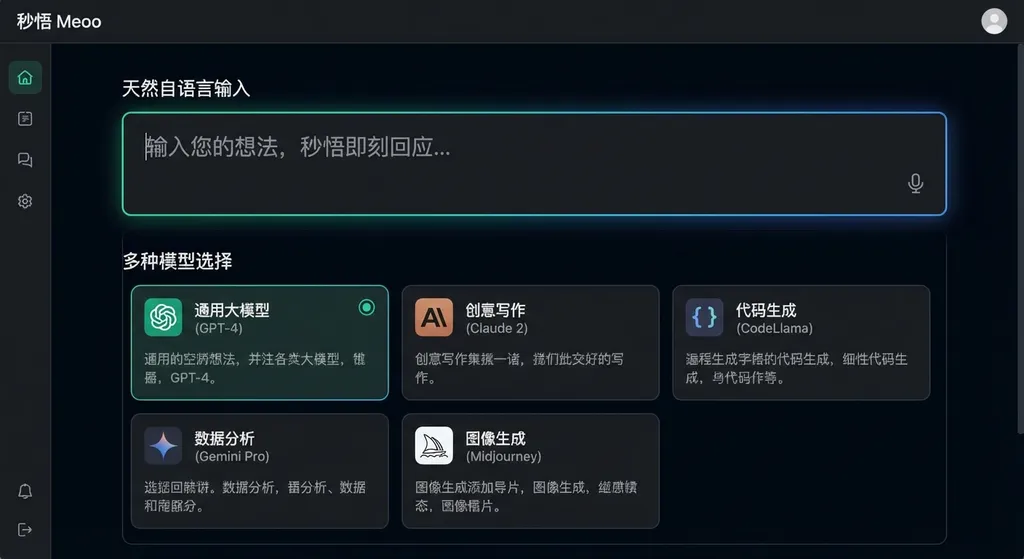
Multi-Model Aggregation: Not Betting on a Single Brain
The most notable architectural decision of Meoo is that it doesn’t rely solely on Alibaba’s own Tongyi Qianwen, but instead integrates five models simultaneously.
Currently built-in models include:
- Qwen3-Coder / Qwen3.5-Plus (Alibaba Tongyi Qianwen series)
- Kimi K2.5 (Moonshot AI)
- GLM-5 (Zhipu AI)
- MiniMax-M2.5 (MiniMax)
This is an interesting approach. While most domestic AI coding tools are “self-supplied” — Baidu uses Wenxin, ByteDance uses Doubao, Tencent uses Hunyuan — Alibaba chooses to include competitor models as well, forming a collaborative multi-model architecture.
Why do this? Because different models excel at different tasks. For example, Qwen3-Coder might handle React component development better, while Kimi K2.5’s long-context capability shines in complex logic handling, and GLM-5 performs strongly in Chinese semantic understanding. Meoo’s philosophy is: instead of forcing users to compare and switch models themselves, do the orchestration at the platform level.
This philosophy aligns with platforms like OpenAI Hub—rather than binding to one model, let developers pick the best one for their scenario.
Three Modes: Covering Everything from “Get It Done Fast” to “Build Properly”
Meoo provides three work modes, designed for different development needs:
Fast (Rapid Delivery)
Ideal for prototypes, event pages, and MVPs—when you just need to “get it online.” You describe what you need, and it generates complete code and deploys it. Speed is the top priority.
For instance, if you say, “Create a dark blue product launch invitation page with a countdown timer and a signup form at the bottom,” the Fast mode will immediately generate a working H5 page.
Agent (Deep Thinking)
Aimed at more complex requirements. The Agent mode first analyzes your business logic, designs the architecture, and then writes the code. It automatically troubleshoots and fixes issues instead of simply handing you error messages.
This mode functions like a junior full-stack engineer: think first, then execute step by step.
Swarms (Parallel Tasks)
Handles multi-module projects in parallel—such as building user management, order systems, and dashboards simultaneously—rather than queuing them.
These three modes reflect well-considered user segmentation. Not every request needs “deep thinking,” and not every scenario demands “ultimate speed.”
Tech Stack: Full Coverage, with Boundaries
Based on available public information, Meoo supports a comprehensive tech stack:
Frontend:
- HTML / CSS / JavaScript
- React, Vue frameworks
- Responsive layouts for web and mobile
Backend:
- Java, Python, Node.js
- API generation, CRUD logic
- Database design and integration
Deployment targets:
- Web applications
- H5 pages
- Mini programs
- Admin dashboards
Meoo also integrates Alibaba Cloud infrastructure such as databases and object storage. This means generated apps aren’t just static files—they can include full backend logic and data persistence.
However, the “1-minute app generation” claim needs context. For a simple form-based marketing page, yes, that’s realistic. But for a complex enterprise management system with intricate access control, no AI tool can deliver production-quality code in one minute. The real value of Meoo lies in drastically compressing the process from 0 to 0.7, leaving the final 0.3 to developers for refinement.
Product Architecture: Create, Skill, Showcase
Meoo’s design revolves around three core modules:
Create — the main battlefield and multi-model code generation engine.
Skill — a plugin marketplace providing prebuilt capabilities for vertical domains, such as product management for e-commerce, course scheduling for education, and customer tracking for CRM. These can be directly invoked to save users from describing business logic from scratch.
Showcase — part community, part app store. Users can publish their generated applications for others to reuse or modify.
This “Create + Skill + Showcase” structure aims to form an ecosystem flywheel:
- Users create apps via “Create.”
- Common use cases become reusable “Skill” plugins.
- Excellent works enter the “Showcase” for reuse.
- More users are drawn in—back to step 1.
Whether the flywheel turns depends on the quality of early users and platform operations.
One-Click Deployment: Solving the Developer’s “Last Mile”
For many AI coding tools, “generating code” is only half the story. How do you actually run it? How do you make it accessible online? That “last mile” often deters users.
Here, Meoo has a clear advantage—it’s integrated with Alibaba Cloud. The generated applications can be instantly deployed; domain management, HTTPS certificates, and server ops are fully hosted. No need to buy servers, configure Nginx, or set up CI/CD.
Meoo supports three deployment modes:
- Public release: immediate online access
- Private deployment: deploy to an organization’s own servers
- Intranet isolation: for finance, government, and other sectors with strict data security requirements
Private and isolated deployments clearly target enterprise customers. This is a major differentiator from Bolt.new and Lovable, which mainly cater to individual developers and small teams, while Meoo is enterprise-ready from day one.
Multi-User Collaboration: More than Just a Developer Tool
Meoo has built-in real-time multi-user collaboration—co-editing, comments, change tracking, and permission control.
This broadens its audience beyond developers. Imagine: a product manager describes a feature in natural language; Meoo generates a draft; a designer tweaks the UI visually; a developer reviews and optimizes the logic; a client comments directly on the preview—all in one platform, without switching between Figma, Feishu Docs, and Git repositories.
The vision is inspiring, but difficult to achieve. Collaboration quality often determines reputation more than the core features themselves.
Competitive Landscape: Where Does Meoo Fit?
Positioning Meoo among current AI coding tools:
| Dimension | Meoo | Bolt.new | Lovable | Trae (ByteDance) | |------------|-------|-----------|----------|------------------| | Model | Multi-model aggregation | Claude/GPT | Claude/GPT | Doubao | | Deployment | Alibaba Cloud one-click | Netlify | Proprietary | Volcano Engine | | Enterprise-grade | Private/Intranet supported | No | Limited | Limited | | Collaboration | Real-time multi-user | No | Limited | Limited | | Ecosystem | Skill store + Showcase | Community templates | Community templates | Plugin marketplace | | China accessibility | Direct | VPN required | VPN required | Direct |
Meoo’s differentiation lies mainly in three areas: multi-model orchestration, enterprise-grade deployment, and deep Alibaba Cloud integration.
But challenges remain. Bolt.new and Lovable benefit from top-tier code models like Claude and GPT-4o. In pure code quality, domestic models still trail slightly. Whether Meoo’s multi-model strategy can offset this remains to be seen.
What This Means for Developers
Together with Bolt.new, Lovable, and Trae, Meoo is redefining what “development” means.
For professional developers, these tools’ value isn’t in replacing you—it’s in replacing the parts you don’t want to write. CRUD APIs, form pages, admin panels—tedious, repetitive work that’s perfect for an AI assistant. Your human expertise belongs in architecture, performance optimization, and complex business logic.
For non-technical staff, Meoo dramatically lowers the barrier between idea and running product. A product manager can generate prototypes in meetings instead of writing PRDs. A marketer can build their own campaign pages instead of waiting on the dev team.
That said, don’t be overly optimistic. AI-generated code still falls short in maintainability, security, and performance for production-grade systems. Meoo is best for rapid prototyping and lightweight scenarios; core business systems still require professional oversight.
If You Want to Call These Models via API
If you want to directly access Meoo’s integrated models—Qwen3-Coder, Kimi K2.5, GLM-5, MiniMax-M2.5—you can connect via an aggregator like OpenAI Hub, using one key to access multiple mainstream models. The API is OpenAI-compatible and works directly inside China.
For example, calling Qwen3-Coder to generate code:
from openai import OpenAI

client = OpenAI(
    api_key="your-openai-hub-key",
    base_url="https://api.openai-hub.net/v1"
)

response = client.chat.completions.create(
    model="qwen3-coder",
    messages=[
        {
            "role": "system",
            "content": "You are a full-stack development assistant skilled at generating complete application code based on requirements."
        },
        {
            "role": "user",
            "content": "Use Vue 3 + Express to create a to-do app with user registration/login, JWT authentication, and an SQLite database."
        }
    ],
    temperature=0.7,
    max_tokens=4096
)

print(response.choices[0].message.content)
Or use Kimi K2.5 for a task requiring deep contextual understanding:
response = client.chat.completions.create(
    model="kimi-k2.5",
    messages=[
        {
            "role": "user",
            "content": "Analyze the following project codebase, find potential security vulnerabilities, and suggest fixes:\
\
[paste project code here]"
        }
    ],
    temperature=0.3,
    max_tokens=8192
)
Switching models only requires changing the model parameter—no other changes. For developers embedding AI coding in their apps, this is far simpler than integrating each API separately.
Final Thoughts
The launch of Meoo marks a new stage in China’s AI development tools. From editor plugins (like Tongyi Lingma, Doubao MarsCode) to independent app-generation platforms (Meoo, Trae), AI is evolving from “assisting you in coding” to “building the application directly.”
Alibaba has chosen a differentiated path: multi-model orchestration + deep Alibaba Cloud integration + enterprise-grade functionality. Whether this approach succeeds will hinge on key questions:
- Does multi-model collaboration truly outperform single-model systems?
- Is code quality sufficient to bridge the gap from prototype to production?
- Can the Skill marketplace and Showcase community form a sustainable ecosystem?
Meoo is still in testing and open via its web portal. If you’re interested in AI-driven full-stack development, it’s worth trying—if only to experience what it feels like to generate a complete application with a single sentence.
References
- Alibaba ATH group launches its first AI development tool “Meoo” — 36Kr Newsflash, initial launch coverage of Meoo


