
Tencent Open‑Source HunYuan 3D World Model 2.0: AI Has Learned to Create Worlds
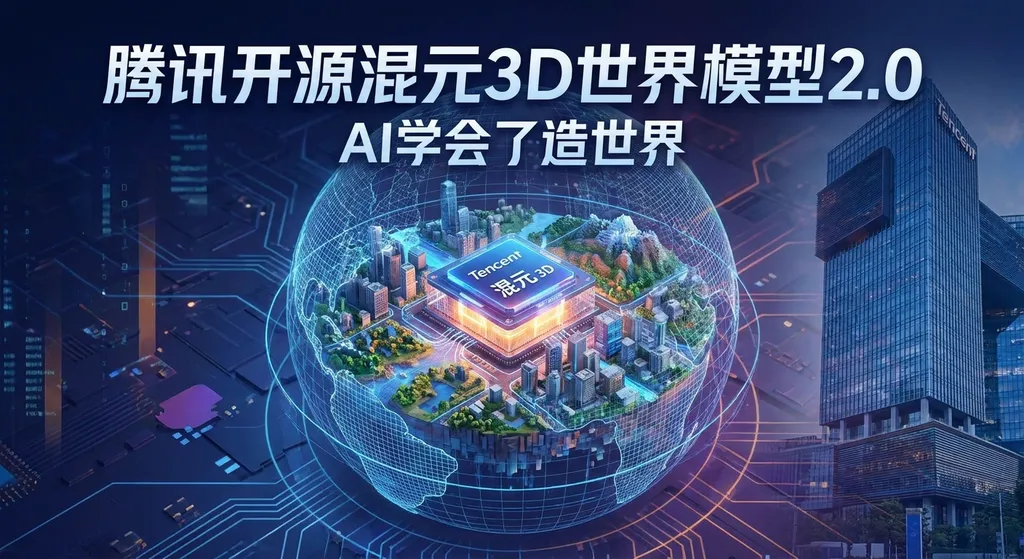
Today, Tencent released and open-sourced the Hunyuan 3D World Model 2.0 (HY-World 2.0), achieving for the first time the direct generation of editable, game-engine-importable 3D world assets from text and images. This marks the evolution of AI 3D generation from "creating objects" to "building worlds."
Tencent today officially released and open-sourced the Hunyuan 3D World Model 2.0 (HY-World 2.0). In one sentence, the core change of this upgrade can be summarized as: AI-generated 3D worlds are now truly usable.
Previously, whether it was Google’s Genie 3 or Tencent’s own Hunyuan World Model 1.5, the so-called “world models” essentially generated videos—you could watch them, but not interact with them. HY-World 2.0 breaks through this barrier: it outputs actual 3D asset files (Mesh, 3DGS, Point Cloud) that can be directly imported into Unity or Unreal Engine for secondary editing.
This is not a gradual version update, but rather a leap in capability.
From “Watching Video” to “Entering the World”: What’s New in 2.0
The evolution path of the Hunyuan World Model is clear: version 1.0 achieved the generation of explorable 3D scenes; version 1.5 (WorldPlay) added a real-time generation framework and spatial memory; version 2.0 solves the final piece of the puzzle—allowing generated results to truly enter production pipelines.
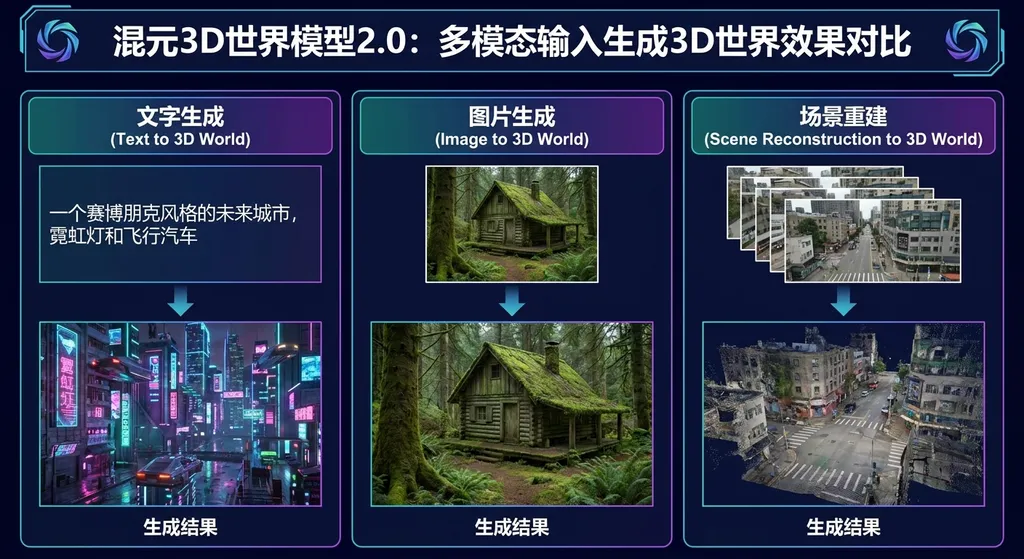
In detail, HY-World 2.0 is a multimodal world model that accepts text, images, videos, sketches, and other inputs to output complete 3D worlds. Its core capabilities can be broken down into three parts:
- World Generation: Input a text description or concept image, and the model automatically generates a complete 3D space containing people, objects, and scenery, supporting multiple styles such as realistic, comic, or game-like.
- Scene Reconstruction: Input a video of a real space or multi-view images, and the model constructs a high-precision digital twin environment.
- Interactive Exploration: Supports “Character Mode,” where users can control a character to freely walk around the generated world, with physics collisions and no time limitations.
The last part deserves extra attention. “Character Mode” here is not a preset-path scene tour—it’s true free exploration with physics-based collision detection. The character stops when hitting a wall or a table. This is made possible by HY-World 2.0’s hybrid representation approach that simultaneously generates 3DGS (for high-quality rendering) and Mesh (for collision detection).
This design is clever. 3DGS provides excellent visual effects but lacks geometric and topological information, while Mesh has topology but weaker rendering quality. Their combination ensures both visual fidelity and physical interactivity.
Technical Architecture: A Unified 3D-Centric Framework
From a technical perspective, HY-World 2.0 does something ambitious: it unifies spatial understanding, generation, and reconstruction within a single framework.
Traditional 3D reconstruction methods (e.g., NeRF models) require precise camera parameters—position, orientation, focal length—none of which can be omitted. But in reality, casual phone-shot videos rarely provide exact camera data. This has long been a major obstacle for real-world 3D reconstruction.
HY-World 2.0’s solution is the upgraded WorldMirror 2.0 architecture. It supports images and videos of any size and simultaneously predicts dense point clouds, multi-view depth maps, surface normals, and camera parameters. In other words, camera parameters are no longer part of the input—they’re one of the model’s inferred outputs.
The benefits are clear: users don’t need specialized equipment or calibration. Just record a simple video with a phone, and the model reconstructs a high-precision 3D scene. For applications such as interior design previews, urban planning, or cultural heritage digitization, this drastically lowers the entry barrier.
On the world-generation side, the architecture has been comprehensively upgraded. Compared with version 1.0, version 2.0 shows significant improvement in detail and realism. More importantly, it inherits the spatial consistency memory mechanism introduced in version 1.5—when you revisit an area in the generated world, the model “remembers” the 3D structure, maintaining continuity and consistency.
This may sound trivial but is extremely hard for world models because it requires maintaining a consistent global spatial representation instead of regenerating regions randomly every time. This relies on state-of-the-art spatial memory mechanisms.
What This Means for the Gaming Industry
To be frank, AI 3D generation has been a hot topic for over two years, yet few tools have genuinely excited game developers. The reason is simple: most AI-generated 3D assets aren’t ready for production—either because of poor quality or incompatible formats—requiring lots of rework once imported into engines.
HY-World 2.0 takes a clear stance: direct integration with existing workflows. Generated assets can be exported as Mesh, 3DGS, or Point Cloud formats and directly imported into Unity and Unreal Engine.
What does that mean? A level designer can quickly generate a prototype level from a text description and refine it within the engine, instead of building from scratch. Independent game developers can generate an initial version of a game map from a few concept images, spending their effort on game mechanics instead of scene modeling.
According to statistics from the Hunyuan team, using Hunyuan 3D reduced the time to create a simple in-game object from 2 days to 0.2 days. The World Model 2.0 extends this efficiency boost from single objects to full scenes.
Of course, a reality check: AI-generated worlds currently serve better as rough drafts or prototypes, still falling short of AAA production standards. But for indie games, lightweight projects, and level prototyping, its practical value is already evident.
Open-Source Strategy: Tencent’s Long-Term Vision
The Hunyuan 3D series has adhered to open-sourcing since the first generation, and 2.0 continues this tradition. Model weights and training code will be released on GitHub and Hugging Face.
A look at Hunyuan 3D’s development timeline shows Tencent’s consistent investment:
| Date | Version | Key Capability | |------|----------|----------------| | Nov 2024 | Hunyuan3D 1.0 | First open-source release; text/image to 3D | | Jan 2025 | Hunyuan3D 2.0 | Architecture upgrade | | Jun 2025 | Hunyuan3D 2.1 | Introduced PBR material generation | | Jul 2025 | World Model 1.0 | Explorable 3D scene generation | | Sep 2025 | Hunyuan3D 3.0 | 3D-DiT multi-stage sculpting, 10B parameters | | Dec 2025 | World Model 1.5 | Real-time generation + spatial memory | | Apr 2026 | World Model 2.0 | Editable 3D asset output, unified framework |
In under two years, seven major versions were released—one of the fastest paces in China’s AI 3D generation space.
Open-sourcing brings more than just community support. For Tencent, the Hunyuan 3D open-source ecosystem directly supports the commercialization of Tencent Cloud APIs and user growth of the Hunyuan 3D Creation Engine (including its international version). The stronger the model and the more active the community, the greater the platform’s business value.
Comparison with Competitors: HY-World 2.0’s Position
Globally, there are few players truly working on world models, with the main comparable product being Google’s Genie series.
Compared with Genie 3, HY-World 2.0 has two key advantages: first, output format—Genie 3 produces videos, while HY-World 2.0 generates editable 3D assets; second, scene completeness—Hunyuan performs better when generating side and back views of objects, avoiding issues like “good front, blurry back.”
That said, Google’s foundation model capabilities and data scale are highly formidable. The world model race is still at an early stage, and the landscape remains far from settled.
Domestically, both ByteDance and Alibaba have R&D work in 3D generation, but no products comparable to a “world model” have been announced yet. Tencent’s Hunyuan currently leads in this segment.
Broader Possibilities
The value of world models goes beyond gaming.
Embodied intelligence is one direct application. Training robots requires massive simulated environments, which are expensive to build manually. If world models can rapidly generate diverse 3D simulation worlds, the data bottleneck in robot training could be broken. HY-World 2.0’s asset export capability to embodied simulation engines is clearly designed for this.
Digital twins are another direction. The ability to reconstruct real spaces using only mobile videos naturally applies to interior design, architectural planning, and heritage preservation. Imagine circling an old building with your phone and instantly getting a high-precision digital model—this is now technically achievable.
For developers interested in experimenting with HY-World 2.0, model weights and source code are available via its GitHub repository. Tencent Cloud also provides API services. Additionally, API aggregation platforms like OpenAI Hub are integrating major domestic models, so developers can keep an eye on upcoming support updates.
Final Thoughts
From version 1.0 at the end of 2024 to today’s World Model 2.0, Hunyuan 3D has completed the leap from “generating an object” to “generating a world” in just a year and a half. That pace is aggressive even in the fast-moving AI industry.
But more important than speed is direction. HY-World 2.0 takes a “practicality-first” approach—it doesn’t chase flashy demo videos but ensures generated results can be used directly in production. This choice may ultimately shape the future trajectory of world model development more than any technical metric.
AI has evolved from text to images, from images to objects, and now from objects to worlds. Each leap extends not just technological frontiers, but also the boundaries of application scenarios. With HY-World 2.0, for the first time, the idea of “AI building worlds” has become a practical engineering reality.
Now, it’s up to developers to decide what kind of worlds they will create with it.
Sources:
- Tencent Hunyuan 3D World Model 2.0 Released: Seamless Game Workflow Integration - IT Home (Detailed product and technical overview)
- Tencent Hunyuan 3D World Model 2.0 Released and Open-Sourced - 36Kr (News brief)


