
Alibaba World Model HappyOyster Launch: Generate an Interactive 3D World with One Sentence
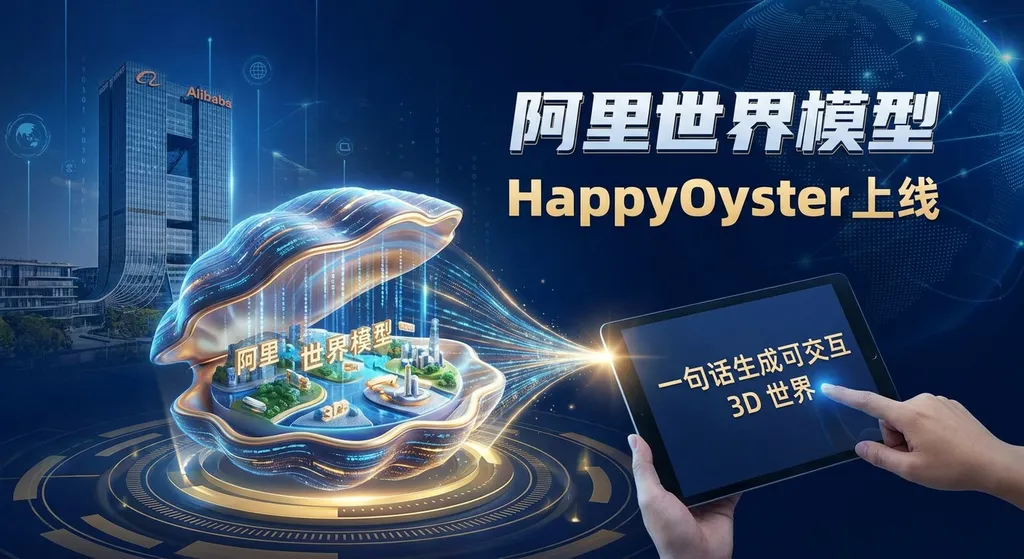
Alibaba ATH released the world model **HappyOyster** today. It supports real-time construction of interactive 3D environments, allowing users to modify scenes and orchestrate characters at any node through natural language — directly competing with Google Genie 3.
Alibaba’s World Model HappyOyster Launched: Generate Interactive 3D Worlds with One Sentence
On April 16, Alibaba’s ATH Innovation Division launched its world model product HappyOyster (快乐生蚝), marking another major push into the generative AI field following HappyHorse (快乐马). Unlike most video-generation models on the market, HappyOyster doesn’t just generate video segments — it builds an interactive, physically consistent 3D world. Users can roam freely, edit storylines, direct characters, and even modify causal logic.
This positioning directly competes with Google’s Genie 3 released earlier this year. Technically, both are betting on the “world model” direction — moving beyond text-to-video or image-to-video generation to enable AI to understand space, physics, and causality, thereby generating dynamic, explorable, and controllable environments.
Two Core Capabilities: Wander and Direct
HappyOyster centers around two main modes: Wander and Direct.
Wander: Generate Explorable 3D Spaces with One Sentence
In Wander mode, users only need to input a sentence or upload an image to generate a physically consistent environment. Here, “physical consistency” isn’t just a theoretical term — object positions remain stable, scenes persist, and lighting dynamically changes according to the user’s first-person perspective.
For example, if you type “an abandoned cyberpunk-style subway station,” the system generates a walkable 3D environment. When you move forward, lighting shifts accordingly. When you turn around, the previously visited area still exists — unlike traditional generated videos where scenes disappear once you pass them.
This capability is particularly handy for game developers. Previously, building level prototypes required modeling, texturing, and lighting adjustments. Now, developers can use natural language to quickly generate playable prototypes, refining them as needed.
Direct: Real-Time Story Editing and Character Direction
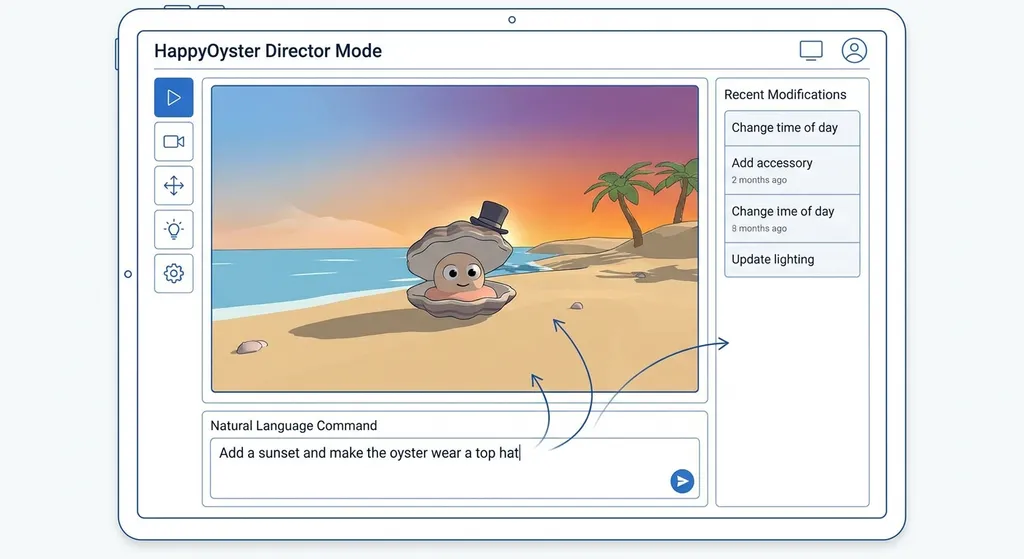
Direct mode is unique to HappyOyster. At any point in the video, users can intervene using text, voice, or image input to modify how the world evolves — switching perspectives, rewriting plotlines, or directing character movements.
This function unlocks vast creative possibilities. In filmmaking, for instance, directors can describe a shot idea in natural language and instantly generate scenes. If a particular shot doesn’t meet expectations, they can input new instructions at that exact timestamp without re-rendering the entire sequence.
In education, teachers could guide students to “enter” historical scenes. When students ask, “What would happen if a different choice was made?” the system can instantly generate an alternative causal branch, helping them understand multiple possible outcomes through interaction.
Technical Architecture: Native Multimodal + Joint Audio-Video Generation
HappyOyster is built upon a native multimodal architecture that supports multimodal understanding and joint audio-video generation. This means the model doesn’t separately process text, images, and audio and then combine them — instead, it models relationships between modalities at a unified foundational level.
This design ensures better cohesion across modalities. For example, when generating a rainy scene, both visuals and synchronized rain sounds are produced. Moreover, the intensity of the rain sound dynamically adjusts based on the visual rain density.
From a technical perspective, world modeling faces three major challenges:
- Spatial consistency: Maintaining geometric and physical consistency across different viewpoints
- Temporal coherence: Ensuring scene evolution follows causal logic without contradictions
- Real-time interactivity: Generating immediate responses to user inputs
HappyOyster optimizes across all three dimensions. Official demos show that the system can respond within seconds after receiving commands — approaching real-time interactive experience levels.
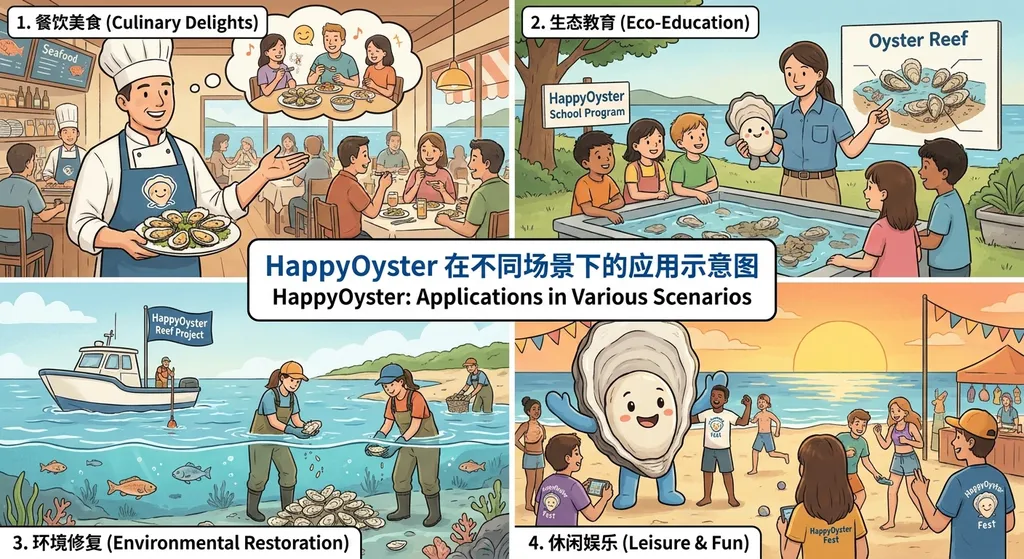
Application Scenarios: From Game Development to Smart Hardware
Alibaba lists a variety of use cases:
Game Development
Developers can rapidly produce playable prototypes, testing gameplay concepts. Traditionally, building a demo could take weeks; now, it can be done within hours.
Film Production
Directors describe shot sequences in natural language and get instant visual outputs. This enables solo creators to produce storyboard-level content without large budgets or teams.
Cultural Tourism & Education
Users can “step into” famous paintings or historical civilizations through a first-person view, exploring causality through interaction. For instance, “enter” Along the River During the Qingming Festival to experience everyday life in Song Dynasty China, or “participate” in historical events and experience alternate outcomes.
Integration with Smart Hardware
The most imaginative extension lies in physical experiences. HappyOyster can integrate with VR/AR devices to generate immersive content based on user location, movement, and language. In theme parks, for example, each visitor’s choices could dynamically shape storylines, ensuring unique experiences for everyone.
Competing with Genie 3: The World Model Race Has Just Begun
Google launched Genie 3 earlier this year, also emphasizing interactive world generation. Although their technical paths are similar, their focuses differ:
- Genie 3: Learns world models from video data, understanding physics and interaction through gameplay footage
- HappyOyster: Focuses on real-time directorial control, allowing users to intervene and modify at any point
This race is just beginning. The ultimate form of a world model may be a fully AI-driven, infinitely explorable virtual world — where each user choice affects world evolution, and AI generates responses consistent with physical and causal laws.
Both HappyOyster and Genie 3 remain in the early stages. Current technology can generate several minutes of coherent scenes, but achieving “infinite exploration” will require solutions for long-term memory, large-scale scene management, and multi-user collaboration.
How Can Developers Use It?
HappyOyster is live at https://www.happyoyster.cn/, where developers can apply for trial access. It offers both a web interface and API integration.
If Alibaba later opens the API, developers may be able to call it through platforms like OpenAI Hub. Assuming API compatibility, the invocation might look like this:
import openai

# Configure OpenAI Hub
openai.api_base = "https://api.openai-hub.net/v1"
openai.api_key = "your-openai-hub-key"

# Call HappyOyster to generate a world
response = openai.ChatCompletion.create(
    model="happyoyster",
    messages=[
        {
            "role": "user",
            "content": "Generate a cyberpunk-style subway station in first-person view, allowing free movement"
        }
    ],
    # World model specific parameters
    world_config={
        "mode": "wander",  # Wander mode
        "duration": 60,    # Generate 60 seconds of interactive content
        "style": "cyberpunk"
    }
)

# Retrieve generated world URL
world_url = response.choices[0].message.content
print(f"Generated world: {world_url}")

# Add director instructions to the world
response = openai.ChatCompletion.create(
    model="happyoyster",
    messages=[
        {
            "role": "user",
            "content": "At 30 seconds, have a subway train enter the station and dim the lights"
        }
    ],
    world_config={
        "mode": "direct",   # Direct mode
        "world_id": world_url,
        "timestamp": 30
    }
)
This is only hypothetical; the actual API may support streaming outputs, multi-view switching, or physical parameter customization.
Industry Trend: From Content Generation to Environment Generation
HappyOyster’s release highlights a broader evolution — generative AI is shifting from “static content generation” to “dynamic environment generation.”
Over the past two years, text-to-image and text-to-video models have matured considerably. However, the outputs remain static — just pictures or clips that users can view but not interact with.
World models change this paradigm. They generate “living” environments users can explore, modify, and create within — enabling transformative potential across industries:
- Gaming: From manually crafted levels to AI-generated infinite ones
- Film: From linear storytelling to interactive narrative
- Education: From passive learning to immersive experience
- Metaverse: From predesigned scenes to real-time generated worlds
Of course, maturity will take time. Current models still face challenges in generation quality, depth of interaction, and computational cost. But the direction is clear — future AI won’t just generate content; it will generate worlds.
Final Thoughts
HappyOyster marks an important move by Alibaba in the world model race. Strategically, it doesn’t merely follow the video generation trend — it aims at building deeper capabilities: enabling AI to understand and generate interactive 3D worlds.
While the vision is vast, challenges abound — spatial consistency, temporal coherence, real-time interactivity on the technical side; identifying strong use cases on the product side; and balancing cost with user experience on the business side.
Still, creators and developers now have a new tool to experiment with. If you work on gaming, film, or education projects, give HappyOyster a try and see how world modeling could transform your workflow.
References
- Alibaba’s “HappyHorse” challenges Google’s Genie 3 — Introducing the HappyOyster World Model - Linux.do — Community discussion with early user feedback
- Alibaba ATH launches open world model HappyOyster - Chinaz.com — Product features and application overview


