
Alibaba Cloud Bailian launches integration with DeepSeek-V4 for the first time, taking the price war to the end
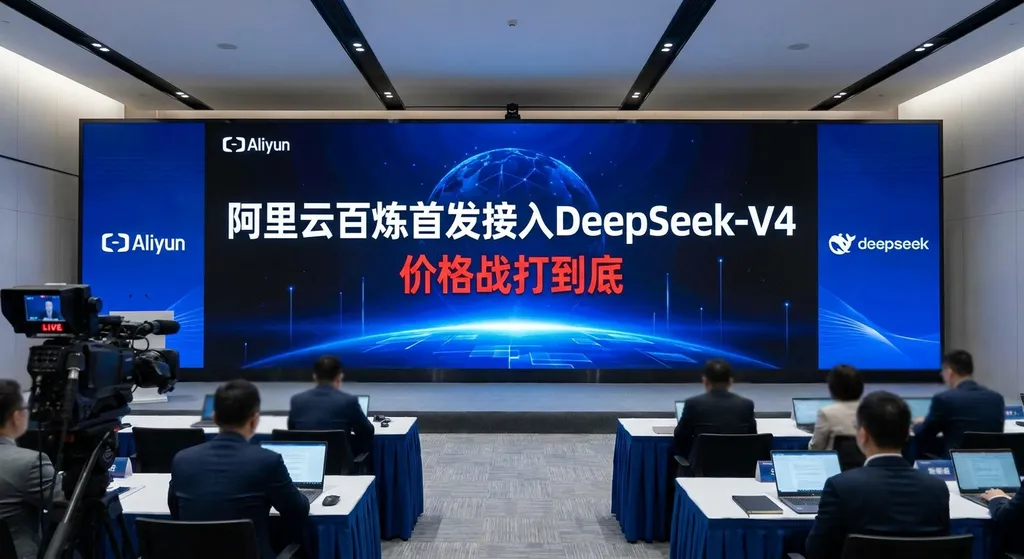
Alibaba Cloud’s Bailian platform officially launched DeepSeek-V4-Pro and DeepSeek-V4-Flash today. The API pricing is exactly the same as on the official DeepSeek website, with the Flash version priced as low as 1 RMB per million input tokens. Bailian’s intent to position itself in the “model marketplace” ecosystem is quite clear.
Alibaba Cloud Bailian First Integrates DeepSeek-V4, API Pricing Matches the Official Website — The "Model Marketplace" Ecosystem Battle
On April 24, Alibaba Cloud’s Bailian platform announced the first launch and integration of the DeepSeek-V4 series of models, including DeepSeek-V4-Pro and DeepSeek-V4-Flash. The API pricing is completely consistent with DeepSeek’s official website, with no markup whatsoever.
The news itself isn’t complicated, but the signals behind it are worth unpacking.
First, the models: What exactly has DeepSeek-V4 upgraded?
DeepSeek-V4 is a major iteration following the V3 series. The positioning of the two models is quite clear:
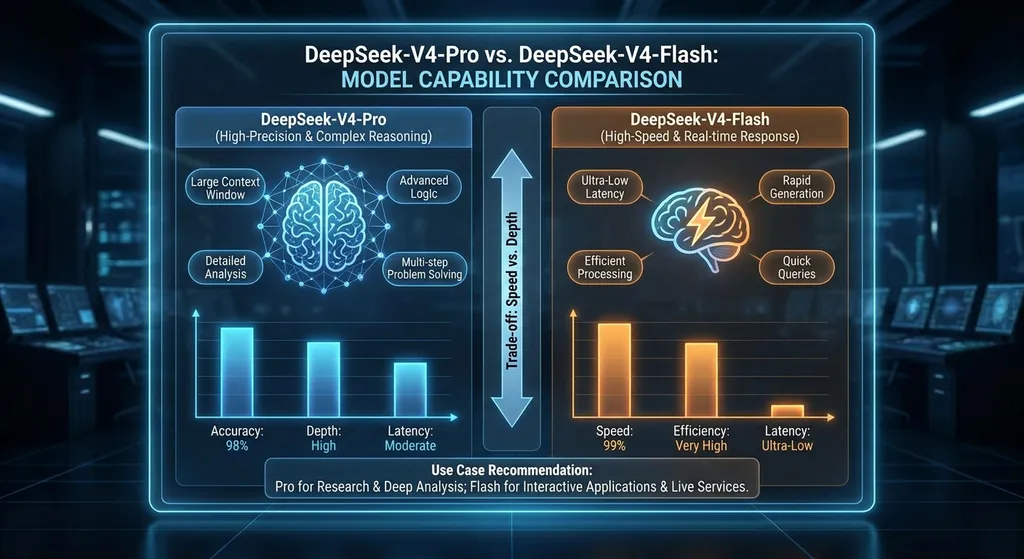
- DeepSeek-V4-Pro: Designed for complex reasoning and long-chain tasks — the flagship option
- DeepSeek-V4-Flash: Focused on efficiency and economy — for high-concurrency, cost-sensitive scenarios
Both models support a super-long 1 million token context window. Six months ago, that kind of scale was still a privilege of a few top-tier closed-source models, but now it has become standard for DeepSeek. A million-token context means you can feed in an entire tech document, a mid-sized codebase, or even dozens of rounds of complex conversation history all at once—and the model won’t “forget.”
For developers, this directly affects the design of RAG architectures — when the context window is large enough, many scenarios that previously required a finely tuned retrieval strategy can be simplified to “just feed it all in and let the model find what it needs.” Of course, that doesn’t mean RAG is obsolete; it simply means the lower bound of engineering complexity has dropped substantially.
Pricing: Flash as low as 1 RMB per million tokens — what about Pro?
Let’s start with Flash’s pricing:
| Billing Item | Price | |---------------|-------| | Input (Cache Hits) | 1 RMB / million tokens | | Output | 2 RMB / million tokens |
This price level is staggering. To put it in perspective: one million tokens roughly equals 750,000 Chinese characters—about two volumes of The Three-Body Problem. Input cost: 1 RMB.
Bailian emphasizes “completely consistent with the DeepSeek official website.” The subtext: we don’t earn from model price spreads — we earn from the platform ecosystem.
This differs from traditional cloud vendors reselling third-party models. Typically, the cloud adds a small profit margin — even just a few percent. Bailian’s choice to offer models at the same price essentially means using DeepSeek’s traffic to nurture its own platform ecosystem — once users arrive, they may also start using Bailian’s fine-tuning, knowledge base, vector search, and app orchestration value-added services. The model itself isn’t the profit center; the tools and services surrounding it are.
This strategy is almost identical to the supermarket “loss leader” concept.
Bailian’s “Model Marketplace” strategy: The platform ambition behind 100+ models
So far, Alibaba Cloud Bailian has launched more than 100 multimodal models. That number alone reveals its positioning — it doesn’t want to just be “the home of Tongyi Qianwen” but the distribution hub for all mainstream models.
From its current model lineup:
- In-house models: The Qwen (Tongyi Qianwen) series covers text, image, speech, and video
- DeepSeek series: From early V3 and R1 to the current V4, with ongoing updates
- Other third-party models: Integrated via partners like Kuaishou Wanqian
Bailian differentiates itself by being more than just an API proxy layer. It offers a complete developer toolchain:
- Model invocation — unified API interface, OpenAI-compatible
- Model fine-tuning — direct SFT support on the platform
- Knowledge base management — built-in vector search for rapid RAG setup
- Application orchestration — agent building, MCP service integration
- Multi-channel publishing — one-click deployment to DingTalk, web, and more
For enterprise developers, this means no need to build infrastructure or juggle multiple model provider API keys. Everything — from model selection to app launch — happens on one platform.
Of course, this “one-stop” convenience comes with a price — your data, workflows, and architecture become increasingly tied to the Bailian ecosystem. That’s the common strategy of all platform-based products — something developers must weigh carefully.
Comparing with other platforms: What Bailian’s integration speed reveals
It’s noteworthy that Bailian used the term “first launch.” On the same day, Huawei Cloud also announced DeepSeek-V4 integration. The two cloud giants both completed integration almost on DeepSeek-V4’s release day.
This implies two things:
First, cloud vendors now treat DeepSeek with “Day 0” importance. That would’ve been unthinkable before. A domestic open-source model prompting Alibaba Cloud and Huawei Cloud to rush for same-day integration shows DeepSeek’s strong pull among developers. Clouds aren’t being charitable — they’re competing for users.
Second, the technical barrier for model integration is dropping fast. The fact that DeepSeek-V4 was adapted across multiple platforms on launch day means two things: DeepSeek’s model architecture and API design are increasingly standardized, and the clouds’ model integration pipelines have become streamlined. From obtaining weights to deployment, API testing, and service launch — the entire process might take only a few hours.
This “Day 0 adaptation” race benefits developers — it means you can use new models on familiar platforms almost instantly.
Bailian Token Plan: DeepSeek-V4 support coming soon
According to 36Kr, the Bailian Token Plan will soon support calls to DeepSeek-V4 models.
The Bailian Token Plan is Alibaba Cloud’s prepaid token package, similar to a phone plan — prepay a certain amount, then deduct usage at a discounted rate compared to pay-as-you-go. For businesses with stable traffic, the Token Plan helps further reduce per-unit costs.
Currently, the plan doesn’t officially support V4 yet, but “coming soon” suggests Alibaba Cloud is already processing it. For enterprises making high-volume DeepSeek-V4 calls, this is a cost-optimization option to watch.
Developer experience: Using DeepSeek-V4 on Bailian in practice
Technically, Bailian connects to the DeepSeek series via OpenAI-compatible interfaces. This means if you’re already using the OpenAI SDK or any client compatible with OpenAI’s API schema, switching to Bailian’s DeepSeek-V4 is nearly frictionless — just change the base_url and model name.
Based on previous DeepSeek integrations (e.g., V3.2-think), the invocation looks roughly like this:
from openai import OpenAI

client = OpenAI(
    api_key="your-dashscope-api-key",
    base_url="https://dashscope.aliyuncs.com/compatible-mode/v1"
)

response = client.chat.completions.create(
    model="deepseek-v4-pro",  # or deepseek-v4-flash
    messages=[
        {"role": "user", "content": "your question"}
    ],
    stream=True
)

for chunk in response:
    delta = chunk.choices[0].delta
    if delta.content:
        print(delta.content, end="", flush=True)
Note: The above code is inferred based on Bailian’s existing DeepSeek integration; please refer to official Alibaba Cloud Bailian documentation for actual model IDs and parameters. Features like “thinking mode” may need confirmation after documentation updates.
Because Bailian’s OpenAI-compatible mode allows you to invoke models via the openai Python package, Node.js SDK, or even curl, there’s no need for new SDKs or retraining on new API schemas — minimizing migration costs, especially for teams already within the OpenAI ecosystem.
The bigger picture: Model distribution as the next battlefield
Zooming out, Alibaba Cloud Bailian’s first launch integration of DeepSeek-V4 reflects a structural shift in the AI industry: model distribution is becoming a new battleground, separate from model development itself.
In the past two years, attention was all on the models — who had more parameters, higher benchmarks, stronger reasoning. But as open-source models increasingly rival (or exceed) closed models, “where to use the model” is now as important as “how good the model is.”
Currently, players in model distribution mostly fall into these categories:
| Type | Representative | Features | |------|----------------|-----------| | Cloud vendor platforms | Alibaba Cloud Bailian, Huawei Cloud ModelArts | Heavyweight, full toolchains | | API aggregation platforms | OpenAI Hub, etc. | Lightweight, one key accesses multiple models | | Model vendor direct | DeepSeek official site | Direct connection, limited features | | Open-source self-deployment | Local/private cloud | Fully controllable, higher ops cost |
Each approach has its ideal use case. Bailian’s advantage lies in Alibaba Cloud’s infrastructure — offering a complete pathway from API to deployment. But for developers wanting to simply test and switch models quickly without being locked into one ecosystem, lightweight API aggregators may be more suitable.
For example, OpenAI Hub allows calling GPT, Claude, Gemini, DeepSeek, and others with one API key in an OpenAI-compatible format — ideal for experimentation and fast context switching. It’s not about building everything in one ecosystem; it’s about flexibility.
Both models can coexist, even complement each other. The key is what your priorities are.
A question to ponder: How long can parity pricing last?
Alibaba Cloud Bailian currently promises API pricing identical to DeepSeek’s official site. But how long that parity can last depends on several factors:
- DeepSeek’s own pricing strategy — If DeepSeek adjusts prices, will Bailian follow?
- Compute costs — Bailian must operate inference clusters to support requests; cost isn’t zero.
- Competition — If Huawei Cloud and Tencent Cloud also maintain parity, Bailian can’t easily raise prices.
For now, DeepSeek-V4 Flash’s input price of 1 RMB per million tokens is already so low that most developers barely need to think about cost. At that level, usage cost is almost negligible in total application operations — real spending lies in developer time, user growth, and maintenance.
Hence cloud vendors are willing to match or even subsidize model access — not for immediate API income, but to retain developers and monetize later through compute, storage, and networking services.
Practical advice for developers
If you’re considering using DeepSeek-V4, here are a few tips:
- Pro or Flash? Choose Pro for complex reasoning, multi-step planning, or code generation tasks. Choose Flash for customer support, content creation, or simple Q&A scenarios—it’s more cost-effective.
- Use Bailian or not? If you already rely on Alibaba Cloud (ECS, OSS, RDS, etc.), Bailian’s integration reduces cross-platform friction. If not, the official DeepSeek API or an aggregator may be simpler.
- How to use the 1M-token context? Don’t just stuff in everything because you can — tokens are billed by volume. Even at 1 RMB per million tokens, overstuffing prompts at high concurrency can quickly add up. Use RAG where appropriate.
- Watch the Token Plan: If your usage is stable and predictable, consider the prepayment plan once V4 support is live to save further on cost.
Final thoughts
That Alibaba Cloud Bailian is the first to integrate DeepSeek-V4 isn’t surprising — cloud platforms routinely rush to adopt popular models now. What’s truly notable are two emerging trends:
- Model distribution competition is evolving from “availability” to “usability.” Simply hosting a model API isn’t enough — differentiation now comes from toolchains, developer experience, and cost flexibility. Bailian’s knowledge base, agent orchestration, MCP integration, and DingTalk publishing are all steps in this direction.
- The open-source model ecosystem is maturing rapidly. Multiple platforms completed V4 integration on the release day, and hardware like Cambricon chips achieved “Day 0” adaptation too. That ecosystem responsiveness shows the open model supply chain is now robust.
For developers, this is the best of times — models are stronger, cheaper, and more numerous than ever. The only real challenge might be having too many choices.
But that’s a good problem to have.
References
- Alibaba Cloud Bailian launches DeepSeek-V4 models, API pricing matches official site - IT Home: First report, includes pricing and model details
- The Jin Yong Saga of the AI World: An In-Depth Survey of Global Major AI Model Vendors - Zhihu Column: Analysis of DeepSeek’s product line and competitive landscape


