
ClaudeCode Enhanced Edition 2API Launch: First-Time Support for Web Search
ClaudeCode Enhanced 2API officially launched, supporting Web Search for the first time, deeply optimized for Agent programming scenarios, and priced as low as 0.1x yuan per dollar—becoming a cost-effective choice following the AWS channel.
ClaudeCode Enhanced Edition 2API Launch: First-Time Support for Web Search
The ClaudeCode Enhanced Edition 2API channel is now officially online, offering a high cost-performance alternative following the AWS channel. Its biggest highlight is the first-ever support for the Web Search feature, along with deep optimization for Agent programming scenarios. Pricing starts as low as 0.1x yuan per dollar; real-world tests show strong reasoning and stable logic performance.
Why an Enhanced Edition Channel Is Needed
As a system-level AI Agent developed by Anthropic, ClaudeCode is essentially an intelligent assistant capable of completing various development tasks through natural language. It doesn’t just write code—it can read codebases, edit files, run commands, and integrate with development tools. However, access to the native Claude API is restricted domestically, and while the AWS channel is usable, its costs are relatively high, creating practical challenges for developers.
The Enhanced Edition 2API fills this gap. It retains Claude’s core capabilities while addressing accessibility and cost issues. More importantly, it’s optimized specifically for Agent programming scenarios—meaning improved responsiveness and accuracy in handling complex multi-step tasks, file operations, and command executions.
The Practical Value of Web Search
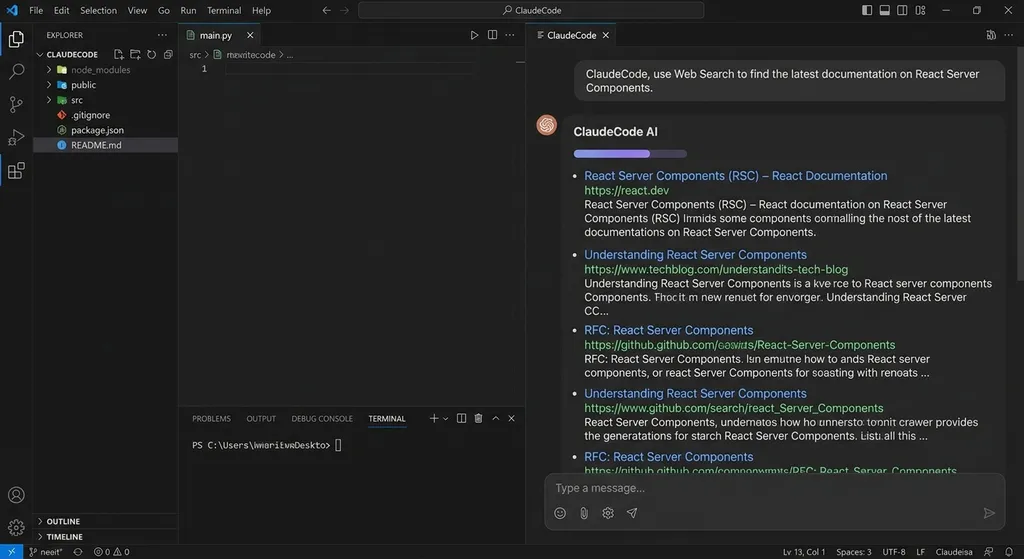
Web Search is the most noteworthy feature in this update. What does real-time access to online information mean for Agent programming?
First is technology stack freshness. During development, you often encounter new frameworks, APIs, and best practices that might not yet appear in training data. With Web Search, ClaudeCode can directly query the latest documentation, Stack Overflow discussions, and GitHub issues to provide more accurate advice.
Next is dependency management. When integrating a library, ClaudeCode can fetch real-time version numbers, compatibility details, and known issues instead of relying on potentially outdated training data. This is particularly valuable in rapidly evolving ecosystems like front-end development.
Finally, error troubleshooting. When errors occur, ClaudeCode can search for solutions, check if other developers have encountered similar issues, and find official bug fix records—offering more reliable help than relying solely on the model’s “memory.”
Deep Optimization for Agent Programming Scenarios
What does “optimized for Agent programming scenarios” specifically entail?
Smarter context management. ClaudeCode scans entire project directories, reads relevant files, and maintains a full conversation history. The enhanced edition improves this process by reducing unnecessary scans and cutting token consumption. This is essential for large projects—where establishing full context might have required tens of thousands of tokens, it can now be managed within a reasonable range.
Improved multi-step task execution. Typical Agent workflows like “write tests → run tests → fix failures → commit code” benefit from optimized task decomposition and execution logic, reducing latency and repetitive steps.
More accurate tool invocation. ClaudeCode supports MCP (Model Context Protocol) for calling external tools. The enhanced edition refines tool selection and parameter passing, reducing failed calls and parameter errors.
Pricing Strategy Considerations
What does “0.1x yuan per dollar” mean? Take Claude 3.5 Sonnet as an example: the official price is $3/M tokens for input and $15/M tokens for output. At a 0.15 yuan/USD rate, this equals roughly ¥0.45/M for input and ¥2.25/M for output—moderately low among domestic API aggregator platforms.
However, ClaudeCode consumes significantly more tokens than normal chat scenarios. It needs to read code files, maintain context, execute commands, and process outputs—one full programming task can use tens of thousands or even hundreds of thousands of tokens. So even with a low unit price, total costs must be carefully evaluated.
From an operational standpoint, launching the enhanced channel targets developers who are price-sensitive but still need Claude’s capabilities. The AWS channel suits enterprise users or high-stability use cases, while the enhanced edition is better for individual developers and small to medium teams.
Comparison with Other Options
Currently, several channels allow access to ClaudeCode:
Official API: Most stable but restricted domestically; requires a proxy and charges official rates.
AWS Bedrock: Offers stable Claude access through AWS but requires account setup, complex configuration, and official pricing.
API Aggregator Platforms: Offer domestic access and discounts but vary widely in stability and service quality. Some simply relay requests, making debugging difficult.
Alibaba Cloud Bailian: Provides Claude Code-compatible interfaces but actually calls Qwen models—not real Claude. Best for tight budgets or less demanding use cases.
Advantages of the Enhanced 2API: Domestic access, competitive pricing, optimization for Agent scenarios, and Web Search support.
Disadvantages: As a third-party channel, it may be less stable or slower than official/AWS options—real-world use will determine actual performance.
Practical Usage Tips
If you plan to use the Enhanced 2API, keep the following in mind:
Control token consumption. Token usage is the main cost driver. Good habits include:
- Ask clear, specific questions—avoid vague prompts that trigger unnecessary file scans
- Use a
.claudeignorefile to exclude directories likenode_modules,dist, or.git - Periodically clear chat history to avoid unbounded context growth
- For large projects, run ClaudeCode on modules instead of loading the entire codebase at once
Use Web Search judiciously. It’s valuable but also adds latency and costs. Not every question requires it—built-in model knowledge often suffices. Enable search only when you need the latest info, unique solutions, or rare tech stacks.
Properly configure your dev environment. ClaudeCode supports multiple interfaces: CLI, IDE plugin, desktop app, and browser. CLI is the most stable and universal—start there. During setup:
- Set your API key and Base URL
- Choose the right model (the enhanced edition supports multiple Claude versions)
- If using MCP, ensure related tools are correctly installed
Monitor costs. Aggregator platforms usually provide usage dashboards. Check them regularly—if a task consumes abnormally high tokens, analyze the reason and adjust accordingly.
Suitable Use Cases
When does the ClaudeCode Enhanced Edition 2API fit best?
Personal projects and learning. If you’re learning new tech or working solo, this edition offers solid performance at an accessible price. Web Search is especially valuable during learning.
Rapid development for small teams. It greatly boosts productivity for fast-moving teams. The enhanced edition’s cost-effectiveness makes it ideal—just keep an eye on consumption.
Code review and refactoring. Let ClaudeCode review code, suggest improvements, and perform refactors. These tasks consume relatively few tokens while offering tangible value.
Less Suitable Scenarios:
- Production environments requiring top stability (use official or AWS channels)
- Enterprise projects with sensitive code (third-party channels pose data security risks)
- Full-scale analysis of massive codebases (token cost will be very high)
Technical Implementation Hypotheses
How might the Web Search feature work? While official details are undisclosed, some reasonable assumptions can be made.
The most straightforward approach is integrating a search API (e.g., Google or Bing Search APIs). When ClaudeCode detects a need for external info, it queries and injects results into the model context. This is simple but depends on third-party API quality.
Another possibility is using the MCP protocol—encapsulating search ability as an MCP server. ClaudeCode would invoke it through a standard MCP interface, allowing flexible backends and custom search sources.
A more advanced option might resemble Retrieval-Augmented Generation (RAG), like Perplexity: generating a search query, retrieving relevant results, and summarizing them via the model. This approach yields the best quality but costs more to implement.
Given the phrase “first-time support,” Web Search is likely exclusive to the enhanced channel, not part of Claude’s official API—suggesting the provider implemented it independently, possibly in a simpler form.
Integration with OpenAI Hub
OpenAI Hub, an AI API aggregation platform, already supports the ClaudeCode Enhanced Edition 2API. Developers can use a single key to access major models (including Claude) with domestic connectivity and OpenAI API compatibility.
For developers switching among multiple models, this aggregated access is highly convenient—for example, using Claude for code generation and refactoring, GPT‑4 for documentation, and DeepSeek for autocomplete—all unified under OpenAI Hub without juggling multiple keys or formats.
Outlook
The launch of ClaudeCode Enhanced Edition 2API reflects several trends:
Agent programming is becoming mainstream. From GitHub Copilot to Cursor to ClaudeCode, AI-assisted coding tools increasingly emphasize Agent abilities—not just autocompletion, but understanding tasks, planning steps, executing actions, and handling errors end-to-end.
Real-time information retrieval is now essential. Tech stacks evolve too rapidly for static training data. Web Search, documentation retrieval, and API calls are becoming standard features of AI developer tools.
Third-party channels add value through optimization and enhancement. The days of simple request relaying are over—providers must optimize for specific scenarios, add enhanced features, and offer superior service to stay competitive.
Cost control remains central. Agent programming consumes far more tokens than normal chat. Everyone is exploring ways to reduce cost without sacrificing capability—through smarter context management, more efficient task execution, better tool invocation, and rational caching.
The ClaudeCode Enhanced Edition 2API is an interesting experiment. It’s not merely a price war; it aims to deliver scenario-specific improvements. Its true value will depend on user feedback—but at least, in the direction of Agent programming, we’re seeing new possibilities.
References
- 【L Station Exclusive Benefit】Free 5M Tokens! ClaudeCode Enhanced 2API First to Support Web Search – Discussion post from the Linux.do community introducing the launch, pricing, and features of ClaudeCode Enhanced Edition 2API


