
Maestro-Flow Open Source: One-Click Activation for Claude Code and Codex Intelligent Programming
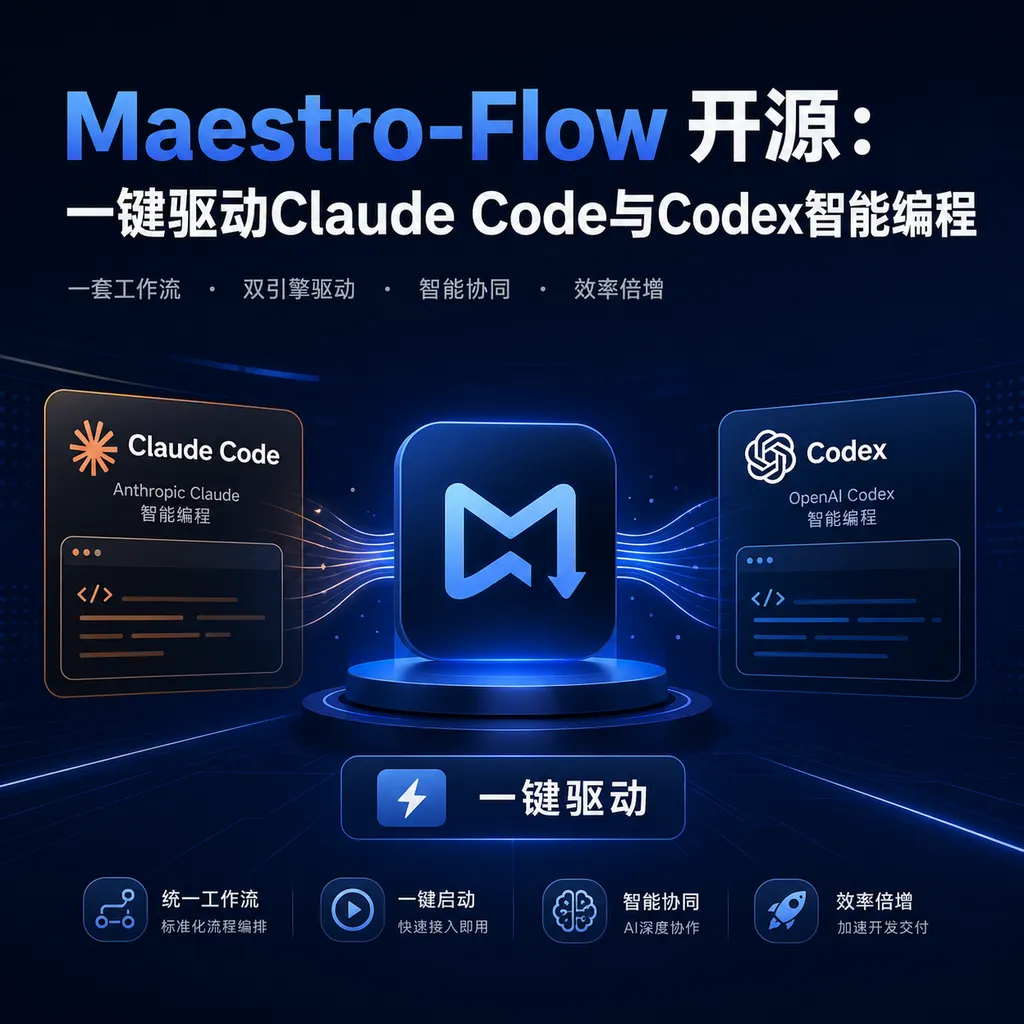
Maestro-Flow was recently open-sourced, supporting agent workflow automation based on Claude Code and OpenAI Codex. It emphasizes closed-loop governance and team collaboration, significantly improving multi-agent development efficiency.
Maestro-Flow Open Source: One-Click Agent Workflow Advancement for Claude Code and Codex
On April 25, 2026, the open-source project Maestro-Flow was officially released, drawing widespread attention from the developer community. This workflow aims to automate the orchestration of multi-agent collaboration, with full support for two mainstream coding AI models—Claude Code and OpenAI Codex—driving closed-loop execution and efficient reuse of agents across code development, project management, and knowledge governance.
The Practical Weapon for One-Click Automated Agent Workflow Execution
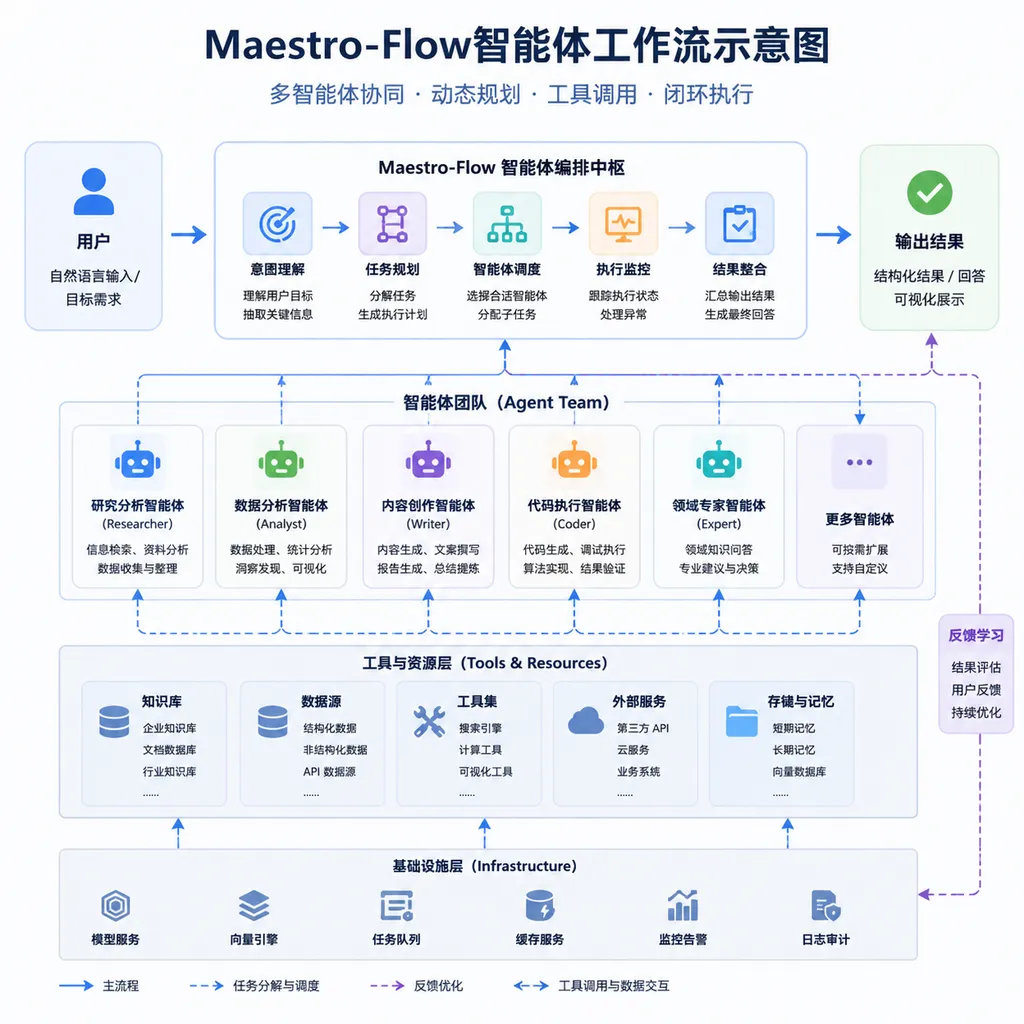
In today’s AI-driven programming environment, developers often need to manage multiple agents across code completion, generation, testing, and deployment—processes that are complex and error-prone. The emergence of Maestro-Flow is undoubtedly a “shot in the arm”: it provides a unified workflow interface that enables “one-click execution” of Claude Code and Codex agent tasks, automatically alternating subtask processing to minimize manual intervention.
Previously, developers had to switch between multiple terminal windows to maintain conversation state and context. Maestro-Flow solves this with parallel worktree branch management and multi-CLI invocation, effortlessly enabling concurrent execution of multi-agent tasks. For asynchronous, collaborative agent projects, it’s nothing short of a game changer.
Deep Focus on Closed-Loop Governance and Knowledge Reuse — Defining Full-Cycle Project Management
Maestro-Flow not only addresses the challenge of coordinating multiple AI models but also emphasizes team collaboration and knowledge capture. Through its closed-loop governance mechanism, every piece of code and documentation generated by agents can be precisely tracked. With built-in version control and metadata management, teams can achieve true knowledge reuse and evolution. Team members can directly reuse previously generated code snippets and conversation records without repeatedly “waking up” agents or redefining contexts.
This closed-loop approach not only minimizes redundant work but also provides a solid foundation for large-scale distributed team development. In particular, domestic developers benefit from pairing Maestro-Flow with locally hosted AI API aggregation platforms (such as OpenAI Hub), which further improve response speed and stability, avoiding international network bottlenecks that could otherwise impact workflow efficiency.
Real-World Scenarios: From Solo Development to Enterprise-Level Projects
Community users have shared various real-world use cases. Some developers use Maestro-Flow to build video streaming assistants—human presenters collaborate with AI-generated speech and real-time comment replies, automatically handling multilingual interactions. Others apply it to cross-platform project management to ensure seamless, interference-free task transitions. For project managers, this toolchain strikes an optimal balance between flexibility and stability: capable of handling both simple single-agent routines and complex multi-agent coordination strategies.
Even more valuable, Maestro-Flow follows a plug-and-play design philosophy. Users can install it via npm commands, supporting both global and local deployments, making it easy to integrate quickly into existing DevOps pipelines.
Comparing Competitors: Advantages and Challenges of the Open-Source Approach
Currently, there are few tools on the market designed specifically for agent orchestration. Most focus on automated deployment and task scheduling for a single model. Maestro-Flow’s biggest highlight is its support for multiple models (Claude Code and Codex) while remaining open source—allowing community customization and extension. Moreover, it emphasizes team collaboration and closed-loop knowledge retention, avoiding the “temporary memory” problem of short-lived agents and focusing on long-term data accumulation and reuse.
Compared with closed or commercial alternatives, open-source ecosystems encourage creative experimentation—such as integrating new AI models or developing custom extension scripts. However, open-source initiatives also face challenges around community engagement and ongoing maintenance. The project’s success will hinge on how it builds a complete ecosystem and delivers a stable, efficient user experience.
Future Outlook: Standardization and Ecosystem Building for Agent Workflows
As programming agents like Claude Code and OpenAI Codex continue improving, orchestration tools such as Maestro-Flow will become standard in AI-assisted development. They enhance the efficiency of individual developers while crucially tackling the complexity of multi-team and multi-agent collaboration.
In the future, we may see more agent platforms supporting multilingual, multi-model parallel workflows, integrating monitoring, logging, and knowledge management systems to deliver true full-lifecycle AI assistant services. As an early innovator, Maestro-Flow has already set a strong example for the industry.
As a reminder, the OpenAI Hub platform already supports integration with Claude Code and Codex, enabling developers in domestic environments to seamlessly connect these agents with one click—combining them with Maestro-Flow to create an automated, future-ready AI programming experience.
Reference Links
- Maestro-Flow Workflow Open Source Submission & Discussion - linux.do — Original discussion thread featuring community use cases
- GitHub: Maestro Agent Orchestration Framework — Project repository (indicative; search for the specific repo)
- Maestro Cross-Platform Desktop AI Agent Task Management - reddit.com — Multi-agent collaboration and workflow case sharing
- Zhihu Column: AI Programming Workflow Insights from Individual Developers — Practical experiences with a developer-centric perspective
The open-source release of Maestro-Flow perfectly aligns with the rapid growth of agent orchestration tools, making it worth the attention and experimentation of every development team relying on Claude Code and OpenAI Codex. In the near future, those who master automated agent advancement and collaborative governance will gain the high ground in AI-assisted development.


