
OpenCode Go Subscription API Real‑World Test: A New Cross‑Platform Tool for Domestic Models
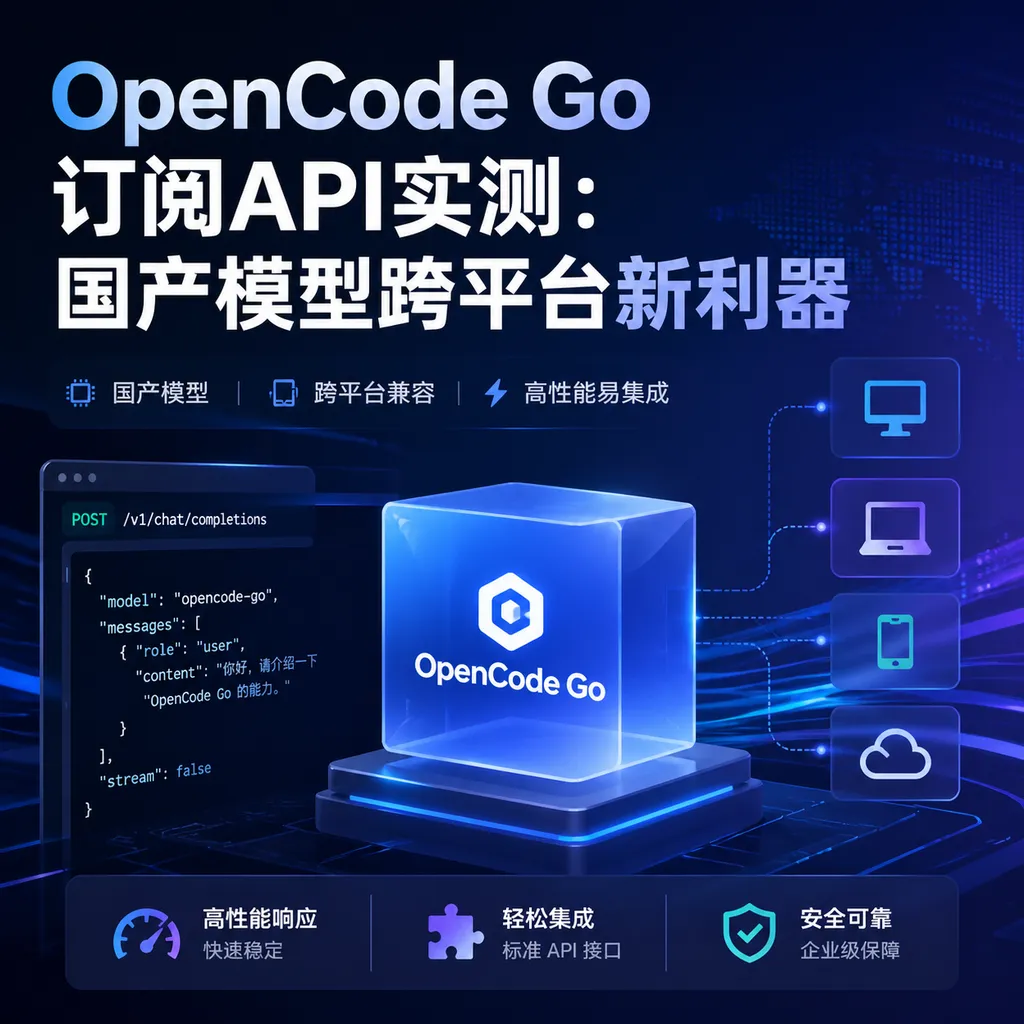
OpenCode has recently launched the Go Subscription API, with monthly fees as low as $10. It supports cross-platform integration with multiple domestic large models and is compatible with various proxy tools. Tests show that it offers flexible usage and stable performance, but limitations and compatibility still require attention.
OpenCode Launches Go Subscription API: A Hands-On Test of a Domestic Model Cross-Platform Invocation Solution
In April 2026, Chinese open-source model service provider OpenCode announced its new “Go Subscription API” plan, highlighting low cost, high quota, and cross-platform compatibility—particularly suited for developers wishing to flexibly integrate domestic models in multi-proxy environments. This initiative not only fills the gap in the usability of domestic large-model APIs but also provides AI developers with more options.
I. What Is the OpenCode Go Subscription API?
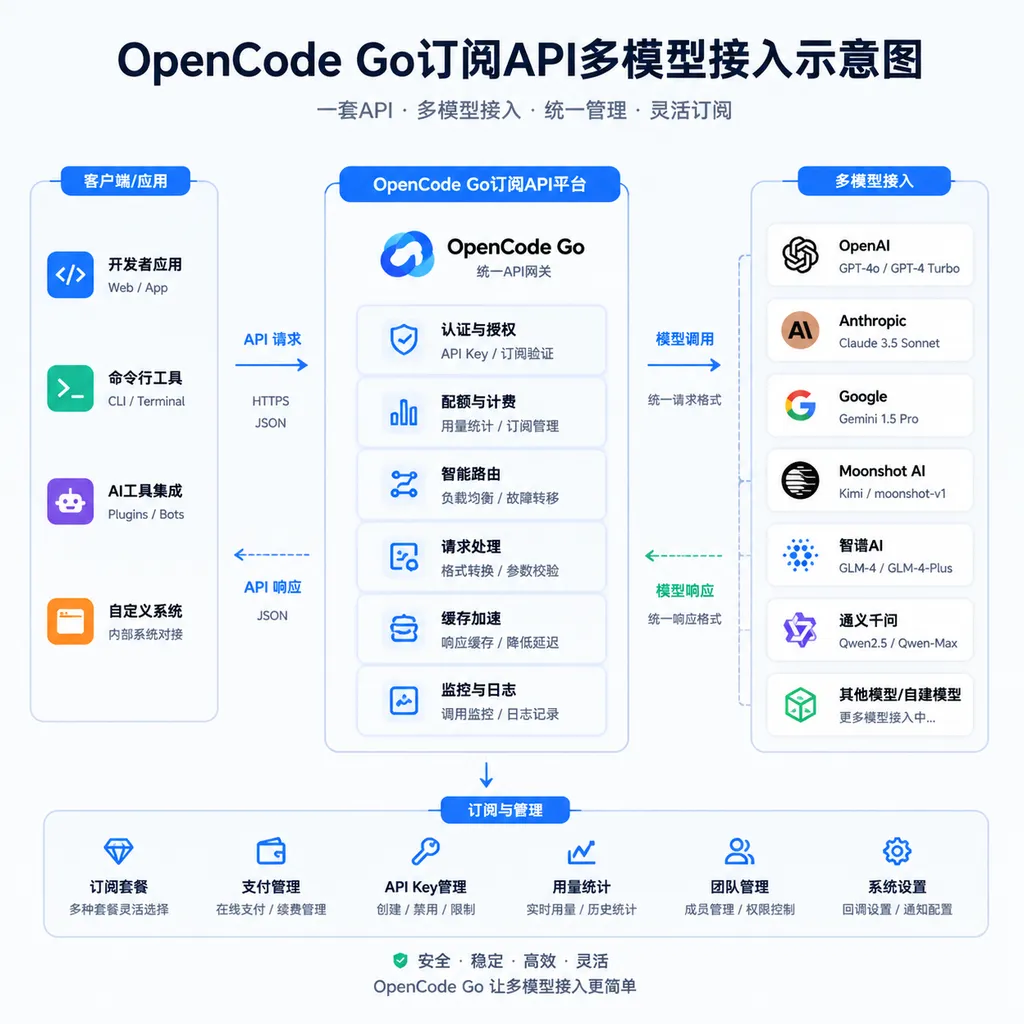
OpenCode Go is a low-barrier programming model subscription service costing only USD 10 per month (first month discounted to USD 5). It offers access to more than a dozen domestic open-source and closed-source model APIs, including GLM‑5 series, Kimi K2.5/K2.6, MiniMax, MiMo‑V2, and DeepSeek V4. The Go Subscription API follows the OpenAI format, ensuring compatibility with multiple proxy tools and third-party platforms:
- Supports common OpenAI-compatible SDKs and proxies such as NewAPI and CPA (Clone Proxy API)
- Compatible with the Anthropic format model invocation (e.g., MiniMax)
- Enables unified management of hybrid multi-platform model calls
Official documentation: https://opencode.ai/docs/zh-cn/go/
II. Technical Features of the Go Subscription API
- Ample Quota: Billing is based on token usage rather than strict call counts, with transparent limits. Some popular models such as K2.6 are temporarily offered with triple quota, ideal for high-frequency code automation.
- Multi-Model Fusion: Covers the core layout of domestic models, including both open-source models and optimized closed versions to meet diverse needs.
- Cross-Proxy Compatibility: Through support for proxies like NewAPI, CPA, and ccswitch, stable operation is ensured across different proxy environments—simplifying integration into existing development frameworks.
Note: Some models such as DeepSeek V4 may return 400 errors when invoked via NewAPI. It is recommended to use the CPA proxy for more stable operation.
III. Field Tests: Understanding Stability and Quota Mechanisms
Based on real developers’ feedback and community discussions, combined with several days of practical use, we analyzed the actual performance of the Go Subscription API:
1. Clear Quota Limiting Mechanism
OpenCode’s official Go subscription enforces a five-hour quota limit, meaning a fixed monthly token or request cap. When the quota is exceeded, a rate limit error will appear, and developers must either wait for the next refresh cycle or manually purchase additional quota.
- Quota is measured in tokens; high usage volume may trigger throttling.
- Currently, provided quotas are generous enough for daily development and testing needs.
2. Testing Multiple Proxy Access Methods
- NewAPI: Easy to configure; official API URL:
https://opencode.ai/zen/go/v1/chat/completions
Supports mainstream model IDs such asglm-5.1andkimi-k2.6. Most models run smoothly via this method. - CPA Proxy: Offers better compatibility for the DeepSeek V4 series, avoiding 400 errors—ideal for developers who require DeepSeek’s high-quality versions.
- ccswitch local proxy mode can be used as an alternative to enhance stability.
3. Invocation Experience and Interface Design
The API design is compatible with the OpenAI standard format, so developers don’t need extra adaptation steps and can continue using existing OpenAI SDK frameworks. It also supports Anthropic and Alibaba Qwen model formats, covering a broader model ecosystem.
During invocation, developers can directly specify a model ID. Some models currently require manual configuration of the model list; future updates are expected to enhance automatic fetching capabilities for a smoother experience.
IV. Observing the Momentum of Domestic Model Ecosystems Through OpenCode Go
Compared to the fragmented and high-threshold usage of previous domestic models, OpenCode Go significantly improves the “ready-to-use” experience. It is particularly suitable for:
- Small and medium developer teams looking for cost-controlled and stable domestic model APIs
- Developers who need unified management of multiple models across international proxy networks
- Complex AI applications that deeply integrate and fuse multi-model invocation chains
At the same time, the Go subscription plan reflects the broader transformation of domestic models—from single-model R&D toward integrated service ecosystems. With an expanding range of models and fusion proxy support, it marks a tangible step toward competing alongside global giants like OpenAI.
V. Existing Issues and Areas for Improvement
- Occasional Compatibility Issues: For example, the DeepSeek series may produce 400 errors via the NewAPI interface; it is not yet fully stable, requiring continued optimization of proxy compatibility layers.
- Quota Policy Needs More Transparency: Some users report encountering “rate limit” warnings despite remaining quota. Pricing and quota refresh mechanisms should be made more explicit to avoid confusion.
- Missing Automatic Model List Management: The current API lacks a built-in model retrieval interface; developers must maintain model IDs manually. An automatic sync feature would be a valuable improvement.
- Documentation Enhancement: More examples and detailed proxy setup guides would reduce barriers to adoption.
Overall, the OpenCode Go Subscription API provides tremendous convenience for accessing and iterating domestic models, catering well to the fast-growing community of Chinese developers. With ongoing technical upgrades and service refinement, it is likely to become the standard solution for cross-platform domestic model invocation.
VI. Conclusion
The launch of the OpenCode Go subscription marks another milestone in the domestic AI model ecosystem. From pricing and quotas to proxy compatibility, it demonstrates deep understanding of developers’ needs. As multi-model fusion and low-cost usage become mainstream trends, OpenCode Go notably expands both the accessibility and application range of domestic models.
If you’re considering practical deployment of domestic large models, trying the OpenCode Go Subscription plan is definitely worth it—it saves cost while delivering reliable invocation performance. In the future, this low-cost, cross-proxy access pathway may well become the secret weapon helping domestic developers stand out.
References
- OpenCode Go Official Documentation - opencode.ai – Official API specifications and model list
- LinuxDo Community Discussion – OpenCode Go Quota Explanation – Details on request count and limit mechanisms
- LinuxDo Community – NewAPI and CPA Proxy Integration – Hands-on experience sharing
- Zhihu Column – 2026 AI Programming Tool Review – Industry background analysis
- GitHub – OpenCode Repository and Source Code – Codebase and architecture information


